Skip to content
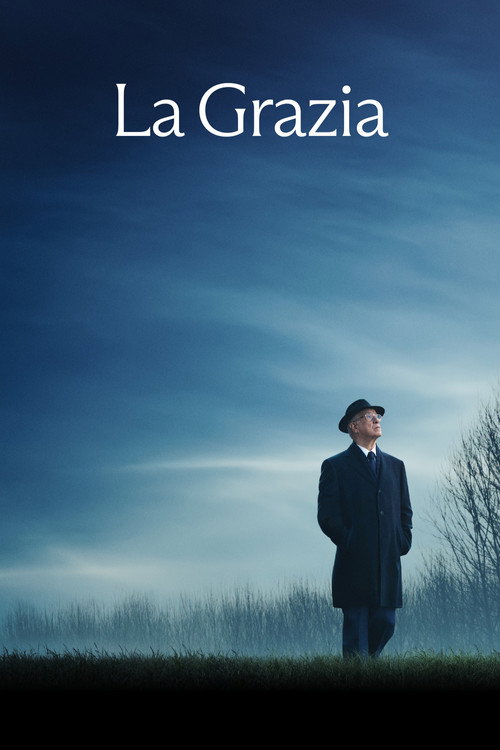
La Grazia
A hushed political drama about a dying term and an unfinished grief, where a president's pen hovers over other people's lives like a candle over dark water.
La Grazia

La Grazia

La grazia

"A president. A pardon. A legacy."

05 December 2025 Italy 133 min 7.3 (443)

Director: Paolo Sorrentino

Cast: Toni Servillo, Anna Ferzetti, Massimo Venturiello, Milvia Marigliano, Orlando Cinque

Drama Mortality and the right to die Grace, pardon and forgiveness Grief and the persistence of love Public duty versus private conscience Faith confronted with secular law
Budget: $24,500,000
Box Office: $68,995

Overview

La Grazia follows Mariano De Santis (Toni Servillo), a fictional but entirely plausible President of the Italian Republic, through the last six months of his mandate. A lifelong scholar of criminal law, a Catholic, a widower, he is a man credited with steadying the country after a period of crisis — and a man who has organised his existence around rules precise enough to keep feeling at a distance.

Two files land on his desk as the term winds down: petitions for presidential clemency from a woman who killed her abusive husband, and from a man who ended the life of his wife in the advanced stages of Alzheimer's. At the same time, a bill legalising euthanasia awaits his signature — legislation prepared and championed by his own daughter Dorotea (Anna Ferzetti), a jurist who works at his side. Law, politics and family collapse into a single knot.

Sorrentino, in one of his most restrained registers, treats all of this less as a procedural than as a study of love in its "intricate offshoots" — doubt, jealousy, tenderness, responsibility. Between religious conviction, institutional pressure and the persistent memory of his late wife, the President is forced to ask what a life is worth, who gets to decide when it ends, and whether forgiveness is something a state grants or something a person must finally give himself.

Core Meaning

The film's title carries a deliberate double sense: grazia is both the legal pardon a head of state signs and the theological grace that arrives unearned. Sorrentino builds the whole picture on that pun. His president is a man who has spent a lifetime believing that justice can be codified — and who discovers that the cases which matter most are precisely the ones the code cannot resolve.

Against a public culture that rewards certainty, La Grazia argues for doubt as a moral virtue. Sorrentino himself framed the film as an embrace of doubt rather than a verdict on euthanasia; De Santis is not asked to be right, he is asked to be present, to actually look at the human beings behind the dossiers. The recurring question the film poses — who owns our days? — is answered only obliquely: they are ours, and a whole life is barely enough to understand what that means.

Underneath the institutional trappings the film is an intimate one about grief. The President cannot legislate his way out of mourning, cannot pardon himself by decree, and cannot love his living daughter properly until he stops administering his dead wife's memory. Grace, in the end, is what happens when a man consents to be changed by another person's pain.

Thematic DNA

Mortality and the right to die 28%
Grace, pardon and forgiveness 24%
Grief and the persistence of love 20%
Public duty versus private conscience 18%
Faith confronted with secular law 10%

Mortality and the right to die

The euthanasia bill is the film's engine: a Catholic president must decide whether the state may authorise a person to end their own life. Sorrentino refuses agitprop on either side — the argument is staged through cases rather than slogans, above all the clemency plea of a man who ended the suffering of a wife lost to Alzheimer's. The abstraction of law keeps colliding with the specificity of a body.

Grace, pardon and forgiveness

Two clemency petitions force De Santis to distinguish between what is legally defensible and what is humanly forgivable. The film treats mercy not as leniency but as an act requiring more courage than punishment — and quietly suggests that the person the President most needs to absolve is himself.

Grief and the persistence of love

The President's late wife is the film's absent centre. His fidelity to her memory shades into jealousy, doubt and self-protection, and Sorrentino lets love appear in all its 'offshoots': tenderness, suspicion, unfinished conversation. The dead are not resolved; they are negotiated with.

Public duty versus private conscience

Every decision De Santis makes is simultaneously constitutional and personal, not least because the bill is his daughter's work. The film dramatises the loneliness of a role in which a signature is both an institutional act and a confession of belief.

Faith confronted with secular law

A believer at the head of a secular republic, De Santis embodies Italy's own unresolved settlement between Catholic conscience and civil legislation. The film stages the tension without caricature: his faith is neither an obstacle to be mocked nor an authority to be obeyed.

Character Analysis

Mariano De Santis

Toni Servillo

Archetype: The reluctant judge / late-life pilgrim Key Trait: Rigorous, reticent, quietly devastated

Motivation

To finish his mandate without betraying either the law he has studied all his life or the people — living and dead — he loves.

Character Arc

Begins as a composed technician of the law — the man credited with stabilising a country in crisis — armoured in procedure and widowerhood. The two clemency cases and his daughter's bill dismantle that armour, moving him from certainty through doubt toward something closer to grace and forgiveness.

Dorotea De Santis

Anna Ferzetti

Archetype: The challenger / conscience-as-daughter Key Trait: Principled, exacting, emotionally direct

Motivation

To see the law catch up with human suffering — and, beneath that, to be genuinely seen by her father.

Character Arc

A jurist working alongside her father, she is the architect and advocate of the euthanasia bill, which makes every professional argument a familial one. Her insistence forces the President out of his abstractions; her performance earned Ferzetti the Pasinetti Award at Venice.

All 3 characters and cast

Symbols & Motifs

The presidential signature

Meaning:

The pen is the film's instrument of power and of terror: a single stroke that converts private conviction into public consequence. It symbolises the unbearable concreteness of responsibility.

Context:

Recurs around the clemency files and the euthanasia bill awaiting promulgation; the film keeps returning to the gap between deciding and acting.

The word 'grazia' itself

Meaning:

Legal pardon and divine grace fused in one noun — the juridical and the theological reading of the same gesture.

Context:

Embedded in the title and in the pardon plot; the film is structured so that each legal meaning shadows a spiritual one.

The Quirinale and its corridors

Meaning:

The palace as a beautiful cage: institutional grandeur that isolates the man inside it. Ceremony stands in for intimacy the President can no longer manage.

Context:

The presidential residence frames most of the film's interiors, all protocol, polished floors and heavy furniture.

The absent wife

Meaning:

An unfillable space that organises the protagonist's entire moral life — love turned into an archive.

Context:

Present through memory, objects and habit rather than flashback spectacle; she is the reason his judgements are never purely juridical.

The end of the mandate / the countdown

Meaning:

The expiring term doubles as a memento mori: an institutional clock running down over a man's own last act.

Context:

The film opens with six months left and is paced by that dwindling calendar.

Rome at night

Meaning:

The eternal city as indifferent witness — beauty that outlasts every office-holder and every verdict.

Context:

Panoramic night views of Rome punctuate the narrative between chamber scenes.

Memorable Quotes

Who owns our days?
— Mariano De Santis (line reported in English translation by critics; the film is in Italian)

Context

Threaded through the President's deliberations over the bill and the two clemency petitions.

Meaning

The film's governing question, and the hinge of the euthanasia argument: if our days belong to us, the state's authority over their end is limited; if they belong to God or the community, it is not.

They are ours, but paradoxically, a lifetime is not enough to understand it.
— Mariano De Santis (reported in English translation)

Context

Arrives late, after the cases have worked on him; it reads as the closest the film comes to a verdict.

Meaning

His eventual, partial answer — an affirmation of self-ownership immediately qualified by humility. Sorrentino's case for doubt in a single sentence.

Philosophical Questions

Who owns our days?

Posed almost verbatim in the film, the question sets self-determination against religious and civic claims on a life. Sorrentino refuses a clean answer, letting the President arrive at ownership qualified by incomprehension: they are ours, and understanding that takes more than a lifetime.

Can mercy be codified, or does it begin where law ends?

A career jurist confronts two cases where the correct legal outcome and the humane one diverge. Clemency exists in the constitution precisely as an escape hatch from the law's own rigour — the film asks what kind of person is fit to use it.

Is doubt a failure of leadership or its highest form?

The President's hesitation is read by those around him as weakness. The film inverts that judgement, presenting certainty as the cheaper commodity and sustained uncertainty as the harder moral labour.

What does love owe the suffering?

Both the pardon petitions and the President's widowerhood circle the same question: whether love means preserving a life at any cost or releasing it. The Alzheimer's case makes the abstraction unbearably concrete.

Can a private conscience survive public office?

Faith, family and constitutional duty are asked to occupy one signature. The film suggests they cannot be reconciled cleanly — only inhabited honestly.

Alternative Interpretations

As a pro-choice argument in disguise. One reading holds that the film's structure — a believer worn down by the sheer humanity of the cases before him — is a quiet advocacy for the right to die, with the President's Catholicism functioning as the strongest possible objection that the film then answers.

Full ending explanation

Cultural Impact

La Grazia arrived at a pointed moment in Italian public life: end-of-life legislation has been contested in Italy for years, caught between constitutional court rulings, regional initiatives and the Catholic Church's opposition. By putting the question in the hands of a devout head of state, Sorrentino dramatised a national fault line that Italian politics has repeatedly declined to resolve. That the film opened the Venice Film Festival gave the debate an unusually large stage.

Its reception confirmed the shift in Sorrentino's standing. After the divisive Parthenope, the critical consensus treated La Grazia as a return to form — Metacritic logged 69/100 from 22 critics, and reviewers described it as a sober, sincere character study, with some arguing it ranks among his best work. Toni Servillo's Volpi Cup and Anna Ferzetti's Pasinetti Award anchored it in the festival's prize record, and roughly $10.7 million in box office made it a commercial success on the arthouse circuit.

Culturally, the film belongs to a European tradition of chamber political dramas — closer to the moral interrogations of Catholic cinema than to the thriller mechanics of contemporary political film. Within Sorrentino's own body of work it functions as the third panel of a triptych on Italian power alongside Il Divo and Loro, but with the satire replaced by something like tenderness.

Audience Reception

Praised: Toni Servillo's performance dominates the response, and the Volpi Cup formalised it — critics described a study in interiority, a man acting mostly with stillness. The film's restraint was widely welcomed as a corrective after Parthenope, with Time Out awarding four stars and calling it a rapturous character study of a grieving politician, Sorrentino at his most sober and sincere. Anna Ferzetti's Dorotea and Daria D'Antonio's carefully colour-coordinated images also drew consistent admiration.

Criticised: The same restraint divided viewers. Detractors found the film slow and static, its dilemmas arranged too neatly, and missed the visual exuberance that defines Sorrentino's signature; some outlets were sharply negative, faulting it as anything but graceful. The muted brown-and-grey palette struck part of the audience as mournful, others as drab.

Controversial: The euthanasia subject itself, and the choice to dramatise it through a devout protagonist — some wanted a firmer position than the film's cultivated ambivalence offers.

Verdict: Generally favourable — Metacritic 69/100 from 22 critics, a long Venice standing ovation, around $10.7 million at the box office, and a widespread sense that this is a mature, minor-key Sorrentino that rewards patience more than it dazzles.

Interesting Facts

  • La Grazia opened the 82nd Venice International Film Festival, premiering in competition in the Sala Grande of the Palazzo del Cinema on 27 August 2025.
  • Toni Servillo won the Volpi Cup for Best Actor at Venice 2025 for his performance as President Mariano De Santis.
  • Anna Ferzetti won the Pasinetti Award for her performance as Dorotea.
  • Sorrentino wrote, directed and produced the film — a rare triple credit for him.
  • The premiere drew a lengthy standing ovation; reports of its length varied, with Deadline timing it at six and a half minutes and other outlets citing around four.
  • The project was announced in December 2024 as Sorrentino's reunion with Toni Servillo, his longest-running screen collaborator.
  • Daria D'Antonio served as cinematographer, continuing her collaboration with Sorrentino after The Hand of God and Parthenope.
  • Sorrentino described the film as an embrace of doubt rather than a position paper on euthanasia when presenting it at Venice.
  • The film played the New York Film Festival in 2025 as part of its international rollout.
  • It grossed roughly $10.7 million worldwide, a strong result for a talk-driven Italian political drama.
  • Metacritic recorded a score of 69/100 from 22 critics, indicating generally favourable reviews.

Easter Eggs

The fictional president in a real palace

De Santis is invented but, as Sorrentino and the festival materials stressed, deliberately 'credible' — an Italian audience inevitably reads him against sitting and former occupants of the Quirinale. The film gets to be political without being a roman à clef.

Servillo as a man of the Italian state, again

Servillo previously embodied Giulio Andreotti in Il Divo and Silvio Berlusconi in Loro. Casting him as a scrupulous, mournful president reads as a deliberate counterweight to those earlier portraits of Italian power.

The title's legal-theological pun

Grazia means both a presidential pardon and divine grace; the whole screenplay is built as an extended gloss on the double meaning, so the title is itself the film's key.

Sorrentino in restrained mode

Critics repeatedly framed the film as an 'atypically restrained' Sorrentino — the flamboyance of The Great Beauty withheld almost as a formal joke about a protagonist who distrusts spectacle.

Frequently Asked Questions

Explore More About This Movie

Dive deeper into specific aspects of the movie with our detailed analysis pages

Comments (0)

Leave a comment

No comments yet. Be the first to share your thoughts!

Similar Movies