Leviticus
"It will never stop."
Director: Adrian Chiarella
Cast: Joe Bird, Stacy Clausen, Mia Wasikowska, Nicholas Hope, Tyallah Bullock
Overview
Core Meaning
Thematic DNA
Religious coercion and conversion practices
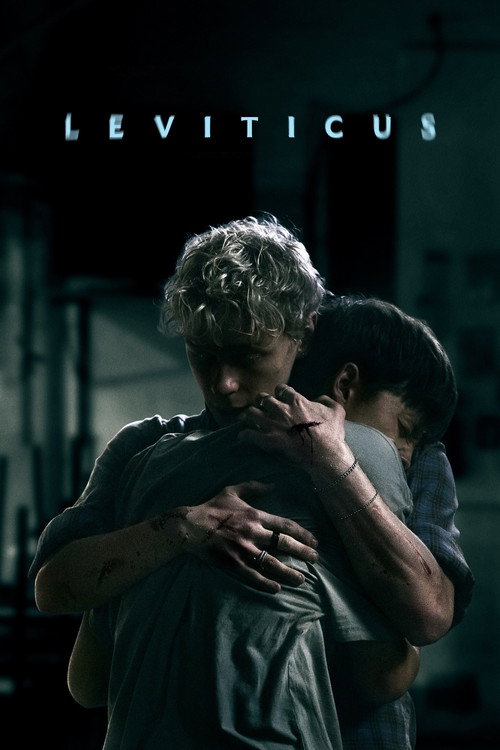
The engine of the plot is a church-sanctioned 'deliverance' ritual performed on two teenagers after they are outed. The film frames faith-based conversion not as misguided kindness but as an act of violence with consequences that outlive the ceremony — the rite is what unleashes the entity, making the town's piety the literal source of the horror.
First love as survival
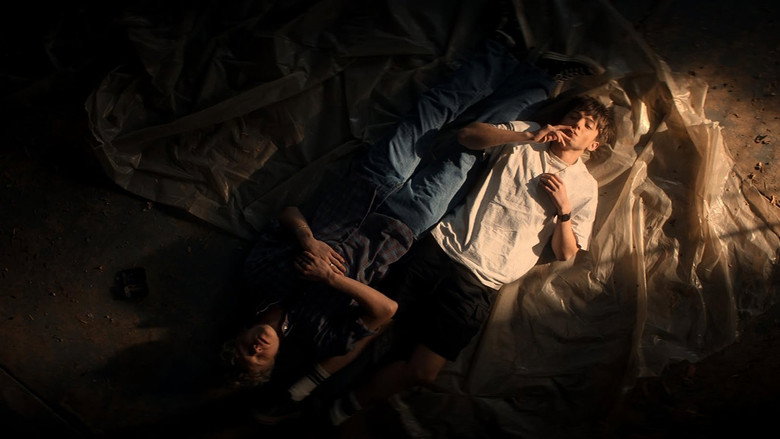
Naim and Ryan's romance is filmed with the awkward, breathless specificity of adolescence — stolen afternoons in an abandoned mill, a secret shared like contraband. The curse then weaponizes that intimacy, so every act of trust between them becomes a risk and a defiance at once. Critics repeatedly noted the leads' chemistry gives the film a romantic charge stronger than its scares.
Shame, secrecy and the closet
Ryan is closeted and local; Naim is a newcomer with less to lose in town but everything to lose in Ryan. The entity attacks only when a boy is alone, turning isolation — the closet's defining condition — into the actual mechanism of death.
The small town as organism
Leviticus is an industrial community with a collective moral immune system: rumour, church authority, the pressure of being watched. The film treats the town less as a setting than as an antagonist that acts through its residents, which is why the ending locates the true threat in the community rather than the creature.
Parenthood and imperfect protection
Arlene, Naim's mother, embodies the limits of an adult's ability to shield a child from a place's beliefs. Wasikowska plays her as a woman negotiating a town whose rules she did not write, raising the question of whether well-meaning love is enough when the surrounding order is hostile.
Character Analysis
Naim
Joe Bird
Motivation
To be with Ryan without having to disappear to do it — and, once the ritual backfires, to keep them both alive.
Character Arc
Arrives in Leviticus as a stranger with his mother, falls furtively in love with Ryan, and is dragged from private happiness into public exposure and supernatural siege. His arc moves from concealment to a form of active resistance: by the finale he is the one who confronts the entity and its logic rather than hiding from it.
Ryan
Stacy Clausen
Motivation
Belonging — first to the town that raised him, and finally to Naim, when he accepts he cannot have both.
Character Arc
As a local boy embedded in the town's church and social order, Ryan has far more to lose than Naim and begins the film managing his own erasure. Being outed strips away his cover, and the curse forces him to decide whether to keep protecting his standing or commit fully to the person he wants.
Symbols & Motifs
The abandoned mill
The ruin of the town's industrial purpose becomes the only free territory the boys have — a space outside adult supervision where desire is permitted precisely because the place has been given up on.
The film opens with Naim and Ryan breaking into the derelict mill, establishing trespass as the grammar of their romance: to be together they must go where they are not allowed.
The shapeshifting entity
The internalized voice of conversion doctrine given a body. It insists that what you desire is what will destroy you, and it can only be defeated by refusing that premise.
Summoned by the deliverance ritual, it takes the form of the person each boy desires most — each other — and strikes only when they are separated.
The deliverance ritual
A symbol of the violence of 'cure': a ceremony that claims to remove something from a person and instead adds something monstrous to their world.
Performed by a healer brought in by the local church after the boys are outed; its backfiring is the film's inciting supernatural event.
The town's name
Naming the town after the biblical book most frequently cited to condemn homosexuality turns geography into scripture — the boys are not just living under a doctrine, they are living inside its name.
The title functions simultaneously as place, verdict and joke: to leave Leviticus is to leave the text that condemns you.
The departing bus
Escape as a physical act rather than a spiritual one — salvation is measured in distance from the community, not in absolution.
The final scene places Naim and Ryan on a bus pulling away from town, the closest thing the film offers to deliverance.
The window / the double
The impossibility of ever fully trusting perception again after being taught to doubt your own heart; also the ghost of the town that will keep travelling with them.
In the last shot, Naim sees what looks like Ryan standing outside the bus window while Ryan sits beside him.
Philosophical Questions
Can love be a form of protection, or only a form of exposure?
The curse makes intimacy simultaneously the boys' only defence — the entity strikes when they are alone — and the reason they are targeted at all. The film refuses to resolve this into a slogan, presenting closeness as something that must be actively maintained rather than something that saves you automatically.
What is the moral status of harm committed in good faith?
The church and the deliverance healer believe they are rescuing two boys. The film's supernatural logic is a judgment on that belief: sincerity does not neutralize the damage, and the ritual's monstrous result is treated as the honest consequence of what the intention already was.
If you are taught to distrust your own desire, how would you ever know what is real?
By making the monster indistinguishable from the beloved, the film puts its characters in an epistemological trap: every perception of the other person becomes suspect. Survival requires developing a knowledge of the beloved that is deeper than sight — recognition instead of appearance.
Is escape the same thing as freedom?
The finale offers a bus out of town, but also a figure at the window. The film asks whether leaving a place removes what the place put inside you, and it declines to promise that it does.
How It Ends
Alternative Interpretations
<p><strong>The literal reading.</strong> The ritual genuinely conjures a supernatural predator; the film is a monster movie in which two boys must survive a demon that hunts them in the shape of their beloved. The final glimpse of a second Ryan outside the bus window means the entity survived and has followed them — an unresolved threat rather than a defeated one.</p><p&...
Cultural Impact
Audience Reception
Interesting Facts
- Leviticus is the feature directorial debut of Australian filmmaker Adrian Chiarella, who also wrote the screenplay.
- Mia Wasikowska both stars in the film, as Naim's mother Arlene, and serves as an executive producer.
- The film world-premiered in the Midnight section of the 2026 Sundance Film Festival on 23 January 2026.
- It was selected as the opening night film of the 55th edition of New Directors/New Films, presented by Film at Lincoln Center and the Museum of Modern Art, which ran 8–19 April 2026.
- The film was released theatrically in Australia on 18 June 2026, to positive reviews from critics.
- Chiarella and leads Joe Bird and Stacy Clausen appeared together in a New Directors/New Films conversation moderated by selection committee member Madeline Whittle.
- The film also screened at the Phoenix Film Festival, where its creative team gave a joint festival interview.
- The cast includes Jeremy Blewitt alongside Joe Bird, Stacy Clausen and Mia Wasikowska.
- IMDb classifies the film under Horror, Romance and Sci-Fi, where it carries a 7.2 user rating.
Frequently Asked Questions
Explore More About This Movie
Dive deeper into specific aspects of the movie with our detailed analysis pages


Comments (0)
No comments yet. Be the first to share your thoughts!