
Skip to content
Love Alarm
A melancholic sci-fi melodrama capturing human vulnerability as fragile hearts clash beneath the synchronized, unforgiving chimes of a glowing smartphone screen.
Love Alarm

Love Alarm

좋아하면 울리는

"When you turn on the application, your heart will ring."

22 August 2019 — 12 March 2021 South Korea 2 season 14 episode Ended 8.2 (2,045)

Cast: Kim So-hyun, Jung Ga-ram, Song Kang, Go Min-si, Lee Jae-eung

Drama Sci-Fi & Fantasy Human Agency vs. Algorithmic Determinism Emotional Trauma and Defensive Isolation Passionate Impulse vs. Patient Devotion Societal Stratification and Digital Validation

Overview

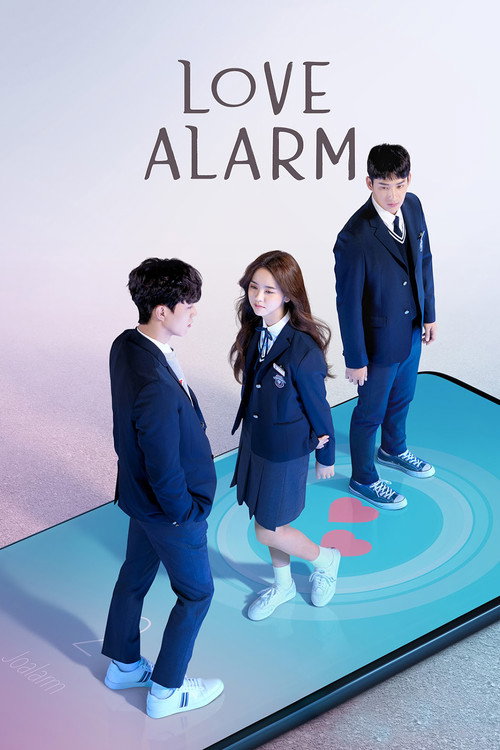
Love Alarm (좋아하면 울리는) is set in an alternate contemporary South Korea fundamentally transformed by the invention of "Love Alarm" (Joalarm), a ubiquitous mobile application synced directly to a person's physiological heart function. The app rings automatically whenever someone harboring romantic feelings comes within a 10-meter radius. Amid this new social reality, the narrative centers on Kim Jo-jo, a hardworking high school girl carrying deep, unhealed childhood trauma, whose life becomes entangled with two best friends from starkly different backgrounds: Hwang Sun-oh, an emotionally neglected model and wealthy heir, and Lee Hye-yeong, the earnest, observant son of Sun-oh’s family housekeeper.

As high school infatuation transitions into young adulthood, the story chronicles how the algorithmic quantification of affection reshapes personal identity, societal status, and intimate relationships. Jo-jo seeks emotional protection from the pain of vulnerability, Sun-oh struggles with the pain of sudden abandonment, and Hye-yeong chooses to express affection patiently through old-fashioned devotion rather than technological shortcuts.

Across a four-year time jump and the rollout of an upgraded version of the technology (Love Alarm 2.0), the trio must confront unresolved emotional wounds and decide whether true love is defined by algorithmic validation or conscious human choice.


Core Meaning

The overarching message of Love Alarm is that genuine human connection, vulnerability, and love cannot be reduced to automated biometric notifications. While the app offers absolute technological certainty, it strips away the courage, patience, and mutual understanding required to nurture authentic intimacy. The creators demonstrate that emotional healing requires confronting internal trauma directly rather than hiding behind artificial safeguards or seeking external digital validation.

Thematic DNA

Human Agency vs. Algorithmic Determinism 30%
Emotional Trauma and Defensive Isolation 25%
Passionate Impulse vs. Patient Devotion 25%
Societal Stratification and Digital Validation 20%

Human Agency vs. Algorithmic Determinism

The series contrasts algorithmic certainty against deliberate human willpower. In Season 1, characters surrender their agency to the app's notifications, while Season 2 highlights the necessity of active choice, showing that feelings must be chosen and maintained rather than passively accepted from an app.

Emotional Trauma and Defensive Isolation

Jo-jo’s survival guilt from her tragic childhood manifests as an instinct to shut others out whenever relationships become intense. Her journey reflects the painful process of learning that self-protection through emotional detachment ultimately harms oneself and others.

Passionate Impulse vs. Patient Devotion

The love triangle contrasts two distinct romantic philosophies: Sun-oh represents immediate, fiery, sensory passion fueled by mutual loneliness, whereas Hye-yeong embodies gentle, patient, enduring care that respects boundaries and allows love to grow organically.

Societal Stratification and Digital Validation

The series explores the dystopian social consequences of the app—ranging from class-based exclusivity (The Love Alarm Badge Club) to ostracization, cyberstalking, and mass suicides among those whose alarms never ring, critiquing society's obsession with quantifiable validation.

Character Analysis

Kim Jo-jo

Kim So-hyun

Archetype: Traumatized Survivor / Reluctant Hero Key Trait: Guarded Resilience

Motivation

Shifts from basic emotional and financial survival to seeking authentic emotional honesty and self-forgiveness.

Character Arc

Evolves from a defensive orphan avoiding intimacy via digital shields into a mature woman who confronts her childhood trauma, accepts vulnerability, and makes an active romantic choice.

Lee Hye-yeong

Jung Ga-ram

Archetype: The Patient Guardian / Steady Devotee Key Trait: Unwavering Patience

Motivation

Transitions from suppressing his feelings out of loyalty to Sun-oh to openly pursuing long-term commitment with Jo-jo.

Character Arc

Moves from an unassertive secret admirer in the background to an emotionally steadfast partner who actively courts Jo-jo through sincere, analog effort without relying on the app.

All 5 characters and cast

Symbols & Motifs

The Shield (방패)

Meaning:

It serves as a literal and psychological defense mechanism, representing Jo-jo's fear of intimacy, self-preservation instinct, and unresolved trauma.

Context:

A custom software patch programmed by Duk-gu that prevents Jo-jo from ringing anyone's Love Alarm, which she uses to conceal her true emotions from Sun-oh.

The Spear (창)

Meaning:

It symbolizes artificial will, emotional manipulation, and the desperate urge to manufacture love where certainty is absent.

Context:

A counterpart feature developed by Duk-gu allowing the user to forcefully ring the alarm of a chosen target regardless of natural biometric output.

The 10-Meter Radius Circle

Meaning:

It represents personal boundaries, the claustrophobic exposure of private feelings, and the shrinking sphere of emotional privacy in the digital era.

Context:

The visual graphic interface depicting the detection zone around users whenever the application is active.

The "Ring" Notification Tone and Cloud Logo

Meaning:

They signify superficial happiness commodified as commercial tech, masking the alienation beneath modern social interactions.

Context:

The ubiquitous chimes and pink cloud graphics deployed throughout urban Seoul and commercial marketing.

The Ringing Heart Icon / Cracked Screen

Meaning:

Symbolizes the fragility of the human heart when mediated entirely through delicate electronic hardware.

Context:

The visual state of the phone screen displaying heart counts or shattered glass after accidents.

Memorable Quotes

좋아하는 사람이 10m 안에 들어오면 울립니다.
— Love Alarm Application

Context

Season 1, Episode 1. Introduced as the central operational premise of the Joalarm application.

Meaning

The foundational tagline of the application, establishing the sci-fi premise and the core mechanism governing the characters' world.

울리지 않는 건, 좋아하는 게 아니야.
— High School Students

Context

Season 1, Episode 4. Uttered during schoolyard debates about the validity and power of the app.

Meaning

Encapsulates the dangerous cultural assumption that biometric data is the absolute measure of romantic reality.

All 5 quotes

Episode Highlights

The Flash of Lightning Before It Thunders

S1E1

Introduces the Joalarm app, Kim Jo-jo’s difficult domestic life, Sun-oh’s return from abroad, and the instantaneous, alleyway first kiss between Jo-jo and Sun-oh.

Significance:

Establishes the central love triangle and the societal fascination with biometric affection.

The Best Feeling in the World is Knowing There's Someone on My Side

S1E4

Sun-oh and Jo-jo’s school trip to Jeju Island exposes Jo-jo’s tragic childhood trauma, while cementing their romantic bond before outside pressures mount.

Significance:

Highlights the vulnerability of both leads and lays the groundwork for Jo-jo’s panic-driven retreat.

Your Heart is Safe Now

S1E6

Following a motorcycle accident, Jo-jo receives the experimental Shield from Duk-gu and uses it to deceptively silence her Love Alarm in front of Sun-oh.

Significance:

The primary turning point of the series; it causes their breakup and drives the central conflict for the remaining seasons.

The Number 1 on the Screen

S1E8

After a four-year time jump, the developer launches Love Alarm 2.0 at a massive public event; Sun-oh and Hye-yeong both stand within 10 meters of Jo-jo, ringing her app while she cannot ring back.

Significance:

Culminates Season 1 on a dramatic cliffhanger regarding Jo-jo's true feelings and Duk-gu's fate.

You Can't Stop the Spear

S2E3

Jo-jo receives the Spear tool from the app developer, tempting her to artificially force her feelings to register on Hye-yeong’s phone.

Significance:

Complicates her inner moral struggle, making her realize that artificial manipulation cannot replace genuine emotional reciprocity.

The Sound of Your Heart

S2E6

Jo-jo confronts her past on Jeju Island, removes all digital crutches, provides final closure to Sun-oh, and chooses a future with Hye-yeong.

Significance:

Resolves the overarching romance arc and reinforces the thematic premise: human choice supersedes technological algorithms.

Philosophical Questions

Can human emotion be accurately quantified by physiological algorithms without losing its intrinsic essence?

The series demonstrates that biometric signals only measure immediate physiological reactions (lust, attraction, infatuation), failing to capture enduring commitment, compassion, and conscious sacrifice.

Does complete emotional transparency enhance human intimacy or destroy it?

By removing the mystery, vulnerability, and verbal bravery required to confess feelings, Love Alarm leads to social alienation, emotional fragility, and devastating isolation for those who are unchosen.

Is love an automatic, involuntary biological state, or an active daily moral choice?

The contrasting relationship dynamics of Sun-oh (instinctive spark) and Hye-yeong (steady intentional devotion) interrogate the very definition of love.

Alternative Interpretations

The series and its ending can be viewed through several distinct analytical lenses:

Full ending explanation

Cultural Impact

Love Alarm was released at a critical crossroads of modern Korean society, reflecting rising concerns over smartphone addiction, hyper-quantified dating culture, algorithmic matchmaking, and intense social comparison. As Netflix's first picked-up K-drama project, it set the template for serialized, high-budget Korean streaming productions split into multiple seasons.

The show sparked widespread discourse across East Asia and international fandoms regarding dating app culture, self-worth tied to social media metrics, and the psychological impact of digital vulnerability.

Audience Reception

Season 1 Reception: Season 1 debuted to strong viewership and high audience enthusiasm, praised for its fresh sci-fi concept, stylish direction, moody electronic soundtrack, and the palpable on-screen chemistry between Song Kang and Kim So-hyun. It garnered a massive global fanbase that strongly championed Sun-oh and Jo-jo's relationship.

Season 2 Backlash: Season 2 was met with significant backlash from casual viewers and international fan communities. Critics and fans cited a drastically slower pace, a shift in directorial tone, disjointed narrative continuations from the Season 1 cliffhanger, and immense disappointment from viewers who suffered extreme "Second Lead Syndrome" when Jo-jo ended up with Hye-yeong.

Overall Critical Consensus: Critics noted that while Season 2 followed the thematic logic of the original webtoon by prioritizing personal healing and agency over sensational romance, the execution felt tonally detached from the vibrant momentum of the initial season.

Interesting Facts

  • Love Alarm was the first South Korean original drama series officially ordered and produced by Netflix, paving the way for the global expansion of the K-drama streaming wave.
  • The series is adapted from the popular webtoon of the same name created by legendary manhwa artist Chon Kye-young, who conceived the premise by contemplating how human romance would function if honesty was fully automated.
  • Song Kang beat out nearly 900 applicants during auditions for the role of Hwang Sun-oh, a performance that catapulted him to international stardom as a leading Netflix heartthrob.
  • Season 1 was directed by Lee Na-jeong (Fight for My Way), while Season 2 was helmed by Kim Jin-woo (Good Doctor, Healer) and Park Yoo-young, leading to a noticeable shift in pacing, visual tone, and narrative style.
  • During the promotional campaign in South Korea, Netflix released a promotional smartphone application replicating the Love Alarm interface, along with an experiential pop-up exhibition in Seoul.

Easter Eggs

Duk-gu’s Computer Screen

In Season 1, background shots in early episodes briefly display complex coding windows on Duk-gu’s personal monitor that reveal he is the original creator and mastermind of the Love Alarm algorithm long before his public reveal.

The Ringing Cloud Above the School

In the series premiere, an alarm notification appears as a cloud formation directly above the schoolyard, foreshadowing that the testing zone was localized to Duk-gu's immediate environment.

Webtoon Author's Visual Tone

Certain illustrative scenes in Jo-jo’s illustrated web-diary ("The Ringing World") mimic the visual aesthetic and poetic phrasing used in Chon Kye-young’s original Daum webtoon.

Frequently Asked Questions

Explore More About This Movie

Dive deeper into specific aspects of the movie with our detailed analysis pages

Comments (0)

Leave a comment

No comments yet. Be the first to share your thoughts!

Similar Movies