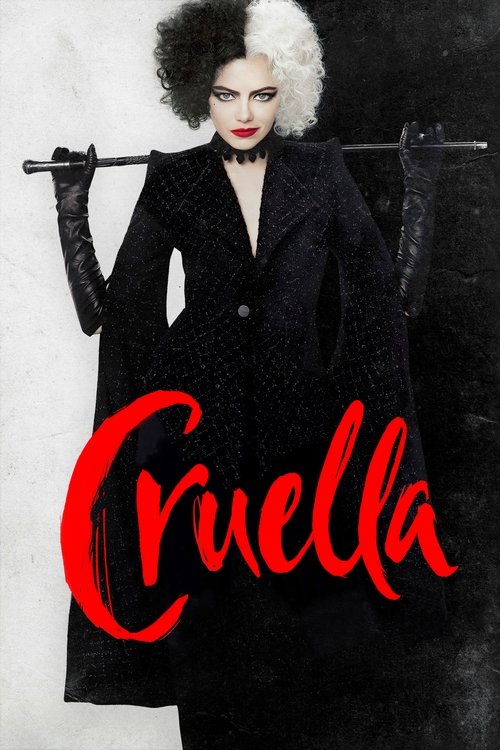
Cruella
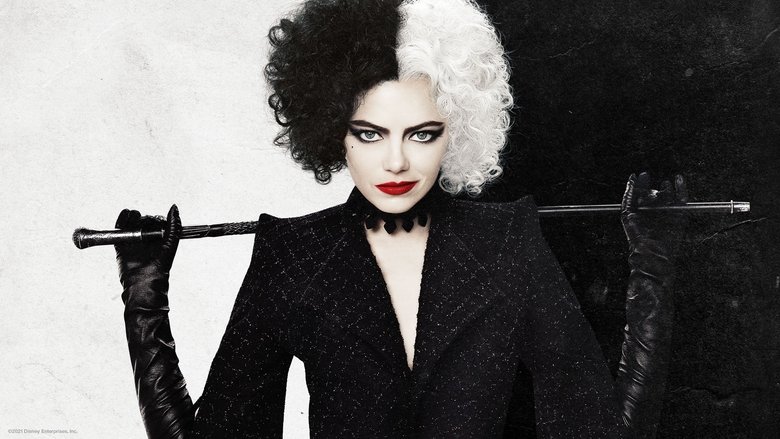
A punk-rock fairytale fueled by rebellious energy, this visually stunning crime comedy paints a deliciously dark and stylish portrait of a woman embracing her wicked nature.
Cruella

Cruella

"Hello cruel world."

26 May 2021 United States of America 134 min ⭐ 8.0 (9,742)
Director: Craig Gillespie
Cast: Emma Stone, Emma Thompson, Joel Fry, Paul Walter Hauser, John McCrea
Crime Comedy Adventure
Rebellion and Individuality Nature vs. Nurture Revenge and Justice Found Family
Budget: $200,000,000
Box Office: $233,503,234

Overview

Set in the vibrant punk rock scene of 1970s London, "Cruella" follows the early life of Estella Miller, a fiercely creative and mischievous young woman with a talent for fashion. Orphaned and left to fend for herself, she falls in with a pair of young thieves, Jasper and Horace, and together they build a life on the streets. Estella's dream of becoming a renowned fashion designer seems within reach when she catches the eye of the legendary and terrifyingly chic Baroness von Hellman.

As Estella's talent blossoms under the Baroness's tutelage, their relationship ignites a series of events and shocking revelations that force Estella to confront her past and embrace a new, wicked persona: the raucous and revenge-bent Cruella. The film explores the journey of a brilliant but outcast girl transforming into one of cinema's most notorious and fashionable villains.

Core Meaning

"Cruella" delves into the timeless debate of nature versus nurture, exploring how our innate predispositions are shaped by our experiences. It questions whether one is born wicked or becomes so through trauma and circumstance. The film suggests that embracing one's true, unconventional self, even the darker aspects, can be a form of empowerment and rebellion against a repressive society. It also serves as a cautionary tale about the corrupting influence of power and the consuming nature of revenge. Ultimately, the film posits that even those deemed 'bad' have a complex past that shapes their present, and that one's identity is a fluid and often conscious creation.

Thematic DNA

Rebellion and Individuality 35%
Nature vs. Nurture 30%
Revenge and Justice 25%
Found Family 10%

Rebellion and Individuality

Set against the backdrop of the 1970s punk rock movement, the film celebrates non-conformity and challenging the establishment. Estella, with her unique black-and-white hair and rebellious spirit, is an outsider who refuses to blend in. Her transformation into Cruella is an act of defiance against the rigid, oppressive world of high fashion embodied by the Baroness. Cruella's avant-garde and disruptive fashion shows are a literal and metaphorical tearing down of the old guard.

Nature vs. Nurture

A central question of the film is whether Cruella's wickedness is innate or a product of her upbringing and trauma. Her mother, Catherine, tries to suppress the rebellious "Cruella" side of Estella, encouraging her to be kind. However, the discovery that her true mother is the narcissistic and cruel Baroness suggests a genetic predisposition to darkness. The film ultimately presents a nuanced view, where Estella consciously chooses to embrace her 'Cruella' persona as a tool for survival and revenge, suggesting that both nature and nurture play a role.

Revenge and Justice

Cruella's primary motivation becomes avenging the death of her adoptive mother, Catherine, whom she believes was killed by the Baroness. This quest for revenge fuels her transformation and her elaborate schemes to dismantle the Baroness's empire. The film explores the fine line between justice and vengeance, as Cruella's methods become increasingly ruthless and theatrical. Her ultimate victory is not just personal but also a form of poetic justice, as she exposes the Baroness's evil to the world.

Found Family

After being orphaned, Estella finds a new family in her fellow street thieves, Jasper and Horace. They provide her with the loyalty and support she lacks, becoming her partners in crime and, eventually, in her fashion revolution. Their relationship is tested as Estella becomes more consumed by her Cruella persona, highlighting the tension between personal ambition and loyalty to those who care for you. Ultimately, their bond endures, forming the core of her support system.

Character Analysis

Estella von Hellman / Cruella de Vil

Emma Stone

Archetype: Anti-hero
Key Trait: Rebellious Genius

Motivation

Her primary motivation is to avenge the death of her adoptive mother, Catherine, and reclaim her birthright from her tyrannical biological mother, the Baroness. She is driven by a desire to make a name for herself in the fashion world and to dismantle the oppressive establishment personified by the Baroness.

Character Arc

Estella begins as a creative but suppressed young woman, trying to adhere to the 'be good' mantra of her adoptive mother. After discovering the truth about her past and the Baroness's cruelty, she allows her darker, more assertive persona, Cruella, to take over. Initially an act for revenge, the Cruella persona eventually becomes her dominant identity. She transitions from a sympathetic orphan to a formidable, theatrical, and morally ambiguous figure who embraces her 'madness' to achieve her goals, ultimately 'killing' her Estella identity to be reborn as Cruella.

The Baroness von Hellman

Emma Thompson

Archetype: The Tyrant / The Shadow
Key Trait: Narcissistic

Motivation

The Baroness is motivated by an insatiable need for control, success, and the spotlight. She sees everyone, including her own daughter, as either a tool to be used or an obstacle to be eliminated. Her core drive is to maintain her position as the undisputed queen of fashion at any cost.

Character Arc

The Baroness is a static character who remains consistently narcissistic, ruthless, and devoid of empathy throughout the film. She serves as a dark mirror to what Cruella could become if she let her ambition completely consume her humanity. Her arc is one of downfall; she begins at the pinnacle of the fashion world and ends up imprisoned, defeated by the very daughter she discarded.

Jasper Badun

Joel Fry

Archetype: The Loyalist / The Conscience
Key Trait: Loyal

Motivation

Jasper is motivated by his deep-seated loyalty and affection for Estella, his found family. He wants to protect her and their way of life. While he enjoys their heists, his primary concern is the well-being of his friends, especially as Cruella's plans become more dangerous and her personality more abrasive.

Character Arc

Jasper evolves from a simple thief and Estella's partner-in-crime to the moral compass of the group. He is the more thoughtful and caring of the duo with Horace. As Estella's transformation into Cruella intensifies, Jasper grows concerned and pushes back against her cruelty, reminding her of the person she used to be. Though their friendship is strained, his loyalty ultimately wins out, and he remains by her side, albeit with a more cautious and mature perspective.

Horace Badun

Paul Walter Hauser

Archetype: The Sidekick / Comic Relief
Key Trait: Bumbling

Motivation

Horace is motivated by simple desires: companionship, security, and a good meal. He is loyal to Jasper and Estella because they are his family. He goes along with Cruella's increasingly elaborate schemes out of this loyalty, even when he doesn't fully understand them or is frightened by the consequences.

Character Arc

Horace is primarily a source of comic relief, often bumbling and focused on food. However, he also demonstrates moments of surprising insight and contributes significantly to their heists. His arc is less about personal change and more about his unwavering, if sometimes begrudging, support for Estella/Cruella. He represents the steadfast, less complicated aspect of their found family.

Artie

John McCrea

Archetype: The Ally
Key Trait: Flamboyant

Motivation

Artie is motivated by a love for art, fashion, and making trouble. He is drawn to Cruella's disruptive energy and talent and is eager to be part of her movement to shake up the stuffy fashion world. His motivation is a shared desire to create and rebel against the mainstream.

Character Arc

Artie is a confident and flamboyant vintage shop owner who immediately recognizes a kindred spirit in Estella. He serves as a consistent ally to Cruella, helping her craft her rebellious public image and execute her fashion-based attacks on the Baroness. He doesn't undergo a significant personal change but rather acts as a catalyst and enabler for Cruella's creative revolution, representing the punk, anti-establishment ethos of the era.

Symbols & Motifs

Dalmatians

Meaning:

The Dalmatians in "Cruella" symbolize both trauma and power. Initially, they are instruments of Estella's childhood trauma, as she believes they caused her mother's death. Later, by taming and controlling the Baroness's Dalmatians, Cruella reclaims her power over her past and turns a symbol of her fear into one of her strength and authority.

Context:

The Baroness uses her three Dalmatians as intimidating status symbols. Estella witnesses them pushing her mother off a cliff. As Cruella, she later kidnaps the dogs, and in the film's climax, they obey her commands, signifying a shift in power. The post-credits scene shows her gifting Dalmatian puppies, Pongo and Perdita, to Roger and Anita.

Fashion and Clothing

Meaning:

Fashion serves as Cruella's primary weapon and form of self-expression. Her designs are a visual representation of her rebellion, creativity, and inner turmoil. Clothing is used to construct and deconstruct identity, with Estella hiding behind disguises and Cruella making spectacular, statement-making appearances. The contrast between the Baroness's structured, classic designs and Cruella's deconstructed, punk-inspired creations highlights their conflicting ideologies.

Context:

Cruella's fashion stunts are central to the plot, from the fiery reveal of her red dress to the dress made of garbage bags and the gown adorned with moth cocoons. Each outfit is a calculated move in her public battle against the Baroness. The film's costume design, by Jenny Beavan, won an Academy Award for its significance to the narrative.

Hellman Hall / Hell Hall

Meaning:

The imposing estate symbolizes oppressive power and inherited legacy. Initially named Hellman Hall, it represents the Baroness's cold, tyrannical reign. By the end, Cruella reclaims it and renames it "Hell Hall," symbolically shedding the patriarchal "man" from the name and embracing her own devilish persona. It becomes the seat of her newfound power and the birthplace of her future exploits.

Context:

Hellman Hall is the site of Catherine's death and the Baroness's lavish parties. In the film's climax, Estella stages her own "death" there, leading to the Baroness's downfall. Cruella inherits the estate and in the final scene, alters the sign to read "Hell Hall," a direct nod to the location in "101 Dalmatians."

The Necklace

Meaning:

The necklace is a key to Estella's past and her true identity. It represents her birthright and the hidden truth about her parentage. For Estella, it's a cherished link to her adoptive mother, Catherine. For the Baroness, it's a symbol of a past she tried to erase. The struggle to reclaim the necklace drives much of the plot and unlocks the central mystery of the film.

Context:

Catherine gives the necklace to Estella before she dies. Estella later sees the Baroness wearing it, which triggers her quest for revenge. The necklace contains a key that unlocks a box with Estella's birth certificate, revealing the Baroness is her mother.

Memorable Quotes

From the very beginning, I’ve always made a statement. Not everyone appreciated that. But I wasn’t for everyone.

— Estella

Context:

This is part of Estella's voiceover at the beginning of the film, explaining her unique perspective on the world from a very young age, even before she becomes Cruella.

Meaning:

This line, from the film's opening narration, establishes Estella's inherent non-conformity and foreshadows her journey. It encapsulates the core theme of individuality and the acceptance that being true to oneself will not please everybody.

I am woman, hear me roar.

— Cruella

Context:

Cruella shouts this line to the press and public during one of her theatrical, headline-grabbing appearances designed to upstage the Baroness.

Meaning:

A direct quote from the 1971 Helen Reddy song, this line serves as a powerful declaration of female empowerment and defiance. In the context of the film, it marks a moment where Cruella fully embraces her powerful, unapologetic persona in her public battle against the Baroness.

I want to make art, Artie, and I want to make trouble. You in?

— Cruella

Context:

Cruella says this to Artie when recruiting him to her cause, laying out her intentions to use fashion as a tool for both creative expression and social disruption.

Meaning:

This quote perfectly summarizes Cruella's mission statement. It shows that for her, art and rebellion are inextricably linked. She isn't just seeking fame; she's seeking to disrupt the status quo and provoke a reaction, making Artie her perfect accomplice.

I’m Cruella. Born brilliant, born bad, and a little bit mad.

— Cruella

Context:

Cruella says this while speaking to her mother's memory at a fountain, after deciding to permanently embrace her alter ego and 'kill off' Estella.

Meaning:

This is a defining moment where she fully claims her new identity. The line is a direct, self-aware acknowledgment of her nature, accepting the darker, more chaotic parts of herself. It's her personal rebranding, moving away from the suppressed Estella.

The good thing about evil people is you can always trust them to do something, well, evil.

— Cruella

Context:

Cruella says this to her accomplices while explaining her plan to frame the Baroness for murder, relying on the Baroness's predictable cruelty to make the frame-up believable.

Meaning:

This line demonstrates Cruella's cynical but strategic understanding of her adversary. It shows her ability to predict the Baroness's actions because she understands her cruel nature, which becomes a key element in her plan to defeat her.

Philosophical Questions

Are people born 'bad,' or are they made so by their circumstances?

The film directly engages with the 'nature vs. nurture' debate. Estella is told by her mother that she has a 'bad' side, Cruella. Later, she discovers her biological mother is a murderous narcissist, suggesting a genetic component to her dark tendencies. However, her transformation is triggered by the trauma of her adoptive mother's death and the injustices she suffers under the Baroness. The film avoids a simple answer, suggesting that while one might be born with certain predispositions ('born brilliant, born bad, and a little bit mad'), it is trauma, experience, and conscious choice that ultimately shape who a person becomes.

Can revenge ever be a form of justice?

Cruella's entire mission is fueled by a desire for revenge against the Baroness for murdering her mother. Her methods are theatrical, disruptive, and often illegal, blurring the line between seeking justice and indulging in personal vengeance. The film presents her actions as both righteous—exposing a truly evil person—and morally gray. It asks the audience to consider whether the ends justify the means and at what point a quest for justice becomes a corrupting force in itself, as Cruella risks becoming as cruel as the woman she despises.

Is conformity a virtue or a cage?

From childhood, Estella is punished for her inability to conform. Her creativity and rebellious streak are seen as problematic. The world, especially the rigid high-fashion establishment of the Baroness, demands she suppress her true self. By embracing Cruella, she breaks free from the cage of conformity and finds immense power and success. The film champions individuality and rebellion as necessary forces for art and change, questioning the value of fitting in at the cost of one's unique identity.

Alternative Interpretations

One alternative interpretation views the film not as a villain's origin story, but as a commentary on the fashion industry itself. The Baroness represents the old guard—classic, structured, and ruthless—while Cruella embodies the disruptive, avant-garde counter-culture that seeks to tear it down. Their battle can be seen as a metaphor for the cyclical nature of fashion, where new, rebellious ideas constantly challenge and ultimately replace the established order.

Another reading focuses on the psychological aspect of Estella's transformation. The name her mother gives her alter ego, "Cruella," can be seen as an internalized label of her own perceived 'badness.' Her journey is then an exploration of self-acceptance, where she stops fighting a part of her personality and instead integrates it. In this view, "Cruella" is not a separate person but the full expression of Estella's repressed ambition, anger, and genius. Her 'death' as Estella is a symbolic act of killing the part of herself that sought societal approval, allowing her true, unapologetic self to live freely.

Some have also interpreted the film through a queer lens, citing Artie as Disney's first openly gay character and Cruella's own dramatic, non-conformist persona as aligning with queer and drag culture. Her rejection of societal norms and creation of a 'found family' resonates with themes prevalent in LGBTQ+ communities. The film's emphasis on theatricality, self-creation, and rebellion against a rigid establishment can be read as a celebration of queer identity.

Cultural Impact

"Cruella" was released in 2021, a time when Disney was heavily invested in live-action remakes and origin stories of its classic animated films. However, it distinguished itself from films like "The Lion King" or "Beauty and the Beast" by taking a radical departure in tone and narrative, more akin to "Maleficent" but with a punk-rock, anti-hero edge reminiscent of "Joker" or "The Devil Wears Prada." Its premiere was one of the first major red-carpet events after the initial wave of the COVID-19 pandemic, marking a tentative return for large-scale film promotion.

Critics praised the film for its audacious visual style, energetic direction, and particularly for the powerhouse performances of Emma Stone and Emma Thompson. The Oscar-winning costume design by Jenny Beavan received widespread acclaim, heavily influencing fashion and pop culture with its 70s punk aesthetic. However, the screenplay received some criticism for its length and for attempting to create a sympathetic backstory for a character known for wanting to skin puppies, a moral quandary the film never fully resolves.

The film's reception was generally positive from audiences, who embraced its unique style and the chemistry between the two leads. It sparked discussions about the trend of rehabilitating villains and whether every antagonist needs a tragic origin story. By positioning Cruella as an anti-hero fighting a greater evil, the film challenged audience perceptions of the classic character and generated debate about its connection to the 101 Dalmatians narrative it precedes.

Audience Reception

Audience reception for "Cruella" was largely positive. Viewers frequently praised the film's stunning visual style, particularly the award-winning costume design and the energetic, punk-rock aesthetic of 1970s London. The performances of Emma Stone and Emma Thompson were a highlight for most, with many enjoying their dynamic and witty rivalry. The killer soundtrack was also a frequent point of praise, effectively capturing the era and mood of the film.

The main points of criticism revolved around the screenplay. Some viewers found the film's runtime of over two hours to be excessive and the plot, at times, disorganized. A significant point of contention was the film's premise of creating a sympathetic origin for a character whose defining trait in the source material is wanting to murder puppies for a fur coat. Many felt the film didn't—and couldn't—successfully bridge the gap between the anti-hero protagonist of this film and the irredeemable villain of "101 Dalmatians". Despite this, the overall verdict was that "Cruella" was a fun, stylish, and entertaining departure from typical Disney live-action remakes.

Interesting Facts

  • Emma Stone had 47 different costumes as Cruella, while Emma Thompson had 33 as the Baroness.
  • The film's costume designer, Jenny Beavan, had a team of 60 people working for four months to create all the looks before shooting began.
  • Glenn Close, who played Cruella de Vil in the 1996 live-action "101 Dalmatians" and its sequel, served as an executive producer on this film.
  • The car Cruella drives is a Panther De Ville, the same type of car used by Glenn Close's version of the character. The name of the car inspires her to adopt the surname "De Vil".
  • The movie features an extensive soundtrack with over 30 songs from the 1960s and 70s, including tracks by The Rolling Stones, Queen, and Nina Simone.
  • Director Craig Gillespie and cinematographer Nicolas Karakatsanis also worked together on "I, Tonya" and brought a similar high-energy, kinetic camera style to "Cruella".
  • Many of the film's impressive visual moments, like the garbage truck dress with a 40-foot train, were achieved with practical effects rather than CGI.
  • The author of the original "The Hundred and One Dalmatians" novel, Dodie Smith, owned nine dalmatians herself, one of whom was named Pongo.
  • The film reportedly had a budget of $100-200 million.
  • Principal photography took place in England between August and November 2019.

Easter Eggs

Roger and Anita, the main human characters from "101 Dalmatians," appear in supporting roles. Roger is the Baroness's lawyer, and Anita is a journalist and Estella's childhood friend.

This directly connects the prequel to the original story. The mid-credits scene solidifies this by showing Cruella gifting them the Dalmatian puppies Pongo and Perdita, setting up their future meeting and the events of "101 Dalmatians".

During a scene where Estella is watching television, the movie playing is Alfred Hitchcock's "Lifeboat" (1944), starring actress Tallulah Bankhead.

Tallulah Bankhead's flamboyant personality and distinctive laugh were a major inspiration for the character design and mannerisms of the animated Cruella de Vil in the 1961 Disney classic.

While Jasper and Horace are in their van, they observe people walking their dogs, and Horace notes that the owners look like their pets.

This is a direct visual homage to the opening sequence of the animated "101 Dalmatians," where Pongo makes the same observation while looking for a mate for Roger.

After taking over the Baroness's estate, Hellman Hall, Cruella paints over the last three letters of the name on the gate.

This transforms the name to "Hell Hall," which is the name of Cruella's dilapidated mansion in the original animated film where the puppies are held captive.

In the original animated movie, Cruella frequently calls Anita "darling." In this film, it's revealed that Anita's last name is Darling.

This retcons the line from the original film, suggesting Cruella was using Anita's full name all along, adding another layer to their pre-existing relationship.

In the background of Hell Hall in the final scene, a suit of armor can be seen.

This suit of armor is placed in the exact same spot as a similar one seen in the animated version of Hell Hall.

⚠️ Spoiler Analysis

Click to reveal detailed analysis with spoilers

Frequently Asked Questions

Explore More About This Movie

Dive deeper into specific aspects of the movie with our detailed analysis pages

Comments (0)

Leave a comment

No comments yet. Be the first to share your thoughts!