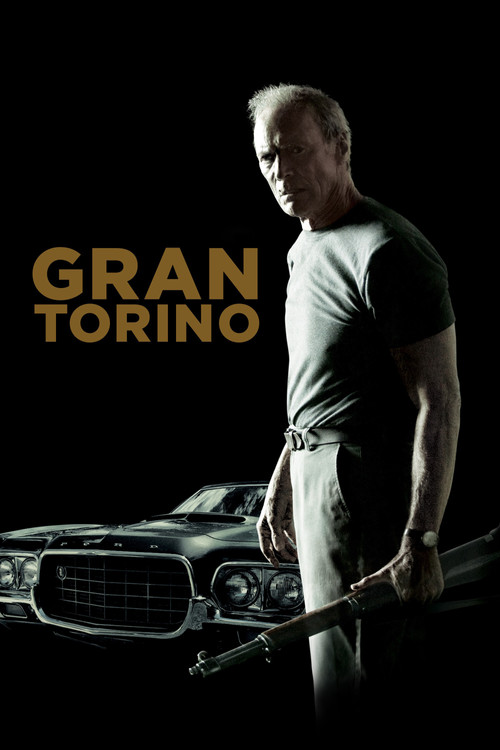
Gran Torino
"Ever come across somebody you shouldn't have f#cked with?"
Overview
"Gran Torino" (2008), directed by and starring Clint Eastwood, is a drama set in a Detroit neighborhood. The film introduces Walt Kowalski, a disgruntled and prejudiced Korean War veteran and retired auto worker who is recently widowed. His neighborhood, once populated by fellow working-class white families, is now home to many Hmong immigrants, whom he openly disdains. Walt's prized possession is his mint-condition 1972 Ford Gran Torino.
The story's turning point occurs when Thao Vang Lor, a quiet Hmong teenager from the family next door, is pressured by a local gang to steal Walt's Gran Torino as an initiation rite. Walt catches Thao in the act, and this event initiates a reluctant relationship between Walt and the Vang Lor family. As penance, Thao's mother insists he work for Walt. Through this forced interaction, and his developing rapport with Thao's assertive sister, Sue, Walt's hardened exterior begins to crack.
As Walt becomes a reluctant protector and mentor to Thao, he is drawn into the family's conflict with the same gang that tried to recruit Thao. This escalating tension forces Walt to confront his own prejudices and the violent memories from his past, leading him to make a fateful decision to protect his new friends.
Core Meaning
"Gran Torino" explores the possibility of redemption and the breaking down of deeply ingrained prejudice. The film posits that it's never too late for an individual to change and find common ground with those they once reviled. Director Clint Eastwood uses the character of Walt Kowalski to examine the legacy of a generation of American men shaped by war and industrial labor, who find themselves alienated in a changing world. The film's core message is about sacrifice, the formation of unconventional families, and the idea that understanding and empathy can overcome cultural and generational divides. It's a commentary on the corrosive nature of racism and the unexpected paths to salvation.
Thematic DNA
Redemption and Sacrifice
Walt Kowalski is haunted by his actions during the Korean War, a guilt he has carried for decades. His relationship with Thao and the Hmong community offers him a chance at redemption. He transitions from a bitter, isolated man to a mentor and protector. This culminates in his ultimate sacrifice, where he orchestrates his own death to ensure the gang that terrorizes the Vang Lor family is imprisoned. His final act is a deliberate, Christ-like martyrdom, trading his life to save his adopted community and absolve himself of past sins.
Prejudice and Cultural Conflict
The film opens with Walt as an unapologetic racist, freely using ethnic slurs and viewing his Hmong neighbors with suspicion and contempt. His neighborhood in Detroit is a microcosm of demographic change in America's Rust Belt. The narrative directly confronts these prejudices as Walt is forced to interact with the Vang Lor family. Through shared experiences and Sue's patient explanations of Hmong culture, Walt's bigotry slowly erodes, replaced by genuine affection and understanding. The film explores how personal relationships can dismantle lifelong prejudices.
Masculinity and Fatherhood
Walt embodies a traditional, stoic model of American masculinity, shaped by his time as a soldier and an auto worker. He is estranged from his own sons, whom he views as weak and materialistic. He finds a surrogate son in Thao, a boy lacking a strong male role model. Walt takes it upon himself to "man up" Thao, teaching him practical skills, how to talk to women, and how to stand up for himself. This mentorship allows Walt to finally fulfill a fatherly role that he failed to perform with his own children.
Life and Death
The film is framed by two funerals. It begins with the funeral of Walt's wife, where he is alienated from his family and confronted by the young Father Janovich about his own mortality and lack of faith. It ends with Walt's own funeral, attended by the Hmong community who have become his true family. Throughout the film, Walt grapples with his past killings in the war and his declining health, symbolized by him coughing up blood. His final, sacrificial death is a choice, giving his life meaning and contrasting sharply with the senseless violence of the gang.
Character Analysis
Walt Kowalski
Clint Eastwood
Motivation
Initially motivated by a desire to be left alone and a cynical worldview, Walt's motivation shifts to protecting the innocent. He is driven by a rediscovered sense of duty and a need to atone for the violence he committed in the Korean War. He ultimately wants to ensure Thao has a future free from the cycle of violence that has plagued his own life.
Character Arc
Walt begins the film as a bitter, prejudiced, and isolated widower, alienated from both his family and his changing neighborhood. His initial interactions with his Hmong neighbors are filled with racial slurs and hostility. Through his forced mentorship of Thao and his friendship with Sue, he slowly sheds his prejudices. He rediscovers a sense of purpose and family, evolving from a grumpy old man into a courageous protector. His arc culminates in an act of selfless sacrifice, giving his life to save the family he has grown to love, thereby achieving redemption for his past sins.
Thao Vang Lor
Bee Vang
Motivation
Thao's primary motivation is to find his own path and escape the pressure of joining a gang. He seeks a sense of purpose and belonging, which he finds through his work for and eventual bond with Walt. He is motivated by a desire to live up to the expectations of his family and, eventually, to make Walt proud.
Character Arc
Thao starts as a shy, passive, and directionless teenager, easily pressured by his gangster cousin. He lacks a father figure and is unsure of his place in the world. Under Walt's reluctant mentorship, Thao gains confidence and learns practical skills, transforming from a boy into a responsible young man. He learns to stand up for himself and finds a path toward a productive life. Inheriting the Gran Torino at the end symbolizes his successful coming-of-age and the positive legacy Walt leaves him.
Sue Lor
Ahney Her
Motivation
Sue is motivated by a strong sense of family and a desire to protect her brother, Thao. She wants to see her family thrive in their new country and understands the importance of building alliances. She is proactive in creating a relationship with Walt, recognizing his potential to be a powerful ally against the local gang.
Character Arc
Sue is a sharp, witty, and confident young woman who is much more assimilated into American culture than her brother. She acts as the initial bridge between Walt and the Hmong community. Her intelligence and persistence break through Walt's gruff exterior, and she helps him understand Hmong culture and her family's plight. Despite being a victim of a brutal assault by the gang, she maintains her resilience. Her character remains a steadfast link between the two cultures throughout the film.
Father Janovich
Christopher Carley
Motivation
His motivation is rooted in his faith and his promise to Walt's deceased wife. He genuinely wants to provide spiritual comfort to Walt and guide him toward confession and peace. He believes in the importance of community and spiritual well-being and is determined to break through Walt's hardened cynicism.
Character Arc
Father Janovich is a young, somewhat naive priest who initially serves as a foil to the cynical Walt. He tries to fulfill a promise to Walt's late wife to get him to go to confession. Walt dismisses him as an inexperienced boy who knows nothing of life and death. However, the priest persists, and over time, a grudging respect develops between the two. By the end, Father Janovich admits that he learned more about life and death from Walt than from anyone else, showing his own growth in understanding the complexities of faith and sacrifice.
Symbols & Motifs
The 1972 Ford Gran Torino
The Gran Torino is a multifaceted symbol. Initially, it represents Walt's past, his pride in American manufacturing, and his traditional sense of masculinity. It is a tangible link to an era he feels has disappeared. As the story progresses, the car becomes the catalyst for his relationship with Thao. Ultimately, by bequeathing the car to Thao, it symbolizes the passing of Walt's legacy, his values of hard work and integrity, and the bridging of a generational and cultural gap.
The car is kept in pristine condition in Walt's garage. The inciting incident of the plot is Thao's failed attempt to steal it. In the final scene, Thao is seen driving the Gran Torino down a coastal road, signifying a hopeful future.
Guns
Guns represent different forms of power and violence. Walt's M1 Garand from the Korean War is a symbol of his past and his readiness to use violence for protection, as seen when he first confronts the gang. The gang's modern firearms are tools of intimidation and senseless violence. The film ultimately critiques the reliance on violence, as Walt's final victory is achieved not with a gun, but by tricking the gang into killing him while he is unarmed.
Walt brandishes his M1 rifle to save Thao from the gang on his lawn. He later uses a finger-gun gesture as a recurring motif to intimidate people. In the climax, he provokes the gang into shooting him by reaching for what they believe is a gun, but is only his lighter.
Zippo Lighter
Walt's Zippo lighter, engraved with the 1st Cavalry Division insignia, is a memento from his time in the Korean War. It represents the painful memories and guilt he carries from the war. It is also a symbol of his mortality, as he is a chronic smoker. In the final scene, it becomes the instrument of his sacrifice; reaching for it is the gesture that provokes the gang to kill him, thereby becoming a tool for justice rather than violence.
The lighter is seen throughout the film whenever Walt smokes. In the climactic confrontation, Walt asks for a light, then reaches into his jacket for his Zippo. The gang members, believing he is pulling out a gun, shoot him down. The camera reveals the lighter in his dead hand.
Crucifixion Pose
When Walt is shot and killed by the gang, he falls to the ground with his arms outstretched, deliberately evoking the imagery of Jesus Christ on the cross. This pose symbolizes his ultimate sacrifice, dying for the sins (or in this case, the safety) of others. It frames his death not as a defeat, but as a redemptive act of martyrdom that saves the Vang Lor family.
This occurs in the film's climax. After being shot multiple times by the gang members, Walt falls backward onto their lawn. The camera lingers on his body from above, clearly showing the Christ-like pose.
Memorable Quotes
Get off my lawn.
— Walt Kowalski
Context:
Walt says this to the Hmong gang members when he first confronts them on his front lawn as they are trying to intimidate Thao and Sue.
Meaning:
This line, growled by Walt while pointing his rifle, becomes his iconic catchphrase. It encapsulates his territorial, cantankerous nature and his initial desire to keep the world at bay. It's a defiant statement of ownership and a warning to anyone who dares to cross his boundaries, both literally and figuratively.
Ever notice how you come across somebody once in a while you shouldn't have messed with? That's me.
— Walt Kowalski
Context:
Walt delivers this line to a group of men who are harassing Sue in the street before he intervenes to rescue her.
Meaning:
This quote solidifies Walt's tough-guy persona, harkening back to Clint Eastwood's iconic roles like Dirty Harry. It's a direct and chilling threat that establishes his capability for violence and his refusal to be a victim, setting the stage for his role as a protector.
We used to stack f**ks like you five feet high in Korea... use ya for sandbags.
— Walt Kowalski
Context:
Walt says this to Smokie, one of the gang members, during his first major confrontation with them on his lawn, emphasizing that he is not afraid of them.
Meaning:
A brutal and vivid line that reveals the depth of Walt's wartime trauma and his capacity for intimidation. It's a stark reminder of the violence he has experienced and is willing to employ, framing his character as a man shaped by the horrors of war.
The thing that haunts a man the most is what he isn't ordered to do.
— Walt Kowalski
Context:
Walt says this to Thao after Thao asks him what it's like to kill a man. This confession happens late in the film, revealing the deep-seated guilt that drives his final actions.
Meaning:
In a moment of vulnerability, Walt reveals the true source of his guilt from the war. It wasn't the killing he was ordered to do, but an act he chose, likely the killing of a young enemy soldier who was surrendering. This line provides the key to understanding his motivation for redemption.
Philosophical Questions
Can deeply ingrained prejudice truly be overcome in old age?
The film champions the idea that it is never too late for personal transformation. Walt Kowalski starts as a man defined by his prejudices, a product of his generation and wartime experiences. The film meticulously charts his evolution, suggesting that direct, personal interaction and the formation of genuine human bonds are powerful enough to dismantle a lifetime of bigotry. His journey from using racial slurs to sacrificing his life for his Hmong neighbors serves as the film's central thesis on the human capacity for change and empathy, regardless of age.
What is the nature of true sacrifice and redemption?
"Gran Torino" explores sacrifice not as a single act, but as a process. Walt is haunted by his past and initially seeks solace in isolation. The film questions what constitutes a meaningful life and death. Father Janovich represents a traditional, faith-based path to redemption through confession, which Walt rejects. Instead, Walt finds redemption through action and mentorship. His final act is a calculated sacrifice, a form of secular martyrdom where he uses his death as a tool to bring justice and peace to his community. This suggests that redemption is found not in words or faith alone, but in meaningful, selfless action that benefits others.
Does the end justify the means when confronting violence?
The film presents a complex moral landscape regarding violence. Walt initially confronts the gang with the threat of superior violence, a tactic that reflects his 'Dirty Harry' persona. However, this only leads to escalation and retaliation against the Vang Lor family. Walt realizes that meeting violence with more violence is a destructive cycle. His ultimate solution is a non-violent act on his part—getting himself killed—that manipulates the legal system to permanently stop the gang. The film argues that the most effective way to defeat violence is not through greater force, but through intelligence, courage, and self-sacrifice.
Alternative Interpretations
While the dominant interpretation of "Gran Torino" is a story of redemption and interracial understanding, several alternative readings exist. One perspective views the film as a deeply conservative parable, where Walt, the white patriarch, must impose his version of American masculinity and order on the 'unruly' immigrant community. His relationship with Thao can be seen less as mentorship and more as a form of cultural assimilation, teaching him how to be a 'proper' American man.
Another interpretation focuses on the film as an elegy for a specific type of white, working-class American male. Walt and his Gran Torino are relics of a bygone era of American industrial might and cultural homogeneity. His death, therefore, can be read not just as a personal sacrifice but as the symbolic end of that era, making way for a new, multicultural America.
A more critical reading, often from within the Hmong community, sees the film as a classic "white savior" narrative. In this view, the Hmong characters are portrayed as helpless and unable to solve their own problems without the intervention of a white protagonist. Walt's sacrifice, while noble, reinforces the idea that minority communities require a white figure to achieve justice and safety, ultimately disempowering the Hmong characters in their own story.
Cultural Impact
"Gran Torino" was released to both critical acclaim and significant public discussion. Critics praised Eastwood's performance, often seeing it as a summation of his iconic screen persona—a blend of the Man with No Name and Dirty Harry, now aged and confronting his own legacy. The film resonated with audiences, becoming a surprise box office hit and earning an "A" CinemaScore. It sparked conversations about racism, generational divides, and the changing landscape of industrial America.
However, the film's portrayal of the Hmong community was a source of significant controversy. While it was the first major Hollywood film to feature a large Hmong cast, many in the Hmong-American community criticized it for relying on stereotypes, cultural inaccuracies, and a "white savior" narrative. Critics pointed out that the Hmong characters, particularly the gang members, were depicted as one-dimensional tropes. Actor Bee Vang later spoke out against the film's use of anti-Asian slurs and its overall impact on the community's representation. Despite these valid criticisms, others in the Hmong community appreciated the visibility the film provided, noting that it was the first time many Americans had even heard of the Hmong people.
The film's impact on pop culture is most evident in the phrase "Get off my lawn," which became a widely recognized meme and catchphrase symbolizing a curmudgeonly, old-fashioned attitude toward the modern world.
Audience Reception
Audiences responded very positively to "Gran Torino," awarding it an "A" grade in CinemaScore polls. Viewers widely praised Clint Eastwood's powerful and nuanced performance, often citing it as a fitting capstone to his acting career. Many found the film to be a touching and humorous story of an unlikely friendship and redemption. The film's blend of politically incorrect humor and heartfelt drama resonated with a broad audience. The emotional climax and Walt's sacrificial act were frequently highlighted as powerful and satisfying.
Criticism from audiences often centered on the perceived weakness of some of the supporting performances, particularly from the first-time actors. Some viewers found the script to be heavy-handed and the symbolism, especially the final crucifixion pose, to be overly obvious. A segment of the audience, particularly those from the Hmong community, criticized the film for its cultural inaccuracies and perpetuation of stereotypes, feeling that it presented a simplified and often patronizing view of their culture.
Interesting Facts
- Clint Eastwood has stated that "Gran Torino" was his last major on-screen acting role.
- The screenplay was written by Nick Schenk, who drew from his experiences working in a factory with Hmong immigrants in Minnesota.
- To ensure authenticity, Eastwood held casting calls in Hmong communities in Detroit, Fresno, and St. Paul, casting many first-time Hmong actors, including Bee Vang (Thao) and Ahney Her (Sue).
- The film was shot on location in and around Detroit, Michigan, including Highland Park.
- The Hmong language used in the film was often improvised by the actors, as the script was written entirely in English. Cultural consultants were used to help with traditions and translations.
- The film was a major box office success, grossing $270 million worldwide on a budget of just $25-33 million, making it one of Eastwood's highest-grossing films.
- Clint Eastwood's son, Scott Eastwood, has a small role in the film as Trey, Sue's date who is harassed by the gang.
- Eastwood co-wrote and performed the film's title song, which plays over the end credits.
⚠️ Spoiler Analysis
Click to reveal detailed analysis with spoilers
Frequently Asked Questions
Explore More About This Movie
Dive deeper into specific aspects of the movie with our detailed analysis pages
Comments (0)
No comments yet. Be the first to share your thoughts!