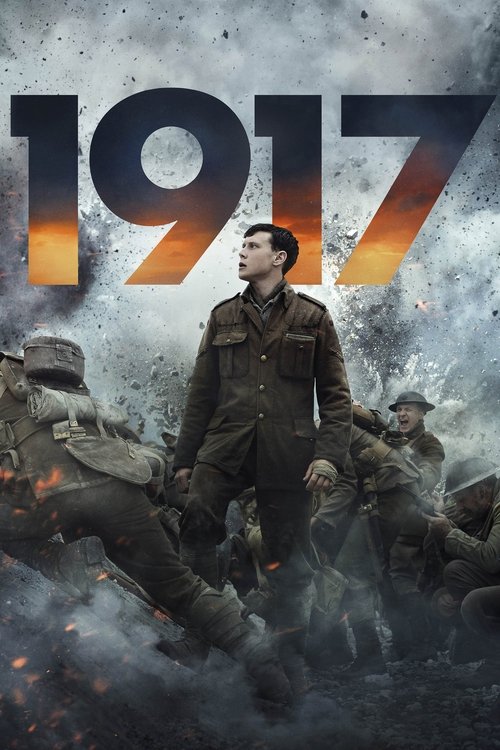
1917
A harrowing, real-time odyssey through the visceral landscapes of war, where a desperate race against time becomes a poetic testament to human endurance and sacrifice.
1917

1917

"Time is the enemy."

25 December 2019 India 119 min ⭐ 8.0 (13,022)
Director: Sam Mendes
Cast: George MacKay, Dean-Charles Chapman, Mark Strong, Andrew Scott, Richard Madden
War History Thriller
The Futility and Brutality of War Sacrifice and Duty Time and Urgency Humanity Amidst Inhumanity
Budget: $100,000,000
Box Office: $394,638,258

Overview

Set on April 6, 1917, on the Western Front, the film follows two young British soldiers, Lance Corporal Schofield and Lance Corporal Blake, who are given a seemingly impossible mission. In a race against time, they must cross into enemy territory to deliver a message that will stop 1,600 of their fellow soldiers, including Blake's own brother, from walking straight into a deadly trap set by the German army. The Germans have feigned a retreat to the Hindenburg Line, but aerial intelligence reveals it is a tactical withdrawal to ambush the advancing British forces.

With communication lines down, the two soldiers must traverse No Man's Land and abandoned German trenches on foot. Their journey is a continuous, perilous ordeal through cratered landscapes, booby-trapped bunkers, and desolate French towns, testing their courage and friendship at every turn. The film unfolds in what appears to be a single continuous shot, immersing the audience directly into the urgency and horror of their mission.
Core Meaning

The core meaning of "1917" revolves around the profound human cost of war, juxtaposing the immense, impersonal machinery of conflict with the deeply personal sacrifices of individuals. Director Sam Mendes, inspired by stories from his grandfather, aimed to capture the visceral, moment-to-moment reality of a soldier's experience. The film argues that amidst the futility and senseless slaughter, acts of courage, duty, and keeping a promise to a friend become the ultimate sources of meaning. It's less a commentary on the grand strategies of war and more an intimate exploration of endurance, resilience, and the sheer will to live, not for glory, but for the sake of others and the hope of returning home. The film questions the nature of heroism, suggesting it's found not in medals or accolades but in the quiet perseverance against overwhelming odds.

Thematic DNA

The Futility and Brutality of War 35%
Sacrifice and Duty 30%
Time and Urgency 20%
Humanity Amidst Inhumanity 15%

The Futility and Brutality of War

The film relentlessly portrays war not as a glorious endeavor but as a landscape of decay, death, and senseless destruction. From the mud-filled trenches littered with corpses to the arbitrary nature of death, the narrative emphasizes that war's primary product is loss. Colonel Mackenzie's cynical line, "There is only one way this war ends. Last man standing," encapsulates this theme, suggesting that victory is a hollow concept in such a devastating conflict. The constant peril and the death of main characters for seemingly little gain underscore the wastefulness inherent in warfare.

Sacrifice and Duty

Despite the overwhelming horror, the characters are driven by a profound sense of duty. Blake's motivation is personal—to save his brother—while Schofield initially is more cynical. However, after Blake's death, Schofield internalizes the mission, driven by a promise to his fallen friend. This theme explores the philosophical conflict between deontological duty (following orders and moral rules) and consequentialism (the outcome justifying the means), ultimately highlighting that personal commitment and sacrifice provide meaning in a world devoid of a clear moral compass.

Time and Urgency

The film's innovative 'one-shot' technique makes time a central antagonist. The mission is a literal race against the clock, and the continuous take forces the audience to experience every agonizing second with the protagonists. This stylistic choice eliminates narrative jumps, creating a relentless sense of forward momentum and claustrophobia. General Erinmore's briefing establishes the stakes, but the real-time presentation makes the audience feel the weight of every passing moment as the deadline to stop the attack approaches.

Humanity Amidst Inhumanity

Even in the most brutal settings, moments of humanity persist. Schofield's encounter with a young French woman and an orphaned baby in the bombed-out town of Écoust offers a brief, poignant sanctuary from the violence. His choice to give them his milk and rations is a powerful act of compassion. Similarly, the soldiers listening to another sing "The Wayfaring Stranger" before going into battle provides a moment of shared, somber humanity, reminding the viewer of the individual lives at stake.

Character Analysis

Lance Corporal William Schofield

George MacKay

Archetype: The Everyman Hero
Key Trait: Resilient

Motivation

Initially, Schofield is motivated by a soldier's duty. After witnessing Blake's death, his motivation becomes deeply personal: to fulfill his promise to Blake to save his brother and write to their mother. The reveal of his family at the end shows his ultimate, hidden motivation was the hope of returning home to them.

Character Arc

Schofield begins the film as a jaded and pragmatic veteran of the Somme, more cautious and world-weary than his companion. Initially, he is motivated purely by duty. After Blake's death, however, Schofield undergoes a transformation, adopting his friend's sense of personal urgency and determination. He evolves from a cynical survivor into a determined hero, driven by a promise to his friend and the underlying hope of returning to his own family.

Lance Corporal Tom Blake

Dean-Charles Chapman

Archetype: The Idealist
Key Trait: Hopeful

Motivation

Blake's primary motivation is clear from the outset: to save his brother, Lieutenant Joseph Blake, who is among the 1,600 men set to walk into the German trap. This personal connection fuels his urgency and courage.

Character Arc

Blake is more optimistic, affable, and emotionally open than Schofield. He is good with stories and maps and is immediately driven by the personal stake of saving his brother. His idealism and comparative naivete are contrasted with Schofield's experience. Though his journey is cut short, his goodness and sense of purpose are passed on to Schofield, becoming the catalyst for Schofield's heroic actions in the second half of the film.

Colonel Mackenzie

Benedict Cumberbatch

Archetype: The Obstacle
Key Trait: Adamant

Motivation

Mackenzie is motivated by a desperate desire to break the stalemate and achieve a victory, believing his attack is the chance to finally push the Germans back. He states, "I hoped today might be a good day. Hope is a dangerous thing," revealing his weariness and his conviction that stopping now would be a greater folly than attacking.

Character Arc

Colonel Mackenzie represents the weary, and perhaps misguided, desperation of command. He is not a villain but a man worn down by the war's stalemate, who clings to the hope of a decisive victory, making him initially resistant to Schofield's message. His character doesn't have an arc so much as he serves as the final, human obstacle Schofield must overcome, embodying the institutional inertia that perpetuates the conflict. He is bitter and believes victory is the only way out.

Captain Smith

Mark Strong

Archetype: The Mentor/Helper
Key Trait: Pragmatic

Motivation

His motivation is to help a fellow soldier and see that the right thing is done. He recognizes the importance of Schofield's mission and does what he can to aid him, showing a weary but unbroken sense of duty and humanity.

Character Arc

Captain Smith appears briefly but serves a crucial role as a calm, wise, and compassionate figure in the chaos. He gives Schofield a ride and offers him practical advice: "make sure there are witnesses" when he delivers the message, acknowledging that some officers just want the fight. He represents seasoned leadership and empathy, providing Schofield with a moment of respite and crucial guidance before he continues his journey alone.

Symbols & Motifs

Cherry Blossoms/Trees

Meaning:

The cherry trees symbolize life, hope, and resilience in the face of destruction. Blake’s story about his mother’s cherry orchard, and his belief that chopping one down just makes more grow, serves as a metaphor for the endurance of life even when cut down by war.

Context:

Schofield and Blake encounter a destroyed cherry orchard after escaping the German trenches. Blake remarks that the trees will grow back stronger. Later, as Schofield floats down the river near death, cherry blossom petals fall around him, signaling a moment of rebirth or peace before he continues his mission.

Milk

Meaning:

The milk symbolizes life, innocence, and a connection to a world outside the war. It represents nurture and the fundamental goodness that Schofield is fighting to preserve, a stark contrast to the death and decay surrounding him.

Context:

Schofield finds a pail of fresh milk in an abandoned farmhouse. He later gives this milk to a starving French woman to feed an orphaned baby she is caring for. This act is one of the film's purest moments of selfless humanity.

The River

Meaning:

The river symbolizes both a path to potential death and a form of cleansing or baptismal rebirth. For Schofield, plunging into the river is an act of desperation, but emerging from it marks a transition and the final, determined leg of his journey.

Context:

To escape a German soldier in Écoust, Schofield leaps into a raging river. He is swept through rapids and over a waterfall, nearly drowning amidst floating corpses, before washing ashore near the forest where the 2nd Devons are located.

The Photograph

Meaning:

The photograph of Schofield's wife and daughters, with the inscription "Come back to us," symbolizes his ultimate motivation and the life he has waiting for him. It represents hope, love, and the personal stakes of his survival, which he keeps hidden until the very end.

Context:

The final shot of the film shows Schofield resting under a tree, mirroring the opening scene. He pulls out the photograph of his family, finally allowing himself a moment to connect with what he's fighting for now that his mission is complete.

Memorable Quotes

I hoped today might be a good day. Hope is a dangerous thing.

— Colonel Mackenzie

Context:

Spoken to Schofield in the command dugout after Mackenzie has read the letter from General Erinmore and is forced to call off the attack he was moments away from launching.

Meaning:

This quote encapsulates the deep-seated cynicism and weariness of the officers who have been fighting a war of attrition. Mackenzie's hope for a "good day" is a hope for victory, and he sees the order to stand down as a crushing blow to that hope, revealing the psychological toll of the conflict.

There is only one way this war ends. Last man standing.

— Colonel Mackenzie

Context:

Said to Schofield in the dugout, immediately following his reluctant order to halt the attack. It is his final, bleak assessment of the war's nature before dismissing Schofield.

Meaning:

This line conveys the grim, nihilistic reality of World War I as perceived by those in command. It dismisses any notion of a strategic or noble victory, reducing the entire conflict to a brutal battle of sheer endurance and annihilation.

Tell her I wasn't scared.

— Lance Corporal Blake

Context:

Blake says this to Schofield as he lies dying after being stabbed by the German pilot they tried to save from a burning plane.

Meaning:

These are Blake's last words, a poignant and heartbreaking request. It is a final act of love for his mother, an attempt to protect her from the horror of his death and preserve an image of his bravery, whether true or not.

Some men just want the fight.

— Captain Smith

Context:

Captain Smith says this to Schofield as he drops him off near the front line, advising him to have witnesses when he delivers his message to Colonel Mackenzie to ensure the order is followed.

Meaning:

This is a piece of sage, cynical advice that warns Schofield about the internal politics and differing mentalities within the army. It suggests that not all officers are concerned with saving lives and that some are driven by a desire for glory or conflict itself.

Philosophical Questions

Does individual action have meaning in the face of overwhelming, impersonal conflict?

The film explores this question through Schofield's mission. While the war itself is a massive, seemingly unstoppable force of destruction, his personal journey to save 1,600 men becomes a focal point of meaning. The film suggests that while one person cannot stop the war, acts of individual courage, loyalty, and sacrifice are what preserve humanity. The mission's success doesn't end the war, but it affirms the value of the individual lives saved, posing a challenge to the nihilism that such a large-scale conflict can induce.

What is the true nature of heroism?

"1917" deconstructs the traditional war hero archetype. Schofield is not a gung-ho patriot; he is a tired, cynical survivor who even traded a medal for a bottle of wine. His heroism is reluctant and born of necessity and a promise to a friend. The film portrays heroism not as a thirst for glory but as the endurance of unimaginable hardship for a greater good. The most heroic acts, like Schofield's final, desperate sprint across the battlefield, are presented as terrifying and selfless rather than glorious.

Can an anti-war film avoid glorifying war?

This is a central dilemma for the genre. While "1917" vividly depicts the horrors of war—the gore, the fear, the futility—its thrilling cinematic technique and the heroic arc of its protagonist can be perceived as inherently exciting. The film grapples with this by focusing on the psychological and physical toll on individuals rather than battlefield triumphs. The 'victories' are surviving another moment or saving lives, not defeating an enemy. By stripping away the typical narrative of glory, it attempts to present the experience of war as a trauma to be endured, not a conflict to be won, though some viewers may still find the spectacle itself exhilarating.

Alternative Interpretations

One alternative interpretation of the film views Schofield's journey not just as a literal mission but as an allegorical descent into hell and back, akin to a classic epic poem. The landscapes he traverses—the corpse-strewn No Man's Land, the fiery ruins of Écoust, the river of bodies—can be seen as different circles of a Dantean underworld. His emergence from the river is a form of rebirth, allowing him to complete his quest.

Another reading focuses on the cyclical and pointless nature of war. The film begins and ends with Schofield resting against a tree. While he has completed his mission and saved 1,600 men, the final shot suggests that this is just a temporary reprieve. The war will continue, and another mission will inevitably follow. This interpretation posits that the 'victory' is fleeting and that Schofield is merely back where he started, awaiting the next horrific task, thus highlighting the unending trauma of the conflict rather than a triumphant conclusion.

Cultural Impact

"1917" was released to widespread critical acclaim, particularly for its groundbreaking cinematography and technical achievements, which created a new benchmark for immersive filmmaking in the war genre. It revitalized interest in World War I, a conflict often overshadowed in cinema by World War II, presenting it to a new generation with a visceral immediacy. The film's 'one-shot' technique, while not entirely new to cinema, was executed on an epic scale that influenced discussions about the future of visual storytelling. Critics and audiences lauded its ability to create tension and emotional connection, though some debated whether the technical prowess occasionally overshadowed character development. The film won numerous awards, including the Golden Globe for Best Motion Picture – Drama and three Academy Awards for Best Cinematography, Best Visual Effects, and Best Sound Mixing, cementing its place as a significant cinematic achievement of its time. It also sparked conversations about historical accuracy, with praise for its detailed production design but also noting the fictionalization of its central narrative.

Audience Reception

Audiences largely praised "1917" as a masterfully crafted and emotionally gripping cinematic experience. The continuous-shot cinematography by Roger Deakins was a near-universal point of acclaim, with viewers describing the film as incredibly immersive, intense, and breathtaking. Many viewers felt a deep emotional connection to the characters' perilous journey, finding the story both thrilling and heartbreaking. The film's technical prowess, production design, and score were also frequently highlighted as exceptional.

Points of criticism, though less common, tended to focus on character development. Some viewers felt that the emphasis on technical filmmaking and constant forward momentum left little room for deep character backstory, making the protagonists feel like 'everyman' ciphers rather than fully fleshed-out individuals. A minority of viewers found the single-take approach to be a 'gimmick' that, at times, drew attention to itself and away from the narrative. However, the overall verdict from audiences was overwhelmingly positive, with many calling it one of the greatest war films ever made.

Interesting Facts

  • The film is inspired by stories director Sam Mendes's paternal grandfather, Alfred H. Mendes, told him about his experiences as a messenger in World War I.
  • To achieve the 'one-shot' illusion, the longest uninterrupted take was about eight and a half minutes long, while the shortest was 39 seconds. Cuts were cleverly hidden when the camera passes an object, through darkness, or with whip pans.
  • The production dug approximately 5,200 feet (nearly a mile) of trenches for the film, as the geography had to be precisely measured to match the scripted dialogue and timing of the scenes.
  • Cinematographer Roger Deakins primarily used a 40mm lens on an ARRI Alexa Mini LF camera, as this focal length most closely mimics the human field of vision, enhancing the immersive experience.
  • The climactic scene where Schofield runs horizontally across the battlefield as the first wave of soldiers charges was unscripted in the moment where he bumps into other soldiers. Those collisions were real, and actor George MacKay kept going, which was used in the final cut.
  • Tom Holland was originally considered for the role of Lance Corporal Blake but had to drop out due to scheduling conflicts.
  • The scene where Schofield encounters the French woman and the baby was filmed on a soundstage at Shepperton Studios, while most of the exterior trench and No Man's Land scenes were shot on Salisbury Plain in the UK.
  • The Sikh soldier seen in one of the British trucks is a minor historical inaccuracy. By 1917, most Indian Army regiments had been transferred from the Western Front to other theaters of war.

⚠️ Spoiler Analysis

Click to reveal detailed analysis with spoilers

Frequently Asked Questions

Explore More About This Movie

Dive deeper into specific aspects of the movie with our detailed analysis pages

Comments (0)

Leave a comment

No comments yet. Be the first to share your thoughts!