Skip to content
MASHLE: MAGIC AND MUSCLES
A magic-school fantasy where the punchline is a punch: one expressionless boy answers a world of spells with dumbbells, cream puffs, and fists that turn wands into splinters.
MASHLE: MAGIC AND MUSCLES

MASHLE: MAGIC AND MUSCLES

マッシュル-MASHLE-

08 April 2023 — 30 March 2024 Japan 1 season 24 episode Returning Series 8.3 (674)

Cast: Chiaki Kobayashi, Reiji Kawashima, Kaito Ishikawa, Takuya Eguchi, Reina Ueda

Animation Sci-Fi & Fantasy Action & Adventure Comedy Merit versus birthright Found family and loyalty Segregation and the value of a life Discipline as its own kind of magic Comedy as critique

Overview

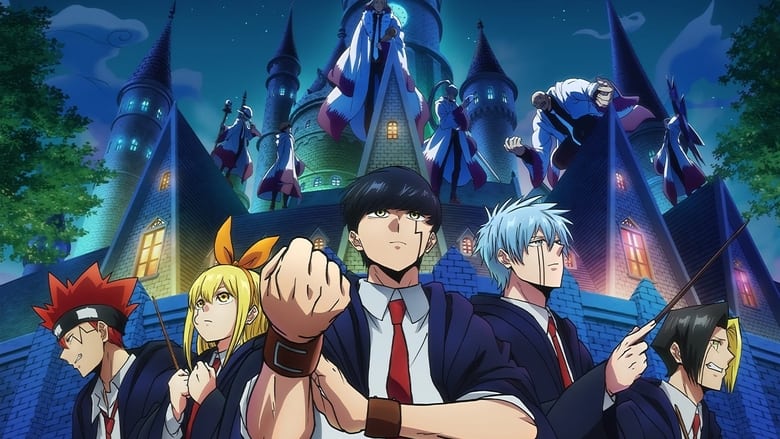
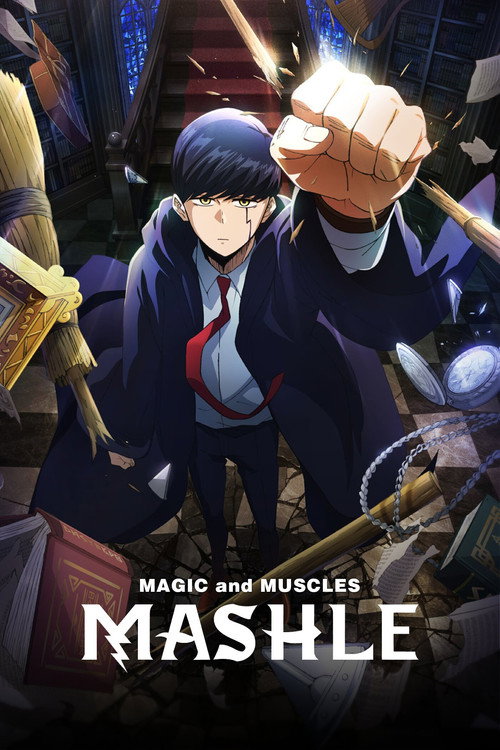
Mashle: Magic and Muscles (マッシュル-MASHLE-), adapted by A-1 Pictures from Hajime Kōmoto's Weekly Shōnen Jump manga, unfolds in a society where magic is the measure of everything. Every person is born with a mark that proves they can cast; those born without one are hunted down and erased. Deep in the forest lives Mash Burnedead, a boy with no mark, no magic, and an absurdly overtrained body, raised in quiet seclusion by his adoptive father. When his existence is discovered, the price of his family's safety is set: enroll at the elite Easton Magic Academy and become the Divine Visionary, the single student crowned above all others.

The first season (April–July 2023) follows Mash's collision with Easton's caste of dorms, coats and prodigies as he collects an unlikely circle of friends — the anxious Finn Ames, the sister-obsessed genius Lance Crown, the loudmouth Dot Barrett and the volatile Lemon Irvine — and punches his way up a ladder built to exclude him. Behind the gag structure, a darker frame tightens: the shadow organization led by Innocent Zero begins probing the academy, and Mash's own origin turns out to be entangled with it.

The second season, subtitled The Divine Visionary Candidate Exam Arc (January–March 2024), raises the stakes from schoolyard bullying to national selection, pitting Mash and his classmates against rival candidates and against Innocent Zero's Fangs. What began as a one-joke comedy — the muscle-bound boy who solves magic with force — gradually reveals itself as a story about a system that decides who is allowed to exist, and about a boy too literal-minded to accept the answer.
Core Meaning

At heart, Mashle is a comedy with a genuinely angry premise. Its world sorts people by an accident of birth — the mark on the face — and then dresses that sorting up as merit, tradition and destiny. Mash refutes the whole structure not by arguing with it but by being physically unanswerable: every wand he snaps is a proof that the hierarchy was never natural, only enforced.

The series argues that worth is something you build rather than something you are issued. Mash's strength is not a gift; it is ten thousand mornings of push-ups in a forest. Against a magical aristocracy obsessed with bloodline, rank and the ornaments of status, the show offers a stubbornly plain counter-proposal: effort, decency, and loyalty to the people who fed you. Reviewers repeatedly note that beneath the gags sit themes of found family, segregation and the hardship of living in a society engineered against you.

Its final message is disarmingly modest. Mash never wants to rule the magical world or reform it by manifesto — he wants to protect his father, eat cream puffs, and be left alone with his friends. The show suggests that the most radical thing a person can do inside an unjust order is to refuse its terms entirely and simply keep being good to the people in front of them.

Thematic DNA

Merit versus birthright 26%
Found family and loyalty 24%
Segregation and the value of a life 20%
Discipline as its own kind of magic 16%
Comedy as critique 14%

Merit versus birthright

Easton Magic Academy is a machine for converting inherited talent into social rank: marks, coat lines, dorm prestige. Mash enters with none of it and climbs anyway. Early episodes play this for laughs — brooms crushed, spells answered with fists — but the joke sharpens as the series continues: the same institution that mocks him depends on him. By the Divine Visionary Candidate Exam arc the question is formalized into a national contest, and the show asks openly whether the crown means anything at all when the rules were rigged before the race began.

Found family and loyalty

Mash begins with one bond — his adoptive father, Regro — and the entire plot is set in motion to protect him. What accumulates around Mash across both seasons is a chosen family: Finn, Lance, Dot and Lemon each arrive as rivals, cowards or nuisances and are absorbed by Mash's blunt, unconditional decency. Critics have singled out found family as the series' emotional engine. In the second season these bonds are tested by an exam designed to isolate candidates, and the group's refusal to compete against one another becomes the arc's real victory.

Segregation and the value of a life

The world's founding cruelty is stated in the premise: the markless are to be disposed of. The show keeps this from becoming background lore by attaching it to a face — Mash's — and by making even friendly characters complicit in the assumption. Reviews note the series' handling of segregation, death and violence beneath its comic surface. Over the run, the villains articulate the ideology outright, revealing that the academy's snobbery and the antagonists' extermination are the same logic at different volumes.

Discipline as its own kind of magic

Every fight is a variation on one thesis: the boy who cannot cast has out-worked the world. The series treats training montages, absurd weight-lifting and joyless repetition as sacred, deliberately inverting the fantasy convention where power is granted by talent or bloodline. As opponents grow stronger, Mash's answer never changes in kind, only in scale — a running gag that doubles as a moral argument about consistency over inspiration.

Comedy as critique

Parody is the show's method, not its decoration. By staging a Hogwarts-like academy — houses, brooms, a Quidditch-adjacent sport, a dark lord — and then having a deadpan strongman walk through it breaking things, the series lets absurdity do the work of criticism. The humor stays constant across both seasons even as the plot darkens, producing a tonal double vision where a genocidal ideology and a stolen cream puff can occupy the same scene.

Character Analysis

Mash Burnedead

Chiaki Kobayashi

Archetype: Deadpan invincible hero / holy fool Key Trait: Unbreakable, expressionless literal-mindedness

Motivation

Initially purely defensive: protect Regro, the father who raised him, and return to obscurity. This survival motive gradually widens into protecting his classmates, and finally into confronting the ideology that says people like him should not exist. Underneath it all, the motive never stops being small and human — comfort, food, and the safety of the people he loves.

Character Arc

Mash begins as a hermit whose entire world is his father and his training regimen, and who is forced into Easton under threat. Across the first season he moves from complete social illiteracy to something like leadership — not by learning the rules but by attracting people who prefer his rules. The second season's exam arc externalizes this: he must chase a title he has no interest in, and the transformation is that he keeps fighting for others rather than for the crown. His growth is horizontal rather than vertical; he does not become stronger in nature, he becomes attached, and it is attachment that finally gives him something to lose against Innocent Zero's forces.

Lance Crown

Kaito Ishikawa

Archetype: Rival turned steadfast ally Key Trait: Icy competence hiding total sincerity

Motivation

Begins with family vengeance and the protection of his sister, which hardens him into isolation; evolves into a broader protective instinct toward his found family, until fighting alongside Mash becomes indistinguishable from fighting for his own.

Character Arc

Introduced as a cold, elite prodigy of Easton with an absurd devotion to his sister, Lance is the character who most completely converts from institutional loyalty to personal loyalty. He starts by judging Mash by the standards the school taught him and ends as the friend who will take on an enemy alone to buy Mash time — most visibly in the second season, where he faces the Third Fang, Wirth. His arc is the series' clearest demonstration that talent is only worth what you spend it on.

All 5 characters and cast

Symbols & Motifs

The facial mark

Meaning:

The single stroke on every citizen's face is the world's entire caste system compressed into a birthmark: proof of magic, proof of the right to live. It symbolizes arbitrary categorization dressed as destiny — worth assigned before a person has done anything at all.

Context:

Established in the opening premise and recurring in every crowd shot; Mash's bare face is the visual reason for his exile, his blackmail into Easton, and the persistent threat hanging over both seasons.

Cream puffs

Meaning:

Mash's obsession stands for the smallness and sincerity of his desires. Against a world fighting over the Divine Visionary crown, his ambition is a pastry and a quiet afternoon — a running joke that quietly defines his incorruptibility.

Context:

A gag from the earliest episodes onward, escalating into plot: cream puffs are what he brings home to celebrate, and a cream puff spilled and crushed underfoot becomes the trigger for one of the series' most serious confrontations with Innocent Zero's man Cell War.

Muscles and the broken wand

Meaning:

The body as counter-argument. Every snapped wand or shattered spell is the refutation of inherited privilege by accumulated labor.

Context:

The visual signature of the whole series, from the first duel to the Divine Visionary exam battles, where progressively more decorated magic users lose to the same unanswerable punch.

The magic mirror

Meaning:

Reflection and self-image: a device that shows a person what they believe about themselves. It symbolizes the gap between the identity a system assigns you and the one you have built.

Context:

Central to the first season's climactic episode, Mash Burnedead and the Magic Mirror, where Mash finally confronts Abel Walker and the series' most explicit statement of its identity theme.

Easton Academy itself

Meaning:

The school is a monument to sorting — dorms, coat lines, prestige — and thus a symbol of institutions that mistake their own rankings for reality.

Context:

Its Hogwarts-like architecture, houses, flying brooms and Quidditch-adjacent sport are used across both seasons as the stage on which Mash's ordinariness looks like heresy.

The Divine Visionary crown

Meaning:

The ultimate prize is also the ultimate hollow object: a title Mash never wanted, pursued only as ransom for his father's safety. It represents ambition imposed from outside rather than chosen.

Context:

Introduced as the blackmail condition in season one and made the entire structure of season two's Divine Visionary Candidate Exam Arc, where every other candidate wants it desperately and the protagonist does not want it at all.

Episode Highlights

Season 1 premiere: Mash Burnedead enters Easton Magic Academy

S1E1

The opening episode establishes the entire engine of the series: a world where magic governs everything, a boy born without a mark, and the blackmail that forces him into the elite academy. It introduces the deadpan comedy rhythm — overwhelming magical spectacle answered by brute physical force — that the show will never abandon.

Significance:

Sets the premise reviewers immediately identified as One-Punch Man meets Harry Potter, and plants the two threads that carry both seasons: the Divine Visionary goal and the lethal danger of being markless.

Mash rescues Lemon; Innocent Zero infiltrates Magia Lupus' base

S1E11

The comedy drops away as Lemon Irvine is taken and Mash mounts a rescue, while the shadowy Innocent Zero moves directly against the Magia Lupus base. The episode splits its attention between Mash's personal stakes and the first full-scale demonstration of the antagonist's reach.

Significance:

The pivot from school-comedy to genuine threat: the season's overarching villain stops being a rumor and becomes an active force, reframing everything that came before as a prologue.

Mash Burnedead and the Magic Mirror

S1E12

The first-season finale delivers the long-awaited confrontation between Mash and Abel Walker, and pairs it with the revelation of Mash's greatest secret. The magic mirror motif turns the fight into a confrontation over identity as much as strength, and Mash overcomes Abel.

Significance:

Closes the school arc on the series' thesis — that a person is defined by what they have built, not what they were born with — and sets up the second season's escalation toward Innocent Zero.

The Divine Visionary Candidate Exam Arc begins

S2E1

The second season opens the national selection process, with Brad anxious that Mash's indifference to the crown will ruin everything, and the field of candidates assembled. The scope widens from a single academy to the whole magical establishment.

Significance:

Transforms the show's central goal from a personal ultimatum into a public contest, forcing Mash's private, defensive motivation into a very public arena and giving the supporting cast — especially Lance and Dot — room to fight independently.

Second season finale: Cell War and the cream puffs

S2E12

After the students celebrate their hard-won victory, Mash returns with cream puffs to share — a sneeze scatters them onto Cell War, one of Innocent Zero's men, and when Mash politely asks for them back, Cell War grinds them into the ground. The gag detonates into the season's most serious confrontation.

Significance:

The perfect distillation of the series' method: the smallest, most absurd stake — a pastry — becomes the moral line that cannot be crossed, and the arrival of Innocent Zero's forces ends the run on a promise of a far darker conflict to come.

Philosophical Questions

What gives a life value in a society that measures worth by an inborn trait?

The world's founding rule — the markless are to be eliminated — makes this the series' first and last question. It is explored through Mash's mere persistence: he does not argue his right to exist, he simply exists so effectively that the argument collapses. The academy's snobbery and Innocent Zero's extermination ideology are gradually revealed to be the same premise at different intensities, which is the show's quiet way of saying that everyday prejudice and atrocity share a root.

Is achievement earned through discipline more meaningful than power received as a gift?

Every fight is an experiment in this question, with magical prodigies as the control group. The series consistently frames talent as inherited privilege and muscle as accumulated labor, and it refuses Mash any secret latent power that would undercut the point. The comedy comes from the imbalance; the argument comes from how boring and repetitive his training is portrayed as being.

Can you be good inside a corrupt institution without becoming part of it?

Mash is coerced into Easton and pursues its highest honor, yet never internalizes its values — he wants no rank, no admiration, no crown. The supporting cast dramatizes the alternative: Lance, Dot and Finn each arrive shaped by the school's hierarchy and are slowly detached from it by proximity to someone immune to it. The series suggests that integrity survives institutions by simply refusing their scoreboard.

What is worth fighting for — grand causes, or the small things?

The show answers with a cream puff. Against villains motivated by ideology and immortality, Mash's stakes are a father, a few friends, and dessert; the series repeatedly stages this contrast so that a trivial personal cruelty provokes more force than any world-ending threat. Rather than mocking the smallness, the narrative treats it as the only honest reason anyone ever fights.

Does family mean the people who made you, or the people who chose you?

Mash is raised by an adoptive father and assembles a second family from classmates who initially wanted nothing to do with him, while the antagonists' ideology is obsessed with blood and lineage. The found-family theme runs through both seasons as the emotional counterweight to the world's biological determinism, and the revelation of Mash's true origins in the first-season finale deliberately puts the two definitions in direct conflict.

Alternative Interpretations

As pure parody. The most common reading takes the series at face value: a comedy with one joke — the magicless boy who wins by force — restaged in escalating variations. Under this interpretation, the plot about Innocent Zero and the Divine Visionary is scaffolding to justify the next punchline, and asking for thematic depth misreads the assignment.

Full ending explanation

Cultural Impact

Mashle arrived in 2023 as part of a wave of Weekly Shōnen Jump adaptations that leaned on parody rather than sincerity, and its cultural position was fixed instantly by comparison: critics filed it as 'One-Punch Man meets Harry Potter', a magic-school fantasy whose hero solves spells with dumbbells. That legibility was both its ceiling and its rocket fuel — the concept explains itself in one sentence, which made it unusually portable across social media.

Its largest impact was musical. The second season's opening theme, 'Bling-Bang-Bang-Born' by Creepy Nuts, escaped the anime entirely: the accompanying 'BBBB Dance' challenge went viral in Japan and internationally, and the track peaked at number eight on the Billboard Global 200, with the duo performing it on The First Take. Director Tomoya Tanaka publicly admitted he had not anticipated the scale of the song's success. For a great many people worldwide, the opening was the point of contact with the series — a rare case of an anime OP functioning as a standalone global pop hit and carrying the show's audience up with it.

Critically, the reception has been warm rather than reverent. Reviewers consistently describe a series with essentially one joke, repackaged, and forgive it because the packaging is excellent: A-1 Pictures' polish, likeable characters, and dependable comic timing. Commentators have also given it credit for smuggling real content past the gags — found family, and the hardship of living in a society structurally built against you — which has kept it in conversation as more than a parody. Its legacy so far is as a demonstration that a shōnen comedy can win a mass audience by being unpretentious, plus the more concrete legacy of an opening theme that briefly belonged to everyone.

Audience Reception

Season 1 (2023). The first cour was received as an easy, likeable crowd-pleaser rather than a prestige title. Reviewers praised A-1 Pictures' visuals, the pleasant humor and a cast that is 'likable' even when not complex, while conceding that the plot is not groundbreaking. The most repeated criticism was structural: the show has essentially one joke — the non-magical hero overcoming the odds with muscle — repackaged in different ways, which some found charming and others found exhausting by mid-season. The heavy Harry Potter resemblance divided viewers between those who read it as loving parody and those who found it derivative.

Season 2 — The Divine Visionary Candidate Exam Arc (2024). The second season broadened the fight roster and gave the supporting cast their own battles, which was widely welcomed by audiences who had wanted more from Lance, Dot and Finn. Its defining event, however, was external: the Creepy Nuts opening 'Bling-Bang-Bang-Born' and its viral dance challenge brought an enormous influx of new viewers, and pushed the song to number eight on the Billboard Global 200. Some longtime fans grumbled that the anime became better known for its opening than its story.

Overall verdict. The consensus is that Mashle knows exactly what it is and executes it well: not the deepest shōnen, but a consistently funny, handsomely animated comedy with more heart than its premise promises. Commentators note that beneath the gags it does handle found family and the pain of living in a hostile society with real sincerity. Audience opinion has been remarkably stable across both seasons — those who accepted the one-joke premise stayed delighted, and those who did not left early.

Interesting Facts

  • The anime adapts Hajime Kōmoto's manga Mashle, and was announced on July 3, 2022 as a TV anime slated for 2023.
  • The series is produced by A-1 Pictures and directed by Tomoya Tanaka, with scripts by Yōsuke Kuroda, character designs by Hisashi Toshima and music composed by Masaru Yokoyama.
  • The first season aired in Japan from April 8 to July 1, 2023 (12 episodes); the second season, subtitled 'The Divine Visionary Candidate Exam Arc', ran from January 6 to March 30, 2024.
  • Crunchyroll announced on February 21, 2023 that it would stream the series; Bang Zoom! Entertainment produced the English dub, which premiered on May 26, 2023.
  • The Japanese cast is led by Chiaki Kobayashi as Mash Burnedead, with Reiji Kawashima as Finn Ames, Kaito Ishikawa as Lance Crown, Takuya Eguchi as Dot Barrett and Reina Ueda as Lemon Irvine.
  • The first season's opening theme, 'Knock Out', was performed by Taiiku Okazaki.
  • The second season's opening, 'Bling-Bang-Bang-Born' by hip-hop duo Creepy Nuts (R-Shitei and DJ Matsunaga), became a global phenomenon through the 'BBBB Dance' internet challenge and peaked at number eight on the Billboard Global 200.
  • Creepy Nuts performed 'Bling-Bang-Bang-Born' on the popular Japanese live-recording channel The First Take.
  • Speaking at Anime Expo, director Tomoya Tanaka said he had not expected the second season's theme song to blow up the way it did, and that his aim on the project was simply to maximize how much fun the series is for both existing fans and newcomers.
  • Aniplex USA produced a behind-the-scenes promotional series titled 'How to Build MASHLE', featuring staff members including composer Masaru Yokoyama; six such behind-the-scenes promos were rolled out during the 2023 broadcast.

Easter Eggs

The Hogwarts blueprint

Easton Magic Academy is built as an affectionate parody of Harry Potter: students are sorted into houses, the castle architecture echoes Hogwarts, brooms are standard transport, there is a sport almost identical to Quidditch, and the ultimate goal is defeating a dark lord of magic to bring peace to the magical world. The homage is systematic enough that critics treat it as the show's structural joke rather than a passing reference.

Saitama in a wizard's robe

Mash's overwhelming, unglamorous strength and permanently blank expression are a direct riff on One-Punch Man's Saitama — reviewers described the series on arrival as 'One-Punch Man meets magic'. The gag extends to the storytelling grammar: enemies get elaborate power explanations, and are then removed from the scene in one motion.

The 'BBBB Dance'

The second season's opening animation spawned a viral dance challenge that spread far beyond anime audiences on social media, pushing 'Bling-Bang-Bang-Born' onto the Billboard Global 200. The opening became a cultural artifact independent of the show it introduced.

Frequently Asked Questions

Explore More About This Movie

Dive deeper into specific aspects of the movie with our detailed analysis pages

Comments (0)

Leave a comment

No comments yet. Be the first to share your thoughts!

Similar Movies