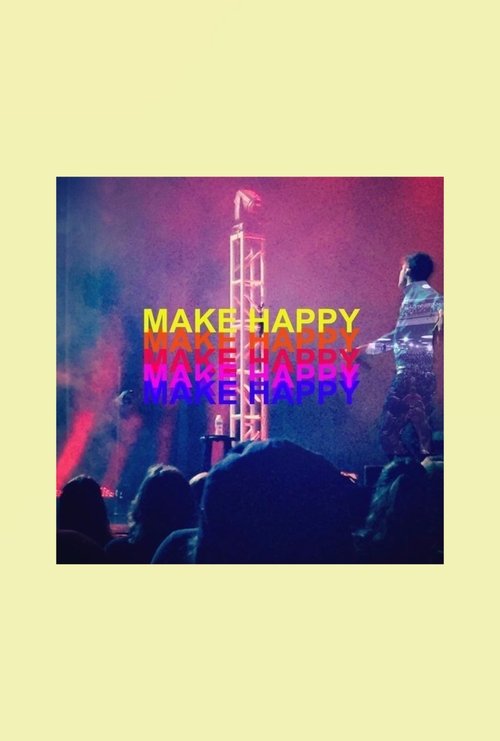
Bo Burnham: Make Happy
A comedic symphony of existential dread, this musical performance art piece cascades through satire and sincerity, leaving a haunting echo of the struggle between artist and audience.
Bo Burnham: Make Happy

Bo Burnham: Make Happy

"Are you happy?"

03 June 2016 United States of America 60 min ⭐ 8.0 (407)
Director: Christopher Storer Bo Burnham
Cast: Bo Burnham, Lorene Scafaria
Comedy Music
The Performer vs. The Audience The Search for Happiness and Authenticity Critique of Celebrity and Entertainment Culture Metacomedy and Deconstruction

Overview

Bo Burnham: Make Happy is a 2016 musical comedy special written by and starring Bo Burnham, and co-directed by Burnham and Christopher Storer. Presented as a one-man show, it's a meticulously choreographed performance that blends stand-up comedy, music, and theater. Burnham uses a variety of musical genres, including pop, hip-hop, and country, to satirize entertainment tropes, celebrity culture, and the nature of performance itself.

Throughout the show, Burnham maintains a complex persona, oscillating between arrogant performer and vulnerable artist. He deconstructs the very format of a comedy special, playing with audience expectations through misdirection, pre-recorded tracks, and elaborate lighting and sound cues. The special moves from bitingly satirical songs about the platitudes of modern country music and the privilege of being a straight white man to more introspective moments that question the relationship between a performer and his audience, culminating in a raw, emotional finale that blurs the line between comedy and confession.
Core Meaning

The core meaning of Make Happy revolves around the profound and often painful conflict between the performer's need for audience validation and the desire for personal authenticity and happiness. Burnham explores the idea that in the age of social media, everyone has become a performer, constantly curating their lives for an audience, leading to a pervasive sense of anxiety and dissatisfaction. The special serves as a critique of the entertainment industry's commercialization of art and the manufactured relatability of celebrities. Ultimately, Burnham questions whether it's possible to genuinely "make" someone happy, including oneself, through performance, suggesting that true happiness might lie in living a life free from the constant need for an audience.

Thematic DNA

The Performer vs. The Audience 40%
The Search for Happiness and Authenticity 30%
Critique of Celebrity and Entertainment Culture 20%
Metacomedy and Deconstruction 10%

The Performer vs. The Audience

This is the central theme, exploring the parasitic and codependent relationship between the artist and their fans. Burnham expresses a deep conflict: he wants to please the audience but also stay true to himself. He sings, "A part of me loves you, a part of me hates you, a part of me needs you, a part of me fears you," perfectly encapsulating this complex dynamic. He critiques the audience's power to dictate his art and their demand for a certain persona, which traps him in a cycle of performance.

The Search for Happiness and Authenticity

The special's title is deeply ironic. Burnham questions whether happiness can be manufactured or found externally through performance and validation. He critiques pop culture's simplistic answers to complex problems like depression. The final two songs, "Can't Handle This" and "Are You Happy?", strip away the comedic artifice to reveal a genuine struggle with anxiety and the pressures of fame, suggesting that authenticity is crucial, yet perhaps unattainable within the confines of performance.

Critique of Celebrity and Entertainment Culture

Burnham relentlessly satirizes modern entertainment. He mocks the formulaic pandering of mainstream country music, the shallow "beat fetishism" of hip-hop, and the vapidness of celebrity culture, such as Jimmy Fallon's lip-sync battles. Through these critiques, he exposes the insincerity and commercialization that he believes are corrupting art.

Metacomedy and Deconstruction

The special is intensely self-aware and meta. Burnham constantly breaks the fourth wall to comment on the structure of the show, his own jokes, and the audience's reactions. From a fake improv song to directly addressing the theatricality of his lighting and sound cues, he deconstructs the conventions of a stand-up special, forcing the audience to remain aware that they are watching a highly controlled, artificial performance.

Character Analysis

Bo Burnham (The Performer)

Bo Burnham

Archetype: Antihero / The Jester
Key Trait: Self-Awareness

Motivation

The character's primary motivation is a deeply conflicted one: to "make happy." He is driven to entertain and please the audience, to give them the show they paid for, while simultaneously battling an internal need to express his true, often unhappy, self and critique the very system he is a part of. This push-and-pull between audience satisfaction and personal authenticity is the engine of the entire special.

Character Arc

The character of "Bo Burnham" on stage begins as a confident, arrogant, and masterful entertainer, fully in control of the audience and the technology around him. As the show progresses, the mask begins to crack. Through moments of meta-commentary and increasingly vulnerable songs, he reveals deep-seated anxiety and conflict. The arc culminates in the final ten minutes where he completely sheds the persona, confessing his struggles and fears, transforming from a polished comedian into a raw, relatable human being questioning the very performance he just perfected.

Lorene Scafaria

Lorene Scafaria

Archetype: Symbol of Reality
Key Trait: Authenticity

Motivation

Her motivation is simply to greet Burnham, offering a connection to a life away from the stage and the audience's gaze. She is the embodiment of the happiness that cannot be found under the spotlights.

Character Arc

Lorene Scafaria appears only in the final seconds of the special. Her role is not a character with an arc but a symbol representing the real, private life that exists outside the performance. Her appearance signifies the end of the show and Burnham's return to an authentic, non-performative existence.

Symbols & Motifs

Stage Lighting and Sound Cues

Meaning:

The elaborate lighting and pre-recorded audio symbolize the artificiality and tight control of the performance. They represent the machinery behind the persona, the elements that create the illusion the audience consumes. When Burnham is bathed in blue light during moments of sincerity, it symbolizes truth, while being silhouetted by a yellow spotlight represents his retreat back into the hollow role of an entertainer.

Context:

Used throughout the show, the cues are often part of the joke, with Burnham arguing with his own pre-recorded voice or deliberately mistiming actions. This is most prominent in the finale, "Can't Handle This (Kanye Rant)," where the lighting shifts dramatically to reflect his internal conflict.

The Overstuffed Burrito / Pringles Can

Meaning:

These seemingly absurd objects from the final song symbolize overwhelming expectations and constraints. The burrito that is too full to be properly enjoyed is a metaphor for his career and the anxieties of fame—he wanted it, but didn't realize it would be too much to handle. The Pringles can his hand can't fit into represents a frustrating, unsolvable problem, mirroring his feelings of being trapped by his profession.

Context:

During the song "Can't Handle This," Burnham launches into a Kanye West-style comedic rant about these mundane frustrations, which then seamlessly transition into a sincere breakdown about his relationship with the audience and his own mental health.

The Small Guest House Room

Meaning:

The isolated room where he performs the final song, "Are You Happy?", symbolizes his inner self and the origin of his creativity—the lonely space where the performance is conceived, away from the grand stage. It contrasts the public spectacle with the private reality of the artist.

Context:

After the main show concludes, the special follows Burnham offstage into this small, simple room. Here, he performs the final, deeply personal song directly to the camera, representing a final, intimate confession to the viewing audience before he steps out to join his real life.

Memorable Quotes

I want to please you, but I want to stay true to myself. I want to give you the night out you deserve, but I wanna say what I think and not care what you think about it.

— Bo Burnham

Context:

Spoken during the climactic song "Can't Handle This," this is the moment Burnham's comedic rant transitions into a raw, honest confession about the immense pressure he feels as an entertainer.

Meaning:

This line, from the finale, is the thesis statement of the entire special. It perfectly articulates the central conflict of the performer: the struggle between artistic integrity and the desire for audience approval.

Social media is just the market's answer to a generation that has demanded to perform... If you can live your life without an audience, you should do it.

— Bo Burnham

Context:

Delivered in a quiet, serious moment near the end of the show, Burnham kneels at the edge of the stage, breaking character to speak directly and sincerely to the audience about the nature of modern life.

Meaning:

This quote extends the special's theme of performance beyond the stage, arguing that modern society, through social media, has turned everyone into a performer. It serves as a stark warning about the psychological toll of living a curated life for public consumption.

The truth is my biggest problem is you. A part of me loves you, part of me hates you. Part of me needs you, part of me fears you.

— Bo Burnham

Context:

These lines are sung during the emotional peak of "Can't Handle This," as Burnham lays bare his anxieties and his conflicted feelings towards the very people he is there to entertain.

Meaning:

This powerfully encapsulates the complex, love-hate relationship between an artist and their audience. It highlights the codependency and the immense psychological weight of being perceived, judged, and relied upon by thousands of people.

Are you happy?

— Bo Burnham

Context:

This is the central lyric of the final song, performed alone in a small room after the main show has ended. He repeats the question, blurring the line between asking the audience and asking himself, before the special abruptly ends.

Meaning:

This simple question is the haunting final refrain of the special. Directed at the audience and himself, it challenges the show's premise. After an hour of trying to "make" people happy, he asks if the effort was successful, or even possible, leaving the viewer with a profound sense of introspection.

Philosophical Questions

What is the true nature of happiness and can it be manufactured by entertainment?

The film relentlessly interrogates its own title. Burnham critiques pop songs that offer simple, anthemic solutions to deep-seated sadness, like his satirical song 'Kill Yourself' which parodies the idea that a song can solve depression. The special posits that happiness is not a product that can be delivered to an audience or consumed externally. The final, haunting question, 'Are you happy?', leaves the audience to ponder whether the preceding hour of laughter was a fleeting distraction or a genuine step towards happiness, suggesting the answer is complex and deeply personal.

In an age of constant self-documentation, is an authentic, non-performative life possible?

Burnham argues that social media has turned life into a continuous performance for an ever-present audience. His plea, 'If you can live your life without an audience, you should do it,' serves as the film's philosophical core. The entire show, a masterclass in performance, acts as a warning against the very act of performing. The ending, where he physically leaves the performance space to join his partner, suggests that authenticity and happiness are only found 'outside'—away from the stage, the camera, and the audience's gaze.

What is the ethical responsibility of an artist to their audience, and vice versa?

The special explores the transactional and often unhealthy relationship between performer and fan. Burnham feels a responsibility to 'give you the night out you deserve' but struggles when that conflicts with his own well-being and artistic truth. He questions the audience's role, their demands, and their consumption of his art (and by extension, his pain). The work suggests a need for boundaries and a more conscious understanding of the human cost of entertainment, from both the creator and the consumer.

Alternative Interpretations

While the primary interpretation of Make Happy focuses on the genuine struggle of the artist, an alternative reading suggests that even the final, vulnerable moments are part of the meticulously crafted performance. From this perspective, the emotional breakdown in 'Can't Handle This' and the quiet confession in 'Are You Happy?' are not a shedding of the persona, but the ultimate act of performance—giving the audience the 'authenticity' they crave. This interpretation views the entire special as a commentary on how even vulnerability has become a marketable commodity in entertainment. The 'real' Bo Burnham remains elusive, and the audience is left questioning if they've witnessed a true confession or the perfect simulation of one.

Another interpretation focuses less on Burnham as an individual and more on the special as a broader allegory for the millennial condition. His anxiety, his constant need for validation, his feeling of being trapped by expectations, and his complicated relationship with technology and media are seen as representative of the struggles of a generation raised online. The show becomes less about a specific comedian and more about the universal experience of navigating identity in a hyper-performative digital world.

Cultural Impact

Bo Burnham: Make Happy was released at a time when the relationship between online creators and their audiences was becoming increasingly complex and social media's impact on mental health was a growing concern. The special was lauded by critics for transcending the genre of stand-up comedy, being described more accurately as performance art. It deeply resonated with a generation that grew up online, articulating a shared anxiety about the pressure to perform and curate one's life for public approval.

Its influence can be seen in the wave of introspective and formally experimental comedy that followed. Burnham's willingness to abandon punchlines in favor of raw emotional honesty in the final act pushed the boundaries of what a comedy special could be. The themes of performance anxiety, the critique of social media, and the struggle for authenticity prefigured his even more culturally significant 2021 special, Inside, with Make Happy serving as its direct thematic and narrative precursor. The special solidified Burnham's reputation as one of his generation's most innovative and vital voices, using the medium of comedy to explore profound existential and cultural questions.

Audience Reception

Audience reception for Bo Burnham: Make Happy was overwhelmingly positive, with many viewers praising its intelligence, originality, and emotional depth. Fans lauded the seamless blend of hilarious, biting satire with moments of profound vulnerability. The final 15 minutes, particularly the 'Kanye Rant' and the closing song 'Are You Happy?', were frequently cited as a powerful and moving conclusion that elevated the work beyond a typical comedy special. Viewers connected deeply with its themes of anxiety and the pressures of modern life. The main point of criticism, though minor, came from some who found the ending's shift to a serious, non-comedic tone to be jarring or out of place for a comedy special. However, for the vast majority, this tonal shift was seen as the special's greatest strength, cementing it as a unique and impactful piece of art.

Interesting Facts

  • The special was co-directed by Christopher Storer, who would later become widely known as the creator of the acclaimed TV series 'The Bear'.
  • Bo Burnham has been open about the fact that he began experiencing severe panic attacks on stage while touring his previous special, 'what.', which heavily influenced the themes of performance anxiety in 'Make Happy'.
  • The climactic finale song, 'Can't Handle This,' was inspired by Kanye West's impassioned rants during his 'Yeezus' tour.
  • Unlike his previous special 'what.', where production elements were added later, 'Make Happy' was conceived and written with the intricate lighting, sound, and theatrical cues as integral parts of the show from the beginning.
  • The final scene, where Burnham enters the guest house to sing 'Are You Happy?', directly connects to the beginning of his 2021 special, 'Inside,' which was filmed almost entirely in that same room.
  • Burnham has stated that he considers 'Make Happy' less of a traditional comedy special and more of a one-man show or piece of performance art.
  • After the 'Make Happy' tour, Burnham took a five-year hiatus from performing live comedy, a decision directly linked to the mental health struggles explored in the special.

⚠️ Spoiler Analysis

Click to reveal detailed analysis with spoilers

Frequently Asked Questions

Explore More About This Movie

Dive deeper into specific aspects of the movie with our detailed analysis pages

Comments (0)

Leave a comment

No comments yet. Be the first to share your thoughts!