Skip to content
My Only Love Song
A vain modern starlet is thrown into ancient Goguryeo by a rattling old van — a candy-colored fable where a con man's greed and an idol's ego melt into unexpected tenderness.
My Only Love Song

My Only Love Song

마이 온리 러브송

01 July 2017 — 01 July 2017 South Korea 1 season 20 episode Ended 8.1 (127)

Cast: Gong Seung-yeon, Lee Jong-hyun, Jin Ye-ju, Lee Jae-jin, Kim Jung-pal

Drama Vanity stripped away by displacement Love versus the price of everything Fate, legend, and the right to rewrite it Performance and authenticity Belonging and the meaning of home

Overview

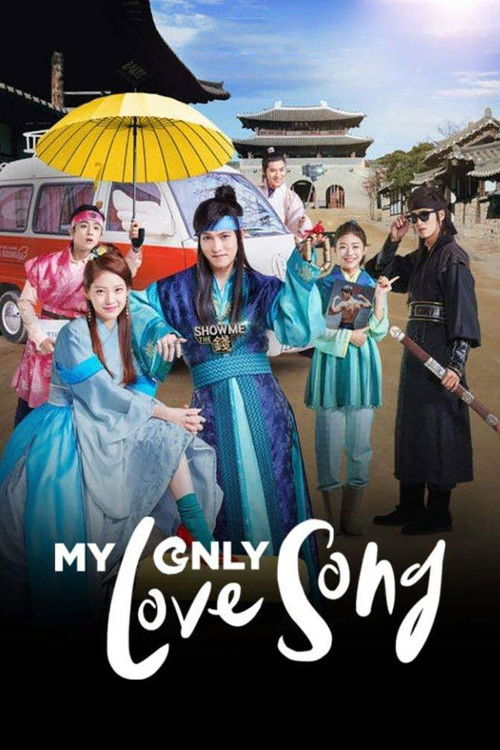
My Only Love Song (마이 온리 러브송) is a 20-episode South Korean fantasy romantic comedy produced by FNC Add Culture and released worldwide on Netflix on 9 June 2017, with every episode dropping at once in roughly half-hour installments. Directed by Min Doo-sik and written by Kim Soo-jin, it stars Gong Seung-yeon as Song Soo-jung, an arrogant top actress, and Lee Jong-hyun as On Dal, a man of the Goguryeo era who will do almost anything for money.

The premise is engineered for collision. When a shoot for her new historical drama goes badly, Soo-jung storms off into a battered old van — nicknamed Boong Boong — which turns out to be a vehicle in the fullest sense: it carries her through a time portal out of her air-conditioned celebrity life and into the actual ancient kingdom whose costume drama she had been resenting. There she meets On Dal, the legendary "fool" of Korean folklore, and Princess Pyunggang, the woman history says he is fated to marry. Soo-jung, who knows how the legend ends, suddenly finds herself inside it.

Across its run the series works as a fish-out-of-water farce that gradually deepens: a woman who traded sincerity for stardom and a man who priced everything he touched are both forced to discover what they would refuse to sell. The tone begins broad and deliberately campy — modern slang against Goguryeo dirt roads, product placement against palace intrigue — before letting real feeling accumulate underneath the jokes, until the question of whether Soo-jung can, or should, go home becomes the story's true engine.

Core Meaning

Beneath the slapstick, My Only Love Song argues that status is a costume and love is the thing underneath it. Its two leads are introduced as people defined entirely by exchange value: Soo-jung is a brand, managed and marketed, whose worth is measured in fame; On Dal is a hustler whose every gesture has a price tag. The series strips both of their currencies — hers is worthless in the sixth century, his is exposed as a defense against being nobody — and asks what remains.

The time-travel conceit sharpens the point. Soo-jung has read the ending of the Ondal legend the way a modern viewer reads a synopsis, and the show uses that irony to interrogate whether a life can be reduced to its plot summary. What the creators seem to be saying is that people are not their assigned roles, whether those roles are handed down by a script, a talent agency, or a thousand-year-old folk tale — and that choosing someone, freely and against your own interests, is the only authorship anyone really gets.

Thematic DNA

Vanity stripped away by displacement 25%
Love versus the price of everything 22%
Fate, legend, and the right to rewrite it 20%
Performance and authenticity 18%
Belonging and the meaning of home 15%

Vanity stripped away by displacement

Soo-jung arrives in Goguryeo carrying the entire apparatus of modern celebrity — the entitlement, the assumption of service, the reflex of being looked at — into a world with no cameras and no fans. The early episodes mine this for pure comedy, with reviewers noting the show leans hard on the heroine sticking out like a fish out of water in the era. As the run progresses the joke inverts: the traits that made her insufferable (stubbornness, performance instinct, refusal to be managed) become survival skills, and her arrogance is revealed as armor rather than character.

Love versus the price of everything

On Dal is introduced as money-crazed, a man who negotiates over rescue and affection alike. The series repeatedly stages transactions that fail — moments where the thing wanted cannot be bought — and each failure erodes his framework. His arc is a slow, comic disarmament, moving from a man who quotes prices to one who gives without invoicing. Reviewers consistently identify this movement, the leads finding love and meaning beyond money and status, as the show's emotional spine.

Fate, legend, and the right to rewrite it

Because the Ondal and Princess Pyunggang legend is famous, both the heroine and the audience know the ordained ending in advance. The series turns foreknowledge into suspense: every step toward the storied outcome feels like a step away from the romance the show is actually building. Late in the run this tension becomes the central dramatic problem — whether history is a track or merely a rumor — and it feeds directly into the finale that many viewers found ambiguous.

Performance and authenticity

The heroine is an actress dropped into a real version of the fiction she was filming, which lets the show run a continuous joke about where acting ends. She lies, improvises, and plays roles to survive, and the series keeps asking whether the self she constructs in the past is a further performance or the first honest one. The framing device — a drama shoot gone wrong — quietly implies that her modern life was the more artificial set.

Belonging and the meaning of home

Time travel converts an ordinary romance question into a metaphysical one: home is not merely a place but an era, a language, a set of people who know you. Soo-jung's initial goal is escape, and the show's later movement complicates it, since returning would mean unmaking every relationship she has built. The recurring van becomes the physical embodiment of that unresolved pull, and the tension is never fully domesticated — which is precisely why the ending divided viewers.

Character Analysis

Song Soo-jung

Gong Seung-yeon

Archetype: Fish-out-of-water heroine / redeemed antiheroine Key Trait: Imperious self-regard that conceals real nerve

Motivation

Initially, to get back to her career and her comforts as quickly as possible. That goal survives the whole run but changes meaning: what starts as a desperate escape from a hostile past becomes a choice she can no longer make cleanly, because going home now costs her something.

Character Arc

She begins as a genuinely unlikable protagonist — a snooty top star whose arrogance drives the plot by driving her off the set and into the van. The early stretch of the series is built on her humiliation: no staff, no status, no one who recognizes her face. Over the twenty episodes she moves from treating Goguryeo as an inconvenience to be escaped, to treating it as a place with stakes, to treating it as a place with people she cannot leave. Her final transformation is not softening into sweetness but redirecting her considerable will outward — the same imperiousness now spent on someone other than herself.

On Dal

Lee Jong-hyun

Archetype: Rogue with a hidden heart / the legendary fool reimagined Key Trait: Mercenary charm masking loyalty he cannot admit to

Motivation

Money, security, and the freedom that comes from owing no one. It evolves into the far riskier desire to be chosen and to choose, which is the one thing his hustling cannot arrange.

Character Arc

Drawn from the famous Korean legend but rewritten as a money-crazed opportunist rather than a simpleton, On Dal spends the early episodes as a comic mercenary who treats the strange woman from nowhere as an asset to be exploited. His arc is the gradual failure of that transactional worldview: the more he tries to price Soo-jung, the less the arithmetic works. By the later stretch he is acting against his own material interest, and the legend's promised destiny — his union with the princess — becomes a burden rather than a prize.

All 5 characters and cast

Symbols & Motifs

Boong Boong, the time-traveling van

Meaning:

The battered van is the show's most literal and most loaded object: a piece of modern junk that behaves like fate. It stands for the unreliable machinery of destiny — something that carries you where you did not choose to go, then refuses to explain itself. It is also the heroine's escape hatch, and therefore the constant, tempting possibility of abandoning what she has come to love.

Context:

Introduced in the opening premise, when Soo-jung storms off a difficult shoot and flees in an old van that guides her on a time-traveling journey. It recurs throughout the series as a physical anchor to the twenty-first century sitting incongruously in ancient Goguryeo, and its status at the story's close is central to how viewers read the ending.

Money and the price tag

Meaning:

Coins, fees, and bargains are the vocabulary of On Dal's self-protection. Money symbolizes his refusal to be owed anything or to owe anything — a way of keeping every human relation contractual and therefore safe.

Context:

Established from his introduction as a man who will do anything for money, and used across the run as a comic register that gradually turns poignant. The moments where he declines payment, or pays a cost with no possible return, function as the series' clearest markers of his transformation.

The historical drama set

Meaning:

The fictional sageuk Soo-jung was filming represents history as commodity — the past flattened into costume, lighting, and marketable romance. Its collapse into the real thing is the series' central irony.

Context:

The framing device of the first episode and a reference point throughout: Soo-jung repeatedly measures the real Goguryeo against the prettier, safer, script-supervised version she was performing, and finds the fiction wanting.

The Ondal legend itself

Meaning:

A story everyone already knows becomes a symbol of predetermined narrative — the sense that a life has been written before it is lived. It represents the pressure of expectation, whether from folklore, family, or an audience.

Context:

Woven through the entire series via the presence of On Dal and Princess Pyunggang as characters with a famous fated union, giving the romance a built-in obstacle that no villain could supply.

Anachronistic modern objects and speech

Meaning:

Every out-of-place gadget, phrase, or gesture is a small monument to the heroine's isolation — proof that she is untranslatable, funny to the audience and unintelligible to everyone around her.

Context:

A running comic device across the run, and the primary engine of the show's early, deliberately campy tone; its diminishing frequency tracks Soo-jung's assimilation into the era.

Philosophical Questions

If you know how the story ends, are you still free to live it differently?

The series builds its central tension on the fact that both the heroine and the audience know the Ondal legend in advance. Every scene that nudges toward the ordained union between On Dal and Princess Pyunggang carries the weight of foreknowledge, and the show keeps testing whether awareness of destiny is a form of power or merely a more painful kind of helplessness. Its ambiguous ending refuses to settle the question, which is arguably the most philosophically honest thing about it.

What is a person worth when nobody is watching?

Soo-jung's entire identity is built on being seen — she is a top star whose value is measured in an audience. Dropped into a century with no cameras, no press, and no one who knows her name, she has to discover whether any of that value was ever hers. The series answers slowly and comically, letting her rebuild a self out of things that cannot be broadcast.

Can something be genuinely given if you have always sold everything?

On Dal's mercenary worldview is played for laughs but examined seriously. The show repeatedly places him in situations where the transactional frame breaks down, and his transformation is measured not by declarations but by the moments he acts without expectation of return. The implicit claim is that generosity is a skill that has to be learned, not a virtue one simply has.

Where is home — a place, a time, or the people who know you?

Time travel makes the question literal. Returning to the twenty-first century would restore Soo-jung's language, comforts, and career while erasing every relationship she has built, and the van sitting incongruously in ancient Goguryeo keeps that choice permanently visible. The series treats home as something chosen rather than inherited, and makes the choice cost something either way.

How much of the self is performance?

An actress trapped inside a real version of the drama she was filming is a premise designed to blur the line. Soo-jung survives by improvising, lying, and playing parts, and the show quietly suggests that her curated modern celebrity was the more thorough fiction — that she becomes more herself precisely when she is forced to make it up as she goes.

Alternative Interpretations

The most contested element of the series is its conclusion. Multiple reviewers reported that the very end of the final episode left viewers confused, and that ambiguity supports several readings that the show never adjudicates.

Full ending explanation

Cultural Impact

My Only Love Song arrived at an inflection point for Korean television. In 2017 Netflix was aggressively moving from licensing existing Korean series to branding them as originals, and this show — a completed FNC Add Culture production picked up by the platform, as Dramabeans reported that June — became part of that early wave. Its structural choices reflect the new distribution model: twenty short episodes of roughly half an hour, released all at once for binge viewing, rather than the two-hour-per-week rhythm of terrestrial Korean broadcast. That format experiment matters more in retrospect than the show's individual reception, since it prefigured the shorter, bingeable Korean series that streaming would normalize over the following years.

Culturally the series sits inside two well-established Korean traditions. The first is the fantasy time-slip sageuk, a genre that lets contemporary anxieties about class, gender, and celebrity be played out in period costume. The second is the folk legend of On Dal and Princess Pyeonggang, a story so familiar in Korea that using it is closer to adapting a fairy tale than to writing historical fiction. By recasting the legendary fool as a money-obsessed hustler, the show performs a small act of cultural irreverence, reading an ancient morality tale through the lens of a market economy where everything, including affection, has a listed price.

Its reception was modest rather than landmark. The series settled at 6.9/10 on IMDb and drew a warm but qualified response from English-language K-drama criticism, which praised the leads and the comedy while flagging plot holes and a confusing conclusion. It did not become a global phenomenon in the manner of the Korean Netflix titles that followed, but it retains a place in the platform's Korean catalogue as an early, lightweight, formally experimental entry — and as a curiosity for fans of Lee Jong-hyun and Gong Seung-yeon, whose We Got Married pairing gave the show a built-in audience.

Audience Reception

Reception was warm but clearly qualified, and remarkably consistent across English-language K-drama criticism and fan reviews. The series carries a rating of 6.9/10 on IMDb, positioning it as an enjoyable minor entry rather than a standout.

What was praised. Almost universally, the leads. Reviewers described the chemistry between Lee Jong-hyun and Gong Seung-yeon as insanely great, singling out kiss scenes and skinship that felt natural rather than forced, and crediting the casting as a genuine success. Many attributed this to the pair's earlier stint as a fictional couple on We Got Married in 2015. The comedy also landed: critics called the show light, easy, and unashamed of having fun, with the fish-out-of-water gags about a modern celebrity stranded in Goguryeo doing much of the heavy lifting.

What drew criticism. The writing. Reviewers pointed to weird plot holes and character decisions that did not really make sense, and the tone was a common sticking point — the series opens very campy, over the top, and ridiculously cheesy, which cost it some viewers before the emotional layer arrived. Several reviews describe a distinct turning point at which feelings enter the equation and previously skeptical viewers found themselves hooked, suggesting the show's biggest structural problem is a front-loaded barrier of camp.

The most contested moment is the finale. Multiple reviewers reported that the very end of the last episode left viewers feeling confused, and that confusion remains the single most discussed aspect of the series among audiences.

Overall verdict. A charming, disposable, well-cast romantic comedy whose leads are better than its script. Viewers who accept the campy opening and treat the plot loosely tend to report a genuinely enjoyable binge; those who need narrative coherence, particularly at the close, tend to come away frustrated. As a short-form streaming experiment it is more interesting for what it attempted than for what it achieved.

Interesting Facts

  • The series premiered on Netflix on 9 June 2017, with all 20 episodes released simultaneously; each installment runs roughly 30 minutes rather than the standard 60-70 minute Korean broadcast length.
  • It was directed by Min Doo-sik and written by Kim Soo-jin, and produced by FNC Add Culture with Ahn Suk-joon as producer.
  • Filming began on 26 September 2016 at the Gaeun Set in Mungyeong, North Gyeongsang Province, a well-known South Korean historical drama backlot.
  • The production was completed before Netflix picked it up for global distribution; Dramabeans covered the acquisition news in June 2017 as the show moved to the streaming platform rather than a traditional Korean broadcaster.
  • Leads Lee Jong-hyun and Gong Seung-yeon had already appeared together as a fictional married couple on the Korean variety show 'We Got Married' from March to August 2015, roughly a year and a half before filming began — a pre-existing pairing that reviewers repeatedly credited for their on-screen chemistry.
  • Lee Jong-hyun is a member of the band CNBLUE, which is signed to FNC Entertainment, the parent of production company FNC Add Culture; co-star Lee Jae-jin is a member of the label's band FT Island.
  • The time-traveling van is given the onomatopoeic nickname 'Boong Boong' — Korean baby-talk for the sound of a car engine.
  • The show draws on the famous Korean folk legend of On Dal 'the Fool' and Princess Pyeonggang of Goguryeo, but recasts On Dal as a money-obsessed schemer rather than the simpleton of the traditional tale.
  • The role of Princess Pyunggang is credited variously as Jin Ye-ju and Kim Yeon-seo across different databases, reflecting the actor's name change.
  • The series holds a rating of 6.9/10 on IMDb.

Easter Eggs

The casting of Lee Jong-hyun and Gong Seung-yeon as the central couple

The two had previously played a fictional married couple on the reality-variety show We Got Married from March to August 2015. For Korean audiences the pairing was itself a meta-joke and a marketing hook, and reviewers widely attributed the drama's unusually natural skinship and unforced chemistry to that prior partnership.

The hero is named On Dal and the princess is named Pyunggang

These are the names of one of Korea's best-known folk legends — On Dal the Fool and Princess Pyeonggang of Goguryeo, whose story is taught to schoolchildren. Viewers therefore enter the series already knowing the 'correct' ending, which the show exploits as a built-in spoiler the heroine is fighting against.

The drama-within-a-drama sageuk that Soo-jung is filming

The series opens on the production of a fictional historical Korean drama, an affectionate satire of the sageuk genre and of the industry that FNC Add Culture itself operates in. The heroine's contempt for her own costume drama is repaid when she is dropped into the real thing.

The FNC label crossover in the supporting cast

Lee Jae-jin of FT Island appears alongside CNBLUE's Lee Jong-hyun, both artists from FNC Entertainment, whose subsidiary produced the show. The casting doubles as an in-house showcase typical of Korean entertainment agencies that operate both music labels and drama studios.

Frequently Asked Questions

Explore More About This Movie

Dive deeper into specific aspects of the movie with our detailed analysis pages

Comments (0)

Leave a comment

No comments yet. Be the first to share your thoughts!

Similar Movies