
Skip to content
My Teen Romantic Comedy SNAFU
A bittersweet school-days comedy-drama in which a cynical loner's sharp wit cracks like frost on a classroom window, revealing the fragile, longing warmth of three teenagers who ache for something real.
My Teen Romantic Comedy SNAFU

My Teen Romantic Comedy SNAFU

やはり俺の青春ラブコメはまちがっている。

05 April 2013 — 25 September 2020 Japan 3 season 38 episode Ended 8.2 (576)

Cast: Takuya Eguchi, Saori Hayami, Nao Toyama, Mikako Komatsu, Takashi Kondo

Drama Animation Comedy Authenticity and the 'genuine' relationship Self-sacrifice versus honest communication Loneliness and the fear of connection Self-reliance and dependence Youth as performance and deception

Overview

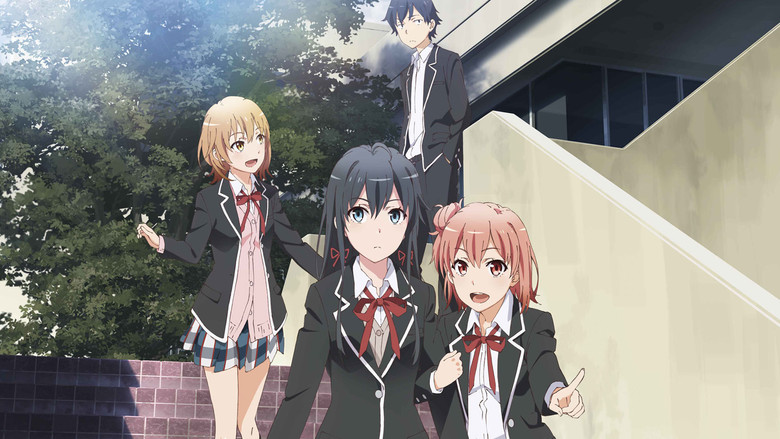
Hachiman Hikigaya is a cynical high schooler who prefers solitude and distrusts the social rituals of youth. His teacher forces him into the Soubu High School Service Club, where he meets fellow loner Yukino Yukinoshita and classmate Yui Yuigahama. The club helps fellow students with their problems, and its requests double as a stage for the complicated psychology of being a teenager.

Across three seasons, the original series, "Too!" and "Climax", Hachiman's habit of solving problems by sacrificing himself is tested by school events and by the people who care about him. The first season was produced by Brain's Base. Studio Feel took over for the later seasons, and Monaca composed the music throughout. The cast of recurring students and teachers gradually exposes how superficial the trio's relationships have become.

The series starts as a satirical take on the high-school rom-com. It then becomes an earnest drama about honesty, in which the three leads try to say what they actually feel to one another. It is the story of a deliberate, painful search for a "genuine" relationship.


Core Meaning

The series argues that real connection cannot be reached through irony, self-sacrifice or unspoken understanding. Hachiman begins by treating kindness as a lie and solving problems by taking the blame himself. The story gradually shows that this protects him from hurt but also hurts the people around him.

Its central image is the wish for something "genuine". By the end that wish is revealed as a demand for honest, risky, imperfect communication, not for a flawless bond free of misunderstanding. Growing up here means putting your feelings into words, accepting that this may cost you a friendship, and taking responsibility for the choice.

Thematic DNA

Authenticity and the 'genuine' relationship 30%
Self-sacrifice versus honest communication 25%
Loneliness and the fear of connection 20%
Self-reliance and dependence 15%
Youth as performance and deception 10%

Authenticity and the 'genuine' relationship

Introduced in the first season as Hachiman's cynical dismissal of fake social bonds. It becomes an explicit demand in the second season and is interrogated in the third season, when the trio confront how much of their relationship was built on avoidance.

Self-sacrifice versus honest communication

Hachiman's habit of solving problems by making himself the villain works at first. Later it is shown to wound Yukino and Yui, who cannot accept being helped at his expense. The cost of this method becomes the dramatic engine of the later seasons.

Loneliness and the fear of connection

All three leads begin as loners for different reasons: pride, cynicism and fear of losing others. The club becomes a fragile shelter whose comfort they are afraid to disturb.

Self-reliance and dependence

Yukino's belief in empowering people to help themselves contrasts with Hachiman's willingness to shoulder burdens. In the final season she asks to become independent, and the characters must decide whether dependence is a flaw or a form of love.

Youth as performance and deception

The title's parody of the rom-com, the school events and the social hierarchies all examine how teenagers perform roles. The series slowly dismantles this performance in favor of vulnerability.

Character Analysis

Hachiman Hikigaya

Takuya Eguchi

Archetype: Cynical antihero and unreliable narrator Key Trait: Sharp, self-deprecating analysis that masks deep vulnerability

Motivation

At first he wants to avoid being hurt again. By the end he wants a real relationship, even though it risks failure.

Character Arc

He begins as a self-isolating loner who solves problems by making himself the scapegoat. Over the seasons he is forced to see that this method hurts others, and in the third season he has to articulate his feelings rather than hide behind irony.

Yukino Yukinoshita

Saori Hayami

Archetype: Proud, brilliant perfectionist Key Trait: Pride that conceals insecurity

Motivation

She wants to be independent and to prove herself apart from her family, and later to be honest about her need for others.

Character Arc

She starts out cold and self-sufficient. Her relationship with Hachiman and Yui exposes how much she depends on them, and she eventually resolves to find her own path rather than follow her family's.

All 4 characters and cast

Symbols & Motifs

The Service Club room

Meaning: A fragile sanctuary and a status quo that all three characters are afraid to break.
Context: Most of the show takes place here. Its quiet tea-and-book routine is contrasted with the pressures of the school's events, and the third season questions whether it can last.

Snow and the changing seasons

Meaning: Melting and renewal, and the passage of time that forces change on the characters.
Context: Yukino's name ('snow') and the third season's opening episode title about the seasons changing and the snow melting tie the imagery to her story.

Sweets, tea and cookies

Meaning: Care and affection expressed indirectly, standing in for feelings the characters cannot say.
Context: Yui's cookies and the shared tea appear repeatedly, and the first episode of the third season opens with Yui's cookies in conversation.

The 'genuine' (honmono)

Meaning: The ideal of a relationship stripped of lies, which is also a wish that may never be fully realized.
Context: It is voiced prominently in the second season, where Hachiman tells his teacher he wants something genuine, and it recurs through the third season's confessions.

The car accident

Meaning: The hidden link between the leads, a debt that distorts how they see one another.
Context: The three are linked by a past accident, which shapes Yui's guilt and the assumptions the club makes about each other.

Memorable Quotes

俺は優しい女の子が嫌いだ。
— Hachiman Hikigaya

Context

Often cited as part of his 'I hate nice girls' monologue from the first season.

Meaning

It sums up his belief that kindness is a lie that invites hurt, and his fear of mistaking politeness for affection.

優しさは嘘だ。
— Hachiman Hikigaya

Context

From the same first-season speech about nice girls.

Meaning

It is his defensive philosophy: if truth is cruel, then lies must be kind. The rest of the series slowly dismantles this idea.

All 3 quotes

Episode Highlights

Season 2, Episode 8

S2E8

Shizuka Hiratsuka confronts the trio about their comfortable stagnation, and Hachiman answers that he wants something genuine. The pivotal Season 2 scene.

Significance:

It states the series' central wish for the first time and sets the course for the rest of the story.

Season 2, Episode 12

S2E12

Yukino's sister Haruno needles Hachiman about trust, while Yui's chocolate plan and Hachiman's help with Hayato add pressure. It is built from ambiguity and unspoken tension.

Significance:

It sets up the unresolved questions that drive the finale of the second season and the third season.

In Due Time, the Seasons Change and the Snow Melts.

S3E1

Yukino asks Hachiman and Yui to support her as she tries to become independent of her family. Starts the third season.

Significance:

It reframes the central conflict as one of independence and dependence.

And, Yui Yuigahama Is Distanced from Her Two Best Friends

S3E10

Yui's feelings come to a head in a heavy emotional confrontation with the others.

Significance:

It is widely discussed as the emotional peak of the series' love triangle.

And So, the Curtain Rises on a Genuine Youth Romantic Comedy

S3E12

The finale, aired on September 24, 2020, resolves the love triangle.

Significance:

It ends the anime's adaptation of the story and settles the debate over what a genuine relationship means for the characters.

Philosophical Questions

Can a relationship be genuine if it is built on unspoken understanding?

Hachiman's hope for a bond without words is tested and found wanting. The later seasons show that honest speech, however clumsy, is what makes a relationship real.

Is self-sacrifice an act of kindness or a form of control?

Hachiman's scapegoating solves problems, but it denies others the chance to help him and leaves them guilty. The series treats it as both generous and selfish.

Is dependence on others a weakness?

Yukino's drive for independence is set against the comfort of the group, and the show suggests that real strength includes being able to rely on others.

How It Ends

Alternative Interpretations

Some read the series as a romance in which the key question is who Hachiman chooses. Others see it as a story about friendship and growth in which the romance is secondary to learning to be honest. The choice at the end has also been debated for whether it fits the thematic idea of authenticity, and some viewers see the ending as open rather than neatly concluded.

Full ending explanation

Cultural Impact

The series is an adaptation of Wataru Watari's light novels, and it rose alongside a wave of introspective high-school anime that deconstructed the genre. It is known for sharp dialogue and for its critique of rom-com conventions. One source notes that its third season was recognized at the 2021 Anime Trending Awards for Best Drama Anime. The final season is also notable for resolving its love triangle, which one reviewer called unusual for the genre. Its finale continues to prompt debate among fans, and scenes from the final stretch have circulated widely in edit videos online.

Audience Reception

The series is generally praised for its sharp writing, its unusually self-aware protagonist and its willingness to let characters confront their feelings. One reviewer of the third season called Hachiman a rare kind of protagonist and praised the way the season brings the triangle to a climax. A reviewer also noted the long focus on the girl who will lose out in love. The third season's MAL score is reported as 8.32. Criticism is mainly aimed at some uneven episodes in the second season, and at the heavy introspection and slow pace that some viewers find draining. The finale remains a point of debate among fans.

Interesting Facts

  • The first season was produced by Brain's Base and directed by Ai Yoshimura, with Shotaro Suga on series composition and music by Monaca.
  • Production moved to Studio Feel for the later seasons, with Kei Oikawa directing.
  • Series composition on the third season was taken over by Keiichiro Ochi, replacing Shotaro Suga, who died in 2015.
  • The first season's main ending theme 'Hello Alone' is performed by Yukino's and Yui's voice actresses, Saori Hayami and Nao Toyama, in character.
  • The third season's main ending theme is 'Diamond no jundo', also sung by Hayami and Toyama as Yukino and Yui, with solo ballade versions in two episodes.
  • The third season, 'Climax', began airing July 9, 2020, and its finale aired on September 24, 2020.
  • The series is adapted from the light novels by Wataru Watari.

Frequently Asked Questions

Explore More About This Movie

Dive deeper into specific aspects of the movie with our detailed analysis pages

Comments (0)

Leave a comment

No comments yet. Be the first to share your thoughts!

Similar Movies