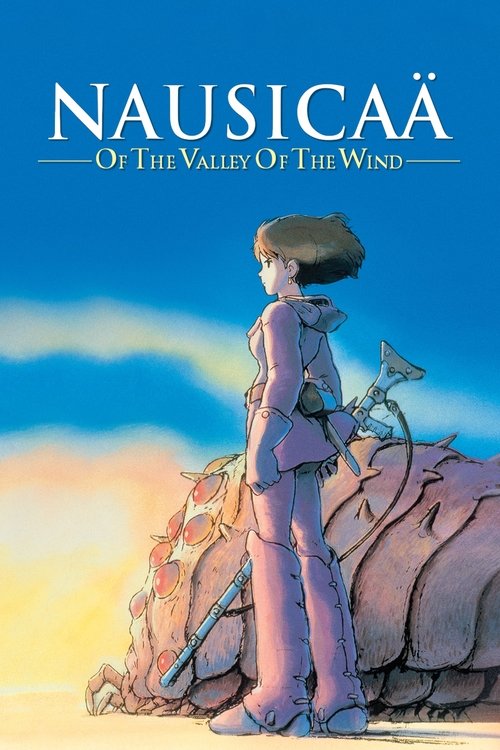
Nausicaä of the Valley of the Wind
風の谷のナウシカ
"A young girl's love called forth miracles…"
Overview
In a distant, post-apocalyptic future, humanity clings to survival on the fringes of a vast, toxic jungle teeming with giant mutant insects. This 'Sea of Corruption' is a constant threat, releasing poisonous spores that are lethal to humans. The film follows Nausicaä, the courageous and empathetic princess of the tranquil Valley of the Wind. Unlike those who fear and seek to destroy the jungle, Nausicaä is a gifted 'wind-rider' who ventures into the toxic forest, studying its unique ecosystem and seeking to understand its purpose. She believes that the jungle and its colossal insect inhabitants, particularly the revered Ohmu, are not inherently evil.
The fragile peace of the Valley is shattered when a massive airship from the militaristic kingdom of Tolmekia crashes, carrying a deadly cargo: the embryo of a Giant Warrior, a catastrophic bioweapon from the ancient war that devastated the world. Led by the pragmatic and ruthless Princess Kushana, the Tolmekians invade the Valley with the intention of resurrecting the Giant Warrior to incinerate the Toxic Jungle. Nausicaä finds herself caught in a escalating conflict between warring human factions, all while desperately trying to prevent another global catastrophe and unravel the true nature of the Sea of Corruption.
Core Meaning
The central message of "Nausicaä of the Valley of the Wind" is a profound plea for ecological understanding, pacifism, and empathy. Director Hayao Miyazaki posits that humanity's antagonistic relationship with nature stems from fear and ignorance. The film suggests that what appears to be a toxic and hostile environment is, in fact, a natural process of purification, healing a world poisoned by humanity's past mistakes. Nausicaä embodies the film's core belief that coexistence is possible through compassion, scientific inquiry, and a willingness to look beyond prejudice. The narrative argues against solving problems with violence and technological arrogance, as represented by the destructive Giant Warrior, advocating instead for a deeper respect for all forms of life and the intricate balance of the natural world.
Thematic DNA
Environmentalism and Ecological Harmony
This is the most prominent theme in the film. The world is suffering from the consequences of past environmental devastation caused by the 'Seven Days of Fire,' an apocalyptic war. The 'Toxic Jungle' and its giant insects, while dangerous to humans, are revealed to be a vital part of the planet's healing process, purifying the polluted soil and water. Nausicaä's scientific curiosity and empathy allow her to understand this, and she advocates for living in harmony with nature rather than trying to dominate and destroy it. The film serves as a powerful allegory for the real-world environmental issues of pollution and humanity's destructive impact on the planet.
Pacifism and Anti-War
"Nausicaä" carries a strong anti-war message. The conflict between the Tolmekians and the Pejites, and their desire to use the Giant Warrior, a weapon of mass destruction, demonstrates the futility and cyclical nature of violence. Nausicaä is a reluctant warrior who is pushed to violence but ultimately chooses a path of self-sacrifice and understanding to stop the conflict. The film suggests that hatred only breeds more hatred and that true solutions cannot be found through warfare.
Humanity's Relationship with Nature
The film explores the complex and often fraught relationship between humans and the natural world. Most of humanity fears the Toxic Jungle and its inhabitants, seeing them as a threat to be eradicated. In contrast, Nausicaä's deep respect and love for all living things allow her to communicate with the giant insects and understand the jungle's true purpose. The film critiques a human-centric worldview and champions a more holistic perspective where humanity is a part of, not separate from, nature.
The Nature of Good and Evil
Miyazaki avoids a simple black-and-white portrayal of good and evil. The supposed antagonists, like Princess Kushana, have complex motivations rooted in the survival of their people and a desire to reclaim the world from the Toxic Jungle. The film suggests that 'evil' is not an inherent quality but rather a product of fear, greed, and misunderstanding. This nuanced approach to morality is a hallmark of Miyazaki's filmmaking.
Character Analysis
Nausicaä
Sumi Shimamoto
Motivation
Nausicaä is driven by a profound love for all life and a desire to find a way for humanity and nature to coexist peacefully. She is motivated to protect her people and to uncover the truth about the Toxic Jungle to prevent further destruction.
Character Arc
Nausicaä begins as a compassionate and capable princess who already possesses a deep understanding of her world. Her journey is not one of drastic personal change, but rather of her unwavering beliefs being tested and ultimately validated. She is forced to confront the violence and prejudice of the world, and through her self-sacrifice, she inspires change in others and fulfills a prophecy, solidifying her role as a savior figure.
Kushana
Yoshiko Sakakibara
Motivation
Kushana is motivated by a desire to protect her kingdom of Tolmekia and to create a world where humans are no longer threatened by the Toxic Jungle. Her motivations are rooted in a pragmatic, albeit aggressive, survival instinct.
Character Arc
Kushana is a complex antagonist who is not purely evil. She is a strong and capable military leader who believes that the only way to ensure humanity's survival is to destroy the Toxic Jungle. While she is ruthless in her methods, she is also shown to have a sense of honor and a deep commitment to her people. Her experiences with Nausicaä and the events in the Valley of the Wind seem to soften her perspective, although the film leaves her ultimate transformation somewhat open.
Lord Yupa
Gorō Naya
Motivation
Lord Yupa is motivated by a desire to understand the world and to find a way for humanity to survive. He is a seeker of knowledge and a protector of the innocent.
Character Arc
Lord Yupa is a wise and skilled warrior who acts as a mentor and father figure to Nausicaä. He is a traveler and an observer, seeking knowledge about the state of the world. He supports Nausicaä's quest for understanding and often provides guidance and a calming presence. His role is to nurture Nausicaä's potential and to represent a more traditional form of wisdom and strength.
Asbel
Yoji Matsuda
Motivation
Initially driven by revenge, Asbel's motivation shifts to helping Nausicaä and protecting both his people and the Valley of the Wind from further destruction.
Character Arc
Asbel is a pilot from the city of Pejite who initially seeks revenge against the Tolmekians for the death of his twin sister. After being rescued by Nausicaä, he comes to understand her perspective and becomes a loyal ally. His journey is one of moving from a desire for vengeance to a commitment to Nausicaä's cause of peace and coexistence.
Symbols & Motifs
The Toxic Jungle (Sea of Corruption)
The Toxic Jungle symbolizes the consequences of humanity's past actions and the powerful, resilient force of nature. While it is deadly to humans, it is also a place of purification and rebirth, cleansing the polluted earth. It represents a natural world that is both dangerous and beautiful, and that humanity must learn to respect and coexist with.
The jungle is a constant presence in the film, its spores threatening the human settlements. Nausicaä's explorations of the jungle and her discovery of the pure world beneath it are central to the plot and her understanding of her world.
The Ohmu
The Ohmu are giant, intelligent insects that are the guardians of the Toxic Jungle. They represent the misunderstood and often feared aspects of nature. Their eyes change color based on their emotions, from blue (calm) to red (enraged), symbolizing the delicate balance of the natural world and its capacity for both tranquility and destructive fury when provoked.
The Ohmu are central to the film's climax, where their stampede threatens the Valley of the Wind. Nausicaä's empathy and connection with the Ohmu are key to resolving the conflict and fulfilling the prophecy.
The Giant Warriors
The Giant Warriors are ancient biomechanical weapons that caused the 'Seven Days of Fire.' They symbolize humanity's hubris, its destructive technological power, and the folly of trying to control nature through force. Their reawakening represents a regression to the same mistakes that led to the world's devastation.
The embryo of a Giant Warrior is discovered by the Tolmekians, who plan to use it to burn the Toxic Jungle. Its premature activation and subsequent decay highlight the uncontrollable and ultimately self-destructive nature of such power.
Wind
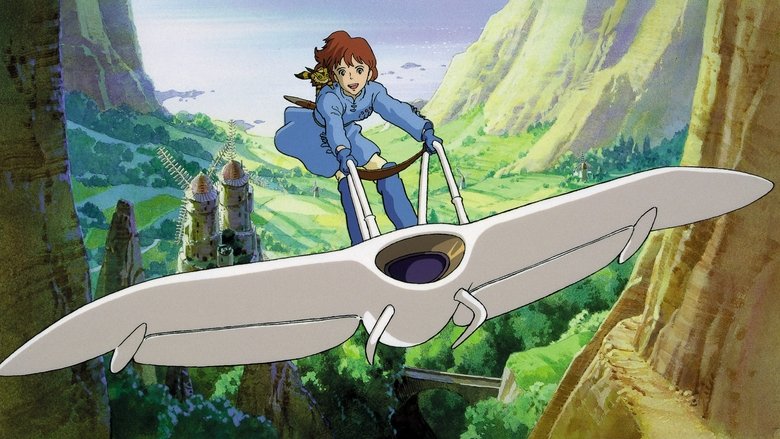
Wind symbolizes life, purity, and the connection between humanity and nature. The Valley of the Wind is protected by the wind, which keeps the toxic spores at bay. Nausicaä is a 'wind-rider,' skillfully navigating the air currents on her glider, which represents her harmony with the natural world.
The film's title emphasizes the importance of the wind. Nausicaä's ability to ride the wind is a visual representation of her unique understanding and respect for nature.
Memorable Quotes
風の谷のナウシカ: 何てきれいな胞子… 私を殺すっていうのに。
— Nausicaä
Context:
Nausicaä says this while exploring the Toxic Jungle, observing the falling spores with a sense of wonder rather than terror.
Meaning:
"It's so beautiful... It's hard to believe these spores could kill me." This quote encapsulates Nausicaä's unique perspective. Even when faced with something deadly, she is able to see its beauty and appreciate it as a part of nature. It highlights her scientific curiosity and her ability to look beyond fear.
クシャナ: 谷の者共よ、聞け! 我が名はクシャナ。トルメキア帝国皇女である。これより、この谷は我が領土となる!
— Kushana
Context:
Kushana declares this to the people of the Valley of the Wind after her forces have invaded and taken control.
Meaning:
"People of the Valley, listen! My name is Kushana, Princess of the Tolmekian Empire. From this day forward, this valley is my domain!" This quote establishes Kushana's authority and her aggressive, expansionist approach. It marks the moment the peaceful existence of the Valley is shattered.
ナウシカ: 私達は井戸の水を飲んで暮らしているわ。湖も川も、人間がみんな汚してしまったから。でも、どうして井戸の水はきれいなのか知ってる?森の木々が浄化してくれてるのよ!
— Nausicaä
Context:
Nausicaä explains this to the people of the Valley, trying to convince them not to fear and destroy the Toxic Jungle.
Meaning:
"Every one of us relies on water from the wells, because mankind has polluted all the lakes and rivers. But do you know why the well water is pure? It's because the trees of the wastelands purify it!" This line explicitly states one of the film's central ecological messages: that nature has the power to heal the damage caused by humanity, and that what appears to be a wasteland is actually a vital part of the planet's ecosystem.
Philosophical Questions
Can humanity ever truly coexist with nature without trying to dominate it?
The film explores this question through the contrasting ideologies of Nausicaä and the other human factions. While the Tolmekians and Pejites see nature as an adversary to be conquered, Nausicaä demonstrates that a symbiotic relationship is possible through understanding and respect. The film suggests that humanity's survival depends on a fundamental shift in its perception of its place in the natural world, from master to partner.
Is pacifism a viable response to aggression and violence?
Nausicaä is a reluctant warrior who strives for peace but is also capable of violence when pushed to her limits. The film grapples with the complexities of pacifism in a world filled with conflict. While it ultimately champions a non-violent approach, it also acknowledges the difficulty of maintaining this stance in the face of brutality. Nausicaä's journey raises questions about whether true peace can be achieved without some measure of resistance.
What is the true nature of 'pollution' and 'purity'?
The film challenges conventional notions of purity and pollution. The 'Toxic Jungle,' which humans perceive as a poisonous blight, is revealed to be a purifying force, cleansing the earth of humanity's toxins. This raises the philosophical question of what is truly 'toxic' – the natural world that has adapted to humanity's mess, or humanity's own ignorance and destructive tendencies. The 'pure' world exists beneath the jungle, a product of nature's slow and patient healing process.
Alternative Interpretations
While the film's primary message is one of ecological harmony, some interpretations delve deeper into its philosophical and religious undertones. Nausicaä's self-sacrifice and subsequent revival by the Ohmu have led many to see her as a messianic figure, a savior who dies for the sins of humanity and is reborn. The prophecy of a figure 'clothed in blue, descending onto a golden field' further reinforces this Christ-like interpretation.
Another interpretation focuses on the film as a critique of blind faith in both technology and prophecy. The Tolmekians' faith in the Giant Warrior to solve their problems is shown to be catastrophic, while the prophecy of the savior is fulfilled in an unexpected and organic way, through an act of empathy rather than divine intervention. This suggests that salvation comes not from ancient weapons or waiting for a messiah, but from human compassion and a scientific understanding of the world.
The ending itself has been subject to debate. Some critics have found Nausicaä's revival to be a 'deus ex machina' that lessens the impact of her sacrifice. An alternative reading is that her revival is not a literal resurrection but a symbolic representation of the triumph of life and the healing power of nature. The manga, with its more complex and darker ending, offers a starkly different interpretation of Nausicaä's role and the future of humanity, suggesting that the film's more hopeful conclusion is a deliberate choice for a cinematic audience.
Cultural Impact
"Nausicaä of the Valley of the Wind" had a profound cultural impact, both in Japan and internationally. Its success was a major catalyst for the founding of Studio Ghibli in 1985, which would go on to become one of the most acclaimed animation studios in the world. The film is credited with helping to elevate anime from a niche genre to a respected art form capable of tackling complex themes and sophisticated storytelling.
The film's strong environmentalist message was ahead of its time and has only become more relevant in the face of growing concerns about climate change and pollution. It has influenced countless other films, anime, and video games with its post-apocalyptic setting, ecological themes, and strong female protagonist. Nausicaä herself is often cited as one of the greatest heroines in anime, a departure from the damsels in distress common at the time.
Critically, "Nausicaä" was highly acclaimed for its stunning animation, imaginative world-building, and mature themes. It demonstrated that animation could be a medium for serious, thought-provoking narratives. The film's legacy is evident in the recurring themes of environmentalism, pacifism, and complex morality that are present in much of Studio Ghibli's subsequent work, particularly "Princess Mononoke," which explores similar ideas in a different setting.
Audience Reception
"Nausicaä of the Valley of the Wind" has been met with widespread critical acclaim and is beloved by audiences worldwide. It is often cited as one of the greatest animated films ever made. Viewers and critics praise its epic scope, stunning hand-drawn animation, and imaginative world-building. The character of Nausicaä is particularly lauded for being a strong, compassionate, and inspiring female protagonist. The film's profound themes of environmentalism and pacifism are frequently highlighted as being both timeless and increasingly relevant.
The score by Joe Hisaishi is also a frequent point of praise, with its blend of orchestral and electronic elements perfectly complementing the film's atmosphere. While some viewers find the pacing to be a bit slow at times and some of the supporting characters less developed than Nausicaä, the overall consensus is overwhelmingly positive. The film's emotional depth and hopeful message, despite its bleak post-apocalyptic setting, resonate strongly with audiences.
Interesting Facts
- The film is based on a manga of the same name, also written and illustrated by Hayao Miyazaki. The movie only covers the first two volumes of the seven-volume manga series, which has a much more complex plot and different ending.
- "Nausicaä of the Valley of the Wind" was released before the official formation of Studio Ghibli, but it is often considered the first Ghibli film due to its creative team and thematic elements that would become hallmarks of the studio.
- An early English-dubbed version of the film, titled "Warriors of the Wind," was heavily edited, removing significant portions of the plot and changing the story's meaning. Hayao Miyazaki was so displeased with this version that he and Studio Ghibli later adopted a strict "no-edits" policy for the international distribution of their films.
- The film's score was composed by Joe Hisaishi, marking his first collaboration with Hayao Miyazaki. Hisaishi would go on to score all of Miyazaki's subsequent feature films.
- The name 'Nausicaä' is taken from a Phaeacian princess in Homer's "Odyssey." Miyazaki was also inspired by a Japanese folktale from the Heian period called "The Princess Who Loved Insects."
- The animation for the film utilized 263 different colors.
- The design of Nausicaä's glider, the 'Mehve,' inspired a real-life project by a group of Japanese aviation enthusiasts called the OpenSky Project, who have built and flown a working replica.
Easter Eggs
In the film "Castle in the Sky," another Studio Ghibli movie, a fox-squirrel, the same species as Nausicaä's companion Teto, can be seen among the animals in the garden on Laputa.
This is a small nod to "Nausicaä," which predates the official founding of Studio Ghibli but is considered a part of its legacy. It's a fun connection for fans of Miyazaki's work.
The Giant Warrior's design and destructive power bear a resemblance to the colossal beings in Hideaki Anno's later work, "Neon Genesis Evangelion." Anno, the creator of "Evangelion," was a key animator on "Nausicaä" and was responsible for animating the Giant Warrior's attack sequence.
This connection shows the influence of "Nausicaä" on one of the most iconic anime series of all time and highlights the early work of a now-famous director.
⚠️ Spoiler Analysis
Click to reveal detailed analysis with spoilers
Frequently Asked Questions
Explore More About This Movie
Dive deeper into specific aspects of the movie with our detailed analysis pages
Comments (0)
No comments yet. Be the first to share your thoughts!