Skip to content
Ode to My Father
A sweeping, tear-soaked family epic where six decades of Korean upheaval pass through one stubborn man's shoulders. Warm nostalgia and quiet grief move together, like a crowded harbor market lit by a single lamp left on for someone who never arrives.
Ode to My Father

Ode to My Father

국제시장

"One promise can shape a lifetime."

17 December 2014 South Korea 126 min 7.4 (145)

Director: JK Youn

Cast: Hwang Jung-min, Yunjin Kim, Oh Dal-su, Jung Jin-young, Jang Young-nam

Drama Filial duty and the promise to the father Generational sacrifice and gratitude War, division and separated families National history seen through one ordinary life Letting go of the past
Box Office: $105,365,782

Overview

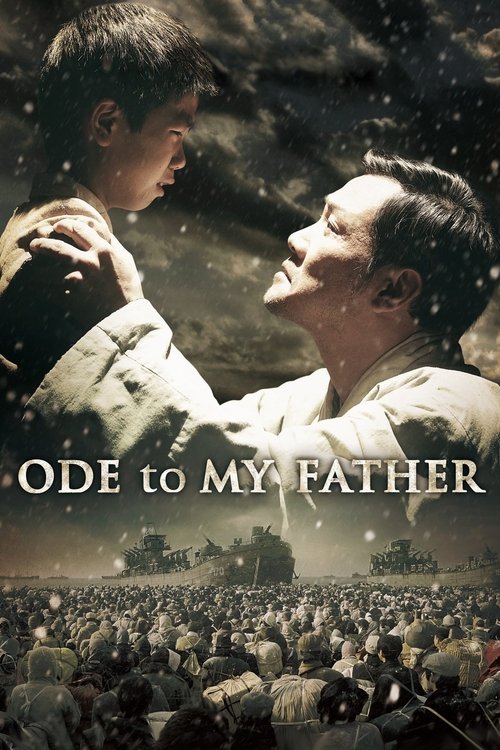
Ode to My Father (Korean: Gukje Market) is a 2014 South Korean drama directed by Yoon Je-kyoon (JK Youn). It opens in December 1950 during the Hungnam evacuation. A young boy, Deok-soo, loses his younger sister Mak-soon in the crowd boarding an American ship. His father goes back to search for her. Before leaving, the father makes Deok-soo promise to act as head of the family in his place.

The family settles in Busan, where Deok-soo's aunt runs a small imported-goods shop in Gukje Market. As the years pass, Deok-soo (Hwang Jung-min as the adult) works one hard job after another. He is a shoe shiner and a stevedore. He goes to West Germany as a miner and later to the Vietnam War as a technician. Each job is meant to feed his mother and siblings and pay for their schooling. Along the way he meets Young-ja (Yunjin Kim), a Korean nurse in Germany, and marries her. His loyal friend Dal-gu (Oh Dal-su) adds comic relief.

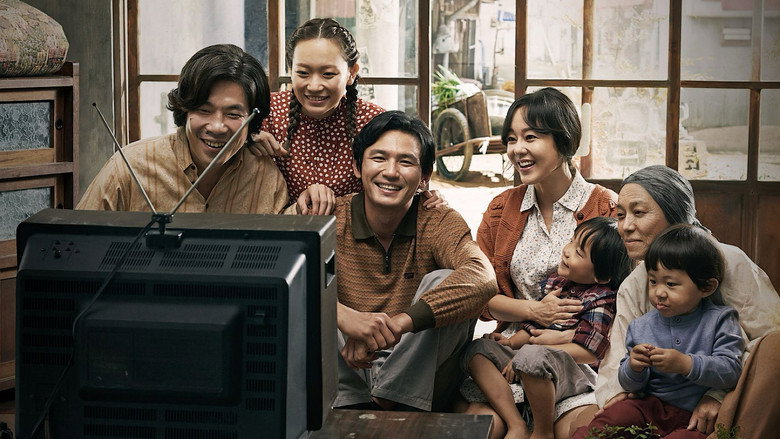
The film works as a kind of one-man history of modern Korea, in the spirit of Forrest Gump. It moves between the war, the postwar poverty, overseas labor, and the 1983 televised reunions of separated families. The present-day frame shows an old Deok-soo clashing with his grown children and grandchildren over the shop he refuses to sell.

Core Meaning

The film is a love letter to the generation that lived through war and poverty and gave up its own dreams so that its children could live in comfort. Director Yoon has said he wanted to talk about his father and that generation, and to make a family film that three generations could watch together. He used his own parents' names, Deok-soo and Young-ja, for the leads.

The central message is that ordinary fathers carry history on their backs. Their sacrifices are often silent and often go unthanked. Deok-soo keeps a promise made as a child. Only at the end does he release himself from it. The film asks younger viewers to see and appreciate what lies behind an old man's stubbornness. It also asks how much of a person's own life should be given up for duty.

Thematic DNA

Filial duty and the promise to the father 30%
Generational sacrifice and gratitude 25%
War, division and separated families 20%
National history seen through one ordinary life 15%
Letting go of the past 10%

Filial duty and the promise to the father

Deok-soo's childhood vow to be head of the family shapes every decision he makes. He drops his own ambitions, including his dream of studying, to support his mother and siblings. The promise defines his identity for sixty years.

Generational sacrifice and gratitude

The older generation's hardships, such as mining in Germany and working in Vietnam, are set against the comfort and impatience of his children. A scene where Deok-soo breaks down alone in a room while his family celebrates in the next room captures how a patriarch's sacrifices go unseen.

War, division and separated families

The loss of his father and sister at Hungnam haunts Deok-soo. The KBS-televised reunion of separated families leads the film to its emotional climax, and the unresolved search for his sister runs through the whole story.

National history seen through one ordinary life

The film moves through the Korean War, the miners and nurses sent to Germany, the Vietnam War and the 1980s. It treats Deok-soo as a stand-in for his whole generation. Critics noted that this approach is close to Forrest Gump and that it softens the contradictions of development.

Letting go of the past

Deok-soo keeps his aunt's shop because his father promised to meet the family there. Once he understands that his father will not return, he is finally able to stop waiting and let go of the burden.

Character Analysis

Yoon Deok-soo

Hwang Jung-min

Archetype: Self-sacrificing patriarch / everyman hero Key Trait: Stubborn, enduring devotion

Motivation

To keep his promise to his father by providing for and protecting his family.

Character Arc

He starts as a boy who loses his father and sister in the Hungnam evacuation. Over the following decades he becomes a shoe shiner, stevedore, miner in Germany and technician in Vietnam. In old age, after the televised reunion fails to bring his father back, he finally understands that his father will not come, and he sells the shop.

Oh Young-ja

Yunjin Kim

Archetype: Supportive partner Key Trait: Warmth and resilience

Motivation

To build a stable family with her husband while supporting him through his sacrifices.

Character Arc

She is a Korean nurse in Germany who marries Deok-soo. She stays with him through decades of hardship and acts as the person who understands his silent burden.

All 4 characters and cast

Symbols & Motifs

The Kkotbun shop in Gukje Market

Meaning:

Waiting, memory and an unbroken promise to the missing father.

Context:

Deok-soo buys the shop from his aunt and refuses to sell it despite his children's complaints. His father had said he would meet the family there, and the shop is the place where his father could find them again. He sells it only at the end.

The lost hand of Mak-soon

Meaning:

Guilt and the trauma that shapes his whole life.

Context:

As a boy, Deok-soo lets go of his sister's hand while boarding the American ship in Hungnam. His father turns back to find her. This moment drives his guilt and his lifelong search for his sister.

The father's photograph

Meaning:

A private bond with the father he lost, and the one place he allows himself to confess his exhaustion.

Context:

Deok-soo keeps his father's picture throughout the decades. He tells it privately how tiring life has been, including in the scene where he retreats to another room after a quarrel with his children.

The SS Meredith Victory and the Hungnam harbor

Meaning:

Rescue and loss at the same moment: the ship that carries the family to safety is also the vehicle of their separation.

Context:

The film opens with refugees crowded at the port, boarding the American freighter that evacuated about 14,000 people.

The KBS reunion broadcast

Meaning:

Collective national grief, and the hope and disappointment of the divided families.

Context:

Deok-soo goes on live television hoping an old man from his hometown is his father. The man is not, but the broadcast leads him to understand that he must stop waiting.

Philosophical Questions

How much of one's own life should be given up for duty to family?

Deok-soo gives up studies and dreams, takes dangerous work and puts his family first. The film honors this but also shows its cost in his private grief and his children's incomprehension.

Do later generations owe gratitude to those who sacrificed for them?

The conflicts between Deok-soo and his children, and his collapse in the quiet room while his family celebrates, ask whether sacrifice that goes unseen can ever be properly repaid.

When should one stop waiting for the lost?

Deok-soo keeps the shop for decades in case his father returns. His decision to sell it presents letting go as an act of acceptance rather than betrayal.

Can personal memory stand for a nation's history?

The film makes one man's life the story of a generation. Critics debate whether this honors collective experience or simplifies a more complicated past.

How It Ends

Alternative Interpretations

One reading sees the film as a heartfelt tribute to ordinary parents with no political agenda, which is how the director described it. Another sees it as sentimental nationalism that glorifies sacrifice and the developmental state while softening its violence and contradictions, particularly regarding the Vietnam War. A third reading is a "national coming-of-age story" in which painful episodes become stepping stones to a confident modern nation. The ending can also be read as a personal liberation: Deok-soo is freed from a burden he carried so long, rather than being a pure tragedy.

Full ending explanation

Cultural Impact

The film belongs to a wave of nostalgic historical films that did very well at the Korean box office. Its release brought much political debate. The critic Huh Ji-woong said it emphasizes the older generation's sacrifices while the current generation's attitudes are the real problem. Some commentators called it a "conservative" film, and President Park Geun-hye used a scene from the movie to call for more patriotism. Politicians from both sides, including Kim Moo-sung and Moon Jae-in, went to see it. Director Yoon said he was shocked by readings that were far from his intent and asked politicians not to interpret the film politically.

Critics compared it with Forrest Gump for putting a simple protagonist through major historical events. Several reviews called it very sentimental and emotionally manipulative but effective as epic melodrama. A 2026 Korea Times essay says the film romanticizes and downplays Koreans' role in the Vietnam War, yet the author still uses it in teaching because it moves students, and says it prompts reflection on what earlier generations sacrificed.

Audience Reception

Praised: Audiences in Korea turned out in huge numbers, with the film passing 10 million tickets sold. Viewers praised its emotional power, its portrayal of what parents and grandparents lived through, Hwang Jung-min's performance, and the humor of Oh Dal-su's scenes. Reviewers noted the grand production values and spectacle, such as the Hungnam evacuation. IMDb users rate it around 7.8.

Criticized: Reviewers called it emotionally manipulative, melodramatic and unsubtle, and noted occasional limits to its CGI. Some thought a few scenes, such as the German mine rescue, were implausible. Politically, it was criticized as conservative or nationalist, and for romanticizing Korea's role in Vietnam.

Verdict: A crowd-pleasing, tear-jerking epic that is more effective as emotion and nostalgia than as nuanced history.

Interesting Facts

  • The film was directed by Yoon Je-kyoon (JK Youn), who also made Haeundae, and was released in South Korea on 17 December 2014.
  • The director used his own parents' real names, Deok-soo and Young-ja, for the lead characters.
  • The film was shot in the Czech Republic, Thailand and Busan.
  • It topped the local box office on its opening weekend, beating The Hobbit: The Battle of the Five Armies with about 1.1 million tickets sold.
  • It passed 10 million admissions in Korea and grossed roughly US$99 million, becoming the second highest-grossing Korean film at the time, behind The Admiral: Roaring Currents.
  • The film includes cameos of real historical figures, such as the future Hyundai founder Chung Ju-yung and the fashion designer Andre Kim.
  • The German miner subplot refers to the program running from 1963 to 1977 that sent close to 8,000 young Korean men to work in German mines for three years.
  • A Korean sequel is listed, Ode to My Father 2.

Easter Eggs

A young Deok-soo meets the future Hyundai founder Chung Ju-yung while working as a shoe shiner on the streets of Busan.

This puts the protagonist beside a real figure of Korea's industrial rise and reinforces the film's idea that ordinary people lived alongside the makers of the economic miracle.

The fashion designer Andre Kim appears as an eccentric character who needs fabric for a design.

He is another real cultural figure used to anchor the film's 1960s–70s period details.

The KBS reunion show scene reenacts the real 1983 KBS programme that reunited families separated by the war.

The finale is built on a real national event in which thousands of families were reunited on live television.

The Korean wrestling legend Lee Mangi is among the cameos mentioned by one reviewer.

This is one of several nods to Korean popular culture included in the film.

Frequently Asked Questions

Explore More About This Movie

Dive deeper into specific aspects of the movie with our detailed analysis pages

Comments (0)

Leave a comment

No comments yet. Be the first to share your thoughts!

Similar Movies