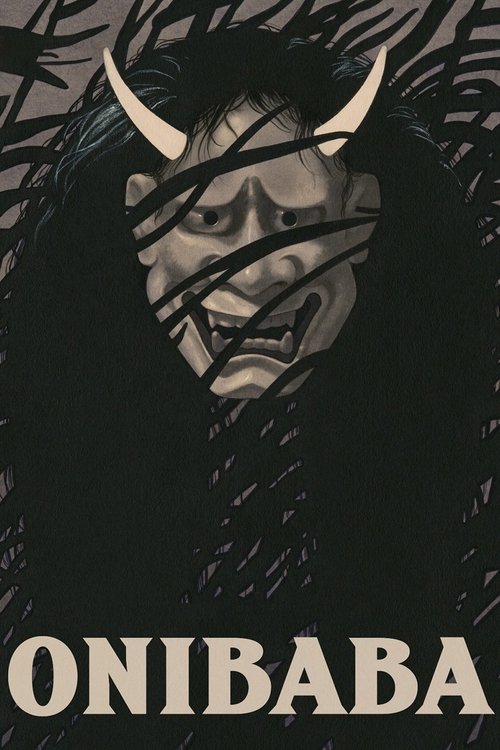
Onibaba
鬼婆
"The most daring film import ever...From Japan!"
Overview
Set in the mid-14th century during a brutal civil war, Onibaba follows an impoverished older woman and her young daughter-in-law who survive in a vast, labyrinthine field of tall susuki grass. Driven by starvation, the pair ambush fleeing samurai, murder them, and strip them of their armor and weapons to trade for grain. To hide their gruesome crimes, they discard the bodies into a deep, dark pit hidden within the swaying reeds.
Their fragile, pragmatic alliance is shattered when a neighbor named Hachi returns from the war, bringing news that the older woman's son—the younger woman's husband—has died. Hachi soon instigates a passionate, lustful affair with the younger widow. Terrified of being abandoned and left to starve, the deeply jealous older woman resorts to desperate measures. She steals a horrifying Hannya demon mask from a wandering samurai and uses it to terrorize her daughter-in-law under the cover of darkness, setting off a chilling chain of events that blurs the line between human depravity and supernatural retribution.

Core Meaning
Director Kaneto Shindō intended Onibaba as a fierce anti-war allegory and an exploration of the primal urge for survival. Shindō suggests that the devastating conditions of war strip away all societal morality, reducing humans to their most animalistic, violent instincts. Furthermore, as a native of Hiroshima, Shindō deeply infused the film with the trauma of the atomic bomb. The gruesome disfigurement caused by the cursed mask serves as a direct, powerful metaphor for the keloid radiation scars suffered by the hibakusha (atomic bomb victims). Ultimately, the film posits that humanity is capable of both profound vitality and horrific evil, creating its own hell on earth through jealousy, war, and selfishness.
Thematic DNA
The Brutal Urge for Survival
The film illustrates how war and extreme poverty eradicate ethics [2.3]. The women's daily routine of murdering soldiers is not born of malice, but of a desperate necessity to eat and survive in an apocalyptic landscape.
Unbridled Lust and Vitality
Eros is presented as an unstoppable life force. The younger woman and Hachi's sexual affair is a defiant expression of life and human vitality against the bleak backdrop of war and death.
The Trauma and Scars of War
The physical and psychological disfigurements of conflict are central to the narrative. The demonic mask leaving horrific scars acts as a potent allegory for the lingering devastation of nuclear fallout and the atomic bomb.
Karma and Divine Retribution
Rooted in a Buddhist fable, the story explores the spiritual consequences of deceit and selfish attachment. The older woman's manipulative jealousy literally manifests on her face as a karmic punishment.
Character Analysis
OlderWoman
NobukoOtowa
Motivation
Driven by the primal fear of starvation and absolute terror of being abandoned by her only companion.
Character Arc
Shedevolvesfromapragmaticsurvivorintoacreatureofpure, manipulativejealousy[1.4]. Her attempt to control her daughter-in-law through fear ultimately transforms her into the literal monster she pretends to be.
Younger Woman
Jitsuko Yoshimura
Motivation
The pursuit of physical gratification and a desperate escape from her grim, death-filled reality.
Character Arc
Initially numb and compliant, she awakens to her own carnal desires and vitality, choosing life and pleasure over her mother-in-law's oppressive fearmongering.
Hachi
Kei Satō
Motivation
To satisfy his immediate carnal and physical hungers without regard for consequence.
Character Arc
A soldier who abandons the war, he introduces a disruptive sexual dynamic into the women's isolated world, fracturing their alliance before meeting his own violent end.
Masked Samurai
Jūkichi Uno
Motivation
To survive the war and hide his face, hinting at intense vanity.
Character Arc
Wanders into the grass seeking escape from battle, only to become prey and a catalyst for the older woman's ultimate damnation.
Symbols & Motifs
TheSusuki(Pampas)Grass
Itsymbolizesnature'scompleteindifferencetohumansufferingandthelabyrinthine, shiftingmoralboundariesofthecharacters[1.3].
The grass fills nearly every frame of the film, obscuring the characters' sins, trapping them, and isolating them from the broader world.
The Deep Pit (The Hole)
The hole operates as a gateway to hell, a primal womb/tomb motif, and a physical manifestation of the accumulating weight of the women's karmic debt.
Hidden in the grass, it is where the women dump the bodies of the murdered soldiers, and where the older woman eventually springs her trap.
The Hannya Mask
Representing jealousy and deceit in traditional Japanese culture, the mask symbolizes the ugly reality of human nature. Allegorically, it represents the devastating radioactive burns of the atomic bomb.
Stolen from a dead samurai, the older woman wears it to terrorize her daughter-in-law, only to have it permanently fuse to her own flesh.
Memorable Quotes
I'mnotademon!I'mahumanbeing!
— OlderWoman
Context:
Screamed repeatedly during the film's climax as the horribly disfigured woman chases her terrified daughter-in-law through the grass.
Meaning:
Thisisthetragicthesisofthefilm, declaringthatthetruemonstersaresimplyhumanswhohavebeendeformedbydesperatecircumstances[1.1].
The hole … Deep and dark … A dark passageway from ancient times to the present.
— On-screen text
Context:
Shown early in the film to introduce the foreboding pit where the victims' bodies are unceremoniously dumped.
Meaning:
It elevates the pit from a mere geographical feature to a mythic symbol of eternal human sin, greed, and death.
If my son's dead, she's all I've got! I can't get along alone. I couldn't even kill! Take her and I'll starve!
— Older Woman
Context:
Pleading desperately with Hachi to end his affair and leave her daughter-in-law alone.
Meaning:
This lays bare the pathetic, terrifying truth behind her actions. Her intense jealousy is fundamentally rooted in the absolute terror of starvation.
Philosophical Questions
Is morality merely a luxury of the comfortable?
The film explores how extreme deprivation and the threat of starvation strip away societal ethics, forcing ordinary humans to adopt a predatory, animalistic existence just to survive [2.3].
Are demons supernatural entities, or manifestations of human trauma and malice?
By having the human protagonist literally morph into a 'demon hag' due to her own jealousy and actions, the film suggests that hell is a condition of the human soul rather than a supernatural realm.
How does the violence of war infect the civilian soul?
The film highlights the collateral spiritual damage of conflict, showing how war turns civilians into scavengers who must feed off the very military system that ruined their lives.
Alternative Interpretations
Supernatural vs. Psychological: Audiences and critics debate whether the mask is genuinely cursed by a demon or Buddha, or if it sticks due to mundane physical reasons—such as the dead samurai's diseased flesh, rain, and sweat. In the latter reading, the 'curse' is entirely psychological, projecting the woman's own immense guilt and malice.
Feminist and Anti-Patriarchal Reading: The women's brutal murders can be interpreted not as villainy, but as an extreme, necessary rebellion against a patriarchal society that drafted their men, devastated their land, and abandoned them to starve. Their survival tactics are a direct consequence of male-dominated militarism.
Cultural Impact
Onibaba is a landmark achievement in the Japanese New Wave, breaking cinematic conventions by blending raw eroticism, brutal realism, and psychological horror. Released in 1964, its cultural impact is deeply tied to post-WWII Japan, acting as a subversive anti-war critique and an allegory for the trauma of the Hiroshima atomic bombing. The film significantly influenced the trajectory of Japanese horror (J-Horror) by proving that folklore could be weaponized to explore modern sociopolitical anxieties. Internationally, its atmospheric dread left a massive footprint on world cinema; most notably, director William Friedkin drew direct inspiration from the film's demon mask when creating the terrifying visage of Pazuzu for The Exorcist. Today, it is universally revered as a masterpiece of survival horror and atmospheric tension.
Audience Reception
Onibaba is widely acclaimed as a cinematic masterpiece, frequently praised for its breathtaking, high-contrast black-and-white cinematography by Kiyomi Kuroda. Audiences marvel at the oppressive, claustrophobic atmosphere generated by the ceaselessly swaying susuki grass and the primal, frenzied drum score by Hikaru Hayashi. The film's daring mix of visceral sexuality and psychological terror was highly controversial upon release but is now celebrated as groundbreaking. While some viewers occasionally critique its unrelenting bleakness or theatrical acting rooted in Noh traditions, the overwhelming verdict from critics and horror aficionados is that it remains an unforgettable, terrifying, and visually stunning exploration of human depravity.
Interesting Facts
- DirectorKanetoShindōbasedthenarrativeonanancientShinshuBuddhistfabletitled'TheMaskofFlesh'(Niku-dzukinoMen)[1.9].
- The horrific scarring on the older woman's face was explicitly designed by Shindō to resemble the keloid radiation burns of the atomic bomb victims from his hometown of Hiroshima.
- Famed director William Friedkin cited Onibaba as 'the scariest film I ever saw'.
- The film's iconic sea of susuki grass was a real marshland; the cast and crew reportedly lived there during the months of production to fully immerse themselves in the desolate environment.
- Upon its Western release in the 1960s, the film faced intense censorship due to its raw depictions of sexuality and violence, resulting in an effective ban in the UK in 1965 before earning an 'X' rating.
Easter Eggs
TheHannyamask'sdesigndirectlyinfluencedthedemonPazuzuinTheExorcist(1973).
DirectorWilliamFriedkinintentionallyusedthemaskfromOnibabaasthevisualblueprintforthesubliminal, white-faceddemonthatpossessesReganinhishorrorclassic[2.8].
The keloid scar makeup on the Older Woman.
Rather than generic horror gore, the scars are a hidden historical reference, meticulously modeled after the radiation burns of the hibakusha (atomic bomb survivors), reinforcing the film's anti-war message.
⚠️ Spoiler Analysis
Click to reveal detailed analysis with spoilers
Frequently Asked Questions
Explore More About This Movie
Dive deeper into specific aspects of the movie with our detailed analysis pages
Comments (0)
No comments yet. Be the first to share your thoughts!