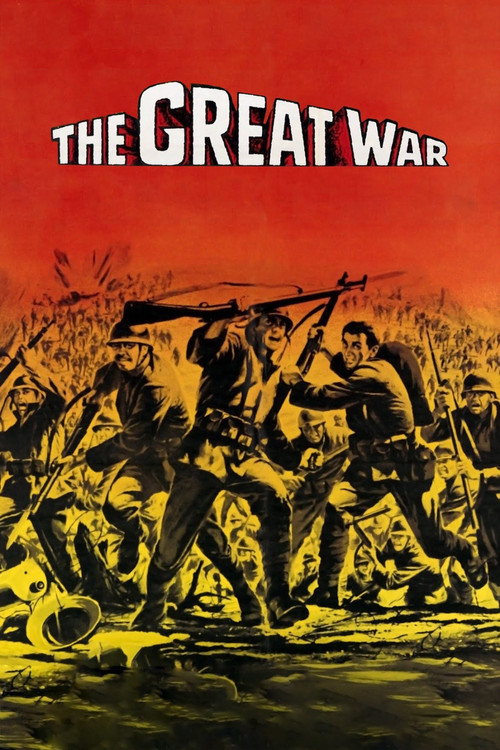
The Great War
La grande guerra
Overview
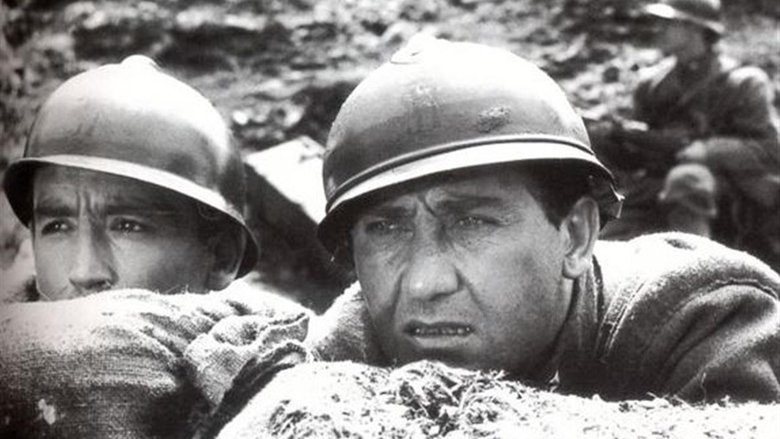
"The Great War" (La grande guerra) follows the story of two reluctant Italian soldiers, the crafty Roman Oreste Jacovacci (Alberto Sordi) and the loudmouthed Milanese Giovanni Busacca (Vittorio Gassman), during World War I. United by a complete lack of patriotic ideals and a shared, singular goal—to survive the war by avoiding danger at all costs—they form an unlikely friendship. Their journey takes them from bungled attempts to dodge conscription to the brutal reality of the trenches on the Austro-Italian front.
Through a series of episodes that swing expertly between comedy and tragedy, the film portrays the daily life of soldiers: the poor food, the grueling marches, the constant fear, and the small moments of camaraderie. The duo navigates the chaos, trying to outwit their superiors and stay away from the fighting, all while the horrors of war encroach upon them. Their relationship is tested, particularly through their interactions with the prostitute Costantina (Silvana Mangano) and their fellow soldiers, as they are forced to confront the grimness of their situation. The film eschews traditional heroic narratives, instead focusing on the perspective of the common, fearful man caught in a conflict far beyond his control.
Core Meaning
At its heart, "The Great War" is a powerful anti-war statement that demystifies the rhetoric of heroism and patriotism. Director Mario Monicelli sought to portray the war not as a glorious struggle of nations, but as a "useless slaughter" from the perspective of the ordinary, unwilling participants. The film's core message is that in the face of mechanized death and indifferent command, the primary human instinct is survival, not sacrifice for abstract ideals. It critiques the nationalist propaganda that fueled the conflict by showing the reality of the trenches—a miserable existence where soldiers from different parts of Italy, with their own dialects and prejudices, are forged into a reluctant, suffering collective. Ultimately, the film suggests that true dignity and heroism can emerge unexpectedly, not from jingoistic fervor, but from a final, stubborn refusal to be dehumanized by the enemy, transforming cowards into martyrs in a moment of profound irony.
Thematic DNA
The Anti-Hero in War
The film centers on two anti-heroes, Giovanni and Oreste, who are defined by their cowardice and desire to shirk responsibility. They represent the average person thrust into a war they neither understand nor believe in. Their constant scheming to find comfort and avoid battle is the main comedic driver, but it also serves a deeper purpose: to present a realistic, unglamorous portrait of soldiering, stripped of heroic clichés. Their journey culminates in an unexpected act of defiance, suggesting that heroism is not the absence of fear, but a complex, last-ditch assertion of human dignity.
The Absurdity and Brutality of War
Monicelli masterfully blends comedy with the grim reality of trench warfare to highlight the absurdity of the conflict. The film juxtaposes moments of slapstick humor with sudden, shocking violence—a soldier killed fetching a hen, a dangerous mission to deliver a Christmas message. This tonal dissonance emphasizes the chaos and meaninglessness of their suffering. The film was groundbreaking in Italian cinema for depicting WWI without the heroic and nationalist rhetoric of previous Fascist-era propaganda, instead showing the mud, fear, and senseless death.
National Identity and Camaraderie
The platoon is a microcosm of the newly unified Italy, featuring soldiers from various regions with distinct dialects and stereotypes (the Roman, the Milanese, etc.). Their initial squabbles give way to a grudging solidarity forged through shared misery. The film suggests that a true sense of Italian identity was not born from political speeches, but forged in the trenches of the Piave river, where common suffering erased regional differences. This forced unity in the face of disaster is a central theme.
Critique of Authority and Class
The film subtly critiques the disconnect between the officers and the enlisted men. The generals are shown as out of touch, making grand statements while the soldiers endure appalling conditions. Giovanni often rants about the "sharks" (pescicani) and profiteers who benefit from the war while ordinary men die for them. This theme aligns the film with the traditions of Italian comedy (Commedia all'italiana), which often focused on the struggles of the lower classes against an indifferent and corrupt system.
Character Analysis
Giovanni Busacca
Vittorio Gassman
Motivation
To survive the war through any means necessary and to expose the hypocrisy of the powerful who orchestrate it.
Character Arc
Giovanni begins as an arrogant, fast-talking Milanese swindler whose only concern is his own welfare. He is cynical, loudly anti-war, and disdainful of authority. Throughout the film, his bravado is shown to be a mask for deep-seated fear. His bond with Oreste, initially one of mutual exploitation, evolves into genuine friendship. His arc culminates in the final scene where, pushed by a personal insult to his dignity rather than a surge of patriotism, he chooses death over submission, finding a heroic end that contradicts his entire life's philosophy.
Oreste Jacovacci
Alberto Sordi
Motivation
To avoid danger and get through the war unscathed, using his wits to secure small comforts and dodge duty.
Character Arc
Oreste is a Roman con-man, more of a follower than a leader, who first appears tricking Giovanni out of money. He is an unabashed coward, openly admitting his fear and prioritizing self-preservation above all else. His friendship with Giovanni grounds him, and he often serves as the more pragmatic of the two. His arc mirrors Giovanni's, but his final moments are defined by terror rather than defiance. After witnessing Giovanni's execution, he pleads for his life, screaming that he is a coward, yet he too is killed, becoming a hero by circumstance and association.
Costantina
Silvana Mangano
Motivation
To survive and maintain a degree of independence in a world dominated by the chaos of war.
Character Arc
Costantina is a prostitute in a town near the front, hardened by the war and the endless stream of soldiers. Initially, she is cynical and transactional, stealing Giovanni's wallet. However, her relationship with Giovanni develops into a kind of weary, affectionate friendship. She represents a sliver of civilian life and normalcy amidst the chaos, but she is also a victim of the war, forced into her trade by circumstance. Her arc is one of finding a moment of human connection in a dehumanizing world.
Symbols & Motifs
The Train
The train symbolizes the relentless, impersonal machinery of war. It transports the unwilling recruits towards an unknown fate, separating them from their civilian lives and delivering them to the front.
The film features several key scenes on trains. The initial journey to the front establishes the characters' anxieties and their forced proximity. In a particularly poignant visual moment, their train passes a silent, whitewashed hospital train—described as a "train of ghosts"—moving in the opposite direction, a stark, unspoken omen of the fate that awaits many of them.
Mud and Rain
The pervasive mud and rain symbolize the miserable, dehumanizing conditions of trench warfare and the overwhelming sense of despair and stagnation.
Throughout the scenes at the front, the soldiers are shown living, fighting, and dying in mud-filled trenches under constant rain. This bleak environment visually represents their grim reality and the quagmire of the war itself, from which there is no clean escape.
The Austrian Officer's Comment
The officer's dismissive remark about Italians only knowing "liver Venetian style" symbolizes the arrogant condescension that strips the protagonists of their last shred of self-worth, ironically becoming the catalyst for their heroic defiance.
In the final scene, captured and facing execution, Giovanni and Oreste are about to betray their army to save themselves. However, when the Austrian officer mockingly insults their national character, it triggers a surge of pride in Giovanni, who refuses to cooperate, sealing his fate. It's not patriotism, but a deeply personal offense that transforms him from a coward into a martyr.
Memorable Quotes
Mi te disi propi un bel nient! Hai capito? Faccia de merda!
— Giovanni Busacca
Context:
Spoken to the Austrian officer who has just mocked Italians. Giovanni has decided not to reveal the location of a strategic bridge, knowing it will lead to his immediate execution.
Meaning:
"I'm telling you bugger all! Got it? Shitface!" This is the climactic line of the film, where Giovanni, a lifelong coward, finds the courage to defy his captor. It's a raw, vulgar assertion of dignity, not in the name of a flag, but in response to a personal insult. It marks the completion of his tragic transformation into an unlikely hero.
Io non so niente! Se lo sapessi, ve lo direi! Io sono un vigliacco, lo sanno tutti!
— Oreste Jacovacci
Context:
Shouted to the Austrian firing squad moments after they have executed Giovanni. Overcome with terror, Oreste tries to save himself by reaffirming his identity as a coward, but he is shot anyway.
Meaning:
"I don't know anything! If I knew, I'd tell you! I'm a coward, everyone knows it!" This is Oreste's final, desperate plea. It tragically and ironically underscores the film's central theme. He dies not because he chose heroism, but because he was in the wrong place at the wrong time, his cowardice failing to save him in the end. He becomes a hero against his will.
L'italiano in fanteria, il romano in fureria.
— Giovanni Busacca
Context:
Said by Giovanni when he first meets Oreste at the enlistment office, sizing him up as a classic Roman shirker who has found a comfortable desk job while others are sent to fight.
Meaning:
"The Italian in the infantry, the Roman in the orderly room." A cynical proverb used by Giovanni, reflecting regional stereotypes. It highlights the internal divisions and prejudices within Italy at the time and establishes the initial antagonistic dynamic between the Milanese Giovanni and the Roman Oreste.
E pensare che anche stavolta quei due lavativi se la sono scampata!
— The Italian Captain
Context:
Spoken by the Italian captain after his troops have retaken the outpost where Giovanni and Oreste were executed. He sees they are missing and assumes the worst of them, as usual, highlighting the tragic anonymity of their sacrifice.
Meaning:
"And to think that once again those two slackers got away!" This is the film's devastatingly ironic final line. The captain, unaware of their sacrifice, assumes Giovanni and Oreste have simply deserted as they always threatened to. It solidifies their status as unsung heroes whose ultimate act of bravery will never be known, perfectly encapsulating the film's tragic and anti-glorious vision of war.
Philosophical Questions
What is the nature of heroism?
The film dismantles traditional definitions of heroism. Giovanni and Oreste are selfish and cowardly for 99% of the story. Their final actions force the viewer to question whether heroism is a consistent character trait or a fleeting choice made in a single moment. Is an act of bravery born of personal pride rather than patriotism still heroic? The film suggests that heroism might not be about fearlessness, but about the complex, often contradictory human capacity to assert one's dignity in the face of annihilation, even if that assertion is accidental or motivated by anger rather than ideals.
Does shared suffering create genuine unity?
"The Great War" explores how a disparate group of men from across Italy, with their own dialects, prejudices, and interests, are thrown together into the crucible of the trenches. The film questions whether the camaraderie that develops is true national unity or merely a temporary bond of survival. It suggests that while political rhetoric fails to unite them, the shared experience of misery, fear, and death forges a powerful, if reluctant, connection. The war becomes the unintentional unifier of a fragmented nation.
Can comedy adequately represent the tragedy of war?
Monicelli's choice to blend comedy and drama was revolutionary and controversial. The film raises the question of whether humor is an appropriate tool to depict such immense suffering. By using comedy, the film makes the characters' plight more relatable and humanizes them, preventing them from becoming mere symbols of victimhood. The sharp shifts in tone—from a funny scheme to a sudden, brutal death—serve to amplify the horror and absurdity of the situation, suggesting that laughter and terror are two sides of the same coin in a world that has lost its reason.
Alternative Interpretations
While the dominant interpretation sees the ending as a tragic and ironic transformation of cowards into heroes, some alternative readings exist. One perspective suggests that Giovanni's final act is not one of newfound patriotism but the ultimate expression of his lifelong anti-authoritarianism. His defiance is aimed less at the national enemy and more at the arrogant officer who personifies the oppressive authority he has always despised. In this view, he dies as a rebel, not a patriot.
Another interpretation focuses on the film as a commentary on the Italian national character ('italianità'). From this angle, the protagonists' journey from self-serving individualism to an involuntary, fatal act of collective dignity is a metaphor for Italy itself. The film could be read as a cynical yet ultimately affectionate portrayal of a nation that, despite its perceived flaws of cynicism and disunity ('furbizia'), possesses an underlying, albeit deeply buried, sense of honor that emerges only under extreme duress. Their heroism is not planned or ideological but instinctual and accidental, a reflection of a national character that resists simple definitions of heroism or cowardice.
Cultural Impact
"The Great War" marked a watershed moment in Italian cinema and the nation's collective memory of World War I. Released in 1959, it was the first film to radically challenge the sanitized, heroic mythology of the war that had been propagated by Fascist and post-war nationalist rhetoric. By adopting the lens of 'Commedia all'italiana' (Italian-style comedy), director Mario Monicelli created a new language for war films, blending sharp comedy with profound tragedy to depict the conflict from the ground up. This approach, focusing on the anti-heroic, fearful common soldier, was controversial but deeply resonant.
The film was a massive critical and commercial success, winning the Golden Lion at Venice and earning an Oscar nomination. Its influence was immense, paving the way for a more critical and realistic representation of history in Italian cinema. It directly confronted the notion of a unified, patriotic Italy, instead showing a country of disparate regions and dialects thrown together in the trenches, forging a national identity through shared suffering rather than shared ideals. The performances of Alberto Sordi and Vittorio Gassman as the cowardly protagonists became iconic, embodying a cynical but deeply human response to the absurdity of war. The film's final, ironic twist—where two slackers die as unknown heroes—became a powerful statement on the anonymous, unglamorous nature of sacrifice, leaving an indelible mark on Italy's cultural understanding of its past.
Audience Reception
Audiences largely embraced "The Great War," making it a significant commercial success both in Italy and abroad, particularly in France. Viewers praised the brilliant performances by Alberto Sordi and Vittorio Gassman, whose comedic chemistry brought a deep humanity to their anti-heroic characters. The film's ability to balance humor with the stark, tragic reality of war was widely lauded, with many finding the approach to be a refreshing and honest departure from traditional, flag-waving war movies.
However, the film was not without its critics. Upon its premiere, some criticized it for not being somber enough, arguing that the use of comedy was disrespectful to the memory of the soldiers. It also faced significant backlash from military and nationalist circles in Italy who felt the depiction of Italian soldiers as cowardly, undisciplined shirkers was insulting and unpatriotic. Despite these controversies, the overwhelming audience verdict was positive, as the film's portrayal of ordinary men trying to survive an extraordinary catastrophe resonated deeply and felt more truthful than any sanitized, heroic epic.
Interesting Facts
- The film won the prestigious Golden Lion at the 1959 Venice Film Festival, sharing the prize with Roberto Rossellini's "Il generale Della Rovere".
- It was nominated for an Academy Award for Best Foreign Film.
- "The Great War" was the first major Italian film to offer a critical, anti-rhetorical perspective on World War I, breaking from the heroic narratives promoted during the Fascist era.
- The production faced difficulties with Italian censors and protests from the military due to its perceived irreverent and unpatriotic depiction of the army.
- The screenplay was co-written by the legendary duo Age & Scarpelli, along with Luciano Vincenzoni and Monicelli himself, who are considered masters of the 'Commedia all'italiana' genre.
- To ensure historical accuracy, the filmmakers hired writer Carlo Salsa as a consultant, who was a veteran of the war on the Italian front.
- Many scenes were filmed on location in the province of Udine, in the actual areas where the Italian and Austro-Hungarian armies fought.
- In 2008, the film was included in the Italian Ministry of Cultural Heritage's list of "100 Italian films to be saved".
⚠️ Spoiler Analysis
Click to reveal detailed analysis with spoilers
Frequently Asked Questions
Explore More About This Movie
Dive deeper into specific aspects of the movie with our detailed analysis pages
Comments (0)
No comments yet. Be the first to share your thoughts!