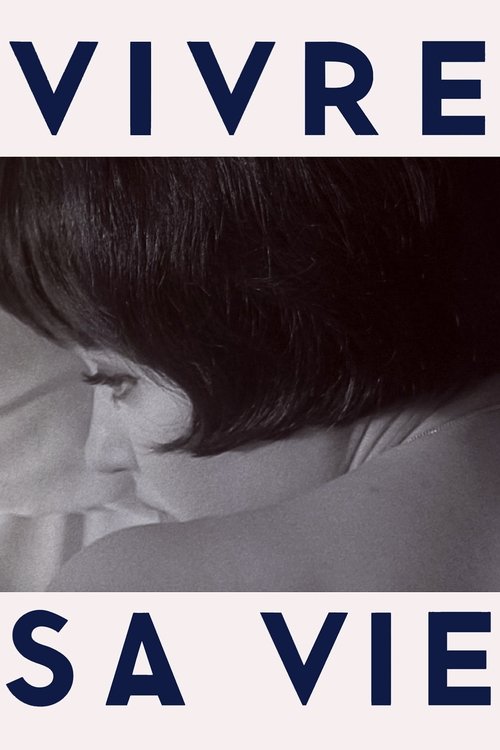
Vivre Sa Vie
French New Wave/Drama + Tragic Melancholy + A fragmented portrait of a soul for sale. A woman's face, filmed like a landscape, dissolves into the grain of 1960s Paris, caught between the silence of thought and the noise of the streets.
Vivre Sa Vie

Vivre Sa Vie

Vivre sa vie: film en douze tableaux

"The many faces of a woman trying to find herself."

20 September 1962 France 84 min ⭐ 7.7 (683)
Director: Jean-Luc Godard
Cast: Anna Karina, Sady Rebbot, André S. Labarthe, Guylaine Schlumberger, Gérard Hoffmann
Drama
Existential Responsibility vs. Determinism The Commodification of the Body Language and Communication Cinema as Reality and Reflection
Budget: $64,000
Box Office: $24,517

Overview

Jean-Luc Godard's Vivre Sa Vie (1962) is a seminal work of the French New Wave, structured as a series of twelve distinct "tableaux" or chapters. The film follows Nana Kleinfrankenheim (Anna Karina), a young Parisian woman who leaves her husband and child with dreams of becoming an actress. When her aspirations fail to materialize and financial pressures mount, she gradually drifts into a life of prostitution.

Rather than a traditional melodramatic narrative, the film presents a detached, almost sociological study of Nana's descent. Through Godard's lens, we witness her mundane interactions with clients, her conversations about philosophy and life, and her brief moments of joy, such as an iconic dance in a pool hall. The story creates a Brechtian distance, constantly reminding the viewer that they are watching a film, yet it remains deeply emotionally anchored by Anna Karina's mesmerizing performance.

The film culminates in a sudden and tragic conclusion where Nana, having found a potential escape through a new love, becomes a pawn in a transaction between pimps. The resulting violence is abrupt and unglamorous, sealing Nana's fate as a victim of a commodified world that ultimately consumed her.
Core Meaning

The Commodification of the Soul and the Failure of Language.

At its heart, Vivre Sa Vie is an existential inquiry into human freedom and responsibility within a capitalist society. Godard uses prostitution not just as a plot point, but as a central metaphor for modern life: the selling of one's body (and by extension, one's time and self) to survive.

The film essentially asks: Can we remain "responsible" for our actions when our choices are constrained by economic necessity? Additionally, it explores the inadequacy of language to convey truth. Nana struggles to articulate her inner self, finding that words often betray meaning, while cinema (the visual image) captures the "truth" of the soul that words cannot reach.

Thematic DNA

Existential Responsibility vs. Determinism 30%
The Commodification of the Body 25%
Language and Communication 25%
Cinema as Reality and Reflection 20%

Existential Responsibility vs. Determinism

Despite her circumstances, Nana asserts her radical freedom in a famous monologue: "I raise my hand, I'm responsible." The film creates a tension between this existential claim of total free will and the grim social reality that pushes her toward prostitution.

The Commodification of the Body

Godard draws a parallel between the prostitute selling her body and the actor selling their image. The film analyzes the mechanics of prostitution with clinical detachment (listing prices and rules), critiquing a society where human relations are reduced to economic transactions.

Language and Communication

The film frequently questions the utility of speech. In the conversation with the philosopher, Nana laments that "the more one talks, the less the words mean," suggesting that silence or pure image might be closer to the truth than language.

Cinema as Reality and Reflection

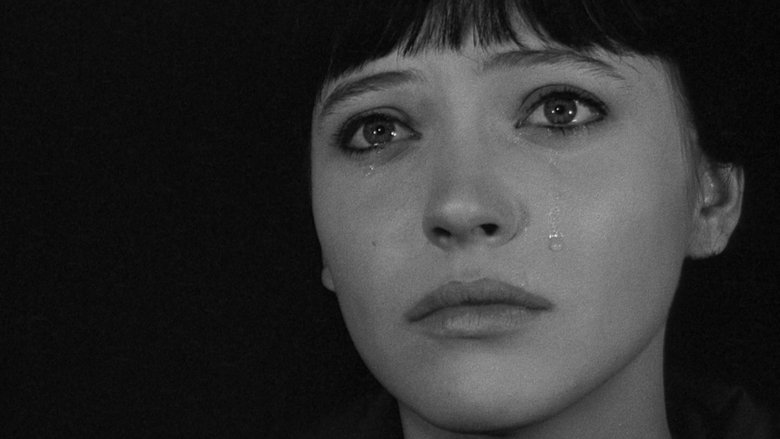
The film is self-reflexive (meta-cinema). By showing Nana crying while watching The Passion of Joan of Arc, Godard links her suffering to cinematic martyrdom, blurring the line between the character Nana, the actress Anna Karina, and the history of film itself.

Character Analysis

Nana Kleinfrankenheim

Anna Karina

Archetype: Tragic Heroine / The Drifter
Key Trait: Melancholy resilience

Motivation

To find independence and "live her life" (vivre sa vie) on her own terms, even as her options narrow.

Character Arc

She begins as a hopeful aspiring actress leaving a stifling marriage, descends into the economic necessity of prostitution, briefly finds hope in a new artistic romance, and is abruptly killed.

Raoul

Sady Rebbot

Archetype: The Pimp / The Businessman
Key Trait: Cold pragmatism

Motivation

Profit and control; he views Nana as an asset.

Character Arc

He appears initially as a stabilizing figure who offers Nana a solution to her poverty but ultimately treats her as a commodity to be traded and sold.

The Philosopher

Brice Parain

Archetype: The Mentor / The Intellectual
Key Trait: Intellectual curiosity

Motivation

To explore the limits of thought and speech.

Character Arc

He serves as a sounding board for Nana, engaging her in a dialectic about the nature of language and truth. He is not a fictional character but a real philosopher playing himself.

Symbols & Motifs

The Oval Portrait

Meaning:

Symbolizes the way art (and cinema) steals life from its subjects to create eternal beauty.

Context:

In the final tableau, the young man reads Edgar Allan Poe's story The Oval Portrait. The voice we hear is actually Godard's, acknowledging that his camera is "capturing" (and perhaps consuming) his wife, Anna Karina.

Joan of Arc

Meaning:

Represents martyrdom, silent suffering, and the power of the human face.

Context:

Nana watches Dreyer's The Passion of Joan of Arc in a theater. The cuts between Falconetti's tearful face and Nana's face link Nana's secular suffering to Joan's spiritual martyrdom.

Pinball and Jukeboxes

Meaning:

Symbols of pop culture, chance, and the fleeting, mechanical distractions of modern life.

Context:

Used throughout the cafe scenes. Nana plays pinball (a game of chance/skill) and dances to the jukebox, moments where she is most "alive" and physically free.

The Camera / The Gaze

Meaning:

Represents the objectifying male gaze that dissects Nana.

Context:

Godard often shoots Nana from behind or in clinical close-ups, emphasizing her status as an object of study rather than just a character in a story.

Memorable Quotes

The more one talks, the less the words mean.

— Nana

Context:

During her conversation with the philosopher in the cafe, struggling to articulate her feelings.

Meaning:

Expresses the film's central skepticism about language and the difficulty of authentic communication.

I think we are always responsible for our actions. We're free. I raise my hand, I'm responsible. I turn my head, I'm responsible... I forget that I'm responsible, but I am.

— Nana

Context:

Spoken to her friend Yvette in a cafe, declaring that her situation is a result of her own choices.

Meaning:

A defining existentialist manifesto. Nana asserts her agency even as she slides into a life of exploitation.

Birds are birds, plates are plates, men are men, life is life.

— Nana

Context:

Part of her dialogue exploring the nature of reality and sincerity.

Meaning:

A tautology representing a desire for simple, concrete truth in a confusing world.

Philosophical Questions

Can language ever truly express reality?

The film suggests a gap between "thinking" and "speaking." Nana feels that words betray her true thoughts, raising the Wittgensteinian idea that language has limits and that the most profound truths lie in silence or pure being.

What is the nature of freedom?

Is freedom an internal state of mind (Sartrean existentialism) that exists regardless of external chains, or is true freedom impossible when one is economically enslaved? Nana claims she is free because she is responsible, yet her material conditions trap her.

Does the camera capture the soul or steal it?

Through the Poe reference, the film questions the ethics of art. Does the artist (Godard) kill the subject (Nana/Karina) by turning her into an object for art? It explores the predatory nature of the artistic gaze.

Alternative Interpretations

Victim vs. Agent: Critics debate whether Nana is a victim of a patriarchal capitalist system or an existential heroine exercising her free will. While she ends up dead, her declaration of responsibility suggests she never saw herself as a victim.

The Director as Pimp: A meta-critical reading suggests that Godard (the director) occupies a role similar to the pimp. He "sells" images of his wife (Karina) to the audience for money. The reading of The Oval Portrait by Godard himself supports this, admitting that art drains the life from its muse.

Spiritual Redemption: Some interpret the ending not just as a tragedy, but as a form of grace or release, similar to the martyrdom of Joan of Arc, where death is the only escape from a corrupted world.

Cultural Impact

Vivre Sa Vie is widely considered one of the masterpieces of the French New Wave and a turning point in Godard's career, blending documentary realism with theatrical abstraction. Culturally, it cemented Anna Karina as the icon of the movement.

Its influence on cinema is vast. The famous "pool hall dance" scene has been referenced and paid homage to by directors like Hal Hartley (Simple Men) and Quentin Tarantino (Pulp Fiction, Bande à part). Intellectually, the film brought high philosophy (existentialism, linguistics) into the gritty setting of a B-movie plot, proving that cinema could be a vehicle for complex thought. Critics like Susan Sontag championed the film, calling it "perfect" and helping to establish Godard's reputation in the US.

Audience Reception

Contemporary: Upon release, the film was praised by critics for its visual beauty and intellectual depth but was seen as "difficult" by general audiences due to its fragmented structure and lack of traditional drama. It won the Special Jury Prize at Venice.

Modern: Today, it is universally acclaimed as one of Godard's most accessible and moving films. Audiences praise Anna Karina's luminous performance and the film's emotional resonance. Criticism is rare but sometimes targets the "coldness" of the Brechtian devices or the abruptness of the ending. The dance scene remains a universal favorite.

Interesting Facts

  • Jean-Luc Godard provided the voice for the young lover reading the Edgar Allan Poe story 'The Oval Portrait', making the scene a direct commentary on his relationship with Anna Karina.
  • The film was shot in just four weeks with a very low budget.
  • Nana's hairstyle was explicitly modeled after Louise Brooks in the 1929 film Pandora's Box, another film about a woman's tragic fall.
  • The gun battle at the end was intentionally filmed to look clumsy and unexciting, stripping the violence of any cinematic glamour.
  • Godard used direct sound recording (on location) rather than post-synchronization, which was rare for the time and gave the audio a raw, realistic quality.
  • The dialogue with the philosopher Brice Parain was unscripted; Godard gave Nana's questions to Anna Karina, but Parain's answers were improvised responses.
  • The film is structured into 12 'Tableaux' (chapters), a device inspired by the theater of Bertolt Brecht to create emotional distance.

Easter Eggs

Cinema named 'Zola'

Nana is seen standing in front of a cinema with a neon sign reading "ZOLA". This is a reference to Émile Zola, who wrote the famous novel Nana about a prostitute.

Jules et Jim

A long line of people is shown waiting to see François Truffaut's Jules et Jim. Godard and Truffaut were close friends and New Wave colleagues at the time.

The Passion of Joan of Arc

Nana watches this 1928 silent film in a theater. The scene draws a direct parallel between the actress Falconetti (Joan) and Anna Karina (Nana), both victims of male judgment.

Childhood Photo

When Nana looks at photos of her child, it is actually a real childhood photo of Anna Karina.

⚠️ Spoiler Analysis

Click to reveal detailed analysis with spoilers

Frequently Asked Questions

Explore More About This Movie

Dive deeper into specific aspects of the movie with our detailed analysis pages

Comments (0)

Leave a comment

No comments yet. Be the first to share your thoughts!