Piper
A heart-warming, nearly photorealistic animated tale of a young bird's emotional journey to overcome fear through a new, underwater perspective.
Piper

Piper

16 June 2016 United States of America 6 min ⭐ 8.1 (1,680)
Director: Alan Barillaro
Animation Family
Overcoming Fear Parenting and Independence Changing Perspective Curiosity and Learning

Overview

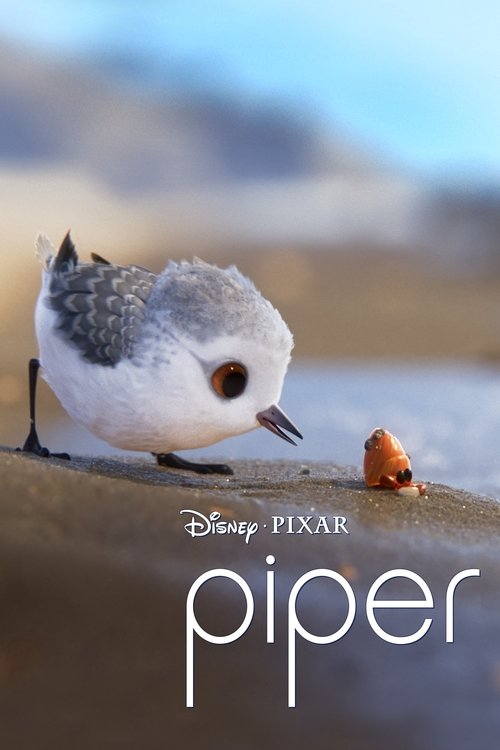
"Piper" is an animated short film from Pixar that graced theaters before "Finding Dory" in 2016. The story centers on a hungry baby sandpiper, named Piper, who is encouraged by her mother to forage for her own food along the shoreline. Initially eager, Piper is quickly traumatized and develops a fear of the water after being engulfed by a wave.

This fear prevents her from getting food, forcing her to confront her anxiety. Her perspective begins to change when she observes a young hermit crab digging into the sand to avoid the waves. By mimicking her new friend, Piper discovers the breathtakingly beautiful world beneath the water's surface, which transforms her fear into wonder and confidence.


Core Meaning

The core meaning of "Piper" revolves around the universal themes of overcoming fear and the importance of changing one's perspective. Director Alan Barillaro was inspired by his own fears as a parent, wanting to convey a message about allowing children to face challenges and learn in their own way. The film posits that fear is a natural obstacle, but by observing the world differently—in Piper's case, by looking under the water instead of fleeing from it—one can find new strengths and solutions. It is a story about resilience, celebrating the idea that conquering personal anxieties can lead to unexpected beauty, growth, and empowerment.

Thematic DNA

Overcoming Fear 35%
Parenting and Independence 30%
Changing Perspective 25%
Curiosity and Learning 10%

Overcoming Fear

This is the central theme of the film. Piper develops a crippling aquaphobia after a frightening encounter with a wave. Her journey is a classic narrative of confronting and conquering a deep-seated fear. Her hunger forces her back to the shore, and through the example of a hermit crab, she learns not to run from the waves but to dive beneath them, turning her greatest fear into her greatest asset. This transformation illustrates that facing fears can lead to empowerment and personal growth.

Parenting and Independence

The film opens with Piper's mother encouraging her to become self-sufficient. Director Alan Barillaro explicitly connected this theme to his own experiences as a parent, wanting to explore the idea of letting children learn from their own mistakes and find their own way. The mother character practices a form of tough love; she doesn't coddle Piper after her scary experience but gently nudges her toward independence, understanding that this is necessary for her survival and growth.

Changing Perspective

A crucial turning point in the film is when Piper is forced to see the ocean from a new vantage point: underwater. What was once a terrifying, formless monster becomes a beautiful, clear world filled with food. This literal change in perspective serves as a powerful metaphor for how reframing a problem can reveal solutions and dissolve fear. The film suggests that sometimes the obstacle is not the thing itself, but the way we look at it.

Curiosity and Learning

Piper's initial failure is contrasted with her eventual success, which comes from observing and learning from another creature. Her curiosity about the hermit crab leads her to discover a new technique for survival. This highlights the importance of being open to new ideas and learning from others, even those who are very different from oneself. It's a story that champions adaptation and the rewards of curiosity-driven learning.

Character Analysis

Piper

N/A (non-verbal character)

Archetype: The Innocent/Hero
Key Trait: Inquisitive

Motivation

Piper's primary motivation is hunger. Her empty, rumbling stomach is what ultimately drives her to overcome her intense fear of the ocean and seek a way to find food for herself.

Character Arc

Piper begins as a dependent and naive hatchling. After a traumatic experience with a wave, she becomes fearful and timid, refusing to leave the nest. Driven by hunger, she is forced to confront her fear. Through observation and courage, she learns a new way to interact with the world, transforming from a frightened child into a confident, skilled, and self-reliant provider for her flock. Her arc is a classic coming-of-age story condensed into a few minutes.

Piper's Mother

N/A (non-verbal character)

Archetype: The Mentor/Guardian
Key Trait: Nurturing

Motivation

Her motivation is to teach her child the necessary survival skills to become an independent adult. She acts out of love and a desire for Piper to be self-sufficient.

Character Arc

Piper's mother has a static arc, representing the steady wisdom of a parent. She begins by nudging her child towards independence, knowing it is time for Piper to learn to feed herself. Even after Piper's traumatic experience, she remains patient but firm, refusing to revert to feeding Piper directly. Her role is to provide the initial push and the safe space from which Piper can venture out and grow.

The Hermit Crab

N/A (non-verbal character)

Archetype: The Catalyst
Key Trait: Resourceful

Motivation

The hermit crab is motivated by its own survival instincts—digging into the sand to find food and protect itself from the surf. It is unaware of its role in Piper's journey.

Character Arc

The hermit crab is a flat character who serves a crucial plot function. It does not change but its actions directly cause the transformation in the protagonist. It goes about its business of survival, inadvertently showing Piper a new and effective way to deal with the waves.

Symbols & Motifs

The Ocean Waves

Meaning:

The waves symbolize life's challenges, obstacles, and fears. Initially, the wave is presented as a terrifying, overwhelming force that traumatizes Piper. It represents the anxieties that can paralyze individuals and prevent them from achieving their goals.

Context:

The waves are a constant presence on the shore. At first, Piper is drenched and terrified by a wave, causing her to retreat. Later, by diving underneath them, she discovers they are not just a threat but also the very force that reveals the food she needs. The symbol evolves from an antagonist to a neutral, manageable part of her environment.

The Hermit Crab

Meaning:

The hermit crab symbolizes mentorship and alternative ways of thinking. It represents the idea that solutions to our problems can come from unexpected places and from observing others. The crab shows Piper that there is another way to deal with the waves besides fleeing.

Context:

When Piper is frozen by fear and hunger, she observes a small hermit crab calmly digging into the sand as a wave approaches. She imitates this behavior, which leads to her epiphany. The crab acts as an unwitting mentor, providing the key to overcoming her fear.

The Underwater World

Meaning:

The underwater world symbolizes a new perspective and the beauty that can be found by facing one's fears. It is a world of clarity, abundance, and wonder that was previously hidden from Piper by her terror of the surface turmoil.

Context:

When Piper first opens her eyes underwater, the sound is muffled, the light is serene, and she sees the large, delicious clams clearly for the first time. This beautiful view transforms her relationship with the ocean from one of fear to one of excitement and opportunity.

Philosophical Questions

What is the relationship between fear and perspective?

"Piper" explores the idea that fear is often a product of a limited perspective. The ocean wave is terrifying to Piper when she sees it as a monolithic, crushing force from above the surface. However, once she sees it from below—as a temporary passage to a calm and beautiful world—her fear dissolves. The film suggests that fear is not an inherent quality of an object or situation, but is rooted in our perception of it. By changing our point of view, we can fundamentally alter our emotional response and transform a perceived threat into an opportunity.

How do we learn to be brave?

The film presents a multi-faceted answer to this question. Bravery isn't just about innate courage. For Piper, it's a process. It begins with a motivation (hunger), is sparked by observation and learning (watching the hermit crab), and is solidified through experience (surviving the wave and seeing the beauty underwater). The film posits that bravery is not the absence of fear, but the act of moving forward despite it, often with the help of new knowledge and the inspiration of others.

Alternative Interpretations

While the primary interpretation of "Piper" is a straightforward coming-of-age story about overcoming fear, other readings are possible.

  • Allegory for Anxiety: The film can be seen as a powerful allegory for social anxiety or generalized anxiety disorder. The ocean represents overwhelming social situations or life challenges that seem terrifying from the outside. Piper's initial retreat and phobia mirror the avoidance behaviors associated with anxiety. Her breakthrough comes from finding a new coping mechanism (digging in the sand) and a new perspective (the beauty underwater), suggesting that managing anxiety often requires developing new strategies and reframing one's perception of the threat.
  • Critique of Overprotective Parenting: An alternative view could focus on the mother's parenting style. While she encourages independence, one could interpret her refusal to help Piper after the traumatic event as a form of neglect. This interpretation would see Piper's success as happening *in spite of* a lack of parental support in a moment of crisis, highlighting the resilience of children even with a hands-off parenting approach. However, director Alan Barillaro has stated his intention was to portray a parent learning *not* to be overprotective, making this a less likely, though still possible, reading.

Cultural Impact

Released in 2016 alongside "Finding Dory," "Piper" was met with widespread critical and audience acclaim. Its most significant impact was winning the Academy Award for Best Animated Short Film, a prestigious honor for Pixar. The film was lauded for its groundbreaking animation, which achieved a level of photorealism rarely seen in stylized animation. The rendering of the sand, water, bubbles, and feathers was considered state-of-the-art and set a new benchmark for the medium. Critics praised its simple, dialogue-free narrative for its emotional depth and universal appeal, drawing comparisons to the storytelling style of Studio Ghibli. While its story of overcoming fear is a timeless one, the film's execution resonated strongly with audiences, who were captivated by the endearing protagonist and the stunning visuals. It is often cited as one of Pixar's best and most beloved short films.

Audience Reception

Audience reception for "Piper" was overwhelmingly positive. Viewers consistently praised the short for its stunning, near-photorealistic animation, with many noting the incredible detail in the water, sand, and bird feathers. The character of Piper was found to be exceptionally adorable and endearing, making the simple story emotionally resonant. The dialogue-free narrative was widely seen as a strength, allowing the universal themes of facing fear and growing up to be understood and felt by audiences of all ages. While a small minority of viewers found the story to be simple or cliché, the vast majority celebrated its heartfelt execution and visual beauty, with many considering it one of Pixar's best short films to date.

Interesting Facts

  • The film won the Academy Award for Best Animated Short Film at the 89th Academy Awards.
  • Director Alan Barillaro was inspired by observing sandpipers during his morning runs along the shore near Pixar Studios in Emeryville, California.
  • The project took three years to complete. It began as a software development test before being developed into a full short film with encouragement from John Lasseter and Andrew Stanton.
  • The animation team visited beaches and the Monterey Bay Aquarium to study the appearance and behavior of shorebirds to achieve a realistic look.
  • Each bird in the film has between 4.5 to 7 million individually rendered feathers.
  • Director Alan Barillaro avoided anthropomorphic features like expressive eyebrows, instead relying on realistic bird movements and feather positions to convey emotion.
  • The score was composed by Adrian Belew, known for his work with the rock band King Crimson. Barillaro had been using his music as a temporary track, and Andrew Stanton, a fan, helped connect them.

⚠️ Spoiler Analysis

Click to reveal detailed analysis with spoilers

Frequently Asked Questions

Explore More About This Movie

Dive deeper into specific aspects of the movie with our detailed analysis pages

Comments (0)

Leave a comment

No comments yet. Be the first to share your thoughts!