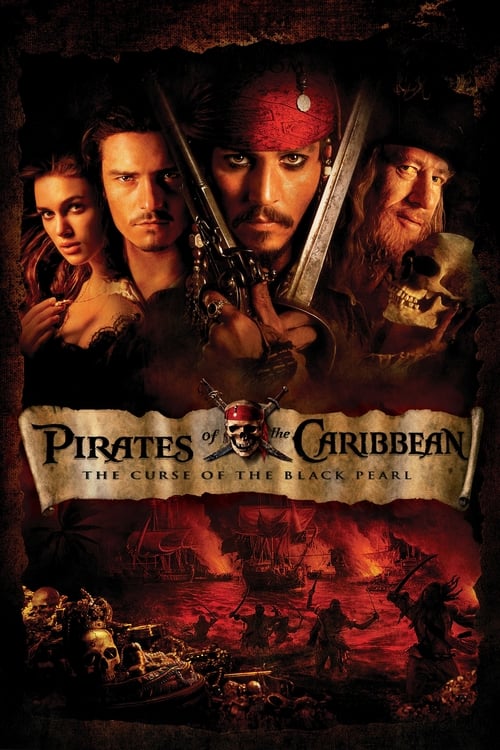
Pirates of the Caribbean: The Curse of the Black Pearl
"Prepare to be blown out of the water."
Overview
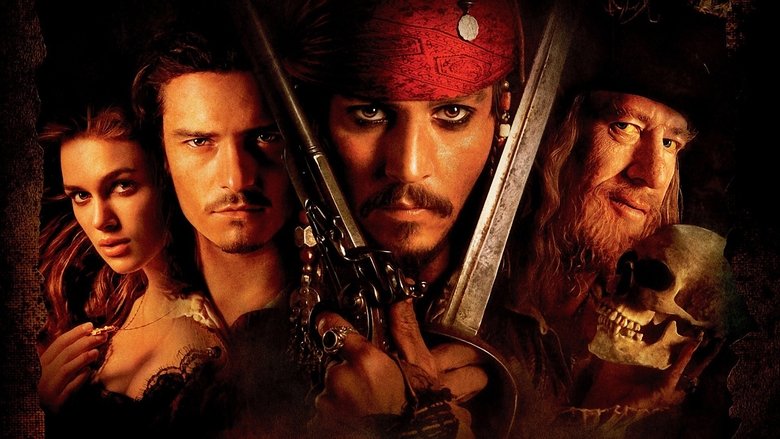
Set in the 18th century, the story begins in Port Royal, a Caribbean outpost of the British Empire. Elizabeth Swann, the daughter of the Governor, is kidnapped by the crew of the Black Pearl, a legendary pirate ship commanded by the ruthless Captain Hector Barbossa. The pirates are not mere thieves; they are afflicted by an ancient Aztec curse that transforms them into immortal skeletons under the light of the moon, leaving them unable to feel, eat, or drink.
To rescue her, the blacksmith Will Turner—who has been secretly in love with Elizabeth since childhood—forms an unlikely and volatile alliance with Captain Jack Sparrow, the eccentric and disgraced former captain of the Black Pearl. Together, they commandeer a ship from the British Navy and pursue the cursed pirates across the high seas. As they head toward the mysterious Isla de Muerta, Jack’s hidden agendas and Will’s forgotten heritage collide in a race to break the curse before the moon rises again.
Core Meaning
At its heart, the film explores the conflict between civilized order and personal liberty. It suggests that morality is not defined by the labels society bestows—such as "pirate" or "governor"—but by an individual's actions and loyalty to their own code. The director uses the supernatural curse as a metaphor for the emptiness of greed, showing that the pursuit of wealth without the ability to enjoy the simple pleasures of life is a living death. Ultimately, the film posits that a "good man" can be a pirate, and a man of the law can be blinded by his own rigid adherence to rules.
Thematic DNA
Rules vs. Guidelines
The film constantly contrasts the legalistic rigidity of the British Empire (Commodore Norrington) with the loose morality of the Pirate Code. Jack Sparrow famously dismisses the Code as "guidelines," suggesting that true justice often requires breaking the law to do what is right.
The Price of Greed
The Aztec gold represents the ultimate consequence of avarice. Barbossa and his crew are physically immortal but spiritually empty, unable to satisfy their hunger or thirst. This illustrates the idea that unrestrained desire leads to a loss of humanity.
Identity and Heritage
Will Turner must reconcile his disdain for pirates with the revelation that his father, Bootstrap Bill, was one. His journey is one of self-acceptance, moving from a repressed blacksmith to a man who embraces his "pirate blood" to save the woman he loves.
Freedom and the Sea
For Jack Sparrow, the Black Pearl is not just a vessel but a symbol of autonomy. The sea represents a space where societal constraints vanish, allowing characters like Elizabeth to shed their restrictive corsets and find their true voices.
Character Analysis
Captain Jack Sparrow
Johnny Depp
Motivation
To reclaim the Black Pearl and achieve absolute freedom on the open sea.
Character Arc
Jack begins as a marooned captain seeking revenge. While he appears selfish, his arc shows him balancing his self-interest with genuine affection for Will and Elizabeth, eventually regaining his ship through wit rather than just brutality.
Will Turner
Orlando Bloom
Motivation
To rescue Elizabeth Swann and clear his family name.
Character Arc
Will starts as a law-abiding blacksmith with a black-and-white view of morality. He undergoes a metamorphosis into a nuanced man who understands that being a pirate is a choice of character, not just a label.
Elizabeth Swann
Keira Knightley
Motivation
To escape the monotony of her social class and find true agency in her own life.
Character Arc
Elizabeth transitions from a restrained aristocrat to a daring strategist. She learns to use her intellect and femininity as weapons, eventually choosing a life of uncertainty over a secure, loveless marriage.
Captain Hector Barbossa
Geoffrey Rush
Motivation
To break the curse of the Aztec gold and satisfy his long-dormant senses.
Character Arc
Barbossa serves as a mirror to Jack. His arc is a tragic quest for mortality; he is a villain driven by the simple, relatable human desire to feel again, only to die the moment he achieves it.
Symbols & Motifs
Elizabeth's Corset
Symbolizes the stifling societal expectations and physical constraints placed upon women in the 18th century.
The film begins with Elizabeth being laced into a corset so tight she eventually faints and falls into the ocean, which triggers the pirates' arrival. Her later abandonment of the corset signifies her transition to a life of adventure.
The Aztec Gold
Represents hollow materialism and the corrupting nature of theft.
The pirates must return every single coin to the chest to end their curse. The gold "calls" to them, acting as a literal and metaphorical anchor to their misery.
Jack Sparrow's Compass
Represents inner truth and desire rather than objective direction.
Unlike a normal compass, Jack’s points toward what the holder wants most. It shows that Jack is guided by instinct and obsession rather than traditional navigation.
Barbossa's Apple
Symbolizes mortal sensation and the forbidden fruit of life.
Barbossa carries a green apple throughout the film, longing for the moment he can taste it once the curse is lifted. It represents his desperate desire to rejoin the world of the living.
Memorable Quotes
The code is more what you'd call 'guidelines' than actual rules.
— Barbossa
Context:
Said to Elizabeth when she tries to use the Pirate Code to demand her release after being taken aboard the Black Pearl.
Meaning:
Highlights the moral flexibility of the pirate world and serves as a direct rebuttal to the rigid laws of Port Royal.
You are without a doubt the worst pirate I've ever heard of.
— James Norrington
Context:
Said by Norrington upon Jack's arrest in Port Royal; Jack famously replies, "But you have heard of me."
Meaning:
Demonstrates the establishment's failure to understand Jack's unconventional genius, which relies on being underestimated.
Me? I'm dishonest, and a dishonest man you can always trust to be dishonest. Honestly. It's the honest ones you want to watch out for.
— Jack Sparrow
Context:
Said to Barbossa during the final confrontation at Isla de Muerta while Jack is secretly plotting his betrayal.
Meaning:
Reveals Jack's paradoxical philosophy: his transparency about his flaws makes him more reliable than those who hide behind a veneer of virtue.
You best start believing in ghost stories, Miss Turner... you're in one!
— Barbossa
Context:
Barbossa steps into the moonlight, revealing his skeletal form to a terrified Elizabeth.
Meaning:
A chilling tonal shift that confirms the film's transition from historical adventure to supernatural fantasy.
Philosophical Questions
What constitutes a 'good man' outside the boundaries of the law?
The film explores this through Will Turner, who realizes that a man can be a pirate and still be 'good,' while a Commodore can follow the law and yet be morally stagnant.
Is immortality a gift or a prison?
The pirates' curse shows that existence without sensation is a form of purgatory, suggesting that mortality is essential to the human experience.
Alternative Interpretations
Critics have often discussed the film as a political allegory. One reading suggests it represents the struggle between the Leviathan (the British Empire's state power) and the Social Contract of the pirates, where Jack represents a form of radical individualism. Another interpretation focuses on the sexual symbolism of the corset and the sword, viewing the film as Elizabeth's coming-of-age journey through the reclamation of her own physical and metaphorical agency.
Cultural Impact
The film is credited with reviving the pirate genre, which had been considered "box office poison" after the failure of Cutthroat Island (1995). It launched one of the highest-grossing film franchises of all time and cemented Johnny Depp's status as a global superstar. Jack Sparrow became a pop culture icon, influencing character archetypes in video games, literature, and subsequent action films. Moreover, it proved that theme park rides could be successfully adapted into complex, narratively rich cinema, paving the way for a new era of IP-driven blockbusters.
Audience Reception
The film was a massive surprise hit, earning over $654 million worldwide. Audiences were particularly captivated by Johnny Depp's eccentric performance, which was initially feared by Disney executives to be "too weird." While the film was praised for its balance of humor, horror, and action, some critics felt the 143-minute runtime was slightly bloated. However, the visual effects (the skeletons in moonlight) and Hans Zimmer's iconic score were universally lauded.
Interesting Facts
- Johnny Depp based his performance as Jack Sparrow on Rolling Stones guitarist Keith Richards and the cartoon character Pepe Le Pew.
- The film was the first Walt Disney Pictures production to receive a PG-13 rating in the United States.
- During the blacksmith shop fight, the 'dirt' on Orlando Bloom's face was actually chocolate powder.
- The character of Jack Sparrow was originally written with Hugh Jackman in mind, but the studio opted for Depp to bring more star power.
- The 'air pocket' scene with the inverted boat was a nod to a similar scene in the 1952 film 'The Crimson Pirate'.
- Geoffrey Rush stood on the left side of the screen as much as possible because he believed audiences look from left to right, ensuring he wouldn't be overshadowed by the 'eye candy' of Knightley and Bloom.
Easter Eggs
The Dog with the Keys
A direct reference to the original Disneyland ride, where a group of prisoners tries to lure a dog holding the keys to their cell with a bone.
Mickey in the Moon
When the curse is broken and the smoke clears at the end, the craters on the moon briefly form the shape of a Hidden Mickey.
Tortuga Cameos
Several background pirates in the Tortuga scenes are dressed in costumes that are exact replicas of the animatronic figures from the theme park attraction.
⚠️ Spoiler Analysis
Click to reveal detailed analysis with spoilers
Frequently Asked Questions
Explore More About This Movie
Dive deeper into specific aspects of the movie with our detailed analysis pages
Comments (0)
No comments yet. Be the first to share your thoughts!