Finding Nemo
"There are 3.7 trillion fish in the ocean. They're looking for one."
Overview
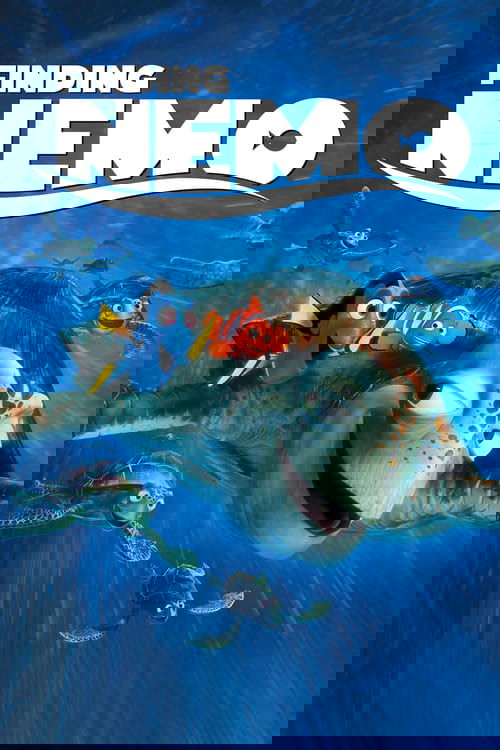
Finding Nemo is a landmark 2003 animated adventure that follows the high-stakes journey of Marlin, a neurotic clownfish living in the Great Barrier Reef. After a tragic predator attack leaves him a widower with a single surviving egg, Marlin becomes obsessively overprotective of his son, Nemo. However, Nemo's rebellious act of defiance leads to his capture by a scuba diver, who takes the young fish to a dentist's office aquarium in Sydney, Australia.
The narrative unfolds through two parallel paths: Marlin's epic quest across the vast, unpredictable ocean and Nemo's struggle to escape his glass prison alongside a motley crew of aquarium residents. Along the way, Marlin is joined by Dory, a cheerful blue tang with short-term memory loss, whose optimistic outlook and "just keep swimming" philosophy challenge Marlin's fearful worldview. The film balances humor with genuine peril, creating a deeply emotional story about the complexities of parenthood and the necessity of risk in a full life.
Core Meaning
The core of the film explores the transformative power of vulnerability and trust. Director Andrew Stanton sought to illustrate that while the world is undeniably dangerous, overprotection is its own kind of prison. The movie suggests that true love involves empowering those we care about to face the world on their own terms, rather than shielding them from every possible harm. It is a meditation on the five stages of grief, as Marlin must move from the trauma of his past to an acceptance of life's inherent uncertainties.
Thematic DNA
Parental Love and Overprotection
Marlin's arc centers on the struggle to balance safety with independence. The film reveals that his "helicopter parenting" is a trauma response that inadvertently hinders Nemo's growth, ultimately showing that protecting a child means preparing them for the world, not hiding them from it.
Perseverance and Optimism
Represented by the iconic mantra "Just keep swimming," this theme highlights the importance of moving forward despite mental or physical obstacles. Dory's resilience in the face of her disability proves that a positive spirit can navigate even the darkest depths.
The Beauty and Danger of the Unknown
The ocean serves as a dual metaphor for life—vast, terrifying, and filled with predators, yet simultaneously breathtaking and filled with wonders like the EAC. The film argues that avoiding the "Drop-off" prevents one from experiencing the richness of existence.
Living with Disability
Through Nemo's "lucky fin" and Dory's short-term memory loss, the film portrays differences not as flaws to be fixed, but as unique traits that require adaptation and can lead to unexpected strengths and heroic moments.
Character Analysis
Marlin
Albert Brooks
Motivation
Driven by the primal need to keep his only surviving family member safe from a world he perceives as entirely hostile.
Character Arc
Marlin begins as a traumatized, fear-driven neurotic who believes control equals safety. By the end, he evolves into a brave traveler who trusts his son's capabilities and learns to find humor in life again.
Dory
Ellen DeGeneres
Motivation
To find friendship and help others, living entirely in the present moment because she cannot retain the past.
Character Arc
Dory provides the emotional catalyst for Marlin's change. While her memory loss remains, she finds a sense of home and belonging through her bond with Marlin, proving that connections transcend biological family.
Nemo
Alexander Gould
Motivation
To prove his independence and return to the reef, demonstrating that he is not defined by his physical handicap.
Character Arc
Nemo moves from being a frustrated child under his father's thumb to a resourceful leader who saves a school of fish, proving he is more capable than his father ever imagined.
Gill
Willem Dafoe
Motivation
Obsessed with returning to the ocean, he sees a reflection of his own physical scars and drive in Nemo.
Character Arc
Gill finds redemption through Nemo; after years of failed escape attempts, he realizes that mentoring the next generation is the key to collective freedom.
Symbols & Motifs
Nemo's 'Lucky Fin'
Symbolizes perceived limitations and the resilience required to overcome them. It represents the scars of the past that Marlin fears but Nemo eventually treats as a badge of courage.
Introduced in the opening scene as a result of the barracuda attack; later used to block the tank filter, proving that his "weakness" is actually a source of strength.
The 'Butt' (Boat)
Symbolizes rebellion and the threshold between childhood and the adult world. It represents the dangerous allure of independence that children seek and parents fear.
Nemo touches the boat as an act of defiance against Marlin's caution, serving as the catalyst for the entire adventure.
The Glass Fish Tank
Represents stagnation and artificial safety. It is a sterile environment that offers protection from the ocean's predators but denies the inhabitants their freedom and natural purpose.
The setting for the B-plot, where Gill and the Tank Gang plot their escape back to the chaotic but authentic ocean.
The EAC (East Australian Current)
Symbolizes letting go and going with the flow of life. It represents the shift from rigid control to trusting the journey.
Marlin must literally dive into a chaotic vortex to make progress, guided by the laid-back wisdom of the sea turtles.
Memorable Quotes
Just keep swimming. Just keep swimming. Just keep swimming, swimming, swimming.
— Dory
Context:
Spoken by Dory when Marlin is at his lowest point in the dark ocean, encouraging him to keep moving despite the lack of a clear path.
Meaning:
The film's most famous line, serving as a philosophy for overcoming depression and hardship through unrelenting persistence.
Fish are friends, not food.
— Bruce
Context:
The pledge recited by the "vegetarian" sharks during their support group meeting in a sunken submarine.
Meaning:
Represents the theme of overcoming one's nature and the struggle to live by higher principles, even when instincts scream otherwise.
You were my lucky fin.
— Marlin
Context:
Said during the emotional reunion, where Marlin finally validates Nemo's identity rather than just his safety.
Meaning:
A poignant realization that Marlin's obsession with Nemo's "weakness" was actually his own source of hope and strength.
Well, you never really know, but when they know, you'll know. You know?
— Crush
Context:
Crush the sea turtle gives this advice to Marlin as they watch the younger turtles navigate the EAC.
Meaning:
Encapsulates the zen of parenting: the realization that children will signal when they are ready for independence if the parent is willing to listen.
Philosophical Questions
Does total safety negate the meaning of life?
The film explores the existential trade-off between security and experience. Marlin's desire to 'not let anything happen' to Nemo is shown to be equivalent to not letting Nemo 'live' at all, suggesting that risk is the price of meaning.
Is memory the foundation of identity?
Through Dory, the film asks if one can have a soul and a sense of belonging without a past. Dory's identity is forged through her current actions and kindness rather than her history, challenging the idea that we are only the sum of our memories.
Alternative Interpretations
Critics and fans have proposed several alternative readings:
- The Grief Theory: A popular (though debunked) dark theory suggests Nemo died in the opening attack, and the name 'Nemo' (Latin for 'No One') implies the entire journey is Marlin's journey through the five stages of grief (Denial, Anger, Bargaining, Depression, and finally Acceptance).
- Religious Parallels: Some interpret the scene where the fish 'swim down' to break the net as a metaphor for collective spiritual transcendence or a critique of industrial consumerism (the fishing industry).
- Disability Allegory: Scholars often analyze the film as a breakthrough for disability representation, viewing the tank as a segregated 'special needs' space and the ocean as an integrated society.
Cultural Impact
Finding Nemo was a seismic event in animation, becoming the highest-grossing G-rated film of all time upon release and winning Pixar its first Academy Award for Best Animated Feature. It fundamentally changed how parents viewed the 'overprotective' archetype in cinema, moving away from simple slapstick toward deep psychological resonance. The film also had a significant environmental impact, known as the "Nemo Effect," which saw a massive surge in demand for clownfish as pets—ironically contradicting the film's "all drains lead to the ocean" message of liberation. It remains a cornerstone of 2000s pop culture, with Dory's catchphrases embedded in the global lexicon.
Audience Reception
The film received near-universal acclaim, boasting a 99% rating on Rotten Tomatoes. Audiences were particularly moved by the opening sequence's emotional weight—often compared to Bambi or The Lion King. Criticism was virtually non-existent, though some marine biologists noted that the film's popularity led to harmful harvesting of wild clownfish. Overall, it is celebrated as a rare 'perfect' film that bridges the gap between slapstick comedy for children and profound emotional truth for adults.
Interesting Facts
- To achieve the authentic 'undersea' look, Pixar's technical team studied the physics of light through water, but they actually had to make the water look LESS realistic because the initial tests looked like live-action footage.
- The character of Gill was originally written with a much more villainous tone, but the team felt his role as a mentor with a shared disability was more impactful.
- The name 'Nemo' means 'No one' or 'Nobody' in Latin, which has led to numerous dark fan theories about the film's reality.
- Director Andrew Stanton voiced the surfer-turtle Crush; his performance was initially a placeholder but was so well-liked by test audiences that it was kept in the final film.
- The animators took a crash course in ichthyology (the study of fish) to ensure the movements were believable while still allowing for expressive, human-like faces.
Easter Eggs
Buzz Lightyear on the waiting room floor
A classic Pixar tradition of hiding characters from previous or future films. Buzz Lightyear can be seen lying near the toy box in the dentist's office.
The Pizza Planet Truck
The iconic yellow truck from Toy Story appears as a passing vehicle outside the dentist's office when Gill is explaining his escape plan.
A-113 on the Scuba Diver's Camera
A reference to the classroom at CalArts where many Pixar animators studied. It appears as the model number on the camera used to capture Nemo.
Mr. Incredible Comic Book
A boy in the dentist's waiting room is reading a comic featuring Mr. Incredible, a teaser for Pixar's next film, The Incredibles (2004).
⚠️ Spoiler Analysis
Click to reveal detailed analysis with spoilers
Frequently Asked Questions
Explore More About This Movie
Dive deeper into specific aspects of the movie with our detailed analysis pages
Comments (0)
No comments yet. Be the first to share your thoughts!