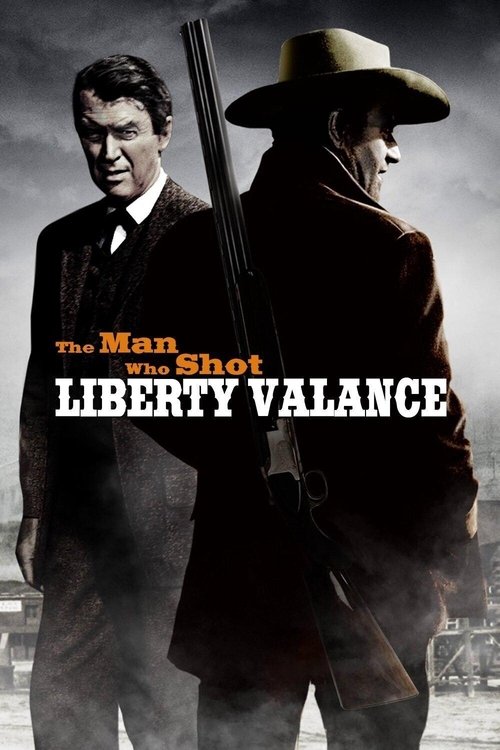
The Man Who Shot Liberty Valance
"Together for the first time"
Overview
The Man Who Shot Liberty Valance is a seminal 1962 Western that explores the transition of the American West from a lawless frontier to a civilized society. The story is told largely in flashback, framed by the return of Senator Ransom Stoddard and his wife Hallie to the small town of Shinbone for the funeral of an obscure, forgotten man named Tom Doniphon. When curious local reporters press the influential Senator for the reason behind his visit, he recounts the events that led to his political rise and the taming of the territory.
Decades earlier, Stoddard arrived in Shinbone as an idealistic young lawyer armed only with lawbooks, but he was immediately brutalized by the sadistic outlaw Liberty Valance. While Stoddard attempted to bring Valance to justice through legal means and education, the rugged rancher Tom Doniphon argued that in the West, only force could stop such a man. The film focuses on the ideological clash between Stoddard’s belief in the rule of law and Doniphon’s mastery of the gun, set against a backdrop of a territory struggling for statehood and the love both men share for Hallie.
Core Meaning
The core meaning of the film lies in the cost of civilization and the duality of history. John Ford suggests that the orderly, peaceful society represented by the modern United States was built upon foundations of violence that it subsequently had to disavow or mythologize. The director posits that the transition from "Wild West" to "Law and Order" required the sacrifice of the very men (like Tom Doniphon) who made that transition possible, and that the resulting "legends" we live by are often sanitized lies necessary to sustain national identity.
Thematic DNA
Legend vs. Fact
Revealed through the famous line, "When the legend becomes fact, print the legend." The film examines how historical narratives are constructed not from truth, but from the heroic myths that a society needs to believe in itself.
Law vs. Violence
The conflict between Ransom Stoddard's lawbooks and Liberty Valance's whip. It explores the paradox that law cannot establish itself without a precursor of decisive, often extra-legal violence to clear the path.
The Vanishing Frontier
Tom Doniphon represents the old way of life—noble but obsolete. As the desert becomes a garden and the railroad arrives, the rugged individualist is replaced by the politician and the bureaucrat.
Sacrifice and Heroism
Tom Doniphon’s tragic arc reveals that true heroism often goes unrecorded. He commits a moral sin (shooting a man from the shadows) to allow the idealist Stoddard to flourish, losing his home and his love in the process.
Character Analysis
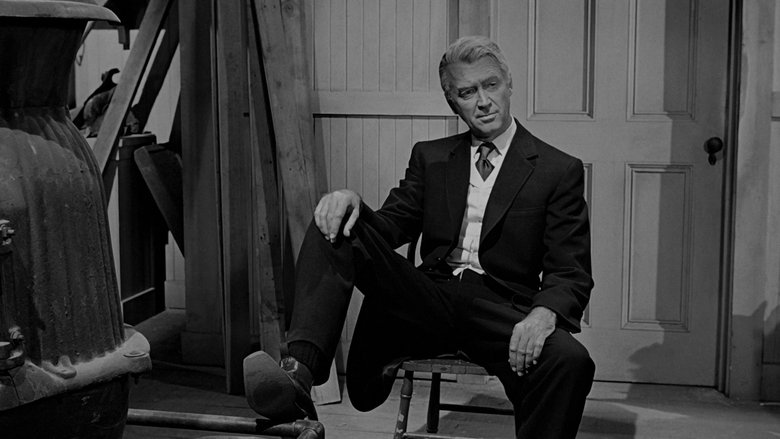
Ransom Stoddard
James Stewart
Motivation
To bring the rule of law and education to the wilderness, believing that books are more powerful than guns.
Character Arc
Transitions from a battered, idealistic lawyer to a powerful, guilt-ridden Senator whose entire career is built on a secret foundation of violence.
Tom Doniphon
John Wayne
Motivation
Protecting Hallie and his community, even if it means destroying his own future and his moral code.
Character Arc
A man of action who realizes he is helping to build a world in which he has no place, ending his life in obscurity and poverty.
Liberty Valance
Lee Marvin
Motivation
Maintaining the lawless status quo for the cattle barons who employ him and indulging his own sadistic impulses.
Character Arc
Remains a static force of pure malice and anarchy until his violent death.
Hallie Stoddard
Vera Miles
Motivation
Desire for self-improvement and a stable life, though she remains emotionally tied to the wilder West.
Character Arc
An illiterate kitchen hand who learns to read and becomes a lady of the state, but carries a lifelong melancholy for the man she left behind.
Symbols & Motifs
The Cactus Rose
Symbolizes the wild beauty of the West being domesticized, as well as Tom Doniphon’s unrequited, enduring love for Hallie.
Doniphon gives a cactus rose to Hallie early in the film; years later, an aged Hallie places one on Tom’s plain pine coffin, signifying her true heart remained with him.
The Lawbook
Represents civilization, reason, and the future.
Liberty Valance tears up Stoddard's lawbooks when they first meet, signaling his rejection of the encroaching social order.
The Apron
Symbolizes domesticity and the loss of traditional masculinity.
Stoddard wears an apron while working in the kitchen to pay his board, a detail Valance uses to mock his lack of "manly" Western traits.
The Shinbone Star
Represents the voice of the community and the engine of myth-making.
The newspaper office serves as a hub for the town's growth, eventually becoming the place where the decision to "print the legend" is made.
Memorable Quotes
This is the West, sir. When the legend becomes fact, print the legend.
— Maxwell Scott
Context:
The newspaper editor says this after hearing Stoddard's true account of the shooting and deciding not to publish it.
Meaning:
The central thesis of the film, suggesting that national myths are more important to society than the messy, unheroic truth.
Whoa, take it easy, Pilgrim.
— Tom Doniphon
Context:
Doniphon's recurring address to Stoddard throughout the film.
Meaning:
Highlights the divide between the experienced frontiersman and the naive newcomer.
I'm not going to be a part of it! I don't want a political career that was started by... murder!
— Ransom Stoddard
Context:
Stoddard yelling at Doniphon at the territorial convention after realizing the truth.
Meaning:
Reveals Stoddard's internal crisis when he believes his success is founded on an act of violence he spent his life opposing.
Philosophical Questions
Can a just society be founded on an unjust act?
The film explores this through Stoddard’s career, which is based on a lie and a killing, yet leads to statehood, schools, and the rule of law. It asks if the 'ends' of civilization justify the 'means' of murder.
Is a useful myth more valuable than a destructive truth?
Through the 'Print the Legend' philosophy, the film challenges the viewer to consider if society needs heroic stories—even false ones—to function and maintain social cohesion.
Alternative Interpretations
Some critics interpret the film as an indictment of Ransom Stoddard, viewing him not as a hero but as a parasitic figure who consumes Doniphon's life and Hallie's love to fuel his own ambition. Another reading suggests that Hallie is the true protagonist, and her choice between the two men represents the American soul's internal conflict between its wild, violent origins and its civilized, domesticated present. Modern interpretations often focus on the racial subtext provided by Pompey (Woody Strode), seeing him as the true 'forgotten man' of the West whose contribution to civilization is even more erased than Doniphon's.
Cultural Impact
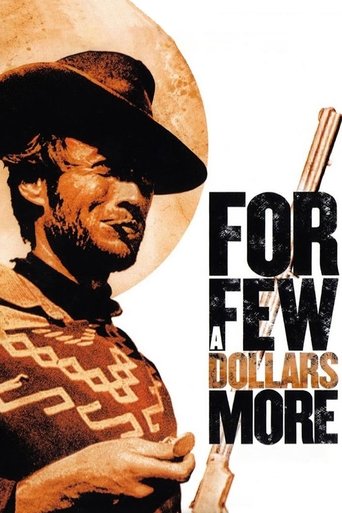
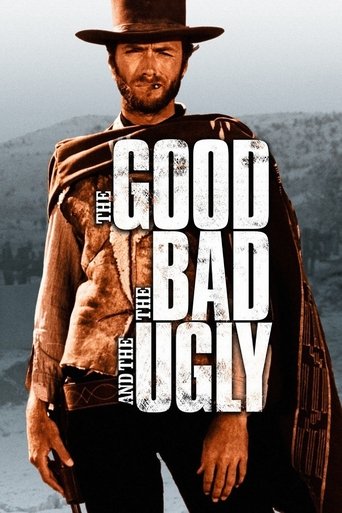
The Man Who Shot Liberty Valance is widely regarded as one of the greatest Westerns ever made and a turning point in the genre. It marks the transition from the "classical" Western of the 1940s and 50s to the "revisionist" Westerns of the late 60s and 70s. By questioning the very myths John Ford himself helped create in films like Stagecoach, it provided a blueprint for later filmmakers like Sergio Leone and Clint Eastwood to explore the darker, more cynical side of the frontier. It remains a fixture in political and philosophical discussions regarding the nature of truth in democracy and the role of the press.
Audience Reception
Upon its initial release in 1962, the film received mixed-to-positive reviews, with some critics finding the soundstage-bound production 'stagy' and the leads too old for their parts. However, it was a solid box office success. Over the decades, its reputation has grown exponentially; it is now considered a complex masterpiece. Modern audiences praise the performances of Wayne and Stewart, Lee Marvin's terrifying turn as Valance, and the film's haunting, elegiac tone. It currently holds a very high rating on aggregators like Rotten Tomatoes and IMDb.
Interesting Facts
- John Ford chose to shoot in black and white not just for aesthetic reasons, but to hide the fact that John Wayne (54) and James Stewart (53) were far too old for their youthful roles.
- The film was shot almost entirely on Paramount soundstages rather than on location in Monument Valley, giving it a claustrophobic, theatrical feel.
- The hit song 'The Man Who Shot Liberty Valance' by Gene Pitney was written for the film but was never actually included in the movie itself.
- Director John Ford was notoriously abusive to John Wayne during the shoot, mocking his lack of military service to keep him on edge for his role as a man who feels obsolete.
- Lee Marvin's whip was real, and he actually struck James Stewart during the famous restaurant scene, causing genuine pain.
Easter Eggs
Young Mr. Lincoln Theme
Ford reuses the musical theme from his 1939 film Young Mr. Lincoln (composed by Alfred Newman) during the scene where Hallie views Tom's body, connecting the myth of Lincoln to the myth of the West.
Ford's Stock Company
The film features almost all of Ford's regular character actors (John Carradine, Andy Devine, John Qualen, Woody Strode), serving as a cumulative 'curtain call' for his cinematic family.
⚠️ Spoiler Analysis
Click to reveal detailed analysis with spoilers
Frequently Asked Questions
Explore More About This Movie
Dive deeper into specific aspects of the movie with our detailed analysis pages
Comments (0)
No comments yet. Be the first to share your thoughts!