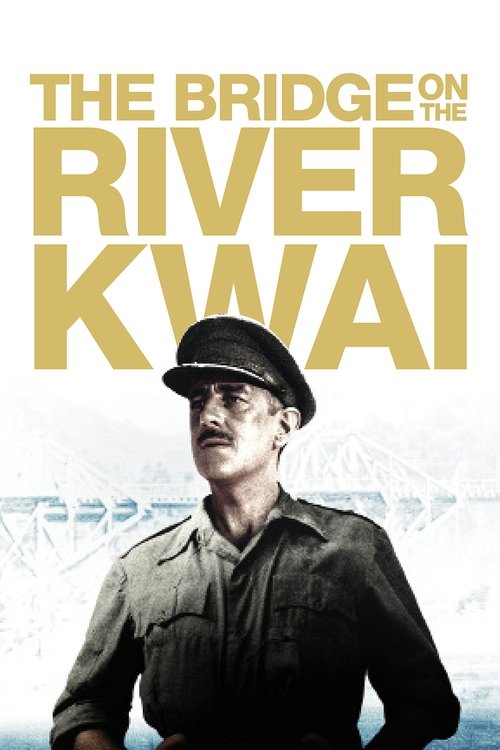
The Bridge on the River Kwai
"It spans a whole new world of entertainment!"
Overview
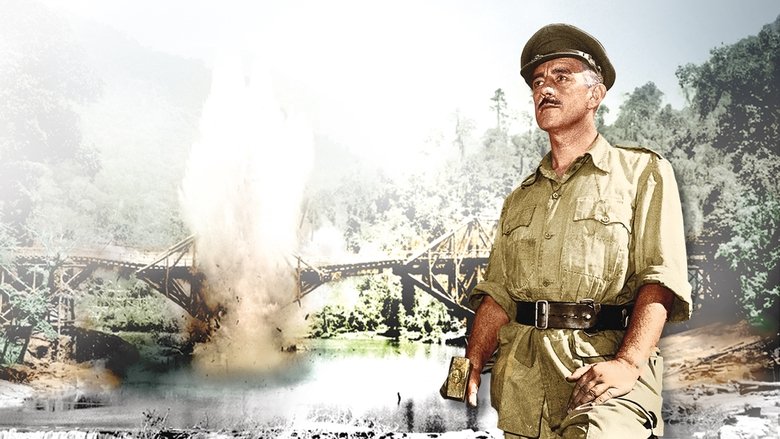
Set in 1943 during World War II, the film follows a company of British prisoners of war led by the uncompromising Colonel Nicholson as they arrive at a Japanese labor camp in the sweltering jungles of Thailand. The camp commandant, Colonel Saito, demands that the prisoners construct a railway bridge over the River Kwai to facilitate the Japanese war effort. A fierce battle of wills ensues when Nicholson refuses to allow his officers to perform manual labor, citing the Geneva Convention, leading to his brutal confinement in a corrugated iron hut known as 'the oven.'
As Nicholson eventually wins his psychological war against Saito, he becomes obsessively devoted to building a superior bridge to prove British ingenuity and maintain the morale of his men. Meanwhile, an American sailor named Shears, who successfully escaped the camp, is blackmailed into joining a British commando team on a perilous mission to return to the jungle and destroy the very bridge Nicholson is so proudly perfecting. The narrative threads collide in a suspenseful finale where the concepts of honor, duty, and patriotism are pushed to a breaking point.
Core Meaning
At its heart, The Bridge on the River Kwai is a profound meditation on the absurdity and futility of war. David Lean explores how high-minded ideals like 'duty' and 'honor' can transform into dangerous obsessions that blind individuals to the larger consequences of their actions. The film suggests that while human achievement is noble, it becomes a form of madness when it serves an inhumane cause. By the end, the distinction between 'hero' and 'villain' is blurred by a shared hubris, leaving only the wreckage of a project that both sides sacrificed everything to create or destroy.
Thematic DNA
The Absurdity of War
The film highlights the nonsensical nature of conflict through the actions of men who follow rules to the point of self-destruction. This is epitomized by Major Clipton's final exclamation of 'Madness!' as he witnesses the carnage of the finale.
Duty vs. Hubris
Colonel Nicholson's rigid adherence to military code begins as a survival tactic but devolves into a prideful obsession. His desire to build a 'proper' bridge for the enemy is a tragic example of duty being corrupted by personal ego.
The Clash of Cultures
The psychological duel between Nicholson and Saito represents the collision of Western military law and the Eastern code of Bushido. Both men are prisoners of their own cultural expectations and the need to 'save face.'
Survival vs. Sacrifice
The character of Shears provides a cynical counterpoint to the 'heroics' of the British officers. His pragmatic focus on staying alive contrasts with the commandos' willingness to die for a tactical objective, questioning what truly defines courage.
Discipline and Morale
Nicholson uses the construction project to restore the dignity and hierarchy of his defeated battalion, showing how work and order can prevent the mental collapse of men in captivity.
Character Analysis
Colonel Nicholson
Alec Guinness
Motivation
Driven by an intense need to uphold British prestige and restore the morale of his regiment through a display of superior skill.
Character Arc
Nicholson moves from a principled defender of his men's rights to a man whose narrow focus on engineering excellence leads him to inadvertently aid the enemy, ending in a moment of horrific self-realization.
Commander Shears
William Holden
Motivation
Purely motivated by self-preservation and a desire to escape the 'heroic' madness of the military.
Character Arc
Initially an opportunist who impersonates an officer to survive, Shears is forced into a role of reluctant heroism, eventually sacrificing his life for a cause he spent the whole film mocking.
Colonel Saito
Sessue Hayakawa
Motivation
To complete the bridge by the deadline to avoid the shame of ritual suicide (Seppuku).
Character Arc
A commander trapped between his duty to the Emperor and his secret admiration for Nicholson's resolve. He begins as a tyrant and ends as a broken man whose authority has been usurped by his prisoner.
Major Warden
Jack Hawkins
Motivation
The successful completion of the sabotage mission at any price.
Character Arc
Representing the cold efficiency of the Allied high command, Warden remains focused solely on the destruction of the target, regardless of the human cost.
Symbols & Motifs
The Bridge
Symbolizes the double-edged nature of achievement. To Nicholson, it is a monument to British civilization; to the Japanese, a vital military asset; to the commandos, a target. It ultimately represents the fragile intersection of pride and utility.
The bridge is the physical and narrative centerpiece of the film, evolving from a site of slave labor into a grand structure that dominates the landscape.
The 'Colonel Bogey March' (Whistle)
Symbolizes defiance and the preservation of spirit. It serves as an auditory 'middle finger' to the captors, signaling that the prisoners' minds have not been conquered.
Introduced when the POWs first march into the camp, the jaunty tune contrasts sharply with their ragged appearance and dire situation.
The Oven
Represents the unyielding weight of oppression and the physical cost of holding onto one's principles.
The small metal box where Nicholson is held in the blistering sun to break his spirit.
The River Kwai
Symbolizes nature's indifference to human conflict. It flows continuously, eventually washing away the debris of the men's vanity.
The river serves as the boundary between the orderly bridge and the chaotic, untamed jungle.
Memorable Quotes
What have I done?
— Colonel Nicholson
Context:
Whispered at the bridge as the commandos' wiring is revealed and the train approaches.
Meaning:
The film's most haunting line, marking the moment Nicholson's 'fog of war' lifts and he realizes his pride has blinded him to his duty to his own country.
Madness! Madness!
— Major Clipton
Context:
The final line of the film, spoken as Clipton looks down at the dead bodies and the wreckage of the bridge.
Meaning:
The definitive verdict on the entire situation. It encapsulates the director's anti-war stance by framing the events as a collective insanity.
Be happy in your work.
— Colonel Saito
Context:
Part of Saito's initial speech to the newly arrived POWs.
Meaning:
A chillingly ironic sentiment that underscores the dehumanization of the prisoners into mere 'useful labor' for the Japanese machine.
How to die like a gentleman... when the only important thing is how to live like a human being.
— Commander Shears
Context:
Shears venting his frustration to Major Warden during their grueling trek through the jungle.
Meaning:
A critique of the rigid military codes of honor that prioritize ritualistic death over the value of human life.
Philosophical Questions
Is achievement meaningful if it serves an evil cause?
The film examines Nicholson's pride in his work. He builds a bridge that will last 600 years, but it is used to transport troops for a genocidal regime. It asks if 'craftsmanship' can ever be neutral.
What is the true nature of 'honor' in a lawless environment?
Both Saito and Nicholson are bound by codes (Bushido and the Geneva Convention) that they prioritize over their own survival, yet these codes eventually lead them both to disaster.
Alternative Interpretations
A major point of debate is whether Nicholson's final fall onto the detonator was an accidental stumble caused by a mortar blast or a final act of redemption. Some critics argue he intentionally depressed the plunger to rectify his error, while others believe the tragedy is deeper if it was a purely accidental event, suggesting that fate—not the characters' will—ultimately decided the bridge's fate. Another reading suggests the film is pro-British in its depiction of ingenuity and discipline, while some British veterans at the time viewed it as anti-British for showing an officer aiding the enemy.
Cultural Impact
The film was a massive critical and commercial success, winning seven Academy Awards and cementing David Lean's reputation as the master of the 'intimate epic.' It signaled a transition in British cinema from the modest, stage-like productions of the early 50s to the grand, Hollywood-financed spectacles. Historically, it sparked significant controversy among POW survivors who felt the portrayal of Nicholson as a 'collaborator' was an insult to the real soldiers who suffered under the Japanese. Despite this, it remains one of the most culturally significant war films, cited for its psychological depth and its refusal to rely on typical 'good vs. evil' tropes.
Audience Reception
At the time of release, audiences were captivated by the film's technical scale and its tense, character-driven narrative. It was the highest-grossing film of 1957. While general audiences praised Alec Guinness's transformation, Japanese audiences initially objected to the depiction of their engineers as 'incompetent.' Modern audiences continue to laud the film for its pacing and its refusal to provide easy moral answers, though modern historians often point out that the real POW conditions were significantly more horrific than the 'sanitized' version depicted on screen.
Interesting Facts
- The screenplay was written by Carl Foreman and Michael Wilson, who were blacklisted in Hollywood at the time. The Oscar went to Pierre Boulle, the author of the novel, who didn't even speak English.
- The bridge built for the film was a real, functional structure in Sri Lanka (then Ceylon) that cost $250,000 to construct and took 8 months to build.
- The real Colonel on whom Nicholson was loosely based, Philip Toosey, did not collaborate; he actually encouraged his men to sabotage the bridge in subtle ways.
- William Holden negotiated a deal for 10% of the film's gross, which eventually made him one of the wealthiest actors of the era.
- The iconic 'Colonel Bogey March' whistling was a compromise because the original lyrics ('Hitler Has Only Got One Ball') were too vulgar for the censors.
- The explosion of the bridge was delayed by a day because a cameraman failed to give a signal and nearly died in the blast zone during the first attempt.
- The river in Thailand where the real bridge stood was originally called the Mae Klong; it was renamed 'Khwae Yai' after the film's success to accommodate tourists.
Easter Eggs
Matthew Guinness Cameo
Alec Guinness's son, Matthew, appears as one of the uncredited British POWs in the marching sequences, providing a small family connection to the epic production.
David Lean's 'Signature' Horizon
The film features Lean's emerging obsession with the 'mirage' effect on the horizon, which he would later perfect in Lawrence of Arabia.
⚠️ Spoiler Analysis
Click to reveal detailed analysis with spoilers
Frequently Asked Questions
Explore More About This Movie
Dive deeper into specific aspects of the movie with our detailed analysis pages
Comments (0)
No comments yet. Be the first to share your thoughts!