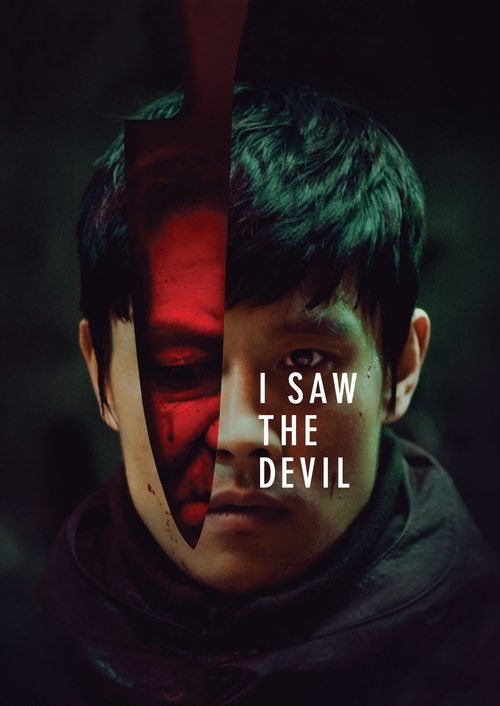
I Saw the Devil
A visceral psychological thriller where the boundary between hunter and prey dissolves into a crimson abyss of nihilistic rage. Revenge is a jagged blade that carves the humanity out of its wielder.
I Saw the Devil

I Saw the Devil

악마를 보았다

"Abandon all compassion."

12 August 2010 South Korea 144 min ⭐ 7.8 (2,859)
Director: Kim Jee-woon
Cast: Lee Byung-hun, Choi Min-sik, Jeon Kuk-hwan, Cheon Ho-jin, Oh San-ha
Thriller Horror
The Futility of Revenge The Humanization of Evil Grief as a Destructive Force The Nature of Psychopathy
Budget: $6,000,000
Box Office: $12,966,357

Overview

I Saw the Devil (2010) is a relentlessly grim South Korean masterpiece that subverts the traditional cat-and-mouse thriller. The story begins with the brutal murder of Jang Joo-yun, the fiancée of elite National Intelligence Service (NIS) agent Kim Soo-hyun. Devastated and consumed by a cold, calculative fury, Soo-hyun identifies the killer as the psychopathic Jang Kyung-chul, a man who murders without motive or mercy. However, instead of delivering Kyung-chul to the authorities or granting him a quick death, Soo-hyun embarks on a sadistic cycle of 'catch and release.'

Equipped with a swallowed tracking device, the killer becomes the victim in a twisted game where Soo-hyun inflicts agonizing physical pain before letting him go, only to hunt him down again. As the violence escalates and collateral damage mounts, the film explores the terrifying reality of what happens when a good man decides to fight a monster by becoming one himself. It is a descent into depravity that questions if justice can ever truly be found in the wreckage of a broken soul.


Core Meaning

The core meaning of the film lies in its exploration of the Nietzschean abyss: the idea that staring into evil for too long causes it to stare back into you. Director Kim Jee-woon suggests that revenge is not a path to catharsis or healing, but a self-destructive mechanism that hollows out the seeker. The film posits that true evil (Kyung-chul) cannot be defeated by superior violence because the act of inflicting that violence destroys the moral fabric of the hero (Soo-hyun). Ultimately, the title refers to three 'devils': the serial killer, the grieving man who loses his soul, and the audience who finds satisfaction in watching the brutality unfold.

Thematic DNA

The Futility of Revenge 35%
The Humanization of Evil 25%
Grief as a Destructive Force 20%
The Nature of Psychopathy 20%

The Futility of Revenge

The film dismantles the 'revenge fantasy' trope by showing that every victory Soo-hyun achieves only leads to more tragedy. His refusal to kill Kyung-chul immediately results in further innocent lives being lost, proving that vengeance is a selfish, narcissistic pursuit that ignores the safety of society.

The Humanization of Evil

While Kyung-chul is a monster, the film explores how Soo-hyun's 'civilized' revenge makes him arguably more terrifying because his cruelty is a choice, whereas Kyung-chul acts out of a primal, psychopathic nature. The film blurs the line until the two characters become mirror images of each other.

Grief as a Destructive Force

Soo-hyun’s transformation is fueled by a grief so profound it turns into a weapon. The film suggests that without a healthy outlet for mourning, pain transmutes into a monstrous energy that consumes everything in its path, including the family he was supposed to protect.

The Nature of Psychopathy

Through Kyung-chul, the film examines an evil that is devoid of traditional motivations like money or power. He represents 'pure' evil—an chaotic force that remains unfazed by fear, rendering the concept of traditional punishment or rehabilitation meaningless.

Character Analysis

Kim Soo-hyun

Lee Byung-hun

Archetype: Antihero
Key Trait: Obsessive

Motivation

Initially motivated by a desire to avenge his fiancée, but his drive evolves into an obsessive need to exert absolute power over a man who knows no fear.

Character Arc

Starts as a disciplined NIS agent and transitions into a merciless vigilante. By the end, he has lost his job, his family, and his moral compass, finishing the film as a broken man crying in the street.

Jang Kyung-chul

Choi Min-sik

Archetype: Shadow
Key Trait: Amoral

Motivation

Driven by predatory instincts and a total lack of empathy; he kills and rapes simply because he can, finding amusement in the 'game' Soo-hyun plays with him.

Character Arc

Kyung-chul does not experience a traditional character arc; he remains a static force of pure psychopathy. He 'wins' by breaking Soo-hyun's spirit, proving that even in death, he could corrupt a good man.

Squad Chief Jang

Jeon Kuk-hwan

Archetype: Mentor
Key Trait: Principled

Motivation

Wants justice for his daughter but is caught between his professional ethics and the visceral desire for her killer's suffering.

Character Arc

A retired police officer who understands the darkness of the criminal world. He tries to warn Soo-hyun of the cost of revenge but eventually becomes a victim of the very cycle he feared.

Symbols & Motifs

The Engagement Ring

Meaning:

Represents Soo-hyun’s lost connection to humanity and his failed promise to protect. Finding it in the drain of Kyung-chul's lair is the moment he abandons the law to become a vigilante.

Context:

It is first seen during the proposal, then lost in the gore of the first murder, and finally recovered by Soo-hyun in the serial killer's basement.

The Tracking Device

Meaning:

Symbolizes Soo-hyun’s god-like omniscience and control over Kyung-chul, but also represents the leash that keeps him tethered to the devil.

Context:

Soo-hyun forces Kyung-chul to swallow the GPS capsule, allowing him to monitor the killer's heartbeat and location at all times.

The Guillotine

Meaning:

A symbol of cold, mechanical, and ultimate judgment. It reflects the 'eye for an eye' philosophy taken to its most literal and horrific conclusion.

Context:

The device used by Kyung-chul to dismember victims is eventually rigged by Soo-hyun to execute the killer in the film's climax.

White Snow

Meaning:

Symbolizes purity and innocence being stained by the irreversible 'red' of violence and blood.

Context:

The film opens and ends with snowy landscapes, providing a stark, cold contrast to the intense, visceral bloodshed occurring within them.

Memorable Quotes

I will kill you when you are in the most pain. When you're in the most pain, shivering out of fear, then I will kill you. That's a real revenge.

— Kim Soo-hyun

Context:

Said during one of the early confrontations where Soo-hyun has Kyung-chul at his mercy but chooses to let him go.

Meaning:

This quote establishes the film's central conflict: the rejection of a quick death in favor of a prolonged, 'complete' psychological and physical torture.

You think you're winning? We're both going to hell.

— Jang Kyung-chul

Context:

Spoken as Kyung-chul realizes the depths of the trap Soo-hyun has set for him.

Meaning:

Kyung-chul acknowledges that Soo-hyun has crossed a threshold from which there is no return, signaling the hero's moral damnation.

There's no heaven or hell. There's only me… hunting you.

— Kim Soo-hyun

Context:

A chilling declaration of intent before the final act begins.

Meaning:

Highlights the nihilistic worldview Soo-hyun has adopted, where the only meaning left in existence is the pursuit of his prey.

Philosophical Questions

Can true justice exist in a lawless pursuit?

The film explores whether the concept of justice is maintained when the punisher adopts the methods of the criminal. It suggests that once the law is discarded, 'justice' becomes indistinguishable from the very evil it seeks to correct.

Does the infliction of pain provide catharsis for grief?

Through Soo-hyun's breakdown in the final scene, the film answers with a resounding 'no.' The more pain he inflicts, the further he drifts from the memory of his fiancée, suggesting that violence is a hollow substitute for mourning.

Alternative Interpretations

One common interpretation is that Kyung-chul 'won' in the end. By goading Soo-hyun into using his own family as unwitting executioners, Kyung-chul ensured that Soo-hyun would have to live the rest of his life with the guilt of traumatizing those he loved most. Another reading suggests that Soo-hyun was always a monster; as a secret agent, he possessed the skills for extreme violence, and the murder of his fiancée was merely the catalyst that allowed him to drop his social mask. Some critics also view the film as a critique of the modern surveillance state, with the tracking device representing a god-like power that ultimately fails to prevent evil because it is used for personal vendettas rather than public safety.

Cultural Impact

I Saw the Devil is considered a cornerstone of the 'Korean New Wave' and a defining entry in the revenge-thriller subgenre. It pushed the boundaries of mainstream cinema by incorporating elements of 'torture porn' and extreme horror into a high-budget, star-driven production. Critically, it sparked intense debates regarding the morality of onscreen violence and the 'heroic' vigilante trope. Its influence can be seen in later Western thrillers that adopt a more cynical, nihilistic approach to the justice system. It cemented Kim Jee-woon's reputation as a genre-fluid master and proved that South Korean cinema could tackle the darkest depths of the human condition without flinching.

Audience Reception

The film was met with a polarizing but largely positive reception. Critics praised the powerhouse performances of Lee Byung-hun and Choi Min-sik, with many calling Choi's Kyung-chul one of the most terrifying villains in cinema history. The cinematography and tight pacing were also widely lauded. However, a segment of the audience and critics found the graphic violence—specifically scenes involving sexual assault and cannibalism—to be gratuitous and 'misogynistic.' Despite the controversy, it has achieved cult status among horror and thriller fans for its uncompromising vision and emotional weight.

Interesting Facts

  • Choi Min-sik specifically chose this role as his major comeback to the screen after a self-imposed four-year hiatus.
  • The film was initially slapped with a 'Restricted' rating in South Korea twice, forcing Kim Jee-woon to cut over 90 seconds of graphic footage to allow for a theatrical release.
  • Director Kim Jee-woon described himself as a 'hitman' director for this project because it was the first time he directed a script he didn't write himself.
  • The famous '360-degree taxi fight' was filmed in a real moving car using a specially rigged camera system to capture the chaos in a single, fluid take.
  • Lee Byung-hun and Choi Min-sik stayed in character during the production, often avoiding each other between takes to maintain the genuine tension seen on screen.

Easter Eggs

The Police Car Cameo

In the opening scene, a police patrol vehicle passes by the stranded car just moments before the killer approaches. This emphasizes the theme of failed protection and the cruel timing of fate.

The 'Vengeance Trilogy' Influence

The casting of Choi Min-sik (the lead from Oldboy) is a meta-commentary on the Korean revenge genre. While Oldboy featured a hero seeking revenge, here Choi plays the villain being hunted, subverting his most famous role.

⚠️ Spoiler Analysis

Click to reveal detailed analysis with spoilers

Frequently Asked Questions

Explore More About This Movie

Dive deeper into specific aspects of the movie with our detailed analysis pages

Comments (0)

Leave a comment

No comments yet. Be the first to share your thoughts!