Skip to content
Pressure
A claustrophobic historical pressure-cooker steeped in agonizing doubt and moral gravity, the film transforms fluctuating barometric lines on parchment into a battlefield where the weight of the free world teeters on the edge of a pencil mark.
Pressure

Pressure

"In the hours before D-Day, one decision changed the world."

25 May 2026 United Kingdom 101 min 7.8 (283)

Director: Anthony Maras

Cast: Andrew Scott, Brendan Fraser, Kerry Condon, Chris Messina, Damian Lewis

War History Thriller Truth vs. Wishful Thinking (Epistemic Integrity) The Burden of Command & Accountability Human Hubris vs. Nature’s Indifference The Sacrifices of the Unsung Specialist Institutional & Allied Cultural Friction
Budget: $30,000,000
Box Office: $18,338,606

Overview

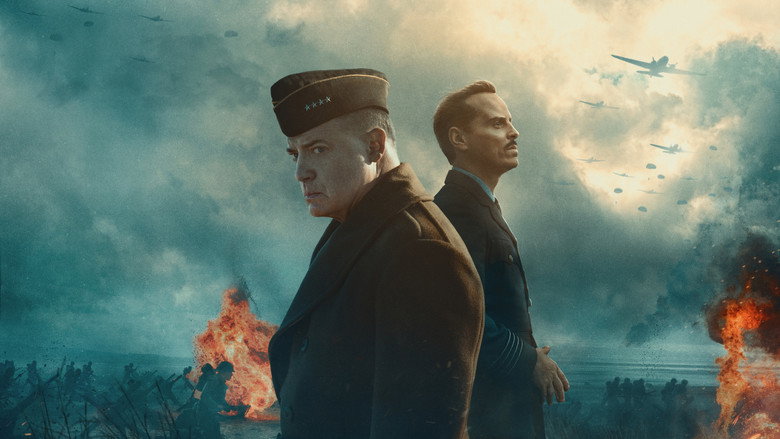
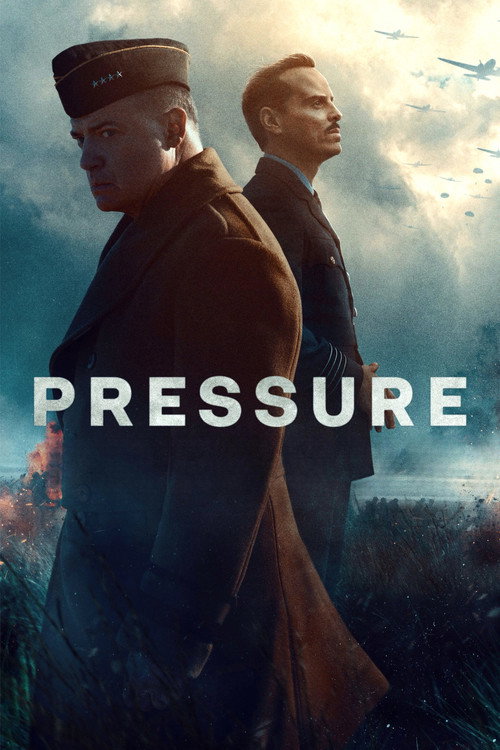
Pressure (2026), directed and edited by Anthony Maras and co-written with Olivier Award–winning playwright David Haig, adapts Haig’s acclaimed 2014 stage play into a high-stakes historical thriller. Set in late May and early June 1944 at Southwick House near Portsmouth, England, the narrative chronicles the grueling 72-hour countdown preceding Operation Overlord—the Allied amphibious invasion of Nazi-occupied Normandy.

Instead of focusing on combat spectacle on the beaches, the narrative narrows its lens to the command rooms, where Supreme Allied Commander Dwight D. Eisenhower (Brendan Fraser) must make the ultimate go/no-go decision. With hundreds of thousands of troops marshaled and enemy intelligence threatening discovery, the critical variable rests on the volatile weather over the English Channel.

The conflict escalates into an intellectual and psychological battle between two meteorological philosophies: RAF meteorologist Group Captain James Stagg (Andrew Scott), a rigorous Scottish scientist who warns of an incoming catastrophic storm, and American meteorologist Colonel Irving P. Krick (Chris Messina), who promises clear skies using historical analog modeling. Caught between political demands, military impatience, and nature's indifference, the Allied leadership faces an agonizing test of nerve and judgment.
Core Meaning

The primary thesis of Pressure is the profound moral courage required to speak uncomfortable truths to absolute power in the face of immense institutional and psychological pressure. Anthony Maras and David Haig explore the paradox of human agency within warfare: while armies wield unprecedented destructive power, human strategy remains humble before the unyielding laws of nature.

The film highlights that true leadership is defined not by bravado or wishful thinking, but by the willingness to embrace vulnerability, absorb crippling uncertainty, and trust meticulous, unvarnished expertise when everything is on the line.

Thematic DNA

Truth vs. Wishful Thinking (Epistemic Integrity) 30%
The Burden of Command & Accountability 25%
Human Hubris vs. Nature’s Indifference 20%
The Sacrifices of the Unsung Specialist 15%
Institutional & Allied Cultural Friction 10%

Truth vs. Wishful Thinking (Epistemic Integrity)

Dramatized via the collision between Stagg’s empirical barometric observations and Krick’s optimistic historical models. Stagg refuses to compromise facts to please commanders desperate for good news.

The Burden of Command & Accountability

Explored through Eisenhower, who is haunted by the hundreds of lives lost during the recent rehearsal disaster Exercise Tiger. Fraser’s portrayal illustrates the crushing isolation of making decisions where any error means mass slaughter.

Human Hubris vs. Nature’s Indifference

Revealed through the military machine's initial impatience with weather forecasting; the characters realize that nature cannot be commanded or negotiated with.

The Sacrifices of the Unsung Specialist

Emphasized through James Stagg, who must maintain unflinching analytical focus while his pregnant wife remains in London under the threat of Luftwaffe bombing raids.

Institutional & Allied Cultural Friction

Exposed through the clash between British methodical skepticism (Stagg, Montgomery) and American optimism and showmanship (Krick).

Character Analysis

Group Captain James Stagg

Andrew Scott

Archetype: The Reluctant Truth-Teller / Cassandra Key Trait: Uncompromising intellectual integrity under severe psychological strain.

Motivation

To ensure operational survival through rigorous scientific accuracy regardless of personal or professional cost.

Character Arc

Begins as a guarded, punctilious scientist resented for his blunt pessimism; grows into an unshakable moral center whose stubborn adherence to truth earns Eisenhower's deep trust.

General Dwight D. Eisenhower

Brendan Fraser

Archetype: The Burdened Commander / Sovereign Key Trait: Empathy balanced with the resolve to shoulder unilateral responsibility.

Motivation

To liberate Europe and defeat fascism while minimizing the catastrophic loss of Allied lives.

Character Arc

Moves from a commander anxious to launch and pressured by political superiors, to an introspective leader who overcomes the trauma of past failures to make a calm, calculated gamble.

All 5 characters and cast

Symbols & Motifs

The Barometer / Isobar Maps

Meaning:

Symbolizes the thin, invisible boundary between triumph and annihilation. The drawn contour lines represent nature's chaos mapped by human reason.

Context:

Constantly analyzed, debated, and redrawn across command tables throughout Southwick House as the pressure systems evolve.

The Wall Clock at Southwick House

Meaning:

Embodying the inexorable passage of time and the narrowing margins for error.

Context:

Serves as a relentless recurring motif ticking backward toward the non-negotiable tidal and lunar launch windows.

The Cigarette Smoke

Meaning:

Visually externalizes the claustrophobia, nervous exhaustion, and atmospheric tension suffocating the Allied leaders.

Context:

Pervades the enclosed meeting rooms and briefing halls of Southwick House during high-stress debates.

Exercise Tiger / The Flotsam of Slapton Sands

Meaning:

A recurring psychological specter representing the catastrophic consequences of military miscalculation and communication breakdown.

Context:

Haunts Eisenhower’s memory and private conversations as a reminder of recent training disaster casualties.

Telephone Receivers and Teletype Tapes

Meaning:

Represent the fragmented, fragile chain of real-time data feeding a command structure desperate for certainty.

Context:

Used continuously by communication staff to transmit raw weather reports from remote Atlantic observation stations.

Memorable Quotes

Nature doesn't take orders from generals, Dwight. It doesn't give a damn about our timetable.
— James Stagg

Context

Stagg confronting Eisenhower when pressured to soften his warning about the June 5 storm.

Meaning

Highlights the core tension between military authority and unyielding reality.

If this goes wrong, the blood of a hundred thousand boys won't be on the weather charts. It will be on my hands.
— Dwight D. Eisenhower

Context

A private conversation with Kay Summersby at Southwick House, haunted by the specter of Exercise Tiger.

Meaning

Captures the moral burden of command.

All 4 quotes

Philosophical Questions

How does human reason negotiate with an indifferent universe?

The film asks how humanity can execute immense logistical endeavors when completely subject to natural systems beyond human control.

What constitutes true courage in leadership?

It questions whether courage is defined by aggressive forward action or by the restraint to wait and absorb immense political criticism.

Can absolute certainty ever exist in high-stakes decision-making?

It explores how leaders must act decisively based on probabilistic data rather than definitive guarantees.

Alternative Interpretations

The Anti-Great-Man Reading: While featuring iconic historical figures, the film can be interpreted as a subversion of the 'Great Man' theory of history. In this view, the liberation of Europe was dictated not by military genius or imperial will, but by an unsung Scottish scientist reading barometric fluctuations in a damp room.

Full ending explanation

Cultural Impact

Historically, D-Day cinema has leaned heavily into visceral front-line realism (such as Saving Private Ryan) or broad operational epics (The Longest Day). Pressure stands alongside films like Darkest Hour (2017) and Oppenheimer (2023) in carving out a subgenre of procedural, intellectual wartime thrillers focused on logistical and ethical dilemmas.

Critically, the film was praised upon its release in May 2026 for its sharp dialogue, lean 100-minute runtime, and the central dynamic between Andrew Scott and Brendan Fraser. It resonated culturally as a parable for modern decision-making—particularly regarding institutional trust, climate data, and the challenges of relying on scientific expertise in politically charged environments.

Audience Reception

Critics and audiences widely praised the gripping chemistry between Andrew Scott (steely, reserved, principled) and Brendan Fraser (empathetic, burdened, resolute), as well as Anthony Maras’ fast-paced editing and direction, which sustains white-knuckle tension entirely through dialogue, clocks, and maps. Reviewers also lauded its historical grounding and refusal to invent artificial action sequences or romantic melodramas.

On the critical side, some reviewers noted its overt 'stage play' origins, with several dialogue-heavy sequences feeling somewhat contained to interior rooms, while secondary historical figures like Montgomery and Tedder received relatively limited screen time. Minor historical debates also surfaced around the degree of antagonism between Stagg and Krick, heightened slightly for dramatic conflict compared to archival meeting minutes.

Overall, the verdict deemed it a tight, sophisticated, and deeply satisfying historical drama that revitalizes the WWII genre through intellectual tension and stellar character acting.

Interesting Facts

  • The screenplay was adapted directly from David Haig’s acclaimed 2014 play Pressure, which originally saw Haig playing the lead role of James Stagg in Edinburgh and London.
  • Anthony Maras served as both director and editor of the film, utilizing rhythmic pacing in the edit room to build suspense from dialogue-heavy boardrooms.
  • Because the real Southwick House is surrounded by modern military and residential infrastructure, principal photography for the exterior and command estate was staged at Mentmore Towers in Buckinghamshire.
  • Academy Award–winning composer Volker Bertelmann crafted an ambient, ticking score composed of low-frequency pulses and brass drones mimicking atmospheric changes.
  • Shot by South African cinematographer Jamie D. Ramsay, who employed muted mid-century palettes to evoke historical realism.
  • The production worked with meteorologists and historical archives at the UK Met Office, referencing Group Captain Stagg's original handwritten weather diaries and isobar charts from June 1944.

Easter Eggs

Krick’s Hollywood Past

In the film, Irving Krick boasts about his weather forecasting for the burning of Atlanta scene in Gone with the Wind (1939)—a historically accurate detail that highlights Krick's penchant for showmanship.

Damian Lewis's WWII Lineage

Casting Damian Lewis as Field Marshal Montgomery serves as a meta-cinematic nod to his iconic portrayal of Major Richard Winters in Band of Brothers (2001).

The 'In Case of Failure' Communiqué

A close-up reveals Eisenhower drafting his famous pocket note ('Our landings have failed... If any blame or fault attaches to the attempt it is mine alone'), grounding the narrative in his real-life humility and resolve.

Met Office Synoptic Code

The background radio chatter and chalkboards feature authentic 1944 British synoptic meteorological code numbers and symbols decoded from wartime logbooks.

Frequently Asked Questions

Explore More About This Movie

Dive deeper into specific aspects of the movie with our detailed analysis pages

Comments (0)

Leave a comment

No comments yet. Be the first to share your thoughts!

Similar Movies