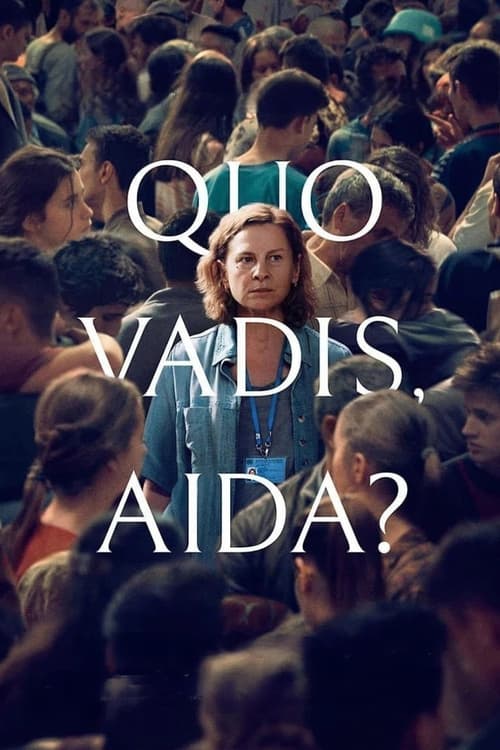
Quo Vadis, Aida?
A harrowing war drama that plunges into the desperate heart of a mother's terror. Amidst the deafening silence of international failure, Aida frantically races through a bureaucratic labyrinth, carrying the agonizing weight of humanity’s darkest blind spots.
Quo Vadis, Aida?

Quo Vadis, Aida?

26 February 2021 Austria 104 min ⭐ 7.6 (461)
Director: Jasmila Žbanić
Cast: Jasna Đuričić, Izudin Bajrović, Boris Ler, Dino Bajrović, Johan Heldenbergh
Drama War History
Bureaucratic Paralysis and Complicity Maternal Desperation and Survival The Banality of Evil Trauma, Memory, and Denial
Budget: $4,750,000
Box Office: $813,253

Overview

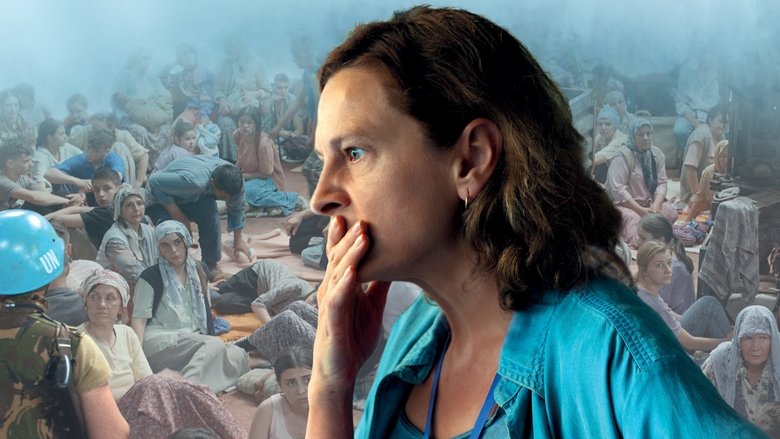
Set in July 1995, Quo Vadis, Aida? immerses viewers in the frantic final days of the Bosnian War as the Serbian army encroaches upon the town of Srebrenica. The film centers on Aida Selmanagić, a local schoolteacher turned United Nations translator, who works within the supposedly secure Dutch UN base at Potočari. As heavily armed forces led by General Ratko Mladić take over the region, the illusion of a UN safe zone quickly evaporates, leaving thousands of desperate civilians pounding on the compound's gates seeking shelter.

Caught between her professional duties as an interpreter and her primal instincts as a mother, Aida is forced to navigate a labyrinth of bureaucratic paralysis and cowardly leadership. As the Dutch peacekeepers fold under pressure and international airstrikes fail to materialize, Aida uses her UN badge and insider access in a harrowing race against time to secure safety for her husband and two sons, fully aware of the horrific fate awaiting the men left outside.
Core Meaning

At its core, Quo Vadis, Aida? is a searing indictment of the international community's complicity in the Srebrenica massacre through bureaucratic inertia and moral cowardice. Director Jasmila Žbanić refuses to focus solely on the bloodlust of the perpetrators; instead, she casts a glaring light on the bystanders—specifically the UN and the Dutchbat peacekeepers—who chose procedural obedience over human life. Beyond the geopolitics, the film explores the agonizing limits of maternal protection, demonstrating how the machinery of genocide strips away human dignity while demanding that we never avert our eyes from the truth of our history.

Thematic DNA

Bureaucratic Paralysis and Complicity 30%
Maternal Desperation and Survival 30%
The Banality of Evil 20%
Trauma, Memory, and Denial 20%

Bureaucratic Paralysis and Complicity

The film meticulously details how the UN peacekeepers enabled the genocide by adhering to protocol instead of morality [1.5]. The Dutchbat commanders' reliance on broken communication chains and their ultimate submission to Mladić highlight the fatal consequences of institutional cowardice.

Maternal Desperation and Survival

Aida's primal drive to save her family is the emotional core of the narrative. Her relentless motion through the camp, utilizing every shred of her privilege as a translator, exposes the brutal lengths one must go to when stripped of basic security.

The Banality of Evil

The film captures the terrifying realization that the perpetrators are former neighbors, students, and colleagues. They casually orchestrate a massacre, demonstrating how easily ordinary people can be transformed into agents of ethnic cleansing.

Trauma, Memory, and Denial

In the aftermath of the atrocity, survivors must literally live among the perpetrators. The film addresses the lingering trauma of the genocide and stands as an act of cinematic remembrance against the ongoing political forces of historical denial.

Character Analysis

Aida Selmanagić

Jasna Đuričić

Archetype: The Desperate Mother / The Witness
Key Trait: Relentless determination

Motivation

Her singular, unrelenting motivation is to exploit her privileged position to save her husband and two sons from certain execution.

Character Arc

Aida transitions from a professional relying on the UN system's protection to a frantic mother recognizing its utter failure [1.6]. She ultimately becomes a tragic survivor who must live among the ghosts of her past, bearing witness to the unpunished crimes.

General Ratko Mladić

Boris Isaković

Archetype: The Charismatic Monster
Key Trait: Casual cruelty

Motivation

Ethnic cleansing masked as historical vengeance and military liberation.

Character Arc

Mladić remains consistent throughout his appearance; he arrives as an arrogant conqueror, methodically orchestrating a genocide while performing magnanimity for his own propaganda cameras.

Colonel Thom Karremans

Johan Heldenbergh

Archetype: The Paralyzed Bureaucrat
Key Trait: Cowardice

Motivation

To follow protocol, avoid immediate military conflict, and shift responsibility away from himself.

Character Arc

Karremans begins with firm but empty reassurances of NATO airstrikes, only to rapidly crumble into submissive compliance and fatalistic abandonment when faced with Mladić's overwhelming aggression.

Nihad Selmanagić

Izudin Bajrović

Archetype: The Resigned Victim
Key Trait: Quiet dignity

Motivation

To protect his family and maintain dignity in the face of inevitable slaughter.

Character Arc

As a gentle man caught in a violent nightmare, Nihad attempts to negotiate for his people but eventually accepts his doomed fate, choosing to stay with his sons rather than save himself.

Symbols & Motifs

The UN ID Badge

Meaning:

It symbolizes the false promise of privilege, safety, and international authority [1.6].

Context:

Aida uses the badge to move freely through the camp, cut corners, and negotiate, believing it can protect her family. Ultimately, it proves utterly useless in the face of brutal force.

Children Covering Their Eyes

Meaning:

It represents the dual concepts of willful blindness to past atrocities and the hope of opening eyes to truth.

Context:

In the film's haunting final scene, children of both survivors and perpetrators perform a school play where they cover and uncover their eyes with their hands, leaving the audience to ponder if the cycle of denial will continue.

The Abandoned Battery Factory

Meaning:

It serves as an industrial cage rather than a sanctuary.

Context:

The physical space of the UN base quickly transforms from a beacon of hope into a claustrophobic trap where Bosniak refugees are methodically separated and handed over to their executioners.

The 1991 New Year's Eve Party

Meaning:

It symbolizes lost innocence and the shared humanity of the victims before the war.

Context:

Shown in a brief, dreamlike flashback, the camera lingers on the faces of Aida's townspeople as they dance joyfully, standing in stark contrast to their imminent, tragic fates.

Memorable Quotes

What happens if the airstrikes do not come?

— The Mayor of Srebrenica

Context:

Spoken early in the film, as the Mayor desperately tries to get UN Commander Karremans to guarantee the town's safety against the encroaching Serbian army.

Meaning:

This poignant question highlights the deadly flaw in trusting empty international promises. It sharply foreshadows the absolute failure of the UN to protect the safe zone [1.4].

Don't shoot the piano player.

— Colonel Thom Karremans

Context:

Uttered by the Dutchbat commander as an attempt at levity before he toasts with Serbian General Ratko Mladić, effectively surrendering control of Srebrenica.

Meaning:

A grotesque display of cowardice and self-preservation, emphasizing how the Dutch commanders abandoned the thousands of people they were sworn to protect.

No one will hurt you!

— General Ratko Mladić

Context:

Spoken through a megaphone to the terrified Bosniak crowds and women on the buses to prevent panic before the men are separated and taken away to be executed.

Meaning:

A chilling, manipulative lie used to pacify victims. It demonstrates the calculated, theatrical nature of the genocide orchestrated by the Serbian forces.

Philosophical Questions

At what point does bureaucratic compliance become moral complicity?

The film harshly critiques the UN peacekeepers who, while not pulling the triggers themselves, facilitated the genocide by strictly adhering to rules and chains of command [1.4]. It forces the audience to ask whether inaction and procedural obedience in the face of evil are functionally identical to the evil itself.

How does one live alongside the architects of their tragedy?

In the epilogue, Aida returns to her hometown and resumes her life as a teacher, educating the children of the very men who murdered her family. The film explores the agonizing philosophical burden of post-conflict coexistence and the absolute limits of human endurance and forgiveness.

Does privilege obligate salvation, and what happens when it fails?

Aida uses her status as a UN translator to try and save her family, grappling with the moral weight of prioritizing her own blood over the thousands doomed outside the gates. Her ultimate failure interrogates the worth of status in a system stripped entirely of its humanity.

Alternative Interpretations

The film's haunting final scene—an elementary school play where children cover and uncover their eyes—has sparked multiple interpretations. A pessimistic reading suggests that this symbolizes the continued denial of the Srebrenica genocide by the international community and the perpetrators' descendants; society continues to play a game of 'blindness' regarding its dark past, ensuring history might repeat itself.

Conversely, a more hopeful interpretation views the uncovering of the eyes as an awakening. By having the new generation literally open their eyes, Žbanić may be advocating for a future built on truth and reconciliation rather than willful ignorance. Additionally, Aida's return to teaching in the very town where her family was murdered can be seen either as a crushing submission to an agonizing reality, or as an act of profound, Christ-like defiance and resilience.

Cultural Impact

Quo Vadis, Aida? stands as a monumental cinematic achievement in processing the trauma of the 1995 Srebrenica massacre, the worst atrocity on European soil since World War II. Directed by Jasmila Žbanić, the film brought global attention back to the devastating failures of the international community, sparking renewed discourse on the ethics of intervention and the fatal consequences of bureaucratic cowardice.

The film received universal critical acclaim, earning a nomination for Best International Feature Film at the 93rd Academy Awards and winning top prizes at the European Film Awards. It profoundly impacted audiences by humanizing the statistics of genocide, focusing intimately on the psychological terror of the victims rather than sensationalizing graphic violence. In the Balkans, its release was highly polarized; while it was celebrated in Bosnia as a vital act of remembrance, it faced backlash from nationalist elements in Serbia who continue to deny the genocide. Ultimately, the film serves as both a historical corrective and a timeless warning against the banality of evil.

Audience Reception

Audiences and critics universally praised Quo Vadis, Aida? for its suffocating tension, emotional devastation, and profound historical importance. Jasna Đuričić’s powerhouse performance as Aida was singled out as the emotional anchor of the film, conveying a heartbreaking mix of fierce maternal instinct and crushing despair. Viewers appreciated Žbanić's masterful restraint; by keeping the actual executions off-screen, the film amplified the psychological horror and dread of the event.

However, the film was not without controversy. In Serbia and Republika Srpska, it was subjected to politically motivated backlash and review-bombing by genocide deniers, demonstrating the raw and unresolved nature of the Bosnian War's legacy. Despite this, the overwhelming global consensus heralded it as a masterpiece of anti-war cinema, leaving viewers physically shaken and deeply reflective on the contemporary relevance of international inaction.

Interesting Facts

  • Jasna Đuričić, who plays Aida, and Boris Isaković, who delivers a terrifying performance as General Ratko Mladić, are actually husband and wife in real life [1.5].
  • Many of the extras in the crowd scenes were actual survivors of the Srebrenica massacres or had lost family members in the genocide.
  • Filming was once interrupted on set because two women, who were survivors themselves, became intensely distressed at the sight of actor Boris Isaković dressed in the uniform of Ratko Mladić.
  • Aida is a fictionalized character, but her story is heavily inspired by the real-life experiences of Hasan Nuhanović, a Bosniak UN translator who faced a similar tragic dilemma and wrote the book 'Under the UN Flag'.
  • General Mladić's dialogue in the film is taken almost verbatim from actual video transcripts recorded by his own camera crew during the fall of Srebrenica.
  • The Dutchbat commanders, Colonel Thom Karremans and Major Rob Franken, are identified by their real names in the film, cementing its historical critique.

Easter Eggs

TheBiblicalReferenceintheTitle

ThephraseQuoVadis(Latinfor'Whereareyoumarching?'or'Whereareyougoing?')referstotheapocryphalActsofPeter.PeteraskstheresurrectedJesuswhereheisgoing, towhichJesusreplies, 'ToRome, tobecrucifiedagain.'ThisprofoundlymirrorsAida'srelentlessrushingthroughthecampandhereventual, agonizingreturntoSrebrenica, facingthemetaphoricalcrucifixionofhercommunity[1.15].

⚠️ Spoiler Analysis

Click to reveal detailed analysis with spoilers

Frequently Asked Questions

Explore More About This Movie

Dive deeper into specific aspects of the movie with our detailed analysis pages

Comments (0)

Leave a comment

No comments yet. Be the first to share your thoughts!