Some Like It Hot
"The movie too HOT for words!"
Overview
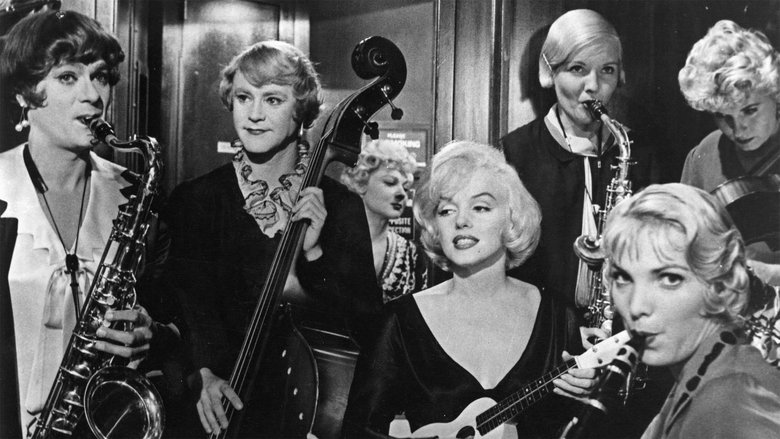
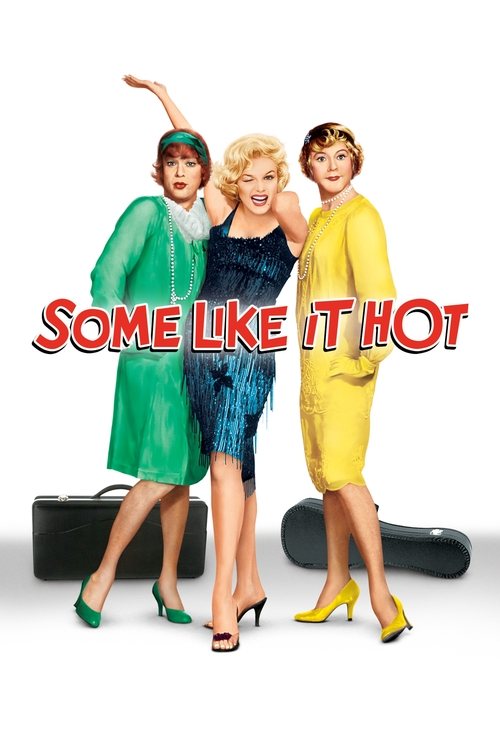
Set in 1929 Chicago, Some Like It Hot follows two musicians, Joe (Tony Curtis) and Jerry (Jack Lemmon), who witness the St. Valentine's Day Massacre. To escape the mobsters led by "Spats" Colombo (George Raft), they disguise themselves as women, taking on the names Josephine and Daphne, and join an all-female band heading to Florida. Their plan gets complicated when they both fall for the band's beautiful and vulnerable singer, Sugar Kane (Marilyn Monroe).
Once in Miami, the deception deepens. Joe, as Josephine, befriends Sugar to learn what she desires in a man. He then adopts a second disguise as a Cary Grant-esque millionaire named "Junior," the heir to the Shell Oil fortune, to woo her. Meanwhile, Jerry, as the vivacious Daphne, finds himself relentlessly pursued by a genuine, and very persistent, millionaire, Osgood Fielding III (Joe E. Brown). The situation becomes a frantic juggling act of maintaining their disguises, dealing with their romantic entanglements, and avoiding the gangsters who have also arrived in Florida for a convention.
Core Meaning
At its heart, Some Like It Hot is a brilliant farce that uses comedy to explore themes of identity, gender, and acceptance. Director Billy Wilder masterfully crafts a narrative that challenges the rigid social norms of the 1950s. By placing its male protagonists in women's shoes, the film satirizes gender roles and stereotypes, forcing Joe and Jerry to experience firsthand the objectification and societal expectations that women face. Beyond the laughter, the film suggests that identity is fluid and that love and connection can transcend conventional boundaries. The famous closing line, "Well, nobody's perfect," serves as the film's ultimate message: a call for tolerance and the acceptance of individuals for who they are, regardless of societal labels.
Thematic DNA
Gender Identity and Performance
The central comedic premise of Joe and Jerry cross-dressing evolves into a deeper exploration of gender. Initially a mere disguise for survival, their female personas take on lives of their own. Jerry, as Daphne, begins to enjoy the attention and perks of being a woman, even accepting a marriage proposal. Joe uses his "Josephine" persona to gain an intimate understanding of Sugar's desires. The film humorously highlights the performative aspects of gender, suggesting that masculinity and femininity are roles people play, constructed through clothing, voice, and behavior. It subverted the restrictive Hays Code of its time by featuring cross-dressing and themes of sexual fluidity, which was groundbreaking for 1959.
Deception and Masquerade
Deception is the film's primary engine. Every main character is pretending to be someone they're not. Joe and Jerry's initial deception as women snowballs into more elaborate lies, most notably Joe's dual masquerade as the impotent millionaire "Junior" to seduce Sugar. Sugar herself isn't entirely truthful, pretending to be more sophisticated to attract a wealthy man. The constant layering of disguises creates a whirlwind of dramatic irony and comedic tension, as the characters struggle to keep their stories straight while their true desires and vulnerabilities peek through.
Love and Acceptance
Beneath the frantic comedy, the film searches for genuine connection. Sugar, who has a history of falling for the wrong men, seeks a kind and gentle partner, a stark contrast to the womanizing Joe. Joe's deception as "Junior" is initially manipulative, but through his interactions with Sugar, he develops real feelings. The film's climax is a testament to acceptance. Sugar chooses Joe even after his lies are revealed, and Osgood's unfazed reaction to Daphne's confession that he is a man—"Well, nobody's perfect"—is a revolutionary statement of unconditional acceptance that transcends gender norms.
Social Class and the Pursuit of Wealth
The desire for financial security is a powerful motivator. Joe and Jerry are broke musicians desperate for a paying gig. Sugar's primary goal is to marry a millionaire to escape her life of getting the "fuzzy end of the lollipop." Joe's most effective disguise is not as a woman, but as a man of immense wealth. The film satirizes the American dream and the obsession with money, showing how characters will contort themselves into different identities to achieve it. Osgood Fielding III represents the pinnacle of this, a man whose wealth makes him blissfully detached from the struggles of others.
Character Analysis
Joe / Josephine / 'Junior'
Tony Curtis
Motivation
Initially, his motivation is survival—escaping the mob. This quickly shifts to seducing Sugar Kane. He is driven by his libido and a desire to win, using deception as his primary tool to get what he wants.
Character Arc
Joe begins as a cynical, manipulative womanizer and gambler. His primary motivation is self-preservation, which leads him to don the disguise of Josephine. However, his desire for Sugar prompts him to create another, more deceptive persona: the millionaire 'Junior'. Initially, this is just another conquest, but as he gets to know Sugar through both his female and male disguises, he develops genuine feelings and a conscience. His arc is one of transformation; by pretending to be a woman and a better man, he ultimately becomes one, confessing his deception and choosing love over manipulation.
Jerry / Daphne
Jack Lemmon
Motivation
Like Joe, Jerry is first motivated by survival. However, his motivations become more complex as Daphne. He gets caught up in the thrill of being pursued by a wealthy man and the promise of "security," to the point where he momentarily forgets the logistical impossibility of his engagement.
Character Arc
Jerry starts as the more anxious and pragmatic of the two musicians, constantly worrying about their predicament. His transformation into Daphne is initially a source of comic panic. However, unlike Joe, Jerry begins to embrace his feminine side. He enjoys the camaraderie with the other women and gets swept up in the whirlwind romance with Osgood Fielding III. His enthusiastic acceptance of his engagement to Osgood signifies a genuine, if comedic, blurring of his own identity. His arc is one of liberation; he discovers a new, freeing side to himself through the disguise, finding unexpected joy and security as Daphne.
Sugar Kane Kowalczyk
Marilyn Monroe
Motivation
Sugar is motivated by a deep desire for love, stability, and financial security. She wants to escape her past heartbreaks and find a man who will treat her well, which makes her susceptible to Joe's elaborate ruse.
Character Arc
Sugar is presented as a sweet but naive band singer who is tired of being taken advantage of by men, particularly saxophone players. Her goal is to find a kind, bespectacled millionaire in Florida and settle down. She falls for Joe's "Junior" persona, believing she has finally found her ideal man. Her arc is less about transformation and more about finding genuine love amidst deception. Despite being repeatedly fooled, her inherent trust and romanticism are ultimately rewarded when she accepts Joe for who he truly is, choosing the man over the millionaire fantasy.
Osgood Fielding III
Joe E. Brown
Motivation
His motivation is simple and direct: he is infatuated with Daphne and wants to marry her. He is driven by romantic pursuit and seems to genuinely enjoy the chase.
Character Arc
Osgood is an aging, multi-divorcee millionaire who is immediately smitten with Daphne. He is portrayed as a persistent, slightly silly, but ultimately harmless playboy. He remains steadfast in his pursuit of Daphne, unfazed by her constant rejections. His character does not have a significant arc but serves a crucial thematic purpose. His final line, accepting Daphne's revelation of being a man, reveals a surprisingly profound and open-minded perspective on love, making him a figure of ultimate acceptance.
Symbols & Motifs
The Yacht
The yacht symbolizes the pinnacle of wealth, luxury, and the romantic ideal that Sugar Kane is desperately seeking. It represents the "sweet end of the lollipop" she dreams of. For Joe, it is the ultimate prop in his deception, a tangible representation of the power and allure of the millionaire persona he adopts to win her over. It is both a symbol of his elaborate lie and the setting for their budding, albeit complicated, romance.
Joe, disguised as the millionaire "Junior," borrows Osgood Fielding III's yacht to seduce Sugar. He pretends it's his own and feigns indifference to its luxury, a tactic to intrigue her. The scenes on the yacht are pivotal, as it's where Sugar falls for "Junior" and where Joe's conscience begins to clash with his manipulative plan.
The "Fuzzy End of the Lollipop"
This phrase, spoken by Sugar, is a recurring metaphor for her life experiences, particularly in romance. It symbolizes her perpetual bad luck, her feeling of being used and getting the short end of the stick, especially from saxophone players. It encapsulates her vulnerability and her deep-seated desire to finally find happiness and security.
Sugar first uses this expression on the train while sharing a drink with "Josephine" and the other girls. She laments her romantic history, explaining her pattern of falling for men who take advantage of her. The line instantly defines her character as both world-weary and naively hopeful.
Jazz Music
Jazz, particularly the "hot" jazz played by the all-girl band, symbolizes a departure from convention, a sense of freedom, and sexual liberation. In the context of the Prohibition era, it represents the looser, more uninhibited side of life that exists beneath a veneer of societal propriety. When "Junior" claims to prefer classical music, he is creating a contrast between his supposedly refined persona and the passionate, unrestrained world that Sugar inhabits.
The film is set against the backdrop of the Jazz Age, opening in a speakeasy where Joe and Jerry play. Their escape leads them to join "Sweet Sue and her Society Syncopators," a jazz band. The film's title itself comes from a conversation where Sugar mentions her band plays "hot jazz," and Joe, as "Junior," replies, "I guess some like it hot."
Memorable Quotes
Well, nobody's perfect.
— Osgood Fielding III
Context:
In the final scene, Jerry, dressed as Daphne, is in a boat with Osgood, trying to break off their engagement. After a list of excuses fails, Jerry exasperatedly rips off his wig and exclaims, "I'm a man!" Osgood simply smiles and delivers this iconic line.
Meaning:
This is arguably one of the most famous closing lines in cinema history. It's a comedic punchline that also carries profound thematic weight. It signifies ultimate tolerance and unconditional acceptance. Osgood's nonchalant response to the revelation that his fiancée is a man suggests that love and connection are more important than gender or societal norms. It was a remarkably progressive statement for its time and perfectly encapsulates the film's playful subversion of identity.
Story of my life. I always get the fuzzy end of the lollipop.
— Sugar Kane
Context:
On the train to Florida, Sugar shares a bottle of bourbon with the other girls in the band. She confides in them about her weakness for saxophone players and how her romantic relationships always end in heartbreak, summing up her experiences with this metaphor.
Meaning:
This quote perfectly encapsulates Sugar's character: her vulnerability, her history of being mistreated in relationships, and her somewhat cynical yet still hopeful outlook on life. It's a poignant and memorable line that makes her instantly sympathetic to the audience and to "Josephine" (Joe), giving him the insight he needs to craft his seductive "Junior" persona.
But you're not a girl, you're a guy. And why would a guy want to marry a guy?
— Joe
Context:
After a night of dancing the tango with Osgood, Jerry (as Daphne) excitedly announces to Joe that he's engaged. A stunned Joe asks who the lucky girl is, to which Jerry gleefully replies, "I am!" This leads to Joe's bewildered questioning.
Meaning:
This exchange between Joe and Jerry highlights the absurdity of their situation and the film's playful exploration of gender and sexuality. Joe's pragmatic question is met with Jerry's surprisingly modern and comedic answer: "Security." The line is a humorous jab at traditional marital motivations and was quite daring for its time, hinting at same-sex partnership as a practical, if not romantic, arrangement.
Look at that! Look how she moves! That's just like Jell-O on springs.
— Jerry
Context:
As Joe and Jerry wait on the train platform in their full drag as Josephine and Daphne, they see Sugar hurrying to catch the train. Despite being disguised as women, their male instincts take over as they watch her walk.
Meaning:
This is a classic example of the film's witty and descriptive dialogue. Jerry's observation of Sugar Kane walking on the train platform is both a hilarious objectification and a moment of genuine awe. It perfectly captures Sugar's magnetic physical presence and the immediate effect she has on the two men, even before they've formally met her.
Philosophical Questions
What is the nature of identity?
The film constantly questions whether identity is fixed or fluid. Joe and Jerry initially adopt female identities as a simple disguise, but the experience changes them. Jerry discovers a part of himself that enjoys being Daphne, while Joe learns empathy by experiencing life from a woman's perspective. The multiple layers of disguise—Joe as Josephine, who then becomes 'Junior'—suggest that identity can be a performance, consciously constructed to achieve a goal. The film playfully posits that who we are is not just about our assigned gender but also about the roles we choose to play.
Can true love exist without complete honesty?
The central romance between Joe and Sugar is built entirely on a foundation of lies. Joe manipulates Sugar by using information he learns as Josephine and by creating a false persona of a millionaire. Yet, through this deception, he develops genuine feelings. The film's resolution, where Sugar accepts Joe despite his lies, seems to suggest that the emotional connection they formed was real, even if the circumstances were fabricated. It raises the question of whether the intention and the feeling behind an action can ultimately matter more than the deceptive action itself.
What does it mean to be a 'man' or a 'woman'?
Some Like It Hot systematically deconstructs gender stereotypes. By living as women, Joe and Jerry experience the discomfort of high heels, the unwanted advances from men, and the societal expectation to be demure. They learn that femininity is a complex performance. The film satirizes masculine tropes through Joe's manipulative womanizing and the violent posturing of the gangsters. Ultimately, the film suggests that the labels of 'man' and 'woman' are insufficient and that human connection transcends these simple binaries, as exemplified by Osgood's perfect acceptance of Daphne/Jerry.
Alternative Interpretations
While on the surface a straightforward farce, Some Like It Hot has invited various interpretations, particularly concerning its ending and themes of gender identity. One common interpretation views the film as a deeply subversive text that uses comedy to explore queer themes. Jerry's enthusiastic embrace of his Daphne persona—especially his joyous exclamation of "I am!" when asked who the lucky girl is in his engagement—is seen by some critics as a journey of discovering a more authentic, perhaps gender-fluid, identity. In this reading, Osgood's final line is not just a punchline but a radical statement of acceptance of a non-binary or queer relationship.
A contrasting view argues that the film is primarily a screwball comedy and that reading too much into its gender politics is anachronistic. This perspective suggests that the cross-dressing is purely a comedic device for creating absurd situations and that Wilder's main goal was entertainment, not social commentary. According to this interpretation, the film is about the lengths people will go for self-preservation and romance, and the gender-bending is simply the hilarious catalyst for the plot. A third perspective finds a middle ground, acknowledging the film's primary goal as comedy while recognizing that its genius lies in its ability to weave in surprisingly progressive and thought-provoking ideas about identity and acceptance, making it a film that was both a product of its time and remarkably ahead of it.
Cultural Impact
Some Like It Hot was a massive critical and commercial success upon its 1959 release, and its legacy has only grown over time. It is widely regarded as one of the greatest comedy films ever made. The film's most significant cultural impact was its direct challenge to the Motion Picture Production Code (Hays Code). By tackling subjects like cross-dressing, homosexuality, and sexual fluidity head-on—albeit through a comedic lens—the film pushed boundaries that had long been enforced in Hollywood. Its overwhelming popularity demonstrated that audiences were ready for more mature and daring themes, and its success is cited as a major catalyst in the weakening and eventual collapse of the Hays Code in the 1960s.
The film had a profound influence on the comedy genre, particularly the "drag comedy" sub-genre, inspiring countless later films like Tootsie and Mrs. Doubtfire. Its blend of screwball comedy, gangster parody, and romance created a unique tone that has been emulated many times. The performances of Jack Lemmon, Tony Curtis, and Marilyn Monroe are considered career highlights, cementing their legendary status. The film's final line, "Well, nobody's perfect," has entered the cultural lexicon as one of the most iconic quotes in movie history, celebrated for its wit and its surprisingly progressive message of acceptance. In 1989, it was one of the first 25 films selected for preservation in the United States National Film Registry by the Library of Congress for being "culturally, historically, or aesthetically significant."
Audience Reception
Upon its release in 1959, Some Like It Hot was met with widespread critical acclaim and was a major commercial success. Critics lauded its breakneck pacing, witty dialogue co-written by Billy Wilder and I.A.L. Diamond, and the brilliant comedic performances of its three leads. Jack Lemmon, in particular, received an Academy Award nomination for his hilarious and nuanced performance as Jerry/Daphne. While most reviews were overwhelmingly positive, the film was not without controversy. Due to its themes of cross-dressing and its risqué innuendo, it was released without the approval of the Motion Picture Production Code and was condemned as "Morally Objectionable" by the Catholic Legion of Decency. The state of Kansas even banned the film, deeming its content "too disturbing." Despite this, audiences flocked to see it, and its popularity has not waned over the decades, consistently ranking on lists of the greatest films and greatest comedies of all time.
Interesting Facts
- The film was shot in black and white, despite Marilyn Monroe's contract stipulating her films be in color, because the makeup on Tony Curtis and Jack Lemmon looked "unacceptably grotesque" and greenish in color test shots.
- The now-famous closing line, "Well, nobody's perfect," was intended by Billy Wilder and I.A.L. Diamond to be a temporary placeholder until they could write a better one. They never did.
- Marilyn Monroe was notoriously difficult to work with during production. It reportedly took her 47 takes to correctly say the line "It's me, Sugar," and 59 takes for the scene where she asks, "Where's the bourbon?"
- The plot is based on the 1935 French film Fanfare of Love and its 1951 German remake, Fanfares of Love. Billy Wilder added the gangster subplot to give the main characters a compelling reason to stay in drag.
- Tony Curtis's voice as Josephine was dubbed by voice actor Paul Frees. However, his voice for the 'Junior' character was his own impression of Cary Grant.
- The film was produced without approval from the Motion Picture Production Code (the Hays Code) due to its themes of cross-dressing and homosexuality. Its massive success is considered a key factor in the eventual abandonment of the Code.
- Frank Sinatra and Mitzi Gaynor were Billy Wilder's original choices for the roles of Jerry/Daphne and Sugar Kane, respectively.
- Marilyn Monroe was pregnant during the filming, which contributed to her looking heavier than usual in some scenes.
- To test their disguises, Tony Curtis and Jack Lemmon walked around the studio lot in full drag. When they used a women's restroom without anyone batting an eye, they knew their costumes were convincing.
Easter Eggs
George Raft's coin flip reference
In one scene, the gangster character "Spats" Colombo (George Raft) sees a younger hoodlum flipping a coin and asks him where he learned that "cheap trick." This is an inside joke referencing Raft's own signature coin-flipping tic from his iconic role in the 1932 gangster film Scarface.
Tony Curtis's Cary Grant Impression
When Joe adopts the persona of the millionaire "Junior," he puts on an accent that is a direct and deliberate imitation of Cary Grant. There's a meta-joke where Jerry criticizes the accent, saying "nobody 'talks loike thaet'!" Grant himself was reportedly amused by the impersonation.
⚠️ Spoiler Analysis
Click to reveal detailed analysis with spoilers
Frequently Asked Questions
Explore More About This Movie
Dive deeper into specific aspects of the movie with our detailed analysis pages
Comments (0)
No comments yet. Be the first to share your thoughts!