Real Girl
3D彼女 リアルガール
Overview
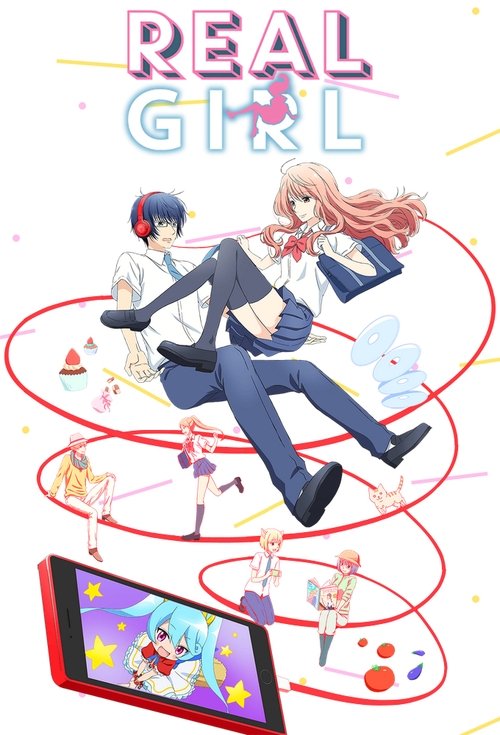
"Real Girl" (3D彼女 リアルガール) follows the unlikely romance between Hikari Tsutsui, a cynical and socially awkward high school student obsessed with anime and video games (a so-called "otaku"), and Iroha Igarashi, a beautiful, popular, and notoriously blunt girl who seems to be his polar opposite. Hikari, who has long given up on "3D" (real-life) girls, finds his world turned upside down when Iroha suddenly asks him to be her boyfriend. He agrees, albeit cautiously, and their relationship begins with a unique condition: they only have six months together before Iroha has to move away.
The series, spanning two seasons, chronicles their journey as they navigate the complexities of a first relationship. It flips the typical romance narrative by having the couple get together at the very beginning, focusing instead on the development of their bond. Across 24 episodes, Hikari and Iroha, along with their supportive group of friends, confront misunderstandings, social prejudice, personal insecurities, and external rivals. The story explores Hikari's gradual emergence from his self-imposed shell and Iroha's hidden vulnerabilities, revealing that she is more than the rumors that surround her. The overarching narrative builds towards the reason for Iroha's six-month deadline, introducing a significant dramatic turn that tests the strength and sincerity of their love.
Core Meaning
The core message of "Real Girl" is a heartfelt exploration of looking past superficial labels and preconceived notions to find genuine human connection. The series champions the idea that love can flourish between two people from entirely different social worlds—the otaku and the popular girl—if they are willing to communicate and understand each other's true selves. It delves into the anxieties of a first relationship, emphasizing that emotional growth often comes from stepping outside one's comfort zone. Ultimately, the story posits that genuine relationships, or "real life," though messy and complicated, offer a depth of experience and emotional fulfillment that cannot be found in escapist fantasies, challenging the protagonist Hikari to embrace the unpredictable beauty of the "3D world."
Thematic DNA
Breaking Stereotypes and Preconceptions
The central conflict revolves around the stereotypes attached to Hikari (a "creepy otaku") and Iroha (a "promiscuous delinquent"). The series systematically deconstructs these labels. Hikari learns that Iroha is not the shallow person rumors make her out to be, but a kind and lonely individual with her own struggles. Likewise, the school community slowly comes to see Hikari's sincerity and courage, challenging their initial prejudice against his hobbies. The entire narrative is a plea for empathy and looking beyond surface-level judgments.
Communication in Relationships
Much of the drama in "Real Girl" stems from miscommunication or a lack thereof. As newcomers to a serious relationship, Hikari and Iroha often struggle to voice their insecurities and fears, leading to misunderstandings and arguments. Their journey is one of learning to be vulnerable and honest with each other. The series portrays their efforts to talk through their problems as a realistic and essential part of building a strong bond, highlighting that love requires continuous effort and open dialogue.
Reality vs. Fantasy (2D vs. 3D World)
Hikari initially prefers the predictable and safe world of 2D anime and games to the complexities of real human interaction. His relationship with Iroha forces him to confront the challenges and rewards of the "3D world." The series explores this theme through his internal monologues, where he often seeks guidance from his favorite magical girl character, Ezomichi. His character arc is defined by his journey to find value and happiness in real-life experiences, even with their inherent pain and uncertainty.
The Nature of Friendship and Support
Beyond the central romance, the series emphasizes the importance of a strong support system. Hikari's best friend, Yuuto Itou, and later, Arisa Ishino, provide crucial advice and encouragement. The friendships that form between the main characters, including the initially antagonistic Mitsuya Takanashi and the shy Sumie Ayado, create a found family of outcasts who support each other through their respective struggles, demonstrating that platonic love is just as vital as romantic love.
Character Analysis
Hikari Tsutsui
Teppei Uenishi
Motivation
Initially, his motivation is simply to survive the six-month relationship he stumbles into. This evolves into a genuine desire to understand and protect Iroha. His ultimate motivation becomes proving that their love is real and lasting, strong enough to overcome social stigma, personal failings, and even fate itself.
Character Arc
Hikari begins as a deeply cynical and isolated otaku who distrusts the real world, particularly "3D girls." His relationship with Iroha forces him out of his comfort zone. Throughout Season 1, he struggles with profound social anxiety and insecurity, often misinterpreting situations and lashing out due to his lack of experience. In Season 2, he matures significantly, becoming more confident and learning to fight for his relationship. His arc culminates in his decision to wait for Iroha and his eventual acceptance of himself, transitioning from a boy who hides in a 2D world to a man who fully embraces the complexities of 3D love and life.
Iroha Igarashi
Yu Serizawa
Motivation
Her primary motivation is to experience a genuine, meaningful relationship before she has to leave for her high-risk surgery. She seeks authenticity and emotional connection, which she finds in Hikari's unpolished but sincere personality. She wants to create lasting, happy memories in the limited time she believes she has.
Character Arc
Iroha is introduced as a beautiful but notorious girl, infamous for being blunt and promiscuous. Her arc is about revealing the vulnerable, lonely, and kind person beneath the rumors. She is drawn to Hikari's earnestness, which contrasts with the superficiality she has experienced in past relationships. Her development involves learning to trust someone completely and open up about her fears, especially concerning her secret illness. Despite her outward confidence, she is deeply insecure. Her journey through surgery and subsequent amnesia, and her eventual recovery of her memories, solidifies her belief in a love that transcends memory and hardship.
Yuuto Itou
Shouta Aoi
Motivation
Yuuto is motivated by his deep loyalty to Hikari and a desire to see his friend happy. He also yearns for his own romantic connection, hoping to find a relationship as meaningful as the one he witnesses between Hikari and Iroha.
Character Arc
Yuuto is Hikari's only friend at the start of the series, a fellow otaku who is slightly more optimistic and socially aware. His arc focuses on supporting Hikari while also embarking on his own romantic journey. He develops feelings for Sumie Ayado, another otaku, and his story explores the anxieties of confessing one's feelings and dealing with rejection. He remains a steadfastly loyal and supportive friend to Hikari throughout, acting as a voice of reason and encouragement. His arc shows growth in his own confidence and his ability to form meaningful connections outside of his friendship with Hikari.
Arisa Ishino
Minami Tsuda
Motivation
Arisa is motivated by a desire to see her friends happy and to prevent them from making the same mistakes she has in her own love life. She is fiercely protective of Iroha and, despite her teasing, of Hikari as well. She seeks a stable and honest relationship for herself and for those she cares about.
Character Arc
Initially annoyed by Hikari, Arisa quickly becomes an indispensable friend and relationship advisor to both him and Iroha. Her own romantic life is messy; she starts the series dating a boy who takes advantage of her. Her arc involves her learning to value herself and seek a healthier relationship, which she eventually finds with the reformed Mitsuya Takanashi. She evolves from a somewhat cynical observer into a core member of the friend group, offering blunt but necessary advice and fierce loyalty.
Symbols & Motifs
Ezomichi (Magical Girl Figure)
Ezomichi, the magical girl from Hikari's favorite anime, symbolizes his initial retreat into a 2D fantasy world. She represents his conscience and a source of comfort and advice when he is overwhelmed by real-life situations. She is the embodiment of his escapism.
Ezomichi appears frequently in Hikari's imagination throughout the series, especially in the first season. He "consults" with her whenever he faces a dilemma in his relationship with Iroha. As he grows more confident in the real world, her appearances become less frequent, symbolizing his decreasing reliance on fantasy and his growing ability to handle problems on his own.
The Matching Keychains
The matching keychains that Hikari and Iroha get at the school's cultural festival symbolize their shared memories and the tangible proof of their bond. It represents a promise and a connection that persists despite distance and hardship.
After Iroha loses her memory following her surgery, the keychain becomes a critical trigger for her dormant feelings. In the series finale, years later, seeing Hikari's matching keychain is the catalyst that helps her remember their love, signifying that their connection was too deep to be completely erased.
Episode Highlights
About the Time I First Met Her.
This episode establishes the core premise and character dynamics. Social outcast and otaku Hikari Tsutsui has a fateful encounter with the beautiful but infamous Iroha Igarashi. In a whirlwind of events, she defends him from bullies, and he stands up for her, culminating in her shocking proposal that they start dating.
It sets the entire series in motion by subverting the typical romance anime trope where the confession comes at the end. The episode immediately establishes the central themes of prejudice, the clash between 2D and 3D worlds, and the beginning of the unlikely relationship that will drive the story for both seasons.
About the Time My Chastity was in a Predicament.
Hikari's relationship with Iroha faces its first major external threat in the form of Mitsuya Takanashi, a popular boy who also has feelings for Iroha and can't accept her choice of boyfriend. This episode delves into Hikari's deep-seated insecurities as he feels inadequate compared to Mitsuya.
This episode is pivotal for introducing the primary rival character and forcing Hikari and Iroha to define and defend their relationship to others. It strengthens their bond through adversity and forces Hikari to confront his own inferiority complex for the first time.
About My Confession.
During a summer trip to the beach with their friends, the relationship between Hikari and Iroha deepens. The episode focuses on their growing emotional and physical intimacy, culminating in a heartfelt moment where they truly confess their feelings and commitment to one another, moving past the initial awkwardness of their arrangement.
This episode marks a turning point from a tentative, experimental relationship to a genuine, loving one. It solidifies the couple's commitment and showcases the growing support of their friend group, cementing them as a cohesive unit.
About the Shape of Our Love.
The first season finale deals with the impending end of the promised six months. Iroha prepares to move, and the truth behind her departure begins to surface. The episode is filled with emotional tension as the couple faces their first major separation and the uncertainty of their future.
It ends the first season on a dramatic cliffhanger, revealing that Iroha's departure is not just a simple move but is connected to a more serious, undisclosed issue. This raises the stakes for the second season and leaves the audience questioning the couple's fate.
Regarding Her Future and Mine.
The series finale. After a significant time skip of seven years, Iroha, who lost her memories after surgery, returns to Japan. The episode follows the friends as adults and orchestrates a reunion between Hikari and Iroha. Through a shared memento—a matching keychain—Iroha's memories of Hikari are finally restored.
This episode provides a definitive and emotional conclusion to the entire series. It resolves the central conflict of Iroha's amnesia and affirms the story's core message that their love was fated and strong enough to overcome time, distance, and memory loss, resulting in a happy ending where they get married.
Philosophical Questions
Can love survive the complete loss of shared memory?
The series explores this question directly through its final arc. After Iroha's surgery erases all her memories of Hikari, their relationship ceases to exist in her mind. The narrative suggests that the emotional impact and the person she became *because* of her time with Hikari left an indelible mark on her heart, a 'hole' that no one else could fill. Her memory is eventually triggered by a physical object tied to their shared past. The series' answer is optimistic: true love creates a bond so profound that it can be reawakened even after the conscious mind has forgotten it, suggesting a connection that exists on a deeper, almost spiritual level.
To what extent should one change their identity for a relationship?
"Real Girl" navigates this question throughout Hikari's development. While he is initially pressured to abandon his otaku hobbies to be a 'normal' boyfriend, the series ultimately argues for a middle ground. Hikari doesn't completely give up his passions; instead, he learns to balance them with his real-world responsibilities and relationships. Iroha never asks him to stop being an otaku but encourages him to engage with the world outside of it. The series posits that a healthy relationship doesn't require erasing one's core identity, but rather expanding it to make room for another person.
Alternative Interpretations
One alternative reading of the series focuses on the ending's reliance on a 'fated love' trope. While the finale is presented as a happy reunion, some viewers interpret Hikari's seven years of passive waiting as a weakness rather than a romantic gesture. From this perspective, their relationship is less about mutual effort and more about a somewhat shallow, soulmate-centric idea that doesn't account for the personal growth and new experiences that would occur over such a long period of separation and amnesia. This view questions whether Iroha, upon regaining her memories, is simply falling back into an old pattern rather than making a conscious choice as the adult she has become.
Another interpretation views the story as a critique of the very stereotypes it presents. The exaggerated initial portrayals of Hikari as a helpless otaku and Iroha as an impossibly perfect (yet troubled) '3D girl' can be seen as a satirical take on common anime archetypes. The series then spends its entire run deconstructing these initial, flawed perceptions, suggesting that the labels society—and otaku culture itself—places on people are inherently limiting and must be broken down to achieve genuine connection.
Cultural Impact
"Real Girl" was created by Mao Nanami and serialized from 2011 to 2016, a period where otaku culture was becoming increasingly mainstream but still carried social stigma. The series arrived as part of a wave of romantic comedies like "Wotakoi: Love Is Hard for Otaku" that explored relationships involving nerds and geeks, but it distinguished itself by pairing an otaku with a non-otaku, focusing on the challenges of bridging that cultural gap. While not a groundbreaking hit, the series found a dedicated audience and was praised for its unique premise of starting the relationship in the first episode, allowing for a deeper exploration of relationship dynamics rather than the typical will-they-won't-they tension.
Critics' reception was mixed. Some praised the realistic portrayal of first-time relationship struggles and the relatable nature of the protagonist's insecurities. However, others heavily criticized the animation quality by Hoods Entertainment, citing it as stilted and visually uninspired, and found the characters' constant miscommunications frustrating. The first season, in particular, was seen by some as a chore to get through, while the second season was generally viewed more favorably for its emotional depth and satisfying conclusion. The series' legacy lies in its contribution to the niche of 'otaku romance,' offering a sincere, if flawed, look at how love can challenge and overcome social barriers and personal anxieties.
Audience Reception
Audience reception for "Real Girl" has been largely divided. Many viewers appreciated the series for its sweet and earnest take on an unconventional romance, enjoying the focus on relationship development from the outset. The second season generally received higher praise than the first, with many fans feeling that it delivered a more emotionally resonant story and a satisfying, conclusive ending. The central couple, Hikari and Iroha, were often lauded for their development, and viewers found their struggles with insecurity and communication to be relatable.
However, a significant portion of the audience criticized the show heavily. Common complaints were directed at the poor and inconsistent animation quality, which many found distracting and cheap-looking. The plot's reliance on frequent misunderstandings caused by a lack of communication was a major point of frustration for some, who found the drama repetitive and the characters dense. The ending, particularly the seven-year time skip and amnesia plot, was also a point of contention, with some finding it a rushed and overly dramatic cliché, while others thought it was a fittingly emotional conclusion. Overall, it is considered a decent but flawed series, appealing most to viewers looking for a character-driven romance that subverts some genre conventions.
Interesting Facts
- The series is based on a manga of the same name by Mao Nanami, which was serialized in Kodansha's 'Dessert' magazine from 2011 to 2016 and spans 12 volumes.
- The anime adaptation by studio Hoods Entertainment covers the entire manga storyline across its two seasons, with only minor omissions.
- A live-action film adaptation of "Real Girl" was also released in Japan in September 2018, the same year the first season of the anime aired.
- The story is unique for a shōjo series as it is primarily told from the male protagonist's point of view, offering a different perspective on the romance genre.
- The opening theme for the first season, "Daiji na Koto" by the band Quruli, was praised for its simple, honest tone that perfectly set the mood for the story.
⚠️ Spoiler Analysis
Click to reveal detailed analysis with spoilers
Frequently Asked Questions
Explore More About This Movie
Dive deeper into specific aspects of the movie with our detailed analysis pages
Comments (0)
No comments yet. Be the first to share your thoughts!