Skip to content
Resident Evil
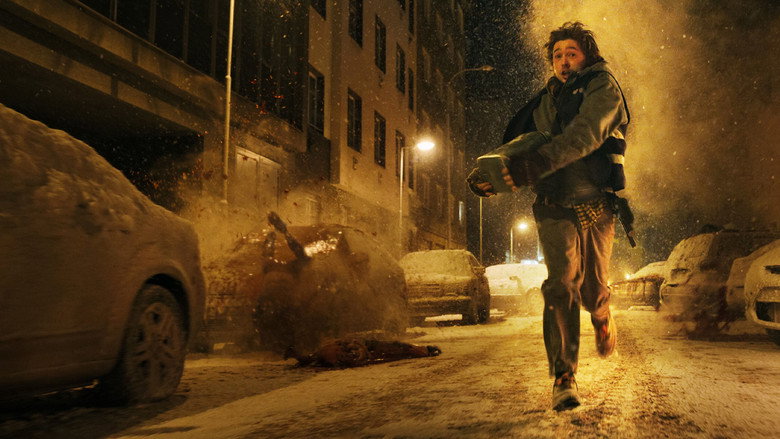
A snowbound night of survival horror where one courier's last delivery becomes a descent into contagion — headlights cutting through falling snow toward a hospital that has already stopped being a place of healing.
Resident Evil

Resident Evil

"A new era of evil."

16 September 2026 United States of America 95 min 7.3 (217)

Director: Zach Cregger

Cast: Austin Abrams, Zach Cherry, Kali Reis, Paul Walter Hauser, Johnno Wilson

Adventure Science Fiction Horror Survival without guarantee Avoidance and the refusal to grow up The body as betrayer Institutions of healing turned lethal Futility and the indifference of catastrophe
Budget: $75,000,000
Box Office: $108,300,000

Overview

Resident Evil (2026) is Zach Cregger's reboot of the Capcom-derived franchise, written by Cregger with Shay Hatten and released by Sony on September 18, 2026. Rather than continuing or remaking the earlier film series, it tells an entirely original story that stands apart from every previous Resident Evil movie.

The film follows Bryan (Austin Abrams), a medical courier who ferries organs between hospitals for transplant operations. Late on a winter night he accepts one last priority job: carry a container to remote Raccoon General Hospital in Raccoon City, Colorado. What should be a routine run through the snow turns into a non-stop race for survival as an outbreak of infected monsters tears the night apart around him.

Cregger frames the material as pure survival horror in the truest sense of the game series — limited ammunition, scarce resources, and monstrosities as Bryan's only company until morning. Critics have described the approach as deliberately smaller, funnier and meaner than the franchise's previous blockbuster incarnations, closer to a single-night nightmare than a globe-spanning war.

Core Meaning

At its center, Cregger's film is about a man who has spent his life running from the things that frighten him and finally runs into a night that refuses to let him keep moving. Bryan is a courier — a professional in-between person, always in transit, never arriving — and the outbreak strips that evasion away by making stillness fatal and arrival impossible.

The film turns the franchise's familiar corporate-bioweapon premise into something intimate: the horror of a body that stops being yours. Where the series has traditionally celebrated human resilience against impossible odds, this version insists that courage and effort are not always rewarded, and that the most terrifying contamination is the one you carry with you while still believing you can outrun it.

Thematic DNA

Survival without guarantee 28%
Avoidance and the refusal to grow up 24%
The body as betrayer 22%
Institutions of healing turned lethal 15%
Futility and the indifference of catastrophe 11%

Survival without guarantee

Cregger strips the franchise back to its survival-horror roots: limited ammunition, scarce resources and a single night to get through. Bryan is not a soldier or a superhuman; he is a working courier whose only advantages are speed and nerve, and the film refuses to promise that either will be enough.

Avoidance and the refusal to grow up

For most of the film Bryan is running away — not only from the infected, but from going home to Michelle and facing the reality of impending fatherhood. The outbreak externalizes an emotional flight that was already underway, turning a private cowardice into a literal chase.

The body as betrayer

Bryan's infection begins with a single bite and progresses invisibly while he keeps functioning. The horror is not only what is chasing him but what is already inside him, converting a story about escape into a story about a countdown he cannot see.

Institutions of healing turned lethal

The destination is a hospital — the one place in a horror story that should mean rescue. Raccoon General instead becomes the epicenter, its laboratories, corridors and medical machinery reframed as the architecture of an outbreak rather than its remedy.

Futility and the indifference of catastrophe

Everything Bryan does is competent, brave and ultimately beside the point. The film's structure builds toward a conclusion that denies the audience the last-minute turning of the tide the genre normally provides, asking what heroism means when the outcome was fixed hours earlier.

Character Analysis

Bryan

Austin Abrams

Archetype: Reluctant everyman hero / tragic protagonist Key Trait: Evasive endurance — he keeps moving rather than facing anything

Motivation

Immediately, to finish the delivery and survive until morning; underneath, to avoid going home to Michelle and confronting the reality of becoming a father.

Character Arc

Begins as a competent but evasive medical courier who keeps his life at arm's length, accepts one last priority delivery, and is forced through a single night of escalating horror. Bitten early and infected without fully reckoning with it, he moves from flight to a desperate attempt to reach help at the hospital laboratory — and is ultimately transformed by the very thing he was carrying documents and cargo against.

Michelle (Bryan's partner)

Not confirmed in available sources

Archetype: The absent anchor Key Trait: The pull of the ordinary life Bryan avoids

Motivation

To build a future with Bryan that he is not yet willing to step into.

Character Arc

Exists largely as the life Bryan is postponing. Her presence in the story defines the home Bryan is not returning to and the future — parenthood — that the outbreak forecloses.

All 5 characters and cast

Symbols & Motifs

The priority package

Meaning:

The container Bryan carries is both his job and his burden — a sealed, unexamined thing whose contents dictate his fate. It symbolizes responsibility accepted without being understood.

Context:

Introduced as one last delivery on a winter night and carried across the entire film as the object that pulls Bryan toward Raccoon General Hospital.

Snow and the winter road

Meaning:

Whiteness as erasure: a blank, muffling landscape that isolates, slows movement and buries evidence. It marks Bryan's world as one where distance itself is the enemy.

Context:

The job arrives on a dark, snowy night and the drive to remote Raccoon City establishes the cold as a second antagonist before any monster appears.

The bite

Meaning:

A small wound that rewrites a life — the moment the protagonist stops being an observer of the outbreak and becomes part of it. It symbolizes consequence with a delay.

Context:

Bryan is bitten by an infected girl in a campervan, and the injury quietly governs every scene that follows.

The courier's vehicle

Meaning:

Motion as identity and as avoidance. As long as Bryan is driving he is neither at work nor at home, neither responsible nor free.

Context:

Bryan's transport work — moving organs between hospitals — defines him before the horror starts and frames his character as someone permanently in transit.

The cure

Meaning:

Science's promise of reversibility, and the film's cruelest object: a solution that exists but arrives out of step with the body it was meant to save. It symbolizes hope measured against time.

Context:

In the hospital laboratory the scientists succeed in preparing a cure, only for Bryan's transformation to accelerate past the point where it can be administered.

The helicopters

Meaning:

Rescue and containment wearing the same face — the arrival of the state not to save survivors but to close the perimeter.

Context:

National Guard helicopters appear in the finale as the last external force, and the film's closing image is defined by how the transformed Bryan responds to them.

Philosophical Questions

Does an act of courage retain its value if it changes nothing?

Bryan fights, runs, improvises and reaches the laboratory — and the film still denies him the save. By removing the reward, the movie isolates the act itself and asks whether bravery is meaningful as an outcome or only as a choice.

At what point does a person stop being themselves?

The infection progresses while Bryan is still thinking, speaking and deciding. The film gives no clean threshold between man and monster, forcing the audience to locate identity somewhere other than the body — and then taking that away too.

Can you outrun a responsibility you have already accepted?

Bryan avoids home, Michelle and fatherhood, and takes a job defined by being permanently in transit. The outbreak converts his metaphorical flight into a literal one and demonstrates that motion is not the same as escape.

Is a cure that arrives too late a mercy or a cruelty?

The scientists succeed; the timing fails. The film uses that gap to question whether the existence of a solution consoles anyone, or whether it simply sharpens the loss by proving the loss was avoidable.

What do institutions owe the individuals caught inside their emergencies?

A hospital becomes an epicenter, a corporation's science becomes an outbreak, and the military arrives as containment rather than rescue. The film consistently shows systems operating correctly by their own logic while the person in front of them is destroyed.

How It Ends

Alternative Interpretations

The nihilist reading. The most direct interpretation takes the ending at face value: Bryan's efforts were futile from the moment he was bitten, and the film cuts to black precisely to deny the audience the reassurance the genre trains them to expect. Under this reading the movie is an argument against the franchise's own mythology of human resilience.

Full ending explanation

Cultural Impact

Resident Evil (2026) arrived as a high-profile test case for two things at once: whether video game adaptations could sustain their recent critical upturn, and whether Zach Cregger could carry a major studio franchise after breaking out as an idiosyncratic horror auteur. The answer, per the early critical consensus, was yes on both counts — Rotten Tomatoes' first-reviews roundup framed it as not just the best Resident Evil movie, but one of the best video game movies ever.

Critically, the film was praised for taking the franchise in a more focused direction. The A.V. Club characterized Cregger's approach as funnier, meaner, and at its best moments smaller, while ScreenRant called it a masterclass in gorgeously gruesome horror and others named it an easy contender for the most entertaining horror film of the year. That reception matters because the previous Resident Evil screen incarnations were commercially durable but critically dismissed; this reboot reframed the property as a filmmaker's vehicle rather than a franchise-maintenance exercise.

Commercially, the film's roughly $108.3 million gross against a $75 million budget positioned it as a mid-budget genre success in an era of inflated tentpoles — evidence for the argument that horror adaptations work best when scaled down rather than up. Its insistence on a downbeat, non-triumphant finale also made it a talking point about how far a studio franchise film can push audiences away from catharsis.

Audience Reception

Praise. The film opened to strongly positive reviews, with critics highlighting Cregger's tonal control — a blend of horror and comedy that reviewers repeatedly described as funnier and meaner than what the franchise had offered before. The commitment to genuine survival horror (limited ammunition, scarce resources, long stretches of isolation) was singled out as the thing previous adaptations had missed, and the craft of the gore and creature work drew descriptions such as gorgeously gruesome. Austin Abrams' everyman lead performance anchored the praise, and several outlets named it among the most entertaining horror films of 2026.

Criticism and controversy. The most divisive element is the ending. The film offers no moment of triumph, no last-minute turning of the tide, and no mid- or post-credits scene to soften the blow — it simply cuts to black. For a series culturally associated with human resilience against impossible odds, this landed for many viewers as a brutal kick in the teeth, and split audiences between those who found it bracingly honest and those who felt cheated of catharsis. The looser connection to established franchise lore also frustrated some longtime fans expecting a more direct adaptation.

Verdict. Widely regarded as the best Resident Evil film to date and, in some assessments, one of the best video game adaptations ever made — a critical rehabilitation of the property that traded spectacle for tension and was rewarded with a roughly $108.3 million gross against a $75 million budget.

Interesting Facts

  • The film is directed by Zach Cregger and co-written by Cregger with Shay Hatten, based on the Resident Evil video game franchise by Capcom.
  • Austin Abrams had already worked with Cregger, having appeared in the director's previous horror film Weapons.
  • The screenplay is an entirely original story with no connection to any of the earlier Resident Evil movies.
  • Filming began in 2025 ahead of the announced theatrical release.
  • Sony released the film in theaters on September 18, 2026, a date the studio announced in 2025.
  • The film was made for a reported budget of roughly $75 million and grossed approximately $108.3 million.
  • Cregger relocates Raccoon City to Colorado and sets the action on a single snowy winter night.
  • Bryan's profession — a medical courier who transports organs between hospitals for transplant operations — gives the film its inciting delivery job.
  • The film deliberately foregrounds classic survival-horror mechanics: limited ammunition, scarce resources, and long stretches where the protagonist is alone with the monsters.
  • There is no mid-credits or post-credits scene; the film ends on its final image without a credits tease.

Easter Eggs

Raccoon City and Raccoon General Hospital

The film keeps the franchise's iconic setting name but reinvents it as a remote Colorado town, signaling both fidelity to the games and a clean break from the earlier film series' continuity.

Survival-horror resource scarcity

Limited ammunition and scarce supplies are lifted directly from the design philosophy of Capcom's games, where inventory management is the source of dread — a mechanic previous adaptations largely abandoned in favor of action spectacle.

Casting Austin Abrams after Weapons

Cregger reuniting with his Weapons lead functions as an in-joke for followers of the director's work and links the two films as part of an emerging authorial run in modern horror.

Frequently Asked Questions

Explore More About This Movie

Dive deeper into specific aspects of the movie with our detailed analysis pages

Comments (0)

Leave a comment

No comments yet. Be the first to share your thoughts!

Similar Movies