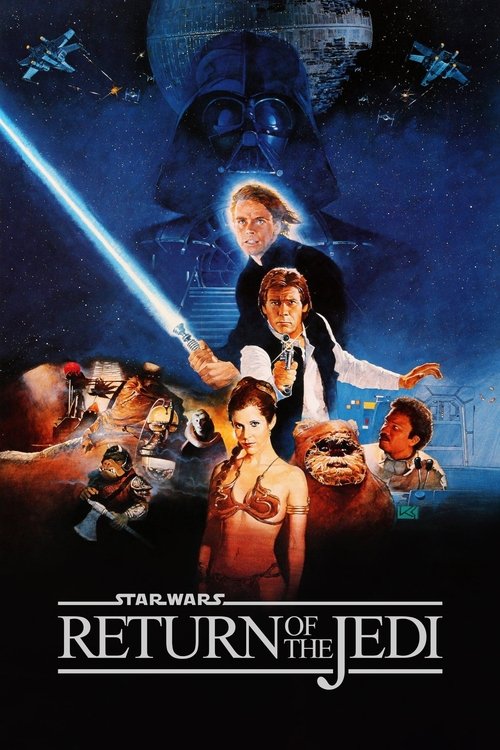
Return of the Jedi
A mythic space opera's crescendo, where desperate hope confronts absolute power in a final, soul-stirring battle for galactic freedom and a father's redemption.
Return of the Jedi

Return of the Jedi

"Return to a galaxy far far away."

25 May 1983 United States of America 132 min ⭐ 7.9 (16,386)
Director: Richard Marquand
Cast: Mark Hamill, Harrison Ford, Carrie Fisher, Billy Dee Williams, Anthony Daniels
Action Adventure Science Fiction
Redemption Conflict: Inner and Outer Triumph of the Underdog Family
Budget: $32,350,000
Box Office: $572,700,000

Overview

Following the rescue of Han Solo from the clutches of the grotesque gangster Jabba the Hutt, the Rebel Alliance regroups for a final, decisive assault on the Galactic Empire. They have discovered that the Emperor himself is overseeing the construction of a second, more powerful Death Star, which poses an existential threat to the galaxy. The station is protected by an energy shield generated from the nearby forest moon of Endor.

While a strike team led by Han and Leia ventures to Endor to disable the shield generator with the help of the native Ewoks, Luke Skywalker confronts his destiny. Believing there is still good in his father, Darth Vader, Luke surrenders himself in a perilous bid to turn him back from the dark side. This leads to a climactic confrontation in the Emperor's throne room aboard the new Death Star, where the fates of Luke, Vader, and the entire galaxy will be decided as the battle rages outside.
Core Meaning

The core meaning of "Return of the Jedi" is centered on the enduring power of hope and the possibility of redemption. It posits that no one is beyond saving and that compassion and love are forces more powerful than hatred and anger. Luke Skywalker's unwavering belief in the good buried within his father, Anakin Skywalker, serves as the film's emotional and philosophical anchor. The film ultimately argues that tyranny is defeated not just through military victory, but through an individual's choice to reject darkness and embrace the light, even at great personal cost.

Thematic DNA

Redemption 40%
Conflict: Inner and Outer 30%
Triumph of the Underdog 20%
Family 10%

Redemption

This is the central theme of the film, embodied by Darth Vader's ultimate sacrifice. Throughout the story, Luke holds onto the belief that the good man his father once was, Anakin Skywalker, is not truly gone. This faith is tested by both Vader and the Emperor, but in the final moments, seeing his son tortured, Anakin resurfaces to destroy the Emperor, fulfilling his destiny as the Chosen One and redeeming himself through this act of love.

Conflict: Inner and Outer

The film masterfully balances the large-scale galactic civil war with Luke's internal struggle. While the Rebel Alliance fights a desperate battle against the Empire's might, Luke battles the temptation of the dark side within himself. The Emperor masterfully uses Luke's love for his friends and his anger to push him toward the same fate as his father. Luke's victory comes not from defeating Vader in combat, but by throwing away his weapon and refusing to give in to hate, thus winning his internal war.

Triumph of the Underdog

A recurring theme in the Star Wars saga, this is most vividly illustrated on the forest moon of Endor. The technologically primitive Ewoks, armed with sticks and stones, manage to defeat the heavily armed and armored Imperial legions. This symbolizes that a determined spirit and collective will can overcome a technologically superior but morally corrupt force. It reinforces the idea that size and strength are not the ultimate determinants of victory.

Family

The Skywalker family drama is the heart of the original trilogy and concludes here. The film reveals that Leia is Luke's twin sister, deepening their bond. The central conflict is a son trying to save his father's soul. Vader's final act is not for the galaxy, but to save his son. His dying wish is to look upon Luke with his own eyes, bringing the tragic family saga to a poignant and emotionally resonant close.

Character Analysis

Luke Skywalker

Mark Hamill

Archetype: Hero
Key Trait: Unwavering Hope

Motivation

Luke's primary motivation is to redeem his father, Anakin Skywalker, from the grip of the dark side. He firmly believes there is still good in him and risks everything on this conviction.

Character Arc

Luke completes his transformation from farm boy to Jedi Knight. He is no longer a student but a confident, powerful figure who has mastered his abilities. His final test is not one of skill, but of spirit. He must confront the temptation of the dark side and his own anger, ultimately choosing compassion over hatred, thereby saving not only himself but his father as well.

Darth Vader / Anakin Skywalker

David Prowse (in suit), James Earl Jones (voice), Sebastian Shaw (unmasked)

Archetype: The Fallen Hero / The Redeemer
Key Trait: Conflicted

Motivation

Initially, his motivation is to serve the Emperor and the dark side. However, his latent love for his son creates a conflict that ultimately leads him to sacrifice himself for Luke.

Character Arc

Vader's arc is one of redemption. Initially serving the Emperor and trying to turn his own son to the dark side, he is internally conflicted. Luke's persistent faith and his suffering at the hands of the Emperor finally break through Vader's dark shell. In a final, selfless act, he reclaims his identity as Anakin Skywalker, destroys the Emperor to save his son, and finds peace in death.

Princess Leia Organa

Carrie Fisher

Archetype: The Rebel Leader
Key Trait: Resilient

Motivation

Her motivation remains the defeat of the Empire and the restoration of freedom to the galaxy. This is intertwined with her fierce loyalty and love for her friends, particularly Han Solo.

Character Arc

Leia's arc shows her continued strength and leadership, but also reveals her heritage. She is a key figure in both the rescue of Han Solo and the mission on Endor. The revelation that she is Luke's sister and Force-sensitive adds a new dimension to her character, reframing her resilience and intuitive nature as part of her Skywalker legacy.

Han Solo

Harrison Ford

Archetype: The Reformed Scoundrel
Key Trait: Loyal

Motivation

Having been saved by his friends, Han's motivation is now driven by loyalty and his love for Leia. He is no longer in it for the money but is fully committed to the Rebel cause and the people he cares about.

Character Arc

Han's journey from a cynical smuggler to a committed leader in the Rebellion is completed. After being rescued, he fully embraces his role, leading the critical ground mission on Endor. His arc concludes with him finding a permanent place within a community and fully reciprocating Leia's love, having moved past his selfish origins.

Symbols & Motifs

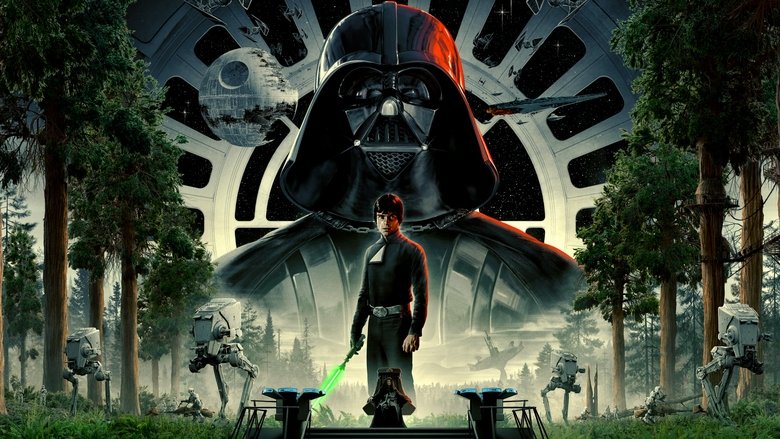
Darth Vader's Mask

Meaning:

The mask symbolizes Vader's entrapment in the dark side and his loss of humanity. It is the machine that keeps Anakin Skywalker buried.

Context:

Throughout the film, the mask represents the fearsome Sith Lord. In the final moments, Luke removes the mask at his father's request, allowing Anakin to see his son with his own eyes. This act symbolizes Vader's death and Anakin's return, revealing the vulnerable, redeemed man underneath.

Luke's Green Lightsaber

Meaning:
Context:

The lightsaber is first revealed in the confrontation at Jabba's sail barge. The color was changed from blue to green during production to stand out better against the blue sky of Tatooine, but it has since become an iconic symbol of Luke's Jedi identity.

The Second Death Star

Meaning:

The incomplete but operational second Death Star symbolizes the Empire's hubris and its cyclical, destructive nature. It is bigger and more powerful, but it represents the Empire's failure to learn from its past mistakes, believing technology alone can ensure its power.

Context:

The entire final act revolves around the Rebel Alliance's desperate attempt to destroy the station before it can annihilate their fleet. Its destruction signifies the definitive end of the Emperor's reign and the collapse of the Empire's power structure.

Luke's Black Attire

Meaning:

Luke's all-black outfit in the first half of the film symbolizes his proximity to the dark side. It visually connects him to his father, suggesting his internal conflict and the danger that he might follow the same path.

Context:

From his entrance into Jabba's palace to his confrontation with Vader on Endor, Luke wears black. In the final duel, he opens his tunic to reveal a white flap underneath, symbolizing his ultimate rejection of the dark side and his choice to remain in the light.

Memorable Quotes

I am a Jedi, like my father before me.

— Luke Skywalker

Context:

Spoken in the Emperor's throne room after Luke has defeated Darth Vader in a rage but refuses to kill him. He throws his lightsaber aside, leaving himself defenseless before the Emperor.

Meaning:

This is the defining moment of Luke's character arc. By proclaiming his identity as a Jedi, he rejects the Emperor's temptation and the path of the dark side. It signifies his victory over his internal conflict and his acceptance of his own destiny on his own terms, choosing peace and control over anger and power.

It's a trap!

— Admiral Ackbar

Context:

Ackbar shouts this on the bridge of his command ship when the Rebel fleet arrives at the Death Star, only to find its shields are still up and the Imperial fleet is waiting for them.

Meaning:

This line has become an iconic and widely referenced meme. In the film, it signifies the moment the Rebel Alliance realizes their meticulously planned attack on the Death Star was anticipated by the Emperor, dramatically raising the stakes of the final battle.

Many of the truths we cling to depend greatly on our own point of view.

— Obi-Wan Kenobi

Context:

Obi-Wan's Force spirit speaks this to Luke on Dagobah when Luke confronts him about having hidden the truth about his father's identity.

Meaning:

This quote explores the philosophical nature of truth and perspective. It is Obi-Wan's justification for telling Luke that Vader killed his father, framing Anakin's transformation to the dark side as a metaphorical death. It challenges a simplistic, absolute view of truth.

Tell your sister... you were right.

— Anakin Skywalker

Context:

A dying Anakin says this to Luke in the Death Star hangar after Luke has removed his helmet. It is his last breath before becoming one with the Force.

Meaning:

These are Anakin's final words, a message for Leia that affirms Luke's unwavering faith. It is the ultimate validation of Luke's quest for his father's redemption, confirming that the good within him did, in fact, return.

Philosophical Questions

Is anyone truly beyond redemption?

The film's central plot explores this question through Darth Vader. Despite his long history of horrific deeds, Luke believes his father can be saved. The film argues that redemption is always possible, predicated on a conscious choice to turn away from evil. Vader's final act is not about atoning for his past, but about making the right choice in the present to save someone he loves, suggesting that the capacity for good can survive even the deepest descent into darkness.

Does destiny control our choices, or do our choices create our destiny?

Luke is told he must confront Vader and that it is his destiny. The Emperor believes Luke's destiny is to take his father's place at his side. However, the climax hinges on Luke's choices. He chooses not to kill his father, rejecting the path of anger and the destiny the Emperor has foreseen. This act of free will, in turn, inspires his father to make his own choice to defy his master. The film suggests that while destiny may present the path, it is individual choice that determines the outcome.

What is the true nature of power?

"Return of the Jedi" contrasts two forms of power. The Emperor wields immense physical and political power through fear, anger, and technological terror (the Death Star). Luke, however, discovers a different kind of power in compassion, love, and self-control. By throwing away his weapon, he demonstrates that true strength lies not in the ability to destroy, but in the will to refuse to do so. His non-violent resistance is ultimately what defeats the Sith, proving that emotional and spiritual power can triumph over brute force.

Alternative Interpretations

While the film's primary themes are quite direct, some elements have prompted alternative readings and fan theories.

  • The Ewoks as a Vietnam War Allegory: One of the most prominent interpretations, supported by George Lucas himself, is that the battle on Endor is an allegory for the Vietnam War. A technologically inferior, native force using guerrilla tactics and knowledge of the terrain (the Ewoks) defeats a technologically superior, invading army (the Empire).
  • The Ewok Holocaust Theory: A darker fan theory posits that the destruction of the second Death Star in Endor's orbit would have caused a catastrophic environmental event on the forest moon. The fallout and debris raining down—dubbed the 'Endor Holocaust'—would have wiped out the Ewoks and much of the moon's ecosystem, turning the Rebels' victory into an unintentional genocide.
  • Cannibalistic Ewoks: Another grim theory suggests that the Ewoks are not as cute and cuddly as they appear. Evidence cited includes their initial attempt to roast Han Solo and Luke for a feast, and the final celebration where they are seen drumming on Stormtrooper helmets. The theory concludes that the victory feast may have included the defeated Imperial soldiers as the main course.

Cultural Impact

"Return of the Jedi" served as the highly anticipated, triumphant conclusion to the original Star Wars trilogy, one of the most influential film series of all time. It solidified the saga's place as a cornerstone of modern mythology and a global pop culture phenomenon. The film's release in 1983 was a major cinematic event, bringing the epic story of Luke Skywalker to a satisfying close.

Its influence on cinema is seen in its groundbreaking special effects, which set a new standard for space battles and creature designs, courtesy of Industrial Light & Magic. The speeder bike chase through the forests of Endor remains a benchmark for dynamic action sequences. While some critics at the time found it slightly weaker than its predecessors, particularly "The Empire Strikes Back," it was a massive box office success and received generally positive reviews praising its visual spectacle and emotional weight. The film's themes of redemption and hope have resonated deeply with audiences for decades. Darth Vader's final turn from villain to hero is one of the most iconic character arcs in film history. However, the introduction of the Ewoks proved divisive, with some fans criticizing them as a cute marketing ploy aimed at children, a debate that continues to this day. Despite this, "Return of the Jedi" cemented the franchise's legacy, ensuring that its characters, concepts, and story would endure for generations.

Audience Reception

Upon its release, "Return of the Jedi" was met with widespread enthusiasm from audiences, who eagerly awaited the conclusion to the trilogy. It was a massive commercial success, and for many, it provided a deeply satisfying emotional payoff to the saga. The rescue from Jabba's palace, the speeder bike chase, and the climactic three-way battle between Luke, Vader, and the Emperor were widely praised as thrilling and inventive sequences. Darth Vader's redemption arc was a particular highlight, providing a powerful and poignant conclusion. However, the film was not without its critics. Some viewers and critics found it to be the weakest of the original three films, arguing it didn't quite reach the narrative depth of "The Empire Strikes Back." The most significant point of contention was the introduction of the Ewoks. Many older fans saw them as overly cute, childish, and a blatant merchandising ploy, finding it unbelievable that they could defeat elite Imperial troops. This debate over the Ewoks has become a permanent part of the film's legacy in fan culture.

Interesting Facts

  • The film's original title was "Revenge of the Jedi," and teaser posters and trailers were produced with this title. George Lucas later changed it back to "Return of the Jedi," reasoning that revenge is not a Jedi trait.
  • The project was filmed under the fake title "Blue Harvest: Horror Beyond Imagination" to deter press and fans and to keep service costs down during location shooting.
  • Several high-profile directors were considered for the film, including Steven Spielberg, David Lynch, and David Cronenberg, before Richard Marquand was chosen.
  • Yoda was not originally in the script. He was added at the suggestion of director Richard Marquand and a child psychologist who advised Lucas that audiences needed an authoritative character to confirm that Vader was telling the truth about being Luke's father.
  • Harrison Ford and co-writer Lawrence Kasdan both thought Han Solo should die a heroic death to give the film more weight, but George Lucas refused, reportedly to avoid hurting merchandise sales of the popular character.
  • The creatures on Endor were originally supposed to be Wookiees, but Lucas changed them to the smaller Ewoks to better represent a primitive society defeating a technological one.
  • Luke Skywalker's new lightsaber was initially blue in promotional materials but was changed to green to be more visible against the blue sky during the Tatooine scenes.
  • The immense Jabba the Hutt was a massive puppet weighing around 2,000 pounds and requiring three operators from inside to control its various parts.
  • The sounds of Jabba moving were created by sound designer Ben Burtt running his hands through a cheese casserole.

Easter Eggs

A tennis shoe and a potato can be seen floating among the debris during the space battle outside the Death Star.

These were inside jokes added by the visual effects artists at Industrial Light & Magic. Ken Ralston, one of the artists, famously included a shoe in the asteroid field in "The Empire Strikes Back" and continued the tradition here as a gag.

During the final confrontation, Darth Vader says to Luke, "Obi-Wan has taught you well."

This line gained a new layer of meaning after the release of "Revenge of the Sith" (2005). It echoes the climactic duel between Obi-Wan and Anakin on Mustafar, where Obi-Wan gained the high ground. Vader's line in "Jedi" can be interpreted as a bitter acknowledgment of Obi-Wan's skill, which led to his own defeat and dismemberment.

Director Richard Marquand has a cameo in the film.

He appears as an AT-ST driver on Endor. He can be seen briefly when Chewbacca and a pair of Ewoks hijack the walker.

The languages spoken by several aliens are based on real-world indigenous languages.

Jabba the Hutt's language, Huttese, was based on Quechua. The Ewoks' language was inspired by Tibetan and Kalmyk Oirat, and Lando's co-pilot Nien Nunb speaks a Kenyan dialect called Kikuyu.

⚠️ Spoiler Analysis

Click to reveal detailed analysis with spoilers

Frequently Asked Questions

Explore More About This Movie

Dive deeper into specific aspects of the movie with our detailed analysis pages

Comments (0)

Leave a comment

No comments yet. Be the first to share your thoughts!