Titanic
An epic romance adrift in a sea of opulent decay, where love's defiant spark illuminates the beautiful, tragic final hours of a doomed steel titan.
Titanic

Titanic

"Nothing on earth could come between them."

18 November 1997 United States of America 194 min ⭐ 7.9 (26,416)
Director: James Cameron
Cast: Leonardo DiCaprio, Kate Winslet, Billy Zane, Kathy Bates, Frances Fisher
Drama Romance
Love and Sacrifice Social Class and Inequality Freedom vs. Confinement Hubris and Disaster
Budget: $200,000,000
Box Office: $2,264,162,353

Overview

"Titanic" (1997) is an epic romance and disaster film that frames a fictional love story within the historical tragedy of the RMS Titanic's maiden voyage. The story begins in the present day with a team of treasure hunters exploring the ship's wreckage, searching for a priceless diamond necklace called the 'Heart of the Ocean'. They discover a nude sketch of a young woman wearing the necklace, dated the day the ship sank. This discovery leads them to 100-year-old Rose Dawson Calvert, the woman in the drawing, who is then flown out to their vessel.

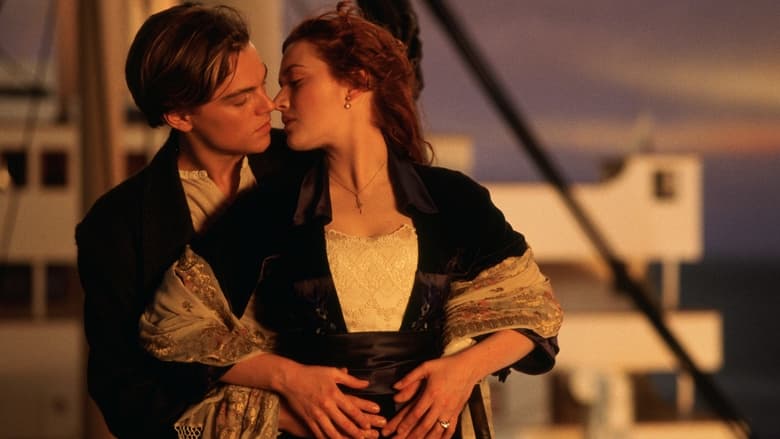
The film flashes back to 1912 as the elderly Rose begins to narrate her story. A 17-year-old first-class passenger, Rose DeWitt Bukater (Kate Winslet), boards the luxurious liner with her domineering mother, Ruth (Frances Fisher), and her wealthy, arrogant fiancé, Cal Hockley (Billy Zane). Feeling trapped by the suffocating expectations of her high-society life and a loveless engagement designed to solve her family's financial troubles, a desperate Rose contemplates suicide by jumping from the ship's stern. She is saved by Jack Dawson (Leonardo DiCaprio), a penniless, free-spirited third-class artist who won his ticket in a poker game.

Despite their vast differences in social standing, a deep and passionate romance blossoms between Jack and Rose. Jack opens Rose's eyes to a world of freedom, art, and authentic joy, starkly contrasting the rigid and passionless existence she was destined for. Their love affair angers Cal and Ruth, who do everything in their power to keep the two apart. The story of their forbidden love unfolds against the backdrop of the ship's grandeur, culminating in the fateful night the 'unsinkable' Titanic collides with an iceberg, turning their personal struggle into a desperate fight for survival.

Core Meaning

At its core, "Titanic" is an exploration of the enduring power of love and the human spirit against the backdrop of a monumental tragedy. Director James Cameron stated his goal was to create a love story interspersed with human loss to convey the emotional impact of the disaster. He wanted to honor those who died by making the audience experience the history, not just as a morality tale, but as a lived, subjective event. The fictional love story of Jack and Rose serves as the vehicle for this emotional journey, making the historical event accessible and deeply personal.

The film's message transcends the disaster itself, focusing on themes of liberation and self-determination. Jack's philosophy of 'making each day count' and living an authentic life becomes a powerful force that liberates Rose from her gilded cage of social expectation and familial duty. Jack's ultimate sacrifice is not just a tragic end to a romance, but a transfer of energy that allows Rose to break free and live a full, adventurous life as she promised him she would. The story posits that love can transcend social class, time, and even death, becoming a timeless memory that gives life meaning.

Thematic DNA

Love and Sacrifice 35%
Social Class and Inequality 30%
Freedom vs. Confinement 25%
Hubris and Disaster 10%

Love and Sacrifice

The central theme is the transformative and enduring power of love, as exemplified by the whirlwind romance between Jack and Rose. Their love transcends the rigid social classes of the Edwardian era and defies the expectations placed upon Rose by her family and fiancé. It's a love that is liberating for Rose, awakening her to a life of freedom and passion she never thought possible. This theme culminates in the ultimate act of sacrifice, where Jack gives his life to ensure Rose's survival, making her promise to 'never let go' and live a full life. This selfless act underscores the film's message that true love is measured by what one is willing to give for another.

Social Class and Inequality

James Cameron dramatizes the stark hostility between the rich and the poor, using the ship as a microcosm of the rigid class structure of the time. The physical separation of first, second, and third-class passengers on the ship is a visual representation of this divide. The romance between first-class Rose and third-class Jack is a direct challenge to these social boundaries. The film starkly portrays the inequality during the sinking, where third-class passengers are physically barred from reaching the lifeboats to give precedence to the wealthy. Cal's snobbery and Ruth's desperation to maintain their high-society status highlight the arrogance and moral bankruptcy of the upper class, contrasted with the vitality and camaraderie of the third class.

Freedom vs. Confinement

Before meeting Jack, Rose feels like she's 'screaming on the inside' while trapped in a life of endless parties, mindless chatter, and a loveless engagement. The ship, a 'ship of dreams' to others, is a 'slave ship' taking her back to America in chains. Jack represents freedom—a life of adventure, unpredictability, and authentic experience. He teaches Rose to break free from the confinement of her social class and expectations, encouraging her to 'fly' both literally at the ship's bow and metaphorically in her life choices. Her ultimate survival and the life she leads are a testament to her choosing the freedom Jack showed her was possible.

Hubris and Disaster

The film explores the theme of human arrogance in the face of nature. The RMS Titanic is presented as a symbol of technological prowess and industrial pride, famously dubbed 'unsinkable'. Characters like Cal Hockley and White Star Line director Bruce Ismay exhibit immense hubris, with Cal even stating, 'God himself could not sink this ship'. This arrogance leads to fatal errors, such as ignoring iceberg warnings in a push for speed. The catastrophic sinking serves as a powerful and tragic reminder of humanity's vulnerability and the folly of believing that technology can conquer the forces of nature.

Character Analysis

Rose DeWitt Bukater

Kate Winslet

Archetype: The Heroine (Damsel in Distress turned Rebel)
Key Trait: Passionate

Motivation

Her primary motivation is to escape the suffocating and hypocritical world of the upper class and to find authentic love and personal freedom. She feels like she is 'standing at a great precipice' with no one to pull her back, and her initial desperation evolves into a conscious desire to live a meaningful life on her own terms, a desire catalyzed by Jack.

Character Arc

Rose begins as a repressed, suicidal teenager trapped by the conventions of her class and a loveless engagement. Meeting Jack ignites a rebellion within her. She transforms from a passive victim of her circumstances into a passionate, courageous, and self-determined woman. She learns to speak her mind, defies her family, and ultimately chooses a life of freedom over one of wealth and security. Her final act of survival, and the full life she leads, fulfills her promise to Jack, completing her journey to becoming the strong, independent woman he saw in her.

Jack Dawson

Leonardo DiCaprio

Archetype: The Romantic Hero / The Catalyst
Key Trait: Charismatic

Motivation

Jack is motivated by a deep appreciation for life and a desire to live it authentically and without constraints. He values experiences over possessions. Once he meets Rose, his motivation becomes twofold: to win her love and to free her from the prison of her social class, enabling her to become the vibrant person he knows she can be.

Character Arc

Jack is a largely static character in terms of his core values; he is already self-aware, free-spirited, and lives life to the fullest. His arc is not one of internal change, but of impact. He acts as the catalyst for Rose's transformation. From the moment he saves her, his purpose is to save her again—not just from the water, but from a life of quiet desperation. His journey is one of falling deeply in love and sacrificing everything for that love, cementing his status as a timeless romantic hero. He exists in the film to change Rose's life forever.

Caledon 'Cal' Hockley

Billy Zane

Archetype: The Villain / The Antagonist
Key Trait: Arrogant

Motivation

Cal is motivated by a need for control, status, and winning at all costs. His desire for Rose seems rooted more in possessing a beautiful object that affirms his social standing than in genuine love. He is driven by jealousy and a deep-seated belief in his own superiority, which is threatened by the penniless Jack.

Character Arc

Cal is the embodiment of upper-class arrogance, entitlement, and possessiveness. He views Rose not as a partner, but as a prize to be owned and controlled. His arc is one of escalating villainy and desperation. As he loses his grip on Rose, his polished veneer cracks, revealing a violent, manipulative, and ultimately pathetic man. He doesn't grow or learn; instead, his circumstances expose his deep-seated insecurity and his inability to value anything beyond money and status. His survival of the sinking is ironic, as he ultimately faces a tragic end driven by the loss of the wealth that defined him.

Ruth DeWitt Bukater

Frances Fisher

Archetype: The Obstacle / The Anxious Matriarch
Key Trait: Pragmatic

Motivation

Her motivation is entirely driven by the preservation of her family's name and financial standing. She pressures Rose into marrying Cal because she sees it as their only way to avoid poverty and social ruin. She pleads with Rose, 'Do you want to see me working as a seamstress?'. Her actions, though cruel to Rose, stem from a place of desperation and a rigid adherence to the societal rules she knows.

Character Arc

Ruth is a woman defined by her fear of losing social status and financial security after her husband left them in debt. She acts as a primary obstacle to Rose's happiness, forcing the engagement to Cal. She is a product of a society where a woman's survival depends on a beneficial marriage. While she loves her daughter, she prioritizes security over Rose's emotional well-being. She does not experience a significant arc of change; she remains committed to her classist values, even during the disaster, and survives the sinking but loses her daughter forever.

Symbols & Motifs

The Heart of the Ocean

Meaning:

The fictional blue diamond necklace is a powerful, multi-faceted symbol. For Cal, it represents wealth, power, and his possessive ownership of Rose. For Rose, it initially symbolizes her confinement but transforms into a symbol of her love for Jack and her newfound freedom. It is a witness to their most intimate moment—the nude sketch—and becomes a tool Cal uses to frame Jack, representing the corrupting power of wealth. Ultimately, when the elderly Rose drops it into the ocean, it symbolizes her letting go of the past, returning her 'heart' to Jack, and fulfilling the cycle of their eternal love.

Context:

The necklace is introduced as a gift from Cal to Rose. Rose wears only the necklace when Jack draws her. Cal's valet plants it on Jack to accuse him of theft. In the present day, the search for the necklace frames the entire story. The film concludes with the elderly Rose revealing she has had it all along and dropping it over the wreck site.

The RMS Titanic (The Ship)

Meaning:

The ship itself is a major symbol. Initially, it represents human achievement, modernity, and the height of luxury—a 'ship of dreams'. However, it also symbolizes the rigid social hierarchy of the Edwardian era, with its physically segregated classes. For Rose, it is a 'slave ship' and a prison. Ultimately, its tragic sinking symbolizes the fallibility of human pride and technology, and the idea that in the face of nature and death, social distinctions become meaningless. It becomes a vessel of both grand dreams and devastating loss.

Context:

The ship is the setting for the entire 1912 narrative. Its grandeur is showcased in the opening scenes and during Jack and Rose's exploration. Its social stratification is evident in the different decks and dining halls. Its vulnerability and eventual destruction form the basis of the film's second half, where it transforms from a luxurious palace into a terrifying vertical deathtrap.

The Clock on the Grand Staircase

Meaning:

The ornate clock where Jack and Rose agree to meet serves as a powerful symbol of time. It represents the precious, limited time they have together, a whirlwind romance condensed into a few days. The clock is a place of promise and a waypoint in their love story. In the film's final dream (or afterlife) sequence, Rose is reunited with Jack at this very clock, where the time is frozen at 2:20 AM, the moment the ship sank. This suggests their love has transcended time, existing eternally in that pivotal moment.

Context:

Jack leaves a note for Rose asking her to meet him at the clock on the Grand Staircase, a central and elegant location on the ship. This is where she decides to defy her family and choose him. The film's poignant final scene returns to this location, as the young Rose approaches Jack, who is waiting for her by the clock, surrounded by those who perished.

Jack's Drawings

Meaning:

Jack's art portfolio represents his soul, his perception of the world, and his focus on the truth of the human condition rather than superficial appearances. His drawings capture the real lives and struggles of people, which is what initially fascinates Rose. The act of drawing Rose nude is a pivotal moment of trust, intimacy, and liberation for her. It is an act of seeing her for who she truly is, beyond her socialite facade. The drawing itself becomes the physical evidence that connects the past to the present, initiating Rose's entire narrative.

Context:

Rose is first drawn to Jack after seeing his sketchbook filled with portraits of Parisian life. The most significant use of this symbol is the scene where Jack sketches a nude portrait of Rose wearing only the Heart of the Ocean. This drawing is recovered from a safe by the treasure hunters in 1996, leading them to the elderly Rose and setting the entire flashback in motion.

Memorable Quotes

I'm the king of the world!

— Jack Dawson

Context:

Jack shouts this line with his friend Fabrizio at the bow of the Titanic shortly after they've boarded. Standing on the railing with the open ocean before them, he feels a sense of infinite possibility and elation at his good fortune to be on the grand ship, heading to America.

Meaning:

This quote is an exuberant, youthful declaration of freedom and boundless optimism. It perfectly encapsulates Jack's character—his joy for life and his ability to feel rich in experience even when he has no material wealth. It has become one of the most iconic and frequently quoted lines in cinema history.

I'll never let go, Jack. I'll never let go.

— Rose DeWitt Bukater

Context:

After the Titanic has sunk, Jack and Rose are in the icy Atlantic. Rose is safely on a piece of wooden debris, but Jack is succumbing to hypothermia in the water. Before he dies, he makes her promise to survive. This line is her final response to him before she has to release his body into the ocean depths.

Meaning:

This is Rose's promise to Jack as he is dying in the freezing water. While on the surface it refers to physically not letting go of his hand, its deeper meaning is that she will never forget him, their love, or the promise he made her keep: to survive and live a full life. It is the emotional climax of their story, signifying that his memory and influence will guide the rest of her life.

Draw me like one of your French girls.

— Rose DeWitt Bukater

Context:

Rose says this to Jack in her first-class suite. She has decided to fully commit to her feelings for him and defy Cal. She takes off her robes and lies on a chaise lounge, wearing only the Heart of the Ocean, ready for Jack to capture her image in his sketchbook.

Meaning:

This line signifies a major turning point for Rose's character. It is an act of total rebellion against her constrained life and a profound expression of trust and intimacy with Jack. By asking him to draw her nude, wearing only the necklace Cal gave her, she is shedding her identity as Cal's property and offering her true, vulnerable self to Jack.

A woman's heart is a deep ocean of secrets.

— Old Rose

Context:

The elderly Rose says this to Brock Lovett and his crew on the research vessel after they tell her there is no record of Jack Dawson. She explains that she has never spoken of him to anyone, not even her late husband. It underscores the personal and sacred nature of her memory before she begins her detailed narration of the events.

Meaning:

This quote, delivered by the elderly Rose, encapsulates the framing narrative of the film and one of its core ideas. It speaks to the private, profound experiences that shape a life, many of which remain unspoken. Rose has kept the truth of her love for Jack a secret for 84 years, and this line poignantly conveys the depth and weight of that lifelong memory before she finally shares her story.

Philosophical Questions

Does true freedom come from rejecting societal expectations or from within?

The film deeply explores the concept of freedom through Rose's journey. She is materially privileged but spiritually and emotionally imprisoned by her social class. Jack, who has nothing, is presented as the freest character. The film poses the question of whether freedom is an external state achieved by breaking rules and leaving one's environment, or an internal state of mind. Jack's philosophy suggests it is internal ('I got air in my lungs, a few blank sheets of paper'), but he is also the catalyst who facilitates Rose's external break from her confining world. Her journey suggests that internal liberation must be accompanied by the courage to make external, life-altering choices.

Can love truly transcend social class and even mortality?

The entire narrative is built around this question. The love between Jack and Rose is a direct assault on the rigid class barriers of their time. Their relationship suggests that human connection is more profound and valuable than any social or economic status. The film's ending pushes this question further. Jack's physical death does not end their love story; Rose keeps his memory alive for 84 years, and he remains the defining force in her life. The final scene, whether interpreted as a dream or the afterlife, suggests that their love achieves a form of immortality, reuniting them beyond the confines of time and death, making a powerful statement on the enduring nature of a profound spiritual bond.

What is the relationship between human ambition, technology, and nature?

The Titanic itself is a monument to human ambition and technological achievement, hailed as 'unsinkable'. The film questions the hubris inherent in believing that humanity can conquer nature. The characters who place their faith in the ship's technological superiority are ultimately proven tragically wrong. The iceberg, a simple, powerful force of nature, effortlessly defeats the pinnacle of modern engineering. The disaster serves as a cautionary tale about the dangers of unchecked pride and the illusion of control, suggesting a need for humility and respect for the natural world that technology cannot replace.

Alternative Interpretations

While the film presents a straightforward love story, viewers and critics have proposed several alternative interpretations over the years.

1. Jack is a Time Traveler: A popular fan theory suggests that Jack is a time traveler sent back to save Rose from committing suicide, which would have altered the timeline. Evidence cited includes Jack's anachronistic hairstyle and rucksack, his mention of ice fishing on Lake Wissota (a man-made lake created five years after the Titanic sank), and his promise to take Rose on the Santa Monica Pier rollercoaster (which was built after 1912). In this reading, his mission is not just to win her heart but to ensure her survival.

2. Jack is a Figment of Rose's Imagination: Another theory posits that Jack was a manifestation of Rose's subconscious, created to give her the courage to escape her miserable life. Proponents point to the treasure hunters finding 'no record' of Jack Dawson and old Rose's line, 'He exists now only in my memory.' In this view, her interactions with Jack are an internal struggle, and the romance is a psychological coping mechanism that ultimately empowers her to save herself. However, this theory is often contested by pointing to Jack's interactions with other characters.

3. The Ending is Rose's Afterlife: The final scene where a young Rose reunites with Jack on the Grand Staircase is often debated. The most common interpretation is that the elderly Rose has passed away peacefully in her sleep, and this is her spirit's arrival in the afterlife, where she is welcomed by Jack and all the other souls who perished in the disaster. The clock striking 2:20, the time of the sinking, supports this idea. James Cameron, however, has stated he prefers to leave this open to the audience's interpretation, allowing for it to be either a dream or a spiritual reunion.

Cultural Impact

James Cameron's "Titanic" was more than a box-office success; it was a global cultural phenomenon that left an indelible mark on cinema and popular culture. Upon its 1997 release, it became the highest-grossing film of all time, a title it held for over a decade, and was the first film to earn over a billion dollars. Its success revitalized the historical epic and disaster genres, proving that audiences had a massive appetite for large-scale, emotional storytelling. The film's groundbreaking use of digital effects, seamlessly blending CGI with live-action and scale models, set a new standard for visual spectacle in filmmaking and pushed the industry forward technologically.

The film had a profound impact on historical consciousness, sparking a massive resurgence of public interest in the actual Titanic tragedy. Documentaries, books, and museum exhibitions about the ship saw unprecedented popularity. The love story of Jack and Rose became a cultural touchstone, with their 'I'm flying!' pose at the ship's bow becoming one of the most iconic and parodied images in film history. The film's theme song, Celine Dion's "My Heart Will Go On," became a global anthem, dominating airwaves and winning numerous awards, further cementing the film's place in the cultural zeitgeist. "Titanic" also influenced fashion with a revival of interest in Edwardian-era styles. Its narrative, blending a fictional romance with a meticulously researched historical event, created an emotional connection for millions, making the century-old tragedy feel immediate and deeply personal.

Audience Reception

The audience reception for "Titanic" was overwhelmingly positive, contributing to its phenomenal box office success and cultural longevity. Viewers were captivated by the epic scale of the production, the breathtaking visual effects, and the meticulous recreation of the historic ship. The central romance between Jack and Rose resonated deeply with audiences, who found their love story incredibly moving and tragic. The performances of Leonardo DiCaprio and Kate Winslet were widely praised, with their on-screen chemistry lauded as one of the most iconic in cinema history. The emotional weight of the film, particularly the harrowing sinking sequence and Jack's sacrifice, left a profound impact on viewers, many of whom saw the film multiple times.

However, the film was not without its critics among audiences. A common point of criticism was its lengthy runtime of over three hours. Some viewers found the dialogue, particularly in the romantic scenes, to be cliché or 'cheesy'. The fictional love story, while praised by many, was also criticized by some for being overly melodramatic and for overshadowing the historical tragedy and the real people who died. Despite these criticisms, the overall verdict from the public was that "Titanic" was a spectacular and emotionally powerful cinematic experience.

Interesting Facts

  • The hands seen sketching Rose in the famous drawing scene are not Leonardo DiCaprio's but those of director James Cameron, who is a skilled illustrator. Since Cameron is left-handed and DiCaprio is right-handed, the footage was mirror-imaged in post-production.
  • The film's production cost of $200 million was more expensive than the original cost to build the RMS Titanic itself, which was approximately $150 million when adjusted for 1997 inflation.
  • When James Cameron wrote the script, he intended for Jack Dawson to be entirely fictional. It was only after the script was finished that he discovered a real "J. Dawson" (Joseph Dawson) had died on the Titanic. Joseph was a coal trimmer, and his grave in Halifax, Nova Scotia is now widely visited by fans.
  • Kate Winslet was one of the few actors who refused to wear a wetsuit during the extensive water scenes. As a result, she suffered from pneumonia.
  • The emotional scene of the elderly couple hugging on the bed as water floods their cabin is a tribute to Ida and Isidor Straus, the co-owners of Macy's department store, who died on the Titanic. Ida was offered a seat on a lifeboat but refused to leave her husband, reportedly saying, 'As we have lived together, so we shall die together.'
  • The scene where Rose is looking up at the stars from the floating debris was corrected for the 2012 3D re-release. Astrophysicist Neil deGrasse Tyson had pointed out to James Cameron that the original film showed an incorrect star pattern for the location and time of the sinking.
  • James Cameron has visited the actual wreck of the Titanic multiple times. He has stated that he spent more time with the ship than its living passengers did. His deep-sea explorations were a primary inspiration for making the film.
  • The time duration of the 1912 scenes, from the iceberg collision to the ship's final plunge, is two hours and forty minutes, which is the exact amount of time the real sinking took.

Easter Eggs

A brief cameo by James Cameron

During the initial boarding scene in Southampton, James Cameron makes a brief appearance as a bearded man in the third-class line getting checked for lice. He also has a voice cameo, saying 'Full speed ahead!' a bit later.

The clock's time is set to 2:20.

In the final dream/afterlife scene, when Rose meets Jack on the Grand Staircase, the clock behind them reads 2:20. This is the exact time the RMS Titanic officially sank on April 15, 1912, symbolizing that their reunion is taking place in a moment frozen outside of mortal time, at the very minute their physical separation occurred.

Real Titanic historian cameo.

Edward Kamuda, the then-president of the Titanic Historical Society, has a non-speaking cameo as an extra walking on the deck as the ship leaves the dock. This was a nod to the extensive historical consultation that went into the film's production.

Reference to 'A Night to Remember' (1958)

James Cameron was heavily influenced by the 1958 British film about the disaster, 'A Night to Remember'. He included several homages, including a scene where a character tells the ship's designer, Thomas Andrews, 'But this ship can't sink!', and the poignant depiction of the ship's band playing on deck as the vessel goes down.

⚠️ Spoiler Analysis

Click to reveal detailed analysis with spoilers

Frequently Asked Questions

Explore More About This Movie

Dive deeper into specific aspects of the movie with our detailed analysis pages

Comments (0)

Leave a comment

No comments yet. Be the first to share your thoughts!