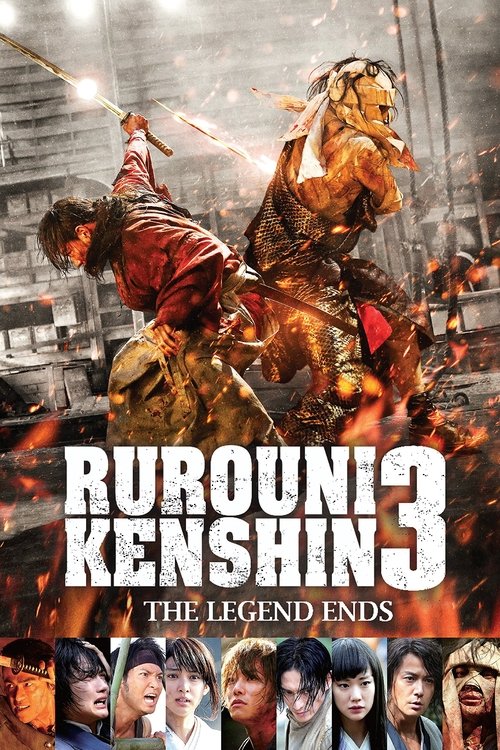
Rurouni Kenshin Part III: The Legend Ends
るろうに剣心 伝説の最期編
Overview
Rurouni Kenshin: The Legend Ends (2014) picks up immediately after the cliffhanger of Kyoto Inferno. Kenshin Himura washes ashore and is rescued by his master, Hiko Seijuro. Realizing he is not strong enough to defeat the ambitious Makoto Shishio, Kenshin begs his master to teach him the ultimate technique of the Hiten Mitsurugi style. The first half of the film focuses on this philosophical and physical training in the quiet mountains, where Kenshin must confront his own lack of self-worth to unlock his true potential.
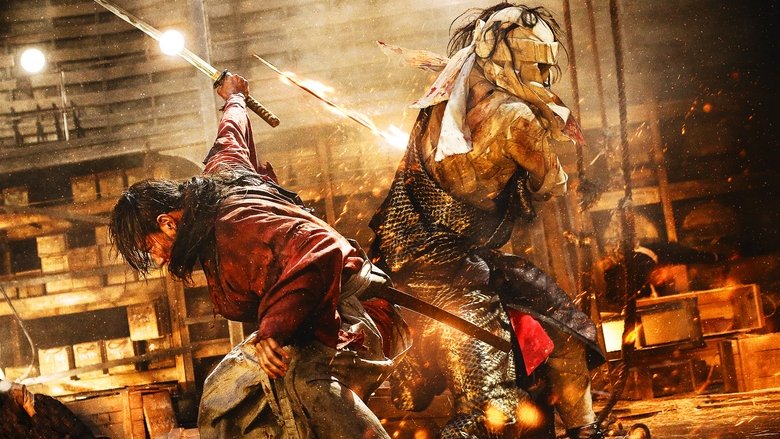
Meanwhile, Shishio Makoto and his ironclad battleship, the Purgatory, threaten to bombard Tokyo, pressuring the Meiji government to execute Kenshin as a scapegoat. The narrative crescendos into a high-stakes climax where Kenshin, aided by former rivals and allies, infiltrates the battleship. The film concludes with a spectacular four-on-one duel against Shishio, determining the future of Japan and the validity of Kenshin's vow not to kill.
Core Meaning
The central message of the film is the triumph of the will to live over the glory of self-sacrifice. Director Keishi Otomo deconstructs the romanticized samurai ideal of dying for a cause (bushido), arguing instead that true strength lies in the courage to survive and protect the future. While Shishio represents a social Darwinist view where the strong consume the weak, Kenshin proves that strength is a responsibility to nurture and protect life, starting with one's own.
Thematic DNA
The Value of Life vs. Self-Sacrifice
This is the film's most pivotol theme. Kenshin believes his life is cheap due to his past sins, willing to die for others. His master, Hiko, teaches him that this "sacrificial" mindset is actually arrogance and weakness. Kenshin can only master the ultimate technique when he fears death and desperately wants to live—not just for himself, but so he can continue to protect others.
Social Darwinism vs. Protection
Shishio's philosophy is simple: "The strong survive, the weak die." He views the Meiji era's peace as a facade. Kenshin counters this by demonstrating that the purpose of strength is not domination, but the protection of the weak, validating the new era's potential for peace.
History and Modernization
The film juxtaposes the fading samurai era with the encroaching industrial age. Shishio's iron battleship represents the terrifying, impersonal power of modern technology, while the sword fights represent the personal, spiritual struggle of the past. The government's manipulation (via Ito Hirobumi) highlights the dirty political reality of building a modern nation.
Character Analysis
Himura Kenshin
Takeru Satoh
Motivation
To protect the peace of the new era and atone for his past sins without killing again.
Character Arc
Starts as a broken warrior willing to throw his life away. Through Hiko's training, he sheds his "death wish" and learns that his own life has value. He evolves from a "sacrificial savior" to a "living protector."
Makoto Shishio
Tatsuya Fujiwara
Motivation
To conquer Japan and establish a nation based on the survival of the fittest, seeking revenge for being betrayed and burned by the government.
Character Arc
Static character representing pure ambition and chaos. He serves as the dark reflection of Kenshin—what Kenshin could have become if he embraced violence completely. He burns brighter until he consumes himself.
Hiko Seijuro
Masaharu Fukuyama
Motivation
To pass on the Hiten Mitsurugi style and ensure his "stupid apprentice" doesn't die in vain.
Character Arc
Reluctantly takes Kenshin back as a student. He serves as the catalyst for Kenshin's psychological breakthrough, teaching him that he cannot be a true hero if he doesn't value his own existence.
Symbols & Motifs
The Ironclad Battleship (Purgatory)
It symbolizes the dark side of the Meiji Restoration: industrialization, westernization, and the destructive power of modern warfare that threatens to consume the "soul" of Japan.
The final act takes place entirely on this ship, serving as a literal and metaphorical battleground between the old ways (swords) and the new world (cannons/steel).
Fire
Represents Shishio's consuming rage, his literal physical condition (overheating), and the hell he intends to unleash on Japan. It is a destructive, purifying force that contrasts with Kenshin's restraint.
Shishio is constantly surrounded by fire, his sword ignites, and he ultimately perishes by his own internal fire (spontaneous combustion) rather than by Kenshin's blade.
The Sakabato (Reverse-Blade Sword)
A symbol of penance and the "will to live" without taking life. It is a paradox: a weapon designed not to kill, representing the difficult path of peace in a violent world.
Kenshin clutches this sword throughout his recovery and uses it to deliver the final, non-lethal blow, proving that one can win without becoming a murderer.
Memorable Quotes
It is the will to live that is stronger than anything else.
— Hiko Seijuro
Context:
Spoken during the intense training sequence in the forest, just as Kenshin finally understands the missing piece in his soul.
Meaning:
This is the core philosophy of the film. Hiko explains that Kenshin's willingness to die is a weakness, not a virtue. True power comes from the desperate, primal urge to survive.
The strong survive, the weak die. That is the law of nature.
— Makoto Shishio
Context:
Repeated by Shishio to justify his plan to burn Tokyo and overthrow the government, and during his final duel with Kenshin.
Meaning:
Encapsulates Shishio's Social Darwinist worldview. He justifies his cruelty as merely following the natural order of the world.
Stupid apprentice.
— Hiko Seijuro
Context:
Used by Hiko when he finds Kenshin washed up on the beach, and later when he criticizes Kenshin's mindset.
Meaning:
A term of endearment and frustration. It highlights the dynamic between the god-like master and the human, flawed Kenshin.
Philosophical Questions
Is a life of atonement worth living if it requires constant suffering?
The film explores this through Kenshin's depression. Hiko challenges him to see that 'atonement' that leads to death is meaningless; true atonement requires the resilience to live on and continue doing good, which is a harder path than dying.
Does the government have the right to sacrifice individuals for the 'greater good'?
Through Ito Hirobumi's decision to execute Kenshin to appease Shishio, the film questions political utilitarianism. It ultimately rejects this, showing that a peace built on the betrayal of a hero is fragile and unjust.
Alternative Interpretations
Critics have discussed the ending as a commentary on Japan's modernization. The government's final salute to Kenshin can be interpreted not just as respect, but as the state acknowledging it can no longer rely on 'assassins' to solve its problems—marking the true end of the samurai era. Alternatively, some view Shishio not as a villain, but as a tragic necessary evil who forced the Meiji government to consolidate its power and face its own hypocrisy regarding how it treated its former warriors.
Cultural Impact
Rurouni Kenshin: The Legend Ends solidified the trilogy's reputation as the gold standard for anime live-action adaptations. In a genre plagued by poor adaptations (like Dragonball Evolution or Attack on Titan), this film was praised for respecting the source material while elevating the action to a cinematic level comparable to Hong Kong martial arts films. It helped revitalize the chanbara (samurai cinema) genre in Japan, merging modern fast-paced choreography with traditional period drama aesthetics. The film's success proved that anime aesthetics could translate to reality if grounded in strong stunt work and character psychology rather than just CGI.
Audience Reception
The film received widespread acclaim from audiences and critics alike.
Praised: The action choreography (especially the final boss fight) is often cited as some of the best swordplay in cinema history. The casting of Shishio and Hiko was universally loved.
Criticized: Some viewers felt the first half (training arc) was too slow compared to the frenetic pace of the previous film. Hardcore manga fans noted changes in the plot (like the removal of the Mount Hiei base), though most accepted these as necessary cinematic streamlining.
Verdict: A satisfying and spectacular conclusion that honors the spirit of the original series.
Interesting Facts
- Filmed back-to-back with 'Kyoto Inferno' over a period of 6 months, with a combined budget of roughly $30 million.
- The actor Tatsuya Fujiwara (Shishio) had to wear a heavy, rubber-like suit for the bandages, which was notoriously difficult to move in and hear through.
- The final four-on-one battle (Kenshin, Sanosuke, Aoshi, Saito vs. Shishio) is an extended sequence that differs from the manga to give all main characters a moment to shine against the villain.
- Masaharu Fukuyama, who plays Master Hiko Seijuro, is a massive pop star and actor in Japan; his casting was a significant 'event' for Japanese audiences.
- The 'Amakakeru Ryu no Hirameki' technique is performed with the left foot stepping forward, a detail from the manga that is biomechanically significant for the move's speed.
- The film was a massive box office success in Japan, grossing over $40 million and sitting at the top of the charts for weeks.
Easter Eggs
Ito Hirobumi's Prominence
The character of Ito Hirobumi (future first Prime Minister of Japan) plays a much larger role here than in the manga. His portrayal as a pragmatic politician who orders Kenshin's execution adds a layer of historical realism and political grit that links the fantasy story to real Japanese history.
Hiko's Pottery
In the background of Hiko's hut, you can see pottery. This is a nod to Hiko's guise in the manga as a pottery artist, showing he lives a life of creation to balance his destructive swordsmanship.
Left-footed Step
During the execution of the ultimate technique, the camera focuses on Kenshin stepping with his left foot. This is a subtle but crucial detail for fans, as the manga explains this specific footing is what generates the technique's god-speed.
⚠️ Spoiler Analysis
Click to reveal detailed analysis with spoilers
Frequently Asked Questions
Explore More About This Movie
Dive deeper into specific aspects of the movie with our detailed analysis pages
Comments (0)
No comments yet. Be the first to share your thoughts!