Skip to content
Sea Fog
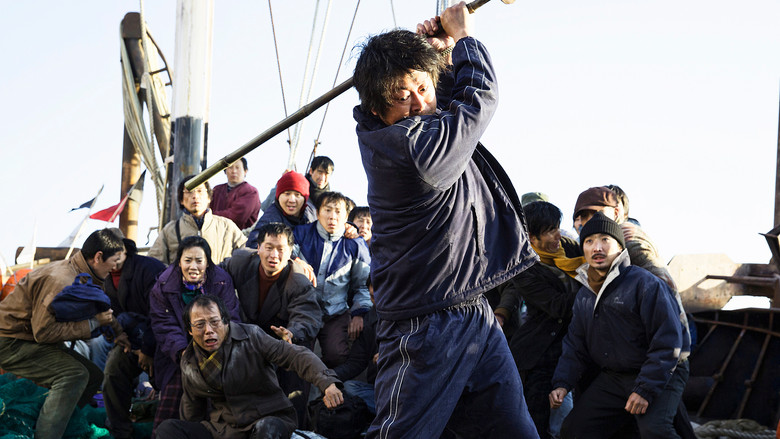
A claustrophobic maritime thriller where fog swallows the horizon and a rusting trawler becomes a pressure cooker. Desperation curdles into dread, and ordinary men drift toward something unspeakable.
Sea Fog

Sea Fog

해무

13 August 2014 South Korea 111 min 6.9 (185)

Director: Shim Sung-bo

Cast: Kim Yun-seok, Park Yoo-chun, Han Ye-ri, Lee Hee-jun, Moon Sung-keun

Drama Thriller Desperation and moral corruption Economic precarity and class Group survival versus individual conscience Human nature versus nature Innocence and love amid brutality

Overview

Sea Fog (Haemoo, 2014) is the directorial debut of Shim Sung-bo, who co-wrote Memories of Murder with Bong Joon-ho. Bong co-wrote and produced this film. It follows the crew of an aging fishing boat, the Jeonjinho. Returns are shrinking, and the owner is threatening to sell the vessel. Captain Cheol-joo is a veteran who feels responsible for his men. He accepts a risky side job: smuggling illegal Chinese-Korean migrants into South Korea.

The crew is a small, tightly knit group. It includes the stern chief engineer, the boatswain, and the youngest hand, Dong-sik. Dong-sik is shy, and he is played by K-pop star Park Yoo-chun in his film debut. The job looks like a quick fix. Then the weather turns, the authorities close in, and thick fog and rough seas cut the boat off from the world.

The film begins as a social drama with some dark humor and a budding romance. It then tightens into a survival thriller. It is adapted from the 2007 stage play Haemoo, which was inspired by a real 2001 tragedy involving migrants and a Korean fishing vessel.


Core Meaning

The film argues that moral collapse needs no monsters, only pressure. Shim Sung-bo said he was drawn to how panic and desperation can turn normal people into criminals. He said it is about how any run-of-the-mill person can become guilty, afraid and dangerous. The ship is a closed society in which economic precarity, loyalty to one's own group and fear of punishment justify ever greater cruelty toward outsiders.

The film also sets individual guilt against systemic failure. The crew's choices come out of a world of debt and corrupt authority. Hope survives only in a small, fragile act of tenderness, and the film does not promise it will be enough.

Thematic DNA

Desperation and moral corruption 30%
Economic precarity and class 25%
Group survival versus individual conscience 20%
Human nature versus nature 15%
Innocence and love amid brutality 10%

Desperation and moral corruption

Cheol-joo's decision to smuggle migrants stems from fear of losing the boat and his men's livelihoods. Each later compromise follows from the first, until the crew crosses lines they could not have imagined.

Economic precarity and class

Reviewers note the film's backdrop of poverty and the era's financial hardship. The crew, the owner who sells their ship and the migrants occupy a hierarchy of expendability, and the boat's layout of above and below echoes it.

Group survival versus individual conscience

The crew turns on the migrants and on each other to protect itself. Dong-sik's attempt to shield Hong-mae is the lone dissent, and it puts him against the men he loves.

Human nature versus nature

The fog, the storm and the isolated sea are not just obstacles. They strip away social restraint and expose the characters' instincts.

Innocence and love amid brutality

The romance between Dong-sik and Hong-mae offers a contrasting vision of humanity. Some critics found it out of tone with the rest of the film, but it works as the story's moral anchor.

Character Analysis

Captain Cheol-joo

Kim Yoon-seok

Archetype: Tragic antihero Key Trait: Authoritarian paternalism

Motivation

To save the boat and his crew's livelihoods.

Character Arc

He begins as a seemingly victimized provider hit by economic circumstances. Under pressure he turns increasingly ruthless and violent.

Dong-sik

Park Yoo-chun

Archetype: Innocent hero Key Trait: Compassion

Motivation

To protect Hong-mae, whom he has fallen in love with.

Character Arc

The youngest crew member, shy and naive. He grows from an obedient hand into the one man willing to defy the crew.

All 5 characters and cast

Symbols & Motifs

The sea fog

Meaning:

Moral blindness and the loss of clear ethical bearings.

Context:

The fog surrounds the ship in the second half, cutting it off from help and shaping the film's claustrophobic atmosphere.

The aging trawler

Meaning:

A fading livelihood and a closed society, a microcosm of a struggling nation.

Context:

The rusted boat is the film's near-single setting. It is threatened with sale, and the crew's whole lives depend on it. Viewers noted its reds, greens and rust.

The engine room / hold

Meaning:

The hidden, lower space where the powerless are kept, and a refuge for secret love.

Context:

Dong-sik hides Hong-mae in the engine room. The migrants are kept below deck, which echoes the above-and-below class imagery some viewers saw.

The captain's authority

Meaning:

Paternal leadership that decays into tyranny.

Context:

Cheol-joo begins as a caring leader and loses control of himself as events escalate. One reviewer observed that he loses control as a way of keeping control.

Philosophical Questions

Can ordinary people be held fully responsible for crimes committed under desperation?

The film makes the crew sympathetic before they cross the line, and asks whether circumstances excuse them.

Is solidarity with one's own group a virtue or a moral trap?

The crew's loyalty to one another drives them to atrocity, while Dong-sik's loyalty to one person pulls the other way.

Who bears guilt for systemic failures?

The film also shows corrupt authorities and an uncaring owner, placing blame beyond the boat.

How It Ends

Alternative Interpretations

It can be read as a national allegory: the ship stands for a society under economic strain that sacrifices outsiders to preserve itself. It can also be read as a study of individual guilt, since the crew's ordinary decency fails under pressure. Some see the romance as a fairy-tale touch, as Shim himself described adding a touch of fantasy. Others, such as one reviewer, felt it jarred with the film's tone and served the casting of a pop star. The ending divides viewers on whether it offers any redemption.

Full ending explanation

Cultural Impact

The film dramatizes a real 2001 human-trafficking tragedy and sets it in the shadow of the late-1990s financial crisis. Variety noted that it might evoke associations with the Sewol ferry disaster. It was South Korea's Academy Awards submission for Best Foreign Language Film, and it helped launch Shim Sung-bo as a director. It also drew attention as the project of Bong Joon-ho's collaborator. Some viewers compared its class imagery to Parasite.

Audience Reception

Critics and viewers praised the tense atmosphere, the confined setting, Kim Yoon-seok's performance and the cinematography. Variety called it meticulously crafted and credited its widespread critical acclaim and healthy domestic box office. Many viewers found the slow first half's quirky humor uneven, with the film becoming gripping once it turns into a survival thriller. Criticisms include thin characters lacking psychological depth, shaky camerawork and the out-of-tone romance. Metacritic and Rotten Tomatoes show generally positive but not unanimous reception, and Rotten Tomatoes lists a 6.2/10 average. The brutal ending divides viewers.

Interesting Facts

  • The film is adapted from the 2007 stage play Haemoo, which was based on the true story of 25 Korean-Chinese illegal immigrants who suffocated in the hold of the fishing vessel Taechangho; the crew dumped their bodies into the sea off Yeosu on October 7, 2001.
  • It is Shim Sung-bo's first feature as director; he co-wrote Memories of Murder with Bong Joon-ho, who co-wrote and produced Sea Fog.
  • Kim Yoon-seok was cast as the captain in June 2013.
  • Song Joong-ki was originally offered the young crewman role but had to decline when he received his mandatory military enlistment papers.
  • K-pop singer and actor Park Yoo-chun was cast in August 2013, in his big-screen debut.
  • The film was released in South Korea on August 13, 2014, and runs about 110 minutes.
  • The budget was about US$10 million and the box office about US$11.4 million, according to Wikipedia.
  • It was South Korea's submission for the Best Foreign Language Film at the Academy Awards, and it played in competition at San Sebastián and in Toronto.
  • Shim has said that in the script the captain is a villain, but that he tried to add humanity to the character during shooting.

Frequently Asked Questions

Explore More About This Movie

Dive deeper into specific aspects of the movie with our detailed analysis pages

Comments (0)

Leave a comment

No comments yet. Be the first to share your thoughts!

Similar Movies