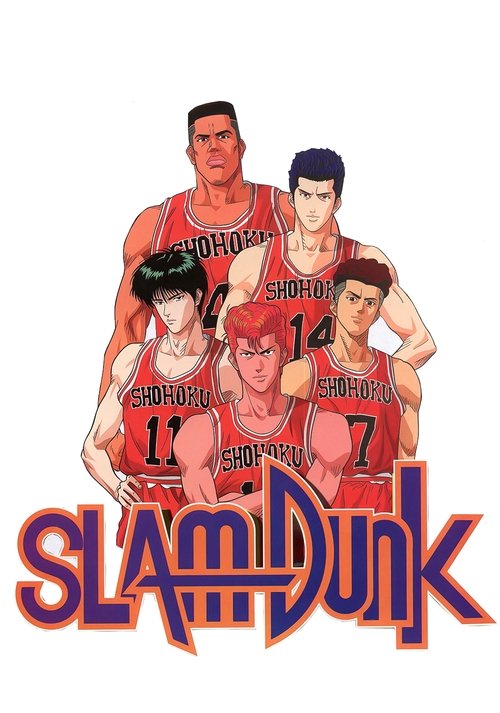
Slam Dunk
スラムダンク
Overview
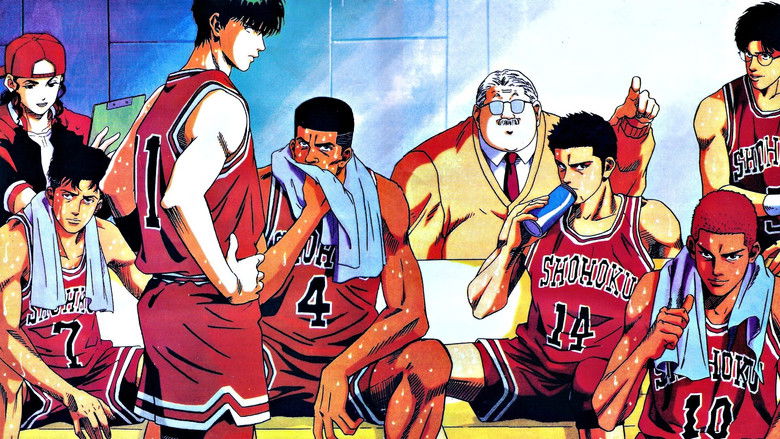
Slam Dunk chronicles the journey of Hanamichi Sakuragi, a volatile high school freshman with a notorious reputation for being rejected by girls and getting into fights. His life takes an unexpected turn when he meets Haruko Akagi, a sweet girl who introduces him to the world of basketball. Smitten, Sakuragi joins the Shohoku High School basketball team to win her affection, despite knowing nothing about the sport and initially despising it. The team is led by Haruko's imposing older brother, Takenori Akagi, the team captain.
What begins as a superficial attempt to impress a girl evolves into a genuine passion. Sakuragi, a complete amateur, must contend with his prodigious and aloof rival, Kaede Rukawa, who is not only a basketball superstar but also the object of Haruko's affection. Alongside returning members like the skilled three-point shooter Hisashi Mitsui and the speedy point guard Ryota Miyagi, the dysfunctional Shohoku team comes together. The series follows their transformation from a group of misfits into a formidable team, documenting their intense training, comedic rivalries, and dramatic matches as they strive to conquer the national championship.

Core Meaning
The core message of Slam Dunk is that passion, perseverance, and dedication can unlock one's true potential, regardless of natural talent or initial motivation. The series powerfully illustrates that love for a craft, in this case, basketball, is a transformative force. Hanamichi Sakuragi begins playing for selfish, romantic reasons, but his journey shows that genuine effort and embracing the process of learning can lead to profound personal growth and a love for the sport itself. The story emphasizes that victory isn't just about winning championships; it's about overcoming personal demons, learning the value of teamwork, and discovering a sense of purpose. It's a celebration of the underdog spirit and the idea that hard work and heart can rival raw genius.
Thematic DNA
Perseverance and Hard Work vs. Natural Talent
This is the central theme, embodied by the rivalry between Hanamichi Sakuragi and Kaede Rukawa. Sakuragi represents raw, untapped athletic potential fueled by relentless, often clumsy, hard work. He starts as a complete novice and dedicates himself to mastering the basics, like rebounding, to become essential to the team. Rukawa is his antithesis, a natural-born genius with incredible skills who seems to play effortlessly. The series explores how Sakuragi's dedication and tenacity allow him to close the gap, suggesting that while talent provides a head start, it's perseverance that ultimately defines a player's greatness.
Redemption and Second Chances
Hisashi Mitsui's character arc is the primary vessel for this theme. A former MVP in junior high, a knee injury led him to quit basketball and become a gang leader who harbors resentment for the sport. His violent return and subsequent tearful confession to Coach Anzai, “I want to play basketball,” is one of the series' most iconic moments. Mitsui's journey back to the team is a powerful story of redemption, as he fights to regain his former glory and make up for lost time, constantly battling his depleted stamina as a reminder of his past mistakes.
Teamwork and Camaraderie
Initially, the Shohoku team is a collection of talented but individualistic and dysfunctional players. Sakuragi and Rukawa are bitter rivals, Miyagi is a hothead, and Mitsui is a returning delinquent. Led by the steadfast Captain Akagi, they slowly learn to trust one another and play as a cohesive unit. The series highlights that individual brilliance (like Rukawa's) is not enough to win against truly strong opponents. It's the combination of their unique skills—Sakuragi's rebounding, Mitsui's three-pointers, Miyagi's speed, and Akagi's defense—that makes them a national-level threat. Their bickering and conflicts give way to moments of profound on-court synergy.
Coming-of-Age and Finding Passion
For Hanamichi Sakuragi, basketball is the catalyst for his maturation. He starts as an immature delinquent obsessed with getting a girlfriend, but the sport gives him direction and discipline. He learns humility through constant failure and practice, develops friendships based on mutual respect rather than gang loyalty, and discovers the joy of dedicating himself to a goal. The basketball court becomes the arena where he confronts his weaknesses and grows from a boy into a young man who defines himself not by how many fights he's won, but by his identity as a basketball player.
Character Analysis
Hanamichi Sakuragi
Takeshi Kusao
Motivation
Initially, his sole motivation is to win the affection of Haruko Akagi. This simple crush drives him to endure grueling practices and humiliation. As the series progresses, his motivation evolves into a fierce rivalry with Kaede Rukawa and a deep-seated desire to prove his 'genius' on the court. Ultimately, his love for the sport and his bond with his teammates become his primary drivers.
Character Arc
Sakuragi begins as an arrogant, girl-crazy delinquent who joins the basketball team for purely selfish reasons. His initial journey is defined by his ignorance of the sport, leading to comedic errors and being forced to master tedious basics. Over the series, his motivation shifts from impressing Haruko to a genuine love for the game. He evolves from a loudmouthed amateur into the team's 'rebound king' and a crucial defensive player. His arc is one of maturation, learning humility, the value of hard work, and finding a true passion that gives his life meaning.
Kaede Rukawa
Hikaru Midorikawa
Motivation
His motivation is pure and simple: to be the best basketball player in Japan. This singular focus makes him incredibly disciplined but also isolates him from his teammates. His rivalry with players like Sendoh from Ryonan and Sawakita in the nationals pushes him to evolve beyond his individualistic style.
Character Arc
Rukawa starts as the undisputed, stoic ace of the team—a prodigy who is incredibly skilled but also selfish and aloof. His primary goal is to become the best player in Japan and eventually go to the USA. His arc is more subtle than Sakuragi's; it's about learning the limits of individual play. Through tough games and advice from Coach Anzai, he begins to understand the importance of teamwork and passing. His evolution is from a solitary star to a player who can elevate his entire team, culminating in the iconic high-five with Sakuragi in the manga's final game.
Hisashi Mitsui
Ryotaro Okiayu
Motivation
His initial motivation is destructive—to ruin the team that reminds him of his own failure. After rejoining, his motivation is to make up for lost time and prove he still has what it takes to be a top player. He is deeply loyal to Coach Anzai, who inspired him in junior high, and this bond fuels his determination to contribute to the team's success.
Character Arc
Mitsui's is a story of redemption. He is introduced as a gang leader seeking to destroy the basketball team out of bitterness. Flashbacks reveal he was a junior high MVP who quit after a severe knee injury. After a dramatic confrontation, he tearfully rejoins the team. His arc is about reclaiming his lost passion and identity. He struggles with his physical limitations, particularly a lack of stamina from his two-year hiatus, which serves as a constant reminder of his past mistakes. He transforms from a villain into the team's clutch three-point shooter, a man fighting against his own past on the court.
Ryota Miyagi
Yoku Shioya
Motivation
His primary motivation is his deep affection for the team manager, Ayako, wanting to impress her with his skills. He also carries a strong desire to be the best point guard in the prefecture. His bond with Sakuragi, built on their shared romantic frustrations, also provides a foundation of loyalty and friendship that drives him.
Character Arc
Miyagi is introduced as another 'problem child,' returning after being hospitalized from a fight with Mitsui's gang. He is cocky, and quick-tempered, and shares a similar history of being unlucky in love with Sakuragi, which forms the basis of their friendship. As the team's point guard, his arc is about channeling his speed and delinquent attitude into leadership on the court. He learns to control his temper and become the steady playmaker who directs the team's offense, proving that his small stature is no obstacle to being a top-tier player.
Takenori Akagi
Kiyoyuki Yanada
Motivation
His singular motivation is to lead Shohoku to the National Championship. This has been his unwavering dream since his first year, and it fuels his intense, disciplined, and sometimes harsh leadership style. He is the foundation of the team's ambition.
Character Arc
Akagi is the captain and emotional pillar of the Shohoku team. For years, he was a talented player on a weak team, his dream of national conquest constantly thwarted by a lack of skilled teammates. His arc is one of fulfillment. With the arrival of Sakuragi, Rukawa, Mitsui, and Miyagi, he finally has a team capable of achieving his dream. He has to evolve from a lone warrior into a true leader, learning to trust his flawed but talented teammates. His journey is about seeing his long-held dream come to fruition and passing on his dedication and spirit to the next generation of players.
Symbols & Motifs
Basketball Shoes
Symbolizes a player's identity, dedication, and journey. For Sakuragi, getting his first pair of Air Jordans marks his official entry and commitment to the basketball world. It represents a rite of passage and his developing identity as a serious player.
Sakuragi's quest for basketball shoes is a significant early plot point. He famously gets a pair of Air Jordan 6s from a shoe store owner who recognizes his potential. This moment signifies his first real investment in the sport beyond just trying to impress Haruko.
The Rebound
Represents Sakuragi's unique, unglamorous, but vital contribution to the team. It symbolizes the idea that success is built on fundamentals and hard work, not just flashy plays. Mastering the rebound gives the 'genius' Sakuragi his core identity and proves his worth.
Captain Akagi teaches Sakuragi the importance of rebounds early on. Sakuragi's mantra, "He who controls the rebounds controls the game," becomes his creed. His exceptional rebounding ability often turns the tide in crucial matches, showcasing his growth and importance.
Sakuragi's Red Hair
Symbolizes his outsider status, rebellious nature, and fiery passion. It makes him instantly recognizable and serves as a visual representation of his explosive energy and unconventional approach to the sport and life.
Sakuragi's red hair is his defining physical feature from the start. It's a mark of his delinquency but later becomes a trademark of the unstoppable 'Tensai' (Genius) basketball player of Shohoku.
Memorable Quotes
諦めたらそこで試合終了ですよ。(Akiramerata ra soko de shiai shūryō desu yo.)
— Coach Mitsuyoshi Anzai
Context:
Coach Anzai first says this to a young Hisashi Mitsui during his junior high championship final, inspiring him to play until the very end and win. The quote resonates throughout the series and becomes a core tenet for the entire Shohoku team during their most difficult matches.
Meaning:
Translated as "If you give up, that's the end of the game." This is the most iconic quote of the series and its central philosophy. It encapsulates the themes of perseverance and hope, reminding the characters and the audience that defeat is only certain when one stops trying.
バスケットは…お好きですか? (Basuketto wa… o-suki desu ka?)
— Haruko Akagi
Context:
This is the first thing Haruko says to Hanamichi Sakuragi in Episode 1, after noticing his impressive height and physique. Sakuragi, desperate to connect with her, immediately lies and says he loves it, setting the entire plot in motion.
Meaning:
Translated as "Do you like basketball?" This simple question is the catalyst for the entire series. It represents the beginning of Sakuragi's journey not only into basketball but also towards personal growth and finding his passion.
安西先生…!!バスケがしたいです… (Anzai-sensei…!! Basuke ga shitai desu…)
— Hisashi Mitsui
Context:
During a violent confrontation where Mitsui and his gang attack the basketball team in the gym (Episode 27), Coach Anzai arrives. Seeing his old mentor, Mitsui breaks down, and amidst tears and blood, makes this heartfelt plea, leading to his return to the team.
Meaning:
Translated as "Coach Anzai…!! I want to play basketball…" This is a raw, emotional confession that marks the climax of Mitsui's redemption arc. It signifies his decision to abandon his delinquent path and return to the sport he truly loves, admitting his vulnerability and regret.
天才ですから (Tensai desu kara)
— Hanamichi Sakuragi
Context:
Sakuragi shouts this phrase frequently throughout the series, often after making a successful (or even unsuccessful) play, to the annoyance of everyone around him. It's his way of asserting his identity and building his own confidence, first appearing in the early episodes as he begins his basketball journey.
Meaning:
Translated as "Because I'm a genius." This is Sakuragi's personal catchphrase. It reflects his immense, often misplaced, confidence and arrogant personality. While initially a comedic declaration of his self-perceived greatness, it becomes a mantra that fuels his rapid development and allows him to attempt seemingly impossible feats.
Episode Highlights
The Genius Basketball Player Is Born!?
The series premiere introduces Hanamichi Sakuragi, a heartbroken delinquent who has been rejected by 50 girls. He meets Haruko Akagi, who asks him the fateful question: "Do you like basketball?" This episode perfectly sets up Sakuragi's motivation and his comedic, clueless entry into the world of basketball.
This episode is the foundation for the entire series. It establishes the main character's initial premise—joining a sport he knows nothing about for a girl—and introduces the central relationships and rivalries that will drive the narrative.
Hisashi Mitsui: The Man of the Past
This episode delves into the backstory of Hisashi Mitsui. After he and his gang invade the gym to fight the team, Kogure reveals Mitsui's history as a star player who quit due to injury. It's a pivotal episode that adds depth and tragedy to a character previously seen only as a villain.
It begins the transformation of Mitsui from an antagonist into one of the series' most beloved and complex protagonists, establishing the powerful theme of redemption.
I Want to Play Basketball!
The climax of the gym fight. When Coach Anzai appears, Mitsui breaks down and delivers his iconic line, "Coach Anzai... I want to play basketball." It's a deeply emotional moment that solidifies his decision to return to the team.
This episode marks the completion of the core Shohoku lineup. Mitsui's return provides the team with a crucial long-range shooter and completes one of the most compelling character arcs in sports anime history.
Shohoku vs. Ryonan: The Fated Showdown
The conclusion of the intense final qualifying match against Ryonan. The game goes down to the wire, showcasing the growth of every player. Sakuragi makes a critical mistake but also a game-saving play, highlighting his development from a liability to a key player under pressure.
This match determines which team goes to the National Championship. The victory is the culmination of the team's journey throughout the prefectural tournament and solidifies Shohoku as a genuine national contender.
For the Nationals!
Shohoku plays their final, decisive game of the prefectural tournament against Ryonan. The match is incredibly intense, with Akagi playing through a severe ankle injury. Sakuragi makes a game-winning dunk at the buzzer, but it's an illegal play that doesn't count, yet he manages to save the game in another way, showing his growth in game sense.
This game solidifies Shohoku's spot in the Nationals. It's a testament to their resilience and growth, with every character pushing past their limits. It is the culmination of the anime's primary arc.
Glory of the Shohoku
The final episode of the anime series. It depicts the Shohoku team departing for the National Championships. It serves as an open-ended conclusion, showing the team ready to face their next great challenge.
This episode concludes the anime adaptation, famously stopping before the manga's final and most celebrated arc, the National Tournament itself. It leaves the audience with a sense of anticipation and cements the series' focus on the journey of becoming a team rather than the ultimate outcome.
Philosophical Questions
Does the motivation for starting a journey matter if the journey itself becomes the passion?
The series explores this through Hanamichi Sakuragi. He begins playing basketball for the shallowest of reasons: to impress a girl. He lies about his interest and endures hardship not for the love of the game, but for romantic approval. However, through the process of learning, failing, and eventually succeeding, he develops a genuine, all-consuming passion for basketball that transcends his initial crush. The series suggests that the origin of a pursuit is less important than the dedication and love one develops along the way.
What is the nature of genius: innate talent or relentless effort?
This question is at the heart of the Sakuragi-Rukawa rivalry. Rukawa is the natural genius, gifted with innate skill and grace. Sakuragi self-proclaims himself a 'genius' but his abilities are forged through grueling, repetitive, and often humiliating practice. The series doesn't give a simple answer. It shows that talent like Rukawa's can stagnate without the drive to evolve, while relentless effort like Sakuragi's can allow someone to achieve feats of genius. Ultimately, Slam Dunk suggests that true 'genius' might be the fusion of both: potential actualized through unwavering hard work.
Alternative Interpretations
One of the most discussed aspects of the Slam Dunk anime is its abrupt ending. The series concludes with the team heading to the National Championship, leaving the manga's most climactic arc unadapted. One interpretation is that this ending deliberately shifts the series' focus from the ultimate goal (winning the championship) to the journey of formation. The 'victory' is not the trophy, but the transformation of five dysfunctional individuals into a true team. The story's core is their growth within the Kanagawa prefecture; the nationals are simply the next step, not the required conclusion.
Another perspective, especially in light of the 2022 film focusing on Ryota Miyagi, is that Slam Dunk is less Sakuragi's singular story and more of an ensemble piece about how a team's shared dream can be the vessel for individual redemption and purpose. Each character—Akagi fulfilling his long-held ambition, Mitsui atoning for his past, Miyagi finding his place, and Rukawa learning teamwork—achieves their personal victory through the team's success, regardless of the final score.
Cultural Impact
Slam Dunk's cultural impact, particularly in Japan and across Asia, is immense and cannot be overstated. Upon its release in the early 1990s, the series is widely credited with sparking a nationwide basketball boom in Japan, a country where the sport had previously been niche. It inspired a generation of young people to pick up a basketball, with many future professional players, like Rui Hachimura and Yuta Watanabe, citing the series as their inspiration. The manga has sold over 170 million copies, making it one of the best-selling manga series in history.
The series revolutionized the sports manga and anime genre by combining thrilling, realistically depicted sports action with compelling character drama, comedy, and coming-of-age themes. Its influence is seen in countless subsequent sports anime that followed its formula of a team of misfits striving for greatness. The series received critical acclaim, winning the 40th Shogakukan Manga Award in 1994. Its popularity has endured for decades, leading to the creation of the 2022 film The First Slam Dunk, which was a massive box office success in Asia and won the Japan Academy Prize for Animation of the Year. Slam Dunk transcended its medium to become a cultural touchstone, leaving a lasting legacy on both Japanese pop culture and the sport of basketball itself.
Audience Reception
Slam Dunk was and remains overwhelmingly popular with audiences, consistently cited as one of the greatest sports anime and manga of all time. During its original run in the 1990s, it achieved massive viewership and was a cultural phenomenon in Japan and across Asia. Audiences praised its perfect blend of high-stakes sports action, laugh-out-loud comedy, and genuinely touching character drama. The character development is a frequently cited strength, with viewers becoming deeply invested in the personal journeys of not just Sakuragi, but the entire Shohoku team, especially the redemptive arc of Hisashi Mitsui.
The primary point of criticism from viewers over the years has been the anime's abrupt ending. Many were disappointed that the TV series concluded before adapting the National Championship arc from the manga, which is widely considered the pinnacle of the story. This decades-long desire to see the final matches animated contributed significantly to the immense anticipation and box office success of the 2022 film The First Slam Dunk, which was met with widespread critical and audience acclaim, particularly for its innovative animation style and emotional depth.
Interesting Facts
- The creator, Takehiko Inoue, is a massive basketball fan, and the Shohoku team's red and black uniforms are believed to be a tribute to the 1990s Chicago Bulls.
- The character of Hanamichi Sakuragi is said to be loosely based on NBA legend Dennis Rodman, known for his red hair, rebounding prowess, and flamboyant personality.
- Kaede Rukawa's design and playing style are often compared to Michael Jordan, including the signature black elbow pad on his left arm.
- The anime series ends before the manga's final arc, the National Championship, where Shohoku faces the reigning champion, Sannoh Kogyo. This legendary match is finally animated in the 2022 film, The First Slam Dunk.
- The Japan Basketball Association honored Takehiko Inoue with a special commendation in 2010 for the series' role in popularizing basketball in Japan during the 1990s.
- An urban legend claimed Hanamichi Sakuragi was based on a real person who died, but this has been debunked; the photo associated with the legend was of Japanese musician Yoshiki Hayashi.
Easter Eggs
In some scenes, Hisashi Mitsui's towel has "Adadis" written on it.
This is a clear and humorous parody of the real-world sports brand "Adidas," a common type of subtle brand satire found in anime from this era.
⚠️ Spoiler Analysis
Click to reveal detailed analysis with spoilers
Frequently Asked Questions
Explore More About This Movie
Dive deeper into specific aspects of the movie with our detailed analysis pages
Comments (0)
No comments yet. Be the first to share your thoughts!