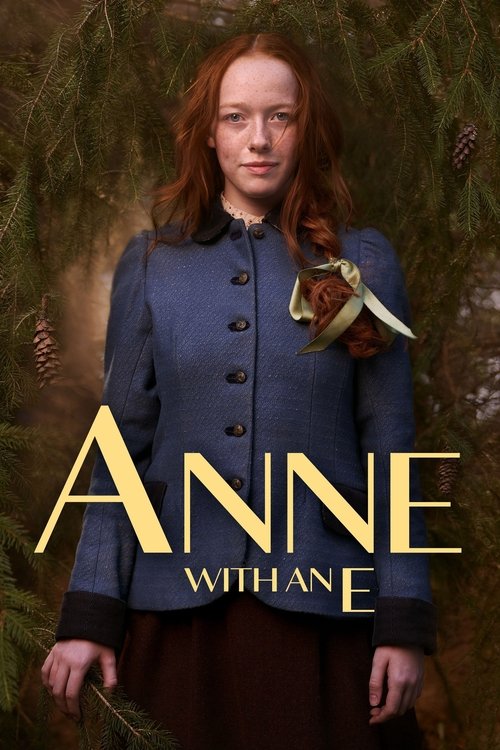
Anne with an E
A heart-wrenching yet hopeful period drama that feels like a bittersweet memory, painting the world through the vibrant, imaginative eyes of a fiercely resilient outsider.
Anne with an E

Anne with an E

"Welcome back to Green Gables."

19 March 2017 — 24 November 2019 Canada 3 season 27 episode Canceled ⭐ 8.7 (4,810)
Cast: Amybeth McNulty, Geraldine James, R.H. Thomson, Dalila Bela, Lucas Jade Zumann
Drama Family
Finding a 'Chosen Family' and Belonging Feminism and Gender Inequality Trauma and Resilience Prejudice and Acceptance of 'The Other'

Overview

"Anne with an E" is a coming-of-age story that reimagines the classic L.M. Montgomery novel, "Anne of Green Gables." Set in the late 1890s, the series follows Anne Shirley, a spirited and imaginative 13-year-old orphan who has endured a traumatic childhood in orphanages and abusive foster homes. Through a twist of fate, she is mistakenly sent to live with Marilla and Matthew Cuthbert, an aging sister and brother who had intended to adopt a boy to help on their farm, Green Gables, in the town of Avonlea on Prince Edward Island.

Across three seasons, the series charts Anne's tumultuous journey to find acceptance and a sense of belonging. Her unique perspective, fierce intellect, and vivid imagination initially clash with the conservative and rigid society of Avonlea. However, she gradually transforms the lives of the Cuthberts and challenges the preconceived notions of the entire town. The narrative delves deeper than the original novel into Anne's past trauma, while also exploring progressive themes for its time period, including identity, feminism, prejudice, bullying, and freedom of speech, making it a story that resonates with contemporary audiences.


Core Meaning

The core meaning of "Anne with an E" revolves around the transformative power of love, acceptance, and finding one's chosen family. The series posits that belonging is not necessarily about blood ties but about finding 'kindred spirits' who see and cherish you for who you are. It is a profound exploration of resilience in the face of trauma, arguing that one's past does not have to define their future. Through Anne's journey, the show champions the importance of imagination as a tool for survival and joy, and the courage it takes to challenge societal norms, fight for justice, and embrace one's own unique identity, flaws and all. The series ultimately suggests that even in the most rigid of worlds, one person's spirit can inspire profound change and create a more compassionate community.

Thematic DNA

Finding a 'Chosen Family' and Belonging 35%
Feminism and Gender Inequality 25%
Trauma and Resilience 20%
Prejudice and Acceptance of 'The Other' 20%

Finding a 'Chosen Family' and Belonging

This is the central theme of the series. Anne, an orphan who has been denied love and stability, yearns for a place to call home. Her arrival at Green Gables is the catalyst for the creation of a 'chosen family' with the initially reluctant Marilla and the gentle Matthew Cuthbert. The series meticulously shows how their bonds are forged not by blood, but by shared experiences, mutual respect, and growing affection. This theme is further explored through Anne's deep friendship with Diana Barry and her connections with other outsiders like Cole and Bash, illustrating that family is a community you build.

Feminism and Gender Inequality

"Anne with an E" consciously injects modern feminist sensibilities into its 19th-century setting. Anne consistently challenges the era's restrictive expectations for women. She champions her right to an education, speaks her mind, and believes women are capable of more than just domestic duties. The series explores this through characters like Miss Muriel Stacy, a progressive teacher who encourages her female students to pursue their ambitions, and Aunt Josephine Barry, who lives an unconventional, independent life. The show tackles issues like a girl's first period and the fight for freedom of speech, portraying Anne as a budding activist.

Trauma and Resilience

Unlike previous adaptations, the series graphically portrays the abuse and trauma Anne suffered before arriving in Avonlea through visceral flashbacks. Her passionate outbursts, vivid imagination, and storytelling are shown not just as charming quirks, but as coping mechanisms developed to survive immense hardship. The series explores how this trauma affects her relationships and her view of the world, but its primary focus is on her incredible resilience and her journey toward healing with the stability and love she finds at Green Gables.

Prejudice and Acceptance of 'The Other'

The series broadens the scope of the original novel to include explicit storylines about prejudice. Anne herself is an 'other'—an orphan with a strange way of speaking and a fiery temper. The show expands on this by introducing diverse characters, such as Sebastian 'Bash' Lacroix, a Black sailor from Trinidad who faces overt racism in Avonlea, and Cole Mackenzie, a fellow student who is bullied for his artistic nature and eventually comes to terms with being gay. Season 3 also introduces the storyline of Ka'kwet, a Mi'kmaq girl, and her family, confronting Canada's dark history of residential schools. Through these arcs, the show champions empathy and the acceptance of those who are different from the norm.

Character Analysis

Anne Shirley-Cuthbert

Amybeth McNulty

Archetype: The Orphan Hero
Key Trait: Imaginative

Motivation

Anne's primary motivation is to find a place where she belongs and to be loved for who she truly is. Initially, this manifests as a desperate need to please the Cuthberts so she won't be sent back to the orphanage. As she becomes more secure in her home at Green Gables, her motivation evolves. She seeks 'kindred spirits,' deep and meaningful connections with others, and strives to make the world a more just and beautiful place, driven by her innate sense of fairness and her powerful imagination.

Character Arc

Anne begins Season 1 as a traumatized but fiercely imaginative child, desperate for love but guarded due to years of abuse. Her arc is one of healing and self-discovery. Throughout the series, she learns to trust, to accept love from the Cuthberts, and to build meaningful friendships. She channels her passion and intelligence from pure escapism into a force for change within her community, tackling issues of sexism and prejudice. By the end of Season 3, she is a confident young woman who has embraced her unique qualities, found her voice as a writer and an activist, accepted her past, and opened her heart to a romantic, intellectual partnership with Gilbert.

Marilla Cuthbert

Geraldine James

Archetype: The Mentor / The Thawing Matriarch
Key Trait: Pragmatic

Motivation

Initially, Marilla's motivation is driven by a sense of duty and propriety. She believes in order, hard work, and suppressing emotions. However, her underlying motivation, which she slowly rediscovers, is a deep-seated desire for connection and family, which was buried after the death of her brother and her failed romance. Anne's presence reawakens this desire, and her motivation shifts to protecting, guiding, and loving her adopted daughter.

Character Arc

Marilla starts the series as a stern, pragmatic, and emotionally repressed spinster, governed by duty and a fear of vulnerability. Anne's arrival cracks open her hardened exterior. Over the three seasons, Marilla's arc is one of emotional awakening. She learns to express her love, moving from a reluctant guardian to a devoted mother. Anne forces her to confront her own past sorrows, including her relationship with Gilbert's father, John Blythe. By the end of the series, Marilla has softened profoundly, embracing her maternal role and finding a new sense of purpose and joy in her life.

Matthew Cuthbert

R.H. Thomson

Archetype: The Gentle Guardian / The Silent Mentor
Key Trait: Kind-hearted

Motivation

Matthew's motivation is simple and pure: he wants Anne to be happy. He sees a kindred spirit in her—another person who doesn't quite fit in—and feels a deep, protective love for her from the start. Everything he does, from convincing Marilla to let Anne stay to encouraging her education, is driven by his desire to provide her with the love, stability, and joy she never had.

Character Arc

Matthew is a painfully shy, kind-hearted bachelor who is immediately charmed by Anne. He is the first to want to keep her. His arc is one of finding his voice. Terrified of women and social interaction, he rarely speaks, but his actions are profound. Through his unwavering, gentle love for Anne, he gains confidence. He learns to stand up to Marilla, to express his opinions, and to venture outside his comfort zone for Anne's sake, such as buying her a dress with puffed sleeves. He remains a man of few words, but by the series' end, he is more emotionally expressive and self-assured in his role as a loving father.

Gilbert Blythe

Lucas Jade Zumann

Archetype: The Rival / The Romantic Hero
Key Trait: Ambitious

Motivation

Gilbert is initially motivated by typical teenage pursuits and a desire to be the top student. After his father's death, his motivation shifts to honoring his father's memory and pursuing his dream of becoming a doctor. This ambition drives him to work hard and seek experiences outside of Avonlea. As his feelings for Anne deepen, his motivation becomes twofold: to achieve his professional goals while also building a future with the girl he loves.

Character Arc

Gilbert begins as a confident, popular boy who makes the mistake of teasing Anne, sparking a fierce academic rivalry. His arc is one of maturation and shifting priorities. After his father's death, he is forced to grow up quickly, leaving Avonlea to work on a steamship, which broadens his worldview. When he returns, his relationship with Anne evolves from rivalry to a deep friendship based on mutual respect for each other's intellect and spirit. He struggles between his ambition to become a doctor and his feelings for Anne. By the end of the series, he has chosen a path that allows him to pursue both, having matured into a thoughtful, compassionate, and worldly young man who values Anne as his equal.

Symbols & Motifs

Red Hair

Meaning:

Anne's red hair symbolizes her outsider status, her fiery spirit, and her perceived otherness. Initially, it's the source of her greatest insecurity and the target of teasing (most notably by Gilbert Blythe). Over time, as she gains confidence, her red hair becomes a defining feature of her unique and passionate identity, a visual representation of the very spirit that makes her extraordinary.

Context:

Throughout the series, Anne laments her red hair, calling it her "lifelong sorrow." Gilbert's teasing of her as "Carrots" in Season 1, Episode 3 is a pivotal moment that ignites their rivalry and connection. Her attempts to dye it black, which result in it turning green, is another iconic scene from the books that highlights her deep-seated desire to fit in.

The Lake of Shining Waters

Meaning:

The Lake of Shining Waters represents the power of imagination and Anne's ability to find beauty and magic in the ordinary. By giving the Barry's pond a poetic name, she transforms a simple body of water into a place of wonder and escape. It is a sanctuary for her and Diana, a physical manifestation of her inner world and her romantic view of life.

Context:

Anne names the pond shortly after her arrival in Season 1, much to Marilla's practical bemusement. It becomes a key location for her and Diana, the backdrop for their oath of friendship and many of their adventures, including the dramatic reenactment of "Lancelot and Elaine" which nearly ends in disaster.

The Green Gables House

Meaning:

Green Gables is the ultimate symbol of home, safety, and belonging. For Anne, who has never had a real home, the house represents the stability and unconditional love she has always craved. It is more than a building; it is the heart of her found family and the foundation upon which she can finally begin to heal and grow.

Context:

From the moment she arrives in Season 1, Anne is enchanted by Green Gables. The threat of being sent away from it is the primary source of conflict in the early episodes. Officially becoming a part of the family by signing her name in the Cuthbert family bible inside the house is a key turning point for her character at the end of Season 1, Episode 2.

Memorable Quotes

It's been my experience that you can nearly always enjoy something if you make up your mind firmly that you will.

— Anne Shirley-Cuthbert

Context:

Anne says this in Season 1, reflecting on her ability to cope with her past and adapt to her new life. It's a recurring idea for her, showing how she uses her mind to overcome external hardships.

Meaning:

This quote encapsulates Anne's core philosophy of life. It speaks to her resilience and her conscious choice to find joy and beauty in the world, even in difficult circumstances. It's a testament to the power of perspective and the strength of her will.

I'm loved now, but when I wasn't, it didn't mean I wasn't worthy of it.

— Anne Shirley-Cuthbert

Context:

This line is a moment of deep reflection for Anne as she processes her past trauma and her present happiness at Green Gables, likely in Season 2 or 3 as she matures and gains perspective.

Meaning:

A powerful statement of self-worth that is central to the series' message. This quote reflects Anne's profound realization that her value as a person was never contingent on whether others loved her. It's the culmination of her journey from a traumatized child seeking validation to a young woman who understands her inherent worth.

Grief is the price you pay for love, you see. So, it's alright.

— Josephine Barry

Context:

Aunt Josephine says this while comforting someone, likely Anne or Diana, after a loss. It reflects her own life experience, particularly her lifelong partnership with her late companion, Gertrude, revealing the depth of her own capacity for love and her understanding of its costs.

Meaning:

Aunt Josephine offers this pearl of wisdom, beautifully articulating the inevitable connection between love and loss. The quote suggests that pain and grief are not things to be avoided, but rather a natural and acceptable consequence of having loved deeply. It reframes sorrow as a measure of love's significance.

It’s not what the world holds for you, it’s what you bring to it.

— Anne Shirley-Cuthbert

Context:

This is a sentiment Anne expresses as she encourages herself and her friends to look beyond their circumstances and create the world they want to live in. It's a theme that runs through her actions, from founding a story club to fighting for justice with the school paper.

Meaning:

This quote embodies Anne's proactive and imaginative approach to life. It rejects passivity and highlights her belief that individuals have the power to shape their own reality and happiness through their actions, creativity, and spirit. It's a call to agency and a rejection of victimhood.

If you have big ideas, you have to use big words to express them, haven't you?

— Anne Shirley-Cuthbert

Context:

Anne often says this in response to adults or peers who are taken aback or confused by her advanced vocabulary. It's a recurring justification for why she doesn't speak like other children, highlighting her unique mind from the very beginning of the series.

Meaning:

This quote is a charming and defiant defense of Anne's expansive vocabulary and intellect. It connects her love of language directly to the scale of her imagination and thoughts, asserting that profound ideas require a rich and precise vocabulary. It's a celebration of intelligence and eloquence in a young woman.

Episode Highlights

I Am No Bird, and No Net Ensnares Me

S1E2

After Marilla wrongly accuses Anne of stealing her brooch and sends her away, she discovers her mistake and a frantic Matthew tries to bring Anne back. The episode culminates in the Cuthberts officially asking Anne to stay at Green Gables and she signs her name in the family Bible, cementing her place in the family.

Significance:

This episode is pivotal as it solidifies Anne's place at Green Gables. It resolves the initial uncertainty of her adoption and marks the true beginning of her new life and the formation of the Cuthbert family. Anne's decision to add a hyphen and an 'E' to her name is a powerful declaration of her identity.

Wherever You Are Is My Home

S1E7

The Cuthberts face financial ruin and may lose Green Gables. Matthew, overwhelmed by past trauma, contemplates suicide. Anne, using her intelligence and resourcefulness, figures out a way to help save the farm. The episode features a fire at the Gillis house, where Anne's quick thinking and bravery help save the family, finally earning her the respect of the town.

Significance:

Rated highly by viewers, this episode marks a major turning point for Anne's relationship with the Avonlea community. Her heroism during the fire transforms her from a distrusted orphan into a valued member of the town. It also deepens the bond between Anne and the Cuthberts as they face their greatest crisis together.

The Growing Good of the World

S2E10

In the season finale, the town wants to fire the progressive teacher Miss Stacy. Anne and her friends rally to defend her, performing a science experiment at the town hall to prove the value of her teaching methods. Meanwhile, Cole, after finding acceptance at Aunt Josephine's party, decides to leave Avonlea to live with her.

Significance:

This episode is a powerful culmination of the season's themes of progressivism vs. tradition and finding one's place. The children's successful defense of Miss Stacy represents a victory for a new way of thinking in Avonlea. Cole's decision is a significant moment for LGBTQ+ representation, as he chooses a path toward self-acceptance and a welcoming community.

A Strong Effort of the Spirit of Good

S3E7

Anne writes a passionate editorial about women's rights and freedom of the press in the school newspaper, which causes an uproar in the town. When the town elders try to censor the paper, Anne and her classmates stage a protest for freedom of speech. The episode ends with the schoolhouse burning down under mysterious circumstances.

Significance:

This episode showcases Anne's full transformation into a young activist. It directly addresses the themes of feminism and censorship, showing the power of the youth voice challenging the established order. The burning of the schoolhouse serves as a dramatic climax, symbolizing the destruction of old ways and forcing the community to a reckoning.

The Better Feeling of My Heart

S3E10

In the series finale, Anne and her friends are off to Queen's College. The episode resolves several key storylines: Anne discovers the truth about her parents from a book Matthew and Marilla find for her. Most significantly, after a series of misunderstandings, she and Gilbert finally confess their love for each other through letters and share a kiss before she leaves for Charlottetown.

Significance:

This episode serves as a satisfying, albeit premature, conclusion to the series. It provides emotional closure for Anne's quest for her origins and culminates the long-awaited romance between Anne and Gilbert. While it leaves some storylines open (like Ka'kwet's), it brings Anne's personal journey of finding love, family, and her place in the world to a hopeful and heartwarming end.

Philosophical Questions

Does our past trauma define who we become, or can it be overcome through love and environment?

The series constantly explores this question through Anne. Her traumatic past is ever-present in Season 1, manifesting in flashbacks and emotional outbursts. She is initially defined by her history as an abused orphan. However, the stable, loving environment provided by Matthew and Marilla allows her to slowly heal. The series suggests that while trauma leaves indelible scars and shapes one's coping mechanisms (like her vivid imagination), it does not have to be a life sentence. Through the unconditional love of a found family and the forging of strong friendships, a person can build a new identity and future not in spite of their past, but by integrating it into a resilient and empathetic self.

What constitutes a 'family'?

"Anne with an E" dismantles the traditional definition of family centered on blood relatives. Anne, Matthew, and Marilla form a family unit based on choice, commitment, and deep affection. The series expands this idea further: Bash, a Black man, becomes part of Gilbert's family and the larger Avonlea community; Cole, rejected by his own parents, finds a chosen family with Aunt Josephine. The show posits that the strongest families are forged by 'kindred spirits'—people who connect on a soul-deep level, offering acceptance and support where biological families may have failed.

How does a community react to ideas that challenge its long-held traditions?

This question is explored throughout the series as Anne and other progressive figures clash with the conservative mindset of Avonlea. Miss Stacy's unconventional teaching methods are met with suspicion and a desire to have her fired. Anne's articles on feminism and free speech lead to censorship and outrage. Bash's presence in the town exposes its underlying racism. The series shows that change is often met with fear and hostility, but it also demonstrates that through persistence, courage, and dialogue, even the most deeply entrenched communities can slowly evolve toward greater acceptance and understanding.

Alternative Interpretations

One of the primary alternative interpretations of "Anne with an E" revolves around its tone and faithfulness to the source material. While the mainstream reading sees the series as a necessary and realistic deepening of the classic story, some critics and viewers interpret it as an anachronistic projection of modern sensibilities onto a historical text. This view suggests that the show's explicit focus on trauma, racism, and LGBTQ+ issues, while well-intentioned, feels out of place and overwrites the subtle charm and optimism of L.M. Montgomery's original work. They argue the series is less an adaptation and more a 'fan fiction' that uses the characters to tell a completely different, much darker story.

Another interpretation focuses on Anne's character as a neurodivergent figure. While the text frames her active imagination and emotional intensity as products of trauma and innate creativity, some viewers interpret her social awkwardness, deep passion for specific interests (like literature), and unique way of processing the world as traits consistent with neurodivergence, such as ADHD or being on the autism spectrum. This reading provides a different lens through which to understand her conflicts with the rigid social norms of Avonlea, seeing it not just as a clash between a creative spirit and a conservative town, but as a struggle of a neurodivergent individual to navigate a neurotypical world.

Cultural Impact

"Anne with an E" made a significant cultural impact primarily through its departure from previous, more saccharine adaptations of "Anne of Green Gables." Creator Moira Walley-Beckett used the historical setting of the late 19th century to explore deeply relevant contemporary issues such as childhood trauma, PTSD, feminism, systemic racism, LGBTQ+ identity, and freedom of the press. This grittier, more realistic approach polarized viewers; some praised it for its depth and relevance, while many purists of the novels criticized it for being too dark and straying from the source material's lighter tone.

The series was critically well-received, winning several Canadian Screen Awards, including Best Drama Series. Its greatest impact, however, was seen in its passionate global fanbase. When CBC and Netflix announced the show's cancellation after Season 3 in 2019, it sparked a massive and sustained fan campaign, #renewannewithane, which trended worldwide on social media for weeks. Fans organized petitions that garnered millions of signatures and even crowdfunded billboards in major cities like New York's Times Square to plead for a fourth season. Celebrities like Ryan Reynolds joined the cause.

The cancellation was reportedly due to a breakdown in the partnership between CBC and Netflix, rather than poor viewership. The series' legacy is its demonstration of how a classic story can be reimagined to speak to a new generation, fostering important conversations about difficult topics within a period drama framework. It left an indelible mark as a show that was deeply loved for its emotional honesty, its progressive spirit, and its powerful message of finding belonging.

Audience Reception

"Anne with an E" received a generally positive but also deeply polarized audience reception. Many viewers praised the series for its emotional depth, stunning cinematography, and the powerful performance of Amybeth McNulty as Anne. Fans lauded the show's willingness to tackle mature themes like trauma, prejudice, and feminism, feeling it added a layer of realism and relevance that was missing from previous adaptations. The slow-burn romance between Anne and Gilbert was a particular point of adoration for a large segment of the fanbase.

However, a significant portion of the audience, particularly longtime fans of the L.M. Montgomery books, criticized the series for its darker tone and significant deviations from the source material. Common complaints included that the show was too gloomy, that it stripped away the lighthearted charm of the original story, and that it introduced storylines (like the con men at Green Gables or Cole's LGBTQ+ arc) that felt anachronistic and not in the spirit of the books.

The evolution of audience opinion was most visible after the show's cancellation. The initial division in the fanbase seemed to coalesce into overwhelming support. The massive #renewannewithane fan campaign demonstrated the profound connection a global audience felt with this specific version of the story. Despite the early controversy, the show's legacy is defined by this passionate, loyal following who embraced its modern take on the classic tale. The series holds high ratings on platforms like IMDb, indicating that the viewers who loved it, loved it fiercely.

Interesting Facts

  • The series was created by Moira Walley-Beckett, an Emmy-winning writer and producer known for her work on "Breaking Bad".
  • The opening theme song is "Ahead by a Century" by the iconic Canadian band The Tragically Hip.
  • The series was filmed primarily in Southern Ontario, Canada, and on Prince Edward Island to capture the authentic setting of the novels.
  • Amybeth McNulty, who plays Anne, is Irish-Canadian and was chosen from over 1,800 girls who auditioned for the role. She naturally has blonde hair and dyed it red for the show.
  • The show's creator made a conscious decision to expand the world of Avonlea to include characters of color and LGBTQ+ storylines, which were not in the original books, to reflect a more historically accurate and diverse depiction of the time.
  • The show was a co-production between the Canadian Broadcasting Corporation (CBC) and Netflix.
  • Each episode title in Seasons 1 and 2 is a quote from Charlotte Brontë's "Jane Eyre," while Season 3 titles are quotes from Mary Shelley's "Frankenstein."

Easter Eggs

Many episode titles are direct quotes from classic literature.

Season 1 titles are quotes from Charlotte Brontë's Jane Eyre (e.g., "I Am No Bird, and No Net Ensnares Me"), Season 2 titles come from George Eliot's Middlemarch, and Season 3 titles are from Mary Shelley's Frankenstein. This literary device pays homage to Anne's love of reading and connects her personal journey to the themes of these classic heroines and stories—governesses finding their way, societal pressures, and the experience of being an outsider or 'creature' trying to find its place in the world.

⚠️ Spoiler Analysis

Click to reveal detailed analysis with spoilers

Frequently Asked Questions

Explore More About This Movie

Dive deeper into specific aspects of the movie with our detailed analysis pages

Comments (0)

Leave a comment

No comments yet. Be the first to share your thoughts!