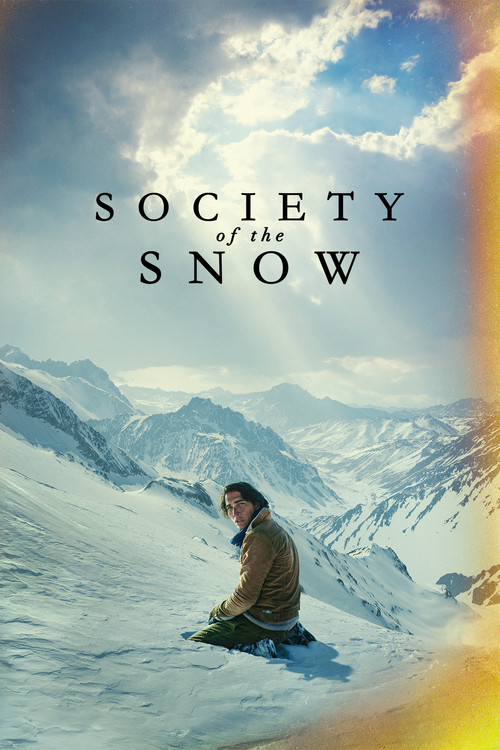
Society of the Snow
A harrowing yet profoundly human drama, where the biting cold of the Andes mirrors the stark choices faced by survivors, painting a visceral portrait of resilience against an unforgiving canvas of white.
Society of the Snow

Society of the Snow

La sociedad de la nieve

"Based on a remarkable true story."

15 December 2023 Spain 144 min ⭐ 8.0 (3,269)
Director: J.A. Bayona
Cast: Enzo Vogrincic, Agustín Pardella, Matías Recalt, Esteban Bigliardi, Diego Vegezzi
Drama History
Survival and Resilience Faith vs. Reality The Social Contract and Morality Sacrifice and the Memory of the Dead
Budget: $65,500,000
Box Office: $1,281

Overview

"Society of the Snow" recounts the harrowing true story of Uruguayan Air Force Flight 571, which crashed in the heart of the Andes mountains in 1972. The film follows the initial survivors, mostly members of a young rugby team, as they grapple with the immediate aftermath of the disaster, facing injuries, freezing temperatures, and the dawning realization that they are stranded in one of the most hostile environments on Earth.

As days turn into weeks, and with rescue efforts officially called off, the group is forced to create a new society, bound by a desperate will to live. The narrative, narrated by Numa Turcatti, one of the passengers, delves into the immense physical and psychological struggles they endure. Faced with starvation, they are pushed to confront an unimaginable ethical dilemma, a decision that will test the very limits of their humanity and forge an unbreakable bond between them.

Core Meaning

The core meaning of "Society of the Snow" transcends a simple survival story. Director J.A. Bayona aimed to explore the profound spiritual and psychological journey of the individuals, focusing not just on the physical ordeal but on their internal struggles with faith, morality, and the very definition of humanity when stripped of civilization's comforts. The film emphasizes the collective over the individual, highlighting how the survivors formed a new social contract to care for one another. It's a meditation on the enduring power of human connection, sacrifice, and the haunting question of what it means to live when so many others have perished. The narrative gives a voice to the deceased, ensuring their memory is honored as an integral part of the survivors' story.

Thematic DNA

Survival and Resilience 35%
Faith vs. Reality 25%
The Social Contract and Morality 20%
Sacrifice and the Memory of the Dead 20%

Survival and Resilience

This is the most prominent theme, depicted through the survivors' relentless struggle against the harsh Andean environment. They endure freezing temperatures, starvation, injuries from the crash, and a devastating avalanche. Their resilience is not just physical but also psychological, as they battle despair and dwindling hope. The film meticulously portrays their ingenuity in creating shelter from the plane's fuselage and their ultimate decision to trek through the mountains for help.

Faith vs. Reality

The survivors, mostly devout Catholics, grapple with their faith in the face of immense suffering. The film explores their debates over whether their predicament is a test from God, a punishment, or a meaningless tragedy. The act of cannibalism becomes a central point of this conflict, as they struggle to reconcile their religious beliefs with the necessity of survival. Some interpret it as a form of communion, while others see it as a transgression.

The Social Contract and Morality

The title itself points to this theme. Isolated from the world, the survivors must establish their own rules and social structure. The decision to consume the flesh of the deceased is a stark example of a new moral code being forged out of necessity. The film explores the discussions and agreements that precede this act, emphasizing the collective and consensual nature of their decision.

Sacrifice and the Memory of the Dead

The film gives significant weight to honoring those who did not survive. The narrator, Numa Turcatti, is one of the last to die, and his perspective frames the story as a testament to all the passengers. The act of consuming the deceased is portrayed as a form of sacrifice, where the dead give life to the living. This is further symbolized by Gustavo Zerbino's insistence on bringing back a suitcase filled with the personal belongings of the deceased, ensuring their memory is not forgotten.

Character Analysis

Numa Turcatti

Enzo Vogrincic

Archetype: The Moral Compass/Sacrificial Figure
Key Trait: Empathetic

Motivation

His primary motivation is to maintain his humanity and moral integrity while also ensuring the survival of his friends. He is driven by a deep sense of compassion and a strong, albeit tested, faith.

Character Arc

Numa begins as an outsider to the rugby team who joins the trip at a friend's urging. Throughout the ordeal, he becomes a pillar of strength and compassion, often taking care of others and struggling deeply with the moral implications of their actions, particularly cannibalism. His narration, even after his death, provides the film's spiritual and philosophical core. His death from an infected wound, just before the rescue, serves as the final catalyst for Nando and Roberto to complete their journey, symbolizing the ultimate sacrifice for the group.

Nando Parrado

Agustín Pardella

Archetype: The Hero
Key Trait: Resolute

Motivation

Fueled by the promise of seeing his father again and the memory of his lost family, Nando is relentlessly driven to escape the mountains and save his friends.

Character Arc

Initially devastated by the loss of his mother and sister in the crash, Nando is consumed by grief. However, this profound loss fuels an iron will to survive and return to his father. He transforms from a grief-stricken young man into a determined leader who, alongside Roberto Canessa, spearheads the perilous trek across the Andes to find help. His journey is one of overcoming unimaginable personal tragedy to become the architect of the group's rescue.

Roberto Canessa

Matías Recalt

Archetype: The Pragmatist
Key Trait: Pragmatic

Motivation

Driven by a scientific and logical approach to their situation, Roberto's motivation is survival at its most fundamental level. He is determined to use his skills and intellect to overcome the odds.

Character Arc

A medical student, Roberto is initially portrayed as somewhat arrogant and individualistic, as seen in the pre-crash rugby match. The crash forces him to channel his assertiveness into a practical leadership role. He takes charge of caring for the wounded and is one of the first to argue for the necessity of cannibalism from a logical, survivalist standpoint. His journey with Nando is fraught with conflict, but ultimately, his medical knowledge and stubborn determination are crucial to their success. He evolves from a headstrong player to a pragmatic survivor who makes incredibly tough decisions for the collective good.

Symbols & Motifs

The Andes Mountains

Meaning:

The mountains symbolize both the unforgiving power of nature and a spiritual crucible. They are a relentless antagonist, presenting physical obstacles and extreme weather. At the same time, their vastness and isolation force the survivors into a state of introspection, questioning their place in the universe and their relationship with God.

Context:

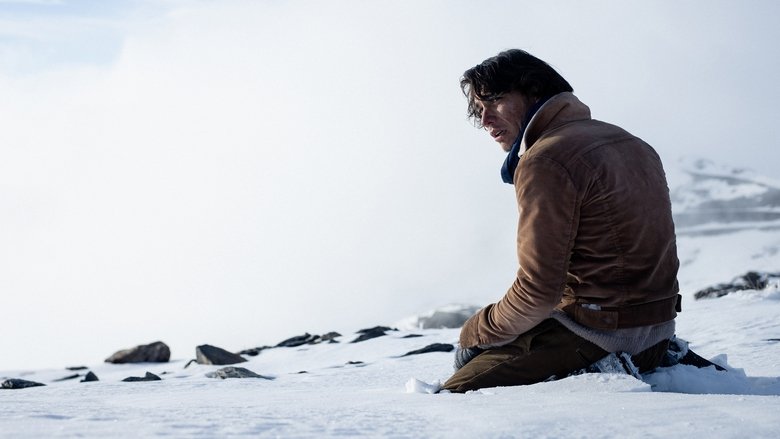
The mountains are a constant visual presence, often shown in wide, sweeping shots that dwarf the human figures, emphasizing their vulnerability. The stark, white landscape creates a sense of both desolation and purity, a blank canvas upon which the survivors' drama unfolds.

The Fuselage

Meaning:

The wreckage of the plane becomes a paradoxical symbol of both a tomb and a womb. It is the site of the initial trauma and death, yet it also provides shelter and becomes the birthplace of their new society. It represents the fragile boundary between life and death that the survivors inhabit.

Context:

The film frequently uses claustrophobic shots inside the fuselage, contrasting with the expansive emptiness outside. It's within this confined space that the survivors huddle for warmth, care for the injured, and make their most difficult decisions.

The Suitcase of Mementos

Meaning:

This symbolizes memory, legacy, and the enduring connection between the living and the dead. By refusing to leave the suitcase behind, Gustavo Zerbino ensures that the stories and identities of those who perished will be returned to their families. It represents a sacred duty to honor their memory beyond the act of survival.

Context:

Towards the end of the film, as the rescue helicopters arrive, Gustavo Zerbino adamantly refuses to board without a suitcase filled with the belongings of the deceased. This act underscores the deep sense of responsibility the survivors felt towards their fallen companions.

The Red Rugby Shirts

Meaning:

The red of the rugby uniforms stands in stark contrast to the white snow, symbolizing life, passion, and the team's identity before the crash. As the ordeal continues, the clothes become tattered and worn, mirroring the physical and mental deterioration of the survivors. The color red can also be interpreted as a symbol of the blood that was shed and the life force they are fighting to preserve.

Context:

In the initial scenes, the rugby players are seen proudly wearing their team colors. After the crash, the red fabric becomes a recurring visual element against the bleak, monochromatic landscape, a reminder of the vibrant life they once knew and are desperately trying to reclaim.

Memorable Quotes

No hay amor más grande que el que da la vida por sus amigos.

— Numa Turcatti (in a note found after his death)

Context:

The survivors find this note in Numa's hand after he succumbs to his injuries. His death is a devastating blow, but his words inspire the group and serve as the final impetus for Nando and Roberto to embark on their seemingly impossible trek to find help.

Meaning:

Translated as "There is no greater love than to give one's life for friends," this quote, a reference to the Bible (John 15:13), encapsulates the theme of sacrifice that runs through the film. It reframes the deaths of the passengers not as tragic losses, but as acts of love that enabled the survival of others. Numa's death, and this final message, provide a profound spiritual justification for the survivors' actions and strengthens their resolve.

¿Qué milagro, mamá?

— A survivor to his mother

Context:

This is said by one of the survivors after being rescued and reunited with his family. While his mother joyfully proclaims his survival a miracle, his haunted response reveals the complex and painful reality of what he endured and lost.

Meaning:

Translated as "What miracle, mom?", this poignant question challenges the simplistic narrative of a miraculous survival. It reflects the deep psychological trauma and survivor's guilt carried by those who returned. For them, the experience was not a clean, divine intervention but a gruesome, harrowing ordeal that cost the lives of their friends. The line questions the very meaning of their survival and rejects easy, celebratory interpretations.

Sigan cuidándose. Y cuéntenle a todos lo que hicimos en la montaña.

— Numa Turcatti (narration)

Context:

These are among Numa's final voiceover lines at the end of the film, as the rescued survivors are shown recovering in a hospital. The shot parallels an earlier photo of the entire group before the flight, emphasizing the idea of the collective and the importance of telling their complete story.

Meaning:

Translated as "Keep taking care of each other. And tell everyone what we did on the mountain." This final piece of narration reinforces the central themes of community and remembrance. It is a plea from the dead to the living to maintain the bond forged in the Andes and to bear witness to their story, ensuring that the full context of their choices and sacrifices is understood.

Philosophical Questions

What defines morality when the rules of society are stripped away?

The film directly confronts this question through the survivors' debate over cannibalism. Faced with certain death from starvation, they must create a new ethical framework. The film explores their struggle to reconcile their actions with their deeply ingrained religious and societal values. It posits that morality is not absolute but situational, and that in extreme circumstances, the fundamental drive to live can necessitate the re-evaluation of profound taboos.

What is the relationship between faith and suffering?

"Society of the Snow" presents a complex exploration of faith. It avoids simple answers, showing characters whose faith is shattered, others whose faith is transformed, and some who find faith not in a divine being but in each other. Arturo Nogueira's line about his faith being in his friends, not a distant God, is a key moment. The film asks whether suffering is a divine test that strengthens faith or evidence of a world without divine intervention, leaving the characters and the audience to ponder the meaning of their ordeal.

What is the meaning of survival in the face of immense loss?

The film delves deeply into the concept of survivor's guilt. Through Numa's narration from beyond the grave, it constantly reminds the audience of those who didn't make it. The survivors don't see themselves as uncomplicated heroes; they are haunted by the question of why they lived while others died. The film suggests that the meaning of their survival lies in their responsibility to remember and to tell the full story, honoring the sacrifice of their friends who, in a very literal sense, gave their bodies so that others might live.

Alternative Interpretations

While the film presents a narrative focused on unity and shared sacrifice, different interpretations can be explored. One perspective might question the singular, unified narrative of the 'society.' The film, while showing debates, ultimately presents a cohesive group. An alternative reading could focus on the potential for more pronounced power struggles and fractures within the group that may have been downplayed for a more inspirational message. The 1993 film 'Alive,' for example, depicted more internal conflict.

Another interpretation centers on the question of divine intervention versus human will. The film leaves the 'miracle' aspect ambiguous, with characters themselves questioning it. A secular interpretation would view the survival as a testament to human ingenuity, resilience, and luck, devoid of any supernatural meaning. Conversely, a more spiritual reading could see the entire ordeal as a profound test of faith, with the survival of the 16 as a complex, messy, and tragic miracle, where the sacrifice of the many was necessary for the salvation of the few. The film deliberately leaves this open, allowing the audience to grapple with the meaning themselves.

Cultural Impact

"Society of the Snow" has had a significant cultural impact by providing a definitive and deeply authentic cinematic account of the 1972 Andes flight disaster. By being filmed in Spanish with a cast from Uruguay and Argentina, it reclaims a story that had been previously popularized by an American film, "Alive" (1993), and offers a perspective that resonates more closely with the actual survivors and their culture. The film was made in close collaboration with the survivors and the families of the deceased, earning praise as the most respectful and accurate depiction of the event.

Critically, the film was lauded for its raw realism, emotional depth, and technical achievements, receiving numerous awards and nominations, including two Oscar nominations. It sparked renewed global interest in the story, prompting discussions about survival ethics, faith, and human resilience. For audiences, particularly younger generations unfamiliar with the story, it served as a powerful introduction to one of the 20th century's most incredible stories of human endurance. The film's success on Netflix brought the story to a massive international audience, ensuring that the legacy of all 45 passengers aboard Flight 571 would be remembered with nuance and dignity.

Audience Reception

Audience reception for "Society of the Snow" has been overwhelmingly positive. Viewers have praised the film for its emotional power, realism, and respectful treatment of the true story. Many felt a deep connection to the characters and were moved by the portrayal of their camaraderie and resilience. The film's authenticity, particularly the use of a Spanish-speaking cast from Uruguay and Argentina, was frequently highlighted as a major strength that set it apart from previous adaptations. The cinematography and the harrowing depiction of the plane crash and its aftermath were also widely commended for their immersive and visceral quality.

Points of criticism are minor and less frequent, but some viewers found the two-and-a-half-hour runtime to be long and the pacing slow in certain parts. A few also noted the difficulty in distinguishing between the large number of characters, especially in the film's first act. However, the overall verdict from audiences is that the film is a powerful, must-watch masterpiece and a fitting tribute to the victims and survivors of the Andes tragedy.

Interesting Facts

  • Director J.A. Bayona spent over a decade developing the film and conducted more than 100 hours of interviews with the living survivors to ensure authenticity.
  • The cast is composed almost entirely of Uruguayan and Argentine actors, many of whom were newcomers, to maintain cultural accuracy.
  • The actors underwent a medically supervised weight loss program to realistically portray the effects of starvation. They also filmed chronologically to make the physical transformation more genuine.
  • Filming took place in challenging conditions in Spain's Sierra Nevada mountains, which doubled for the Andes, as well as at the actual crash site in Argentina for some shots.
  • The production built five different sets of the plane's fuselage to film the various stages of the 72-day ordeal.
  • The filmmakers were given complete creative freedom by the survivors, who were heavily involved in the production to ensure their story was told respectfully.
  • All the background scenery of the Andes seen in the film is real footage shot on location, as director J.A. Bayona prefers practical effects over digital ones for backdrops.

Easter Eggs

Cameo by survivor Nando Parrado.

The real Nando Parrado makes a brief appearance in the airport scene at the beginning of the film, holding a door open for his family and the actor portraying his younger self, Agustín Pardella. This poignant cameo serves as a blessing from the real survivor to the cinematic retelling of his story.

Cameo by survivor Roberto Canessa.

The real Roberto Canessa, who became a pediatric cardiologist after the ordeal, appears as a doctor in the hospital scene near the end of the film. He is seen attending to the actor Matías Recalt, who plays the young Roberto, creating a powerful full-circle moment.

Cameo by survivor Carlos "Carlitos" Páez.

The real Carlitos Páez plays his own father, Carlos Páez Vilaró. In a moving scene, he is the one who reads the list of the 16 survivors' names over the radio. This was a deeply personal tribute, as his father was instrumental in the search efforts and never gave up hope.

Other survivor and family cameos.

Several other survivors, including Antonio "Tintín" Vizintín, Ramón "Moncho" Sabella, Gustavo Zerbino, and José Luis "Coche" Inciarte, also have small cameos in the film. Additionally, Numa Turcatti's real-life nephew, Joaquín De Freitas Turcatti, appears in a scene, further deepening the film's connection to the real people involved.

⚠️ Spoiler Analysis

Click to reveal detailed analysis with spoilers

Frequently Asked Questions

Explore More About This Movie

Dive deeper into specific aspects of the movie with our detailed analysis pages

Comments (0)

Leave a comment

No comments yet. Be the first to share your thoughts!