Skip to content
Source Code
A taut sci-fi thriller that turns eight repeating minutes into a meditation on second chances — a commuter train hurtling toward fire, and one man learning that a borrowed life can still be lived fully.
Source Code

Source Code

"Make every second count."

30 March 2011 United States of America 93 min 7.3 (9,382)

Director: Duncan Jones

Cast: Jake Gyllenhaal, Michelle Monaghan, Vera Farmiga, Jeffrey Wright, Michael Arden

Thriller Mystery Science Fiction Identity and the borrowed body Second chances and the value of eight minutes The individual versus the institution Determinism, free will and branching realities Trauma, war and the soldier's afterlife
Budget: $32,000,000
Box Office: $147,332,697

Overview

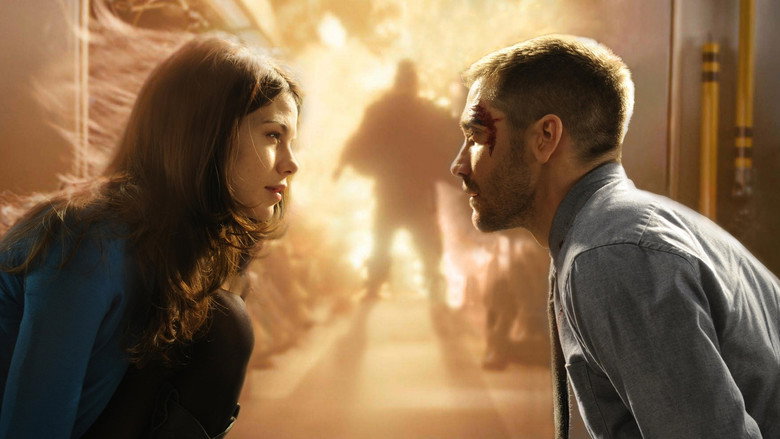
Captain Colter Stevens, a decorated U.S. Army helicopter pilot, wakes on a Chicago commuter train sitting across from a woman who calls him Sean and speaks to him as if they have known each other for months. The face in the window is not his. Eight minutes later the train explodes — and Colter comes to inside a cramped metal capsule, where a military officer on a screen calmly instructs him to go back in and do it again.

Directed by Duncan Jones from a debut feature screenplay by television writer Ben Ripley, Source Code uses this loop as an engine for both suspense and character. Colter is told he is inside an experimental program that lets him occupy the last eight minutes of another man's experience; his assignment is to identify the bomber before a second, far larger attack strikes the city. Each pass through the carriage sharpens what he knows and sharpens, too, his questions about the people running him.

What begins as a procedural puzzle — check the bags, clear the passengers, find the device — steadily becomes something more personal. The more Colter learns about the mission, the less willing he is to treat the passengers, and especially Christina Warren, as data in an exercise. Jake Gyllenhaal anchors the film opposite Michelle Monaghan, Vera Farmiga as the handler on the other side of the screen, and Jeffrey Wright as the scientist who built the machine.

Core Meaning

At its heart Source Code argues that a life is measured by what is done inside it, not by how long it lasts or how "real" its substrate is. The film repeatedly compresses existence to eight minutes and then asks its hero — and us — what those minutes are for.

Duncan Jones has described his central task as taming an abstract, hard-to-grasp technology: establish the rules clearly, then keep the tone light enough for humor and feeling to survive alongside the ticking clock. That choice is the meaning. The machinery is deliberately half-explained because the film is not finally about physics; it is about a man treated as a resource who insists on being treated as a person, and who extends that same insistence to strangers a system has already written off as dead.

The result is a thriller with an unusually humane thesis: compassion is not a distraction from the mission, it is the mission. Where the source material of the premise points toward fatalism — the past cannot be changed, the dead stay dead — the finished film opts for a message about second chances and the possibility that kindness creates something, somewhere, that lasts.

Thematic DNA

Identity and the borrowed body 25%
Second chances and the value of eight minutes 22%
The individual versus the institution 20%
Determinism, free will and branching realities 18%
Trauma, war and the soldier's afterlife 15%

Identity and the borrowed body

Colter spends the film inside a face that is not his, answering to a name that is not his, while his own body's condition is withheld from him. Every loop forces the question of what actually constitutes him — memory, duty, the reflection in the window, or the choices he keeps making. Christina's affection is aimed at Sean Fentress; Colter has to decide whether to accept love addressed to someone else.

Second chances and the value of eight minutes

The film's central exchange asks what a person would do with less than a minute to live, and answers it: make those seconds count. Colter uses successive runs not only to hunt a bomber but to reconcile with his father, comfort strangers, and finally to build one perfect version of eight minutes — the same span that first delivered only fire.

The individual versus the institution

Goodwin and Dr. Rutledge represent two faces of the same apparatus: one that has come to see Colter as an asset to be redeployed, and one that still sees a soldier owed the truth. The program's efficiency depends on withholding information from the man it uses, and the drama turns on whether anyone inside the system will break protocol for him.

Determinism, free will and branching realities

Rutledge insists the exercise is a closed recording that cannot be altered; Colter behaves as though every run is a live world with live people in it. The film stages this as an argument between two physics and two ethics, and lets the ending render a verdict on which one the story believes.

Trauma, war and the soldier's afterlife

Colter's last clear memory is of a mission in Afghanistan, and his unresolved relationship with his father shadows every loop. The film reads as a study of a veteran suspended between service and rest — kept operational by a country that will not let him stop, and finding peace only when he is finally allowed to choose his own ending.

Character Analysis

Captain Colter Stevens

Jake Gyllenhaal

Archetype: Reluctant hero / soldier-everyman Key Trait: Stubborn moral persistence

Motivation

Initially to understand what has happened to him and get home; ultimately to protect the passengers as people rather than complete an assignment.

Character Arc

Begins disoriented and compliant, becomes furious and investigative as he grasps how he is being used, and ends in a state of chosen purpose — trading the pursuit of his own survival for the chance to save people he has been told cannot be saved.

Christina Warren

Michelle Monaghan

Archetype: The catalyst / the one worth saving Key Trait: Disarming, life-affirming warmth

Motivation

To encourage the man she believes is her friend Sean to take a risk with his life; to make the moments she has count.

Character Arc

Unchanging by design — she experiences the same eight minutes each time — yet her warmth and candor progressively reorient Colter's priorities, turning an intelligence exercise into a rescue.

All 5 characters and cast

Symbols & Motifs

The eight-minute loop

Meaning:

A whole human life compressed to its smallest survivable unit. The repetition strips away the illusion that we have unlimited time to be kind, brave or honest.

Context:

Structures the entire film: each re-entry replays the same carriage, the same spilled coffee, the same conductor, while Colter's behavior inside it changes completely.

The capsule

Meaning:

Isolation, institutional confinement and the reduction of a person to a functioning component — a cockpit that never flies anywhere.

Context:

The dim, riveted pod Colter returns to between runs, communicating only through a screen, is the visual opposite of the bright, crowded, sunlit train.

The commuter train

Meaning:

Ordinary life in motion, and fate on rails: a vehicle whose destination is fixed while the people aboard behave as if it is not.

Context:

Every passenger has a mundane errand — a job interview, a phone call, a joke — which is precisely what makes their preservation matter to Colter.

Cloud Gate, the mirrored 'Bean' in Millennium Park

Meaning:

A reflecting surface that shows a curved, doubled world — an image of a reality that has folded into a second version of itself.

Context:

The film's closing passage takes Colter and Christina to Chicago's Millennium Park and the Cloud Gate sculpture, where the mirrored skin literally reflects the new timeline back at them.

The reflection in the train window and mirror

Meaning:

The gap between self-perception and the self the world sees; identity as something imposed from outside.

Context:

Colter's recurring shock at seeing Sean Fentress's face is the film's most economical statement of its identity theme.

The unanswered call to his father

Meaning:

Unfinished business and the debt the living owe the people they left on bad terms.

Context:

Threaded through several runs, the phone call becomes the private mission Colter pursues alongside the official one.

Memorable Quotes

What would you do if you knew you had less than a minute to live?
— Colter Stevens

Context

Asked of Christina on the train, during one of the later runs, when Colter has stopped treating the eight minutes purely as an investigation.

Meaning

The film's thesis stated as a direct question. It reframes the loop from a technical constraint into an existential test that applies to everyone watching, not just to the man inside the machine.

I'd make those seconds count.
— Christina Warren

Context

Christina's reply to Colter's question aboard the train — a throwaway remark from her perspective that becomes the character's guiding rule.

Meaning

The answer the film endorses. It converts a doomed span of time into a moral opportunity and gives Colter the principle he acts on in the finale.

All 4 quotes

Philosophical Questions

Is a simulated experience less real than a physical one if it is fully lived?

Rutledge insists the train is only a residual recording, while Colter finds inside it grief, humor, fear and love indistinguishable from the real thing. The film refuses to let the ontological status of the carriage settle the moral question, and its ending tips decisively toward the view that a world you can act meaningfully within has a claim on you.

What makes someone the same person — the body, the memories, or the choices?

Colter's mind occupies Sean Fentress's body while his own is in a condition he is not permitted to know. Neither body nor circumstance survives intact across the film, only continuity of intention, which is what the story ultimately treats as the seat of identity.

Can an institution owe a debt to the person it has turned into a tool?

Rutledge's utilitarianism holds that the program's benefit to millions outweighs any claim by one soldier; Goodwin's arc is the counter-argument, culminating in her willingness to break protocol. The film sides with Goodwin without pretending the choice is cost-free.

If the past cannot be changed, does trying to change it still matter?

Colter acts as though rescue is possible under a theory that says it is not, and the film's structure — his best actions occurring after he stops expecting a payoff — suggests that the moral value of the attempt is independent of its outcome.

How much time does a meaningful life require?

The Christina exchange about making the seconds count is answered by the film's own construction: a single well-used eight-minute span is given more weight than years of unexamined routine, and the final loop is offered as evidence that a short life can be complete.

Alternative Interpretations

The optimistic reading. The Source Code is not a recording at all. Each entry opens a genuinely parallel world, and Colter's final run creates a branch in which the bomb never detonates and he goes on living as Sean Fentress. Rutledge is simply wrong about his own invention, and the film's closing minutes are an unironic gift: a real life, really saved.

Full ending explanation

Cultural Impact

Source Code arrived in 2011 as the second feature from Duncan Jones, following Moon, and consolidated his reputation for modestly budgeted science fiction built around a performer in confinement. Made for roughly $31.9 million and grossing over $147.3 million worldwide, it demonstrated that an original-premise studio sci-fi thriller without franchise backing could still be a substantial commercial success — a case frequently cited in arguments about mid-budget original filmmaking.

It premiered at SXSW in March 2011 and was generally well received, though not unanimously. The most common critical complaint targeted the final act: detractors argued the film went 'off the rails' via half-baked Inception-style theatrics and a dose of all-you-need-is-love moralism, one review memorably dismissing the turn as a 'wibbly-wobbly, timey-wimey, mushy-wushy mess.' Admirers countered that the shift from procedural to romance was the point rather than a betrayal of it.

Culturally, the film sits at a crossroads of post-9/11 terrorism anxiety, the loop narrative revived by Groundhog Day, and the era's fascination with nested and simulated realities. Its combination of body-swapping, iterative do-overs and a soldier trapped in an experimental program has become a widely referenced template — the compressed loop thriller in which repetition is used for moral education rather than mere puzzle-solving.

Audience Reception

Audiences and critics largely praised the film's efficiency and clarity. The most consistently admired elements are Jake Gyllenhaal's performance — carrying disorientation, rage and tenderness through the same repeated eight minutes — the propulsive, economical pacing, and Duncan Jones's success at making an abstract premise legible without drowning the film in exposition. Vera Farmiga's restrained work as the handler and Jeffrey Wright's chilly scientist were also frequently singled out.

The recurring criticism concerns the last act. A significant contingent felt the film abandoned its tense, inventive suspense mechanics for Inception-adjacent metaphysical flourishes and a sentimental, love-conquers-all resolution — the harshest formulation calling it a 'wibbly-wobbly, timey-wimey, mushy-wushy mess.' Related complaints include the underdeveloped villain and the thinness of the science on inspection. Overall reception, however, was positive enough to make it both a critical success by genre-thriller standards and a substantial financial one, and its reputation has held up as a rewatchable, humane entry in the loop-narrative canon.

Interesting Facts

  • The screenplay was written by television writer Ben Ripley and was his feature film debut; he drafted it around 2006–2007 and it appeared on the industry's Black List of admired unproduced scripts.
  • Duncan Jones came aboard after the script had already gone through multiple passes; the production combined what they considered the best material from the various drafts, after which Ripley returned to finish the screenplay.
  • Jones has said the element he was least sure about on first reading was tone — he felt the script took itself very seriously and joked that it was 'kind of like an episode of 24 with some sci-fi ideas in it.'
  • Because the technology is abstract and hard for audiences to hold onto, Jones's stated approach was to set the rules out as clearly as possible while keeping the tone light and injecting humor.
  • Jones described his directing challenge as making sure the film didn't feel like 'train pod, train pod, train pod' — Ripley framed the split as the writer's job being to close the story down and the director's job being to open it up and let it breathe.
  • The film premiered at the SXSW festival in Austin in March 2011, where Jones and Ripley discussed the project publicly.
  • It was a strong commercial performer, earning more than $147.3 million worldwide against a budget of roughly $31.9 million.
  • Earlier versions of the story ended with Colter dying permanently; test audiences responded so strongly to the idea of a continuing branching timeline that the final cut adopted the more hopeful conclusion.
  • The closing sequence was shot in Chicago's Millennium Park, with Gyllenhaal and Monaghan walking toward the Cloud Gate sculpture.

Easter Eggs

The finale at Chicago's Cloud Gate sculpture

Ending at the mirrored 'Bean' in Millennium Park is more than location scouting: the sculpture's warped reflective surface doubles and distorts everyone who approaches it, making it a found visual pun on a reality that has split into a second copy of itself.

The '24'-style ticking-clock structure

Duncan Jones himself compared the script's initial register to an episode of 24 with science fiction ideas grafted on — the film's real-time countdown, terror-plot procedural beats and screen-mediated handler are all knowing borrowings from post-9/11 television thriller grammar.

Frequently Asked Questions

Explore More About This Movie

Dive deeper into specific aspects of the movie with our detailed analysis pages

Comments (0)

Leave a comment

No comments yet. Be the first to share your thoughts!

Similar Movies