Z
A pulse-pounding political anatomy of an assassination that races with the rhythm of a heartbeat. Amidst the sun-drenched corruption of a Mediterranean police state, a single letter becomes an immortal cry for justice: He Lives.
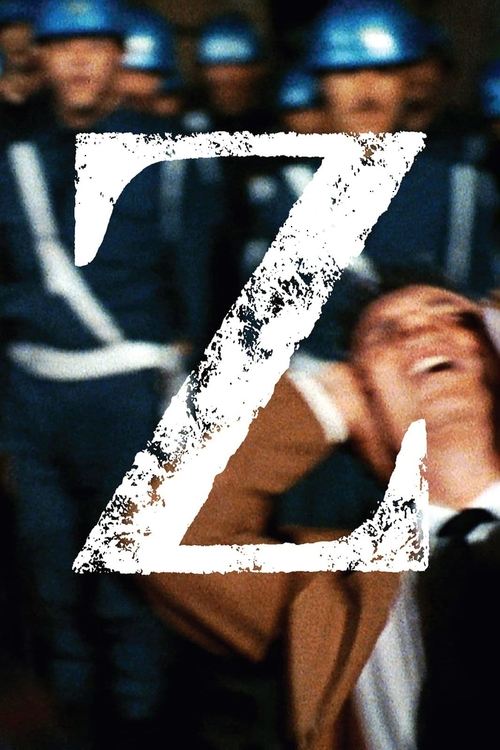
Z

Z

"He is alive!"

26 February 1969 Algeria 127 min ⭐ 7.8 (595)
Director: Costa-Gavras
Cast: Yves Montand, Irene Papas, Jean-Louis Trintignant, Jacques Perrin, Charles Denner
Drama Crime Thriller
The Corruption of Authority The Power of Truth vs. Brute Force Political Apathy and Awakening The Immortality of Ideas
Box Office: $83,305

Overview

In a thinly disguised Greece, a prominent leftist politician and pacifist, known only as The Deputy, arrives in a provincial town to deliver a speech on nuclear disarmament. The atmosphere is thick with tension as right-wing extremists, coordinated by the police and military, violently disrupt the event. In the chaos, The Deputy is clubbed over the head by thugs in a three-wheeled delivery truck, an attack masqueraded as a drunk driving accident. He succumbs to his injuries, sparking a volatile political crisis.

Enter the Examining Magistrate, a fastidious and apolitical legal official assigned to investigate the "accident." Initially expected by the regime to rubber-stamp their official version of events, the Magistrate methodically pulls at the loose threads of the case. Aided by a tenacious photojournalist and courageous witnesses, he uncovers a vast conspiracy implicating the highest levels of the government, the military police, and the secret service. The film transforms into a gripping procedural as the Magistrate brings the powerful to justice, one indictment at a time.

However, the film concludes with a chilling reality check. despite the Magistrate's successful investigation and the temporary victory of truth, a military coup d'état sweeps the country. The indicted officers receive lenient sentences, the witnesses die under mysterious circumstances, and the new junta imposes a draconian ban on everything from modern art to the letter "Z" itself—which has become a symbol of the Deputy's immortality.
Core Meaning

Z is a blistering indictment of fascism and the fragility of democracy. Costa-Gavras strips away the romanticism of political struggle to reveal the brutal mechanics of power. The film's core message is that justice is a temporary state that must be constantly fought for.

By showing how an authoritarian regime uses "law and order" to suppress dissent and orchestrate violence, the film serves as a universal warning. The famous opening disclaimer—"Any resemblance to real events, to persons living or dead, is not accidental. It is INTENTIONAL"—declares that this is not just a story, but a witness to history. Ultimately, it argues that while you can kill a man, you cannot kill an idea; the harder a regime tries to erase a symbol (Z), the more powerful it becomes.

Thematic DNA

The Corruption of Authority 30%
The Power of Truth vs. Brute Force 25%
Political Apathy and Awakening 25%
The Immortality of Ideas 20%

The Corruption of Authority

The film portrays the government and military not as protectors of the people, but as a gangster syndicate protecting its own interests. The General and the Chief of Police coordinate with low-level thugs, blurring the line between the state and organized crime. The "disease" metaphor used by the General reveals a mindset that views opposing ideologies as infections to be purged.

The Power of Truth vs. Brute Force

The conflict is personified in the battle between the Magistrate's pen and the thugs' clubs. The Magistrate represents the methodical, objective pursuit of truth, while the regime represents chaos and violence. The film questions whether legal truth is enough to dismantle a system built on raw power.

Political Apathy and Awakening

The Magistrate begins as a neutral, perhaps even conservative, bureaucrat who trusts the system. His arc represents the necessity of taking a stand; he realizes that being "apolitical" is impossible when the state itself is criminal. His awakening drives the narrative forward.

The Immortality of Ideas

The physical death of The Deputy (Lambrakis) leads to his symbolic resurrection. The regime's attempt to silence him backfires, turning him into a martyr. The banning of the letter "Z" at the end ironically confirms that his spirit permeates the entire society.

Character Analysis

The Examining Magistrate

Jean-Louis Trintignant

Archetype: The Relentless Investigator / The Unlikely Hero
Key Trait: Incorruptible precision

Motivation

A strict adherence to the law and objective truth, regardless of political consequences.

Character Arc

Starts as a loyal, by-the-book civil servant expected to cover up the crime. He undergoes a transformation not of ideology, but of professional integrity, becoming a relentless force for truth who dismantles the government's conspiracy piece by piece.

The Deputy

Yves Montand

Archetype: The Martyr / The Idealist
Key Trait: Charismatic courage

Motivation

To promote peace, nuclear disarmament, and democracy in the face of violent opposition.

Character Arc

He walks knowingly into danger, refusing to back down from his principles. Although he dies early in the film, his presence haunts every subsequent scene through flashbacks and the consequences of his death.

The Photojournalist

Jacques Perrin

Archetype: The Truth Seeker / The Helper
Key Trait: Tenacity

Motivation

To expose the truth and document history.

Character Arc

Acts as the audience's eyes and the Magistrate's unofficial partner. He uses his camera as a weapon, physically chasing down witnesses and evidence when the law cannot.

The General

Pierre Dux

Archetype: The Corrupt Authority / The Antagonist
Key Trait: Fanatical nationalism

Motivation

To preserve the "order" of the state and protect it from the perceived infection of foreign ideologies.

Character Arc

Remains static in his arrogance. He moves from pompous speeches to panicked cover-ups, ultimately losing his position but retaining the systemic power that eventually leads to the coup.

Symbols & Motifs

The Letter "Z"

Meaning:

It stands for the Greek word Zei, meaning "He Lives." It symbolizes the enduring spirit of resistance and the idea that the martyr's cause cannot be killed.

Context:

It appears scrawled on sidewalks and walls in the final scenes, and is explicitly listed as a banned item in the film's closing credits.

The Three-Wheeled Truck (Kamikaze)

Meaning:

A symbol of the clumsy, brutal, and blue-collar nature of the violence employed by the state. It represents the "accident" narrative the state tries to sell.

Context:

Used by the thugs Vago and Yago to strike The Deputy in the town square; it becomes the central piece of physical evidence in the investigation.

Mildew and Disease

Meaning:

The General's metaphor for communism and dissent. It symbolizes the fascist mindset that views society as a biological body that must be "cleansed" of impurities.

Context:

Used in the General's opening and closing speeches, where he rants about "mildew of the mind" and "sunspots" affecting the people.

The Magistrate's Tinted Glasses

Meaning:

They represent his initial opacity and neutrality. He observes without revealing his thoughts. As he sees the truth, his vision becomes clear, but he remains an enigmatic force of justice.

Context:

Worn by Jean-Louis Trintignant throughout the investigation, shielding his eyes from the emotional pleas of both the victims and the accused.

Memorable Quotes

Any resemblance to real events, to persons living or dead, is not accidental. It is INTENTIONAL.

— Opening Title Card

Context:

The very first text that appears on screen before the action begins.

Meaning:

This is the film's manifesto. It breaks the "fourth wall" of fiction immediately, telling the audience that they are about to witness a true history of political crime.

Nom, prénom, profession.

— The Magistrate

Context:

Spoken repeatedly by Trintignant as he indicts high-ranking officials one by one in his office.

Meaning:

Translates to "Name, first name, profession." The repetition of this bureaucratic phrase becomes a weapon. It reduces the powerful generals to common criminals, subjecting them to the same law as the thugs they hired.

Ideally, it should be like a biological auto-defense... antibodies... to chase away the mildew of the mind.

— The General

Context:

From the General's speech to government officials at the beginning of the film.

Meaning:

Reveals the fascist philosophy of the regime: dissent is a disease, and the military are the white blood cells. It dehumanizes the opposition to justify their elimination.

Always blame the Americans. Even if you're wrong!

— The Colonel

Context:

Spoken during the panic of the cover-up as they try to control the narrative.

Meaning:

A cynical admission of how the regime uses anti-American sentiment (or conversely, reliance on them) to manipulate public perception, or perhaps a deflection of their own responsibility.

Z

— The Crowd / Closing Title

Context:

Chanted by the crowds and appearing as the final image of the film.

Meaning:

"He Lives." The ultimate refusal to accept the erasure of the leader.

Philosophical Questions

Is truth enough to stop tyranny?

The film presents a situation where the truth is fully exposed, yet the regime wins (temporarily) through brute force. It asks whether 'knowing the truth' is a victory in itself, or if it is meaningless without the power to enforce consequences.

What is the responsibility of the neutral individual?

Through the Magistrate, the film explores the impossibility of neutrality. He tries to be just a 'judicial machine,' but his adherence to facts forces him into a revolutionary position. The film suggests that in a corrupt system, simply doing one's job honestly is a radical political act.

Alternative Interpretations

While primarily a political drama, some critics view Z as a structural Western. The Deputy is the lone law-abiding figure entering a lawless town, and the Magistrate is the Sheriff who must clean it up. The "thugs" are the outlaws hired by the corrupt cattle barons (the Generals).

Another reading focuses on the Tragedy of Justice. The film can be interpreted as a cynical statement that the "system" works only when it doesn't matter. The investigation succeeds, the truth comes out, but the machinery of power (the coup) simply crushes the legal victory, suggesting that law is impotent against raw military force.

Cultural Impact

Z is widely considered the grandfather of the modern political thriller. Upon its release in 1969, it was a sensation, capturing the global zeitgeist of unrest, protest, and distrust in authority. It broke the barrier between art-house cinema and the action blockbuster, proving that a film could be intellectually rigorous and thrillingly entertaining simultaneously.

Culturally, it brought worldwide attention to the Greek military dictatorship (the Regime of the Colonels), acting as a piece of cinematic activism. In Hollywood, its kinetic editing and cinéma vérité style (zoom lenses, handheld tracking shots) revolutionized the way action and procedural dramas were filmed, directly influencing directors like William Friedkin, Oliver Stone, and Paul Greengrass.

Audience Reception

Z was a massive critical and commercial success. Audiences were electrified by its pacing and outraged by its story. Critics praised it for inventing a new cinematic language—the kinetic political thriller. It holds a 94% rating on Rotten Tomatoes.

Praised: The editing (Françoise Bonnot), the performances (especially Trintignant and Montand), the courageous political stance, and the score by Theodorakis.

Criticized: Some contemporary critics felt the characters were slightly one-dimensional or caricatured (the "good" leftists vs. the "evil" generals), lacking nuance in favor of political impact. However, most agreed this was intentional for the genre.

Interesting Facts

  • The film is based on the 1963 assassination of Greek politician Grigoris Lambrakis. The Magistrate is based on Christos Sartzetakis, who was imprisoned by the Junta but later became the President of Greece (1985–1990).
  • Z was the first film in Academy Awards history to be nominated for both Best Picture and Best Foreign Language Film (a feat not repeated until 'The Emigrants' and 'Life Is Beautiful' decades later).
  • Because the military junta was still in power in Greece, the film was shot entirely in Algiers. The actors spoke French, but the signs and newspapers were in Greek to maintain the illusion.
  • The film's score by Mikis Theodorakis was composed while he was under house arrest in Greece. He smuggled the music out to Costa-Gavras.
  • The actor who played the Magistrate, Jean-Louis Trintignant, won the Best Actor award at the 1969 Cannes Film Festival.
  • The final list of banned items in the credits is real. The Junta actually banned: long hair, mini-skirts, Sophocles, Tolstoy, Mark Twain, the Beatles, and the letter Z.
  • Costa-Gavras edited the film at a breakneck pace to mimic the urgency of a news report; this style heavily influenced later Hollywood thrillers like 'The French Connection' and the 'Bourne' series.

Easter Eggs

The Opening Disclaimer

Unlike the standard "any resemblance is coincidental" legal text, Z uses an "Intentional Resemblance" disclaimer. This is a direct provocation to the Greek Junta, asserting the film's role as a document of truth.

Raoul Coutard's Cameo

The legendary cinematographer of the French New Wave, Raoul Coutard, who shot the film, makes a brief appearance. His visual style (handheld camera, natural light) defines the film's documentary look.

The 'Banned' List

The scrolling text at the end of the film lists things banned by the Junta. Included are "modern mathematics," "sociology," and "popular music." This serves as a dark easter egg revealing the absurdity and intellectual insecurity of the regime.

⚠️ Spoiler Analysis

Click to reveal detailed analysis with spoilers

Frequently Asked Questions

Explore More About This Movie

Dive deeper into specific aspects of the movie with our detailed analysis pages

Comments (0)

Leave a comment

No comments yet. Be the first to share your thoughts!