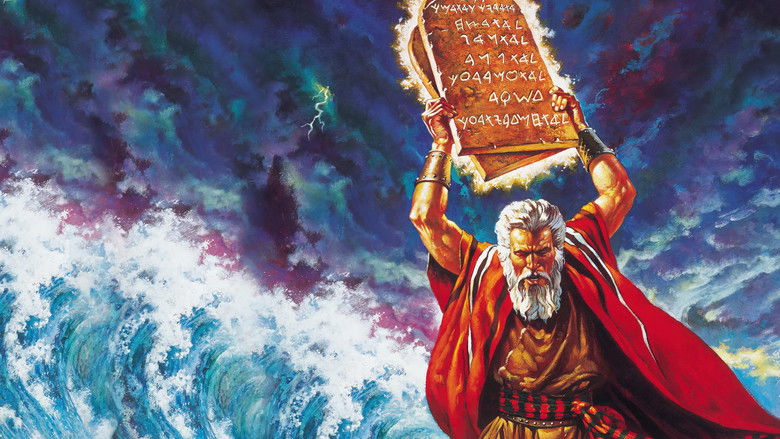
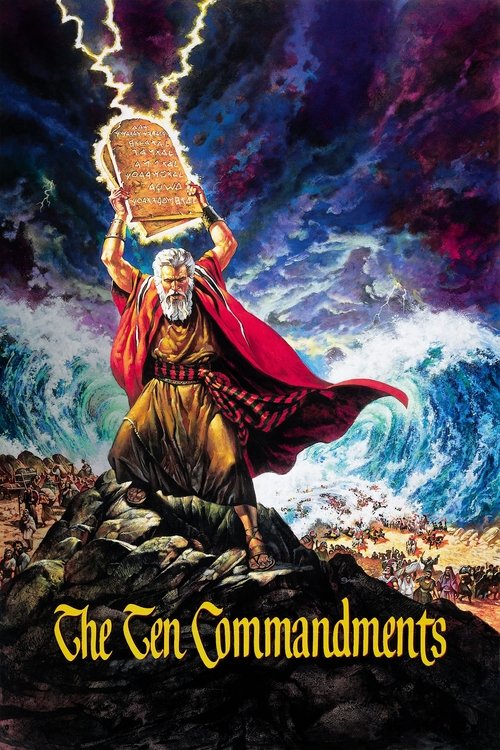
The Ten Commandments
A colossal Biblical epic of Technicolor grandeur where the divine clashes with the tyrannical. Amidst parting seas and burning bushes, one man's transformation from Egyptian prince to Hebrew prophet embodies the eternal struggle for freedom against the chains of bondage.
The Ten Commandments

The Ten Commandments

"The greatest event in motion picture history!"

05 October 1956 United States of America 220 min ⭐ 7.8 (1,779)
Director: Cecil B. DeMille
Cast: Charlton Heston, Yul Brynner, Anne Baxter, Edward G. Robinson, Yvonne De Carlo
Drama History
Freedom vs. Tyranny Identity and Heritage The Law Faith vs. Skepticism
Budget: $13,000,000
Box Office: $122,700,000

Overview

The Ten Commandments is a monumental retelling of the biblical story of Moses, beginning with his infancy when he is saved from Pharaoh's slaughter of Hebrew firstborns. Raised as an Egyptian prince in the royal court, Moses rises to become a successful general and rival to the throne, unaware of his true heritage. When he discovers his Hebrew roots and the brutal oppression of his people, he chooses to renounce his privileged life to share in their suffering, leading to his banishment into the desert by his adoptive brother and rival, Rameses.

In the wilderness, Moses finds redemption and a divine calling at the burning bush, where God commands him to return to Egypt and demand the release of the Hebrews. A titanic battle of wills ensues between Moses, armed with the power of God, and Rameses, hardened by pride and the manipulations of Queen Nefretiri. Through a series of devastating plagues culminating in the parting of the Red Sea, the Hebrews escape bondage. The film concludes at Mount Sinai, where Moses receives the law of God, forging a new nation amidst the trials of faith and the temptation of idolatry.

Core Meaning

At its heart, the film is a Cold War allegory framing the biblical narrative as a conflict between freedom under God and human tyranny. DeMille explicitly states in the prologue that the central question is whether men are the property of the state or free souls. The film posits that true liberty is not merely the absence of chains but the voluntary submission to a moral law higher than any earthly ruler.

Thematic DNA

Freedom vs. Tyranny 35%
Identity and Heritage 25%
The Law 20%
Faith vs. Skepticism 20%

Freedom vs. Tyranny

This is the film's driving force, contrasting the brutal, state-imposed slavery of Rameses' Egypt with the liberty Moses seeks for his people. It presents freedom not as anarchy, but as the right to serve a divine authority rather than a human despot.

Identity and Heritage

Moses' internal journey is defined by his shift from the Prince of Egypt to the Deliverer of Israel. He must strip away his Egyptian identity—his name, his rank, his love for Nefretiri—to embrace his true self as a Hebrew slave, finding dignity in his humble origins.

The Law

The film emphasizes that freedom requires law to sustain it. The climax is not the escape from Egypt but the giving of the Ten Commandments, symbolizing that a free society must be built on moral absolutes rather than the whims of a dictator.

Faith vs. Skepticism

Characters constantly grapple with belief. Rameses and the Egyptians rely on tangible idols and military might, while Moses and the faithful Hebrews must trust in an invisible God. The Golden Calf sequence illustrates the fragility of faith when miracles cease to be visible.

Character Analysis

Moses

Charlton Heston

Archetype: The Prophet / Hero
Key Trait: Righteous indignation

Motivation

Initially motivated by justice and compassion for the oppressed, and later by absolute obedience to God's command to liberate His people.

Character Arc

He begins as a confident, worldly prince of Egypt, falls to the lowest status of a slave, finds humility as a shepherd, and rises again as a divinely empowered leader. His journey is one of stripping away ego to become a vessel for God's will.

Rameses II

Yul Brynner

Archetype: The Tyrant / Shadow
Key Trait: Hubris

Motivation

To surpass his father Sethi, destroy Moses, and prove that he is a god-king with absolute power over life and death.

Character Arc

Rameses remains static in his arrogance, moving from a jealous brother to a hardened tyrant. His arc is a descent into obsession, as his refusal to bend to a power greater than himself costs him his son and his army.

Nefretiri

Anne Baxter

Archetype: The Femme Fatale
Key Trait: Vengeful obsession

Motivation

Possessive love for Moses and a desire to control the throne through him.

Character Arc

She tragically devolves from a powerful princess playing kingmaker to a bitter, vengeful woman. Her love for Moses turns to hate when he chooses God over her, and she becomes the catalyst for the final tragedy by goading Rameses into war.

Dathan

Edward G. Robinson

Archetype: The Traitor
Key Trait: Cynicism

Motivation

Greed, survival, and a desire for social status within the Egyptian oppressor's system.

Character Arc

He serves as the cynical collaborator who profits from his own people's misery. He constantly undermines Moses, leading the rebellion of the Golden Calf, only to be destroyed by his own corruption.

Symbols & Motifs

The Staff of Moses

Meaning:

It represents the transfer of power from earthly might to divine authority. Initially a shepherd's tool, it becomes the instrument of God's will, capable of turning into a cobra or parting the sea, surpassing the weapons of Pharaoh.

Context:

Moses uses it to confront Rameses, turn the Nile to blood, and part the Red Sea. It is a visual anchor for his authority.

The Burning Bush

Meaning:

A symbol of the divine presence that is powerful yet self-sustaining—it burns but is not consumed. It represents the awakening of Moses' spiritual consciousness and his direct commission by God.

Context:

Located on Mount Sinai, this visual effect marks the turning point where Moses ceases to be a shepherd and becomes a prophet.

The Red Sea

Meaning:

The ultimate barrier and the threshold of baptism. Passing through it symbolizes the death of the old life of slavery and the birth of a free people. It is the final severance from Egypt.

Context:

The parting sequence is the film's visual centerpiece, representing the impossible made possible through faith.

The Mud and Straw

Meaning:

These materials symbolize the degradation of human life into mere economic units. The struggle to make bricks without straw highlights the cruelty of a system that values production over humanity.

Context:

Used extensively in the first half of the film to depict the Hebrews' suffering in the brick pits of Goshen.

Memorable Quotes

So let it be written, so let it be done.

— Rameses II

Context:

Rameses says this repeatedly when issuing decrees, most chillingly when ordering the death of the Hebrew firstborns.

Meaning:

The ultimate assertion of absolute, dictatorial power. It signifies that the Pharaoh's word is law, requiring no debate or justification, contrasting sharply with God's law.

God made men. Men made slaves.

— Joshua

Context:

Spoken by Joshua the stonecutter when defending his dignity against Egyptian overseers.

Meaning:

A concise summary of the film's humanistic and theological message: freedom is the natural state of humanity, while bondage is an artificial human construct.

Let my people go!

— Moses

Context:

Moses delivers this message to Rameses in the royal court, initiating the cycle of plagues.

Meaning:

The central demand of the Exodus. It is not a request but a divine command, establishing the conflict between God's will and Pharaoh's will.

His god... IS God.

— Rameses II

Context:

Spoken by a broken Rameses sitting on his throne after his army is drowned in the Red Sea.

Meaning:

The final admission of defeat. The man who claimed to be a living god is forced to acknowledge the supremacy of the Hebrew God after losing everything.

Oh, Moses, Moses! You stubborn, splendid, adorable fool!

— Nefretiri

Context:

Nefretiri says this while trying to seduce Moses back to her side before he leaves the palace.

Meaning:

Highlights the romantic tragedy and Nefretiri's inability to understand Moses' spiritual transformation. She sees his mission as foolishness compared to the earthly power she offers.

Philosophical Questions

Does freedom require submission to law?

The film argues that freedom without law is anarchy. Moses' goal is not just to break chains but to bring the people to Mount Sinai to receive the Law. The Golden Calf sequence shows that without moral structure, the newly freed slaves immediately degrade themselves, suggesting true liberty is found in voluntary obedience to a higher moral order.

Is destiny determined by birth or choice?

Moses is born a slave but raised a prince. The film explores whether his nobility comes from his royal upbringing or his Hebrew blood. Ultimately, it suggests that his greatness comes from his choice to sacrifice his privilege for justice, rejecting the determinism of caste and social station.

Alternative Interpretations

While primarily a straightforward religious epic, the film invites several readings:

  • Cold War Propaganda: Critics often analyze the film as a political allegory where the Hebrews represent the 'free world' and Egypt represents the Soviet Union, with Rameses as a Stalin-like dictator.
  • Nefretiri as the True Villain: Unlike the biblical account where God 'hardens Pharaoh's heart,' the film suggests Nefretiri's sexual manipulation and goading are what repeatedly drive Rameses to refuse Moses, shifting the theological blame to human jealousy.
  • The 'Camp' Perspective: Modern audiences often enjoy the film for its melodramatic, theatrical dialogue and Anne Baxter's vampish performance, viewing it as a masterpiece of high camp alongside its serious religious intent.

Cultural Impact

The Ten Commandments is a defining monument of 1950s cinema and the Biblical Epic genre. Historically, it resonated deeply with the American public during the Cold War, serving as a spiritual reinforcement of American values of freedom against Soviet 'godless' tyranny. Cinematically, it set a benchmark for special effects (winning the Oscar for VFX) and scale that influenced decades of blockbusters, from Ben-Hur to modern CGI spectacles. Culturally, it has become a perennial television tradition, broadcast annually in the US during the Passover/Easter season for over 50 years, cementing its imagery—particularly the parting of the Red Sea and Heston's Moses—as the definitive visual interpretation of the Exodus story for generations.

Audience Reception

Praised: Audiences and critics alike have historically revered the film's sheer spectacle, the groundbreaking special effects (especially the Red Sea), and the iconic, larger-than-life performances of Heston and Brynner. It is widely considered the epitome of the 'Hollywood Epic'.

Criticized: Modern critics often point out the stiff, theatrical acting style, the lengthy runtime (nearly 4 hours), and the historical inaccuracies (white actors in Egyptian roles). Some find the dialogue overly melodramatic.

Verdict: Despite its age and theatricality, it remains a beloved classic, respected for its ambition, technical achievement, and storytelling power.

Interesting Facts

  • Charlton Heston's newborn son, Fraser Heston, played the infant Moses in the basket scenes.
  • The hail that falls during the seventh plague was actually popcorn spray-painted white so it wouldn't hurt the actors.
  • Director Cecil B. DeMille suffered a major heart attack while checking a camera on the high gates of the exodus set but returned to work against doctors' orders after only two days.
  • To create the parting of the Red Sea, the special effects team flooded a massive tank with 360,000 gallons of water and then played the film in reverse.
  • Charlton Heston provided the voice of God at the Burning Bush, slowed down to a lower register to sound more mysterious.
  • The production utilized approximately 14,000 extras and 15,000 animals, making it one of the largest casts in film history.
  • Yul Brynner (Rameses) was so concerned about being overshadowed by Charlton Heston's physique that he started an intense weightlifting program to bulk up for the role.

Easter Eggs

Herb Alpert as a Drummer

Future music legend Herb Alpert appears uncredited as a Hebrew drummer during the Exodus sequence, long before his fame with the Tijuana Brass.

The 'Lunch!' Command

A famous onset anecdote involves a female extra ignoring DeMille. After she retorted to a friend about 'that bald-headed old coot,' DeMille paused the entire production and shouted 'Lunch!' through his megaphone, proving he heard her and humorously ending the tension.

Animation in the Burning Bush

The flames of the burning bush were not just practical effects but included animated elements to give them a supernatural, non-consuming appearance, a technique rarely used in live-action at the time.

⚠️ Spoiler Analysis

Click to reveal detailed analysis with spoilers

Frequently Asked Questions

Explore More About This Movie

Dive deeper into specific aspects of the movie with our detailed analysis pages

Comments (0)

Leave a comment

No comments yet. Be the first to share your thoughts!