Skip to content
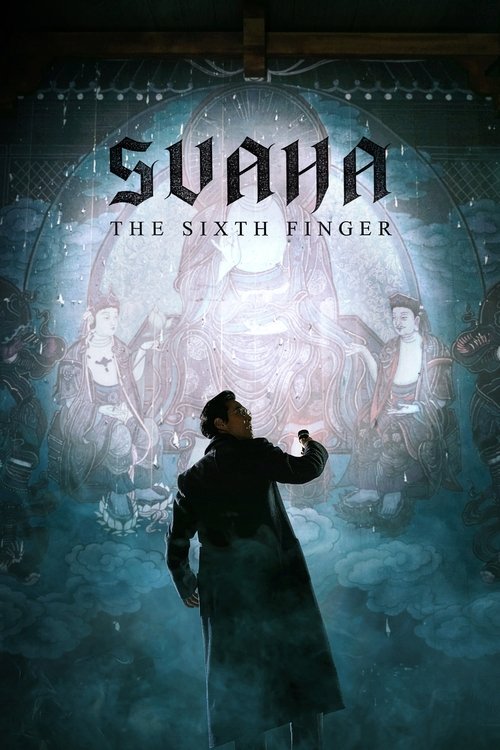
Svaha: The Sixth Finger
A cold, incense-heavy religious mystery where faith curdles into dread and compassion hides in the darkest place. Light and shadow trade names, like a shackled hand reaching from beneath a shed door.
Svaha: The Sixth Finger

Svaha: The Sixth Finger

사바하

"Demon awakened with this call."

20 February 2019 South Korea 122 min 6.7 (227)

Director: Jang Jae-hyun

Cast: Lee Jung-jae, Park Jeong-min, Lee Jae-in, Yoo Ji-tae, Jung Jin-young

Crime Thriller Mystery Horror Faith versus fanaticism Ambiguity of good and evil Syncretism of Buddhism and Christianity Family, sacrifice and innocence Prophecy, immortality and the cost of salvation
Box Office: $17,607,783

Overview

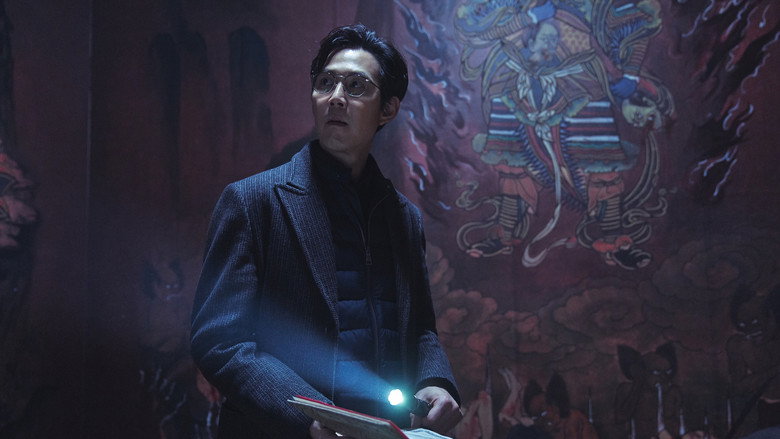
Svaha: The Sixth Finger (2019) is a South Korean mystery thriller written and directed by Jang Jae-hyun. It follows Pastor Park (Lee Jung-jae), a Christian minister who makes his living investigating and debunking dubious religious movements. His motives are partly financial. He becomes interested in a secretive splinter Buddhist sect called Deer Mountain, and a string of strange deaths seems to be tied to it.

The story runs on several tracks at once. In one, Park and his associate dig into the sect's obscure scriptures and its history. In another, a young disciple is hunting girls who share a birth year. In the third, a teenager named Geum-hwa lives with her grandparents. A deformed twin sister is kept locked in a shed on their property, and the family considers her a demon.

Jang has described the film as a "classical" movie that may read like a fictional mystery. It leans on dense exposition, borrowed scripture and slow-building atmosphere more than on jump scares. It asks who is truly good and who is truly evil, and what faith permits people to do.
Core Meaning

The film argues that the line between good and evil is less fixed than doctrine claims. Reviewers read it as a critique of religious fundamentalism. Believers who follow scriptures written by fallible individuals may commit atrocities in the name of good. It also raises the question of whether those teachers were truly speaking from enlightenment.

Labels such as "demon", "snake" and "light" are applied by people with something to protect. The film suggests that those who are called monstrous may be the innocent ones, and that those who are called holy may be the real threat. Beneath this is a quieter message about the bond between siblings, and about compassion that survives where doctrine fails.

Thematic DNA

Faith versus fanaticism 30%
Ambiguity of good and evil 30%
Syncretism of Buddhism and Christianity 15%
Family, sacrifice and innocence 15%
Prophecy, immortality and the cost of salvation 10%

Faith versus fanaticism

The Deer Mountain disciples believe they are protecting the light and kill children in the name of prophecy. Pastor Park, meanwhile, treats religion as a business. The film shows belief turning into coercion, and it condemns both zeal and cynicism.

Ambiguity of good and evil

The twin sister is introduced as a demon, and the prophecy casts her as the 'snake'. Roles reverse as the story proceeds. Evil acts are committed in the name of good, and apparent monsters turn out to be victims.

Syncretism of Buddhism and Christianity

A Christian pastor investigates a Buddhist sect. Geum-hwa's grandmother prays to Jesus and punishes herself, and Christmas imagery echoes the Herod massacre. The film places these traditions against Korean folk belief.

Family, sacrifice and innocence

The sisters' bond, and the family's guilt over the deaths of the parents, run through the story. The film sets familial love against institutional dogma, and it makes children the casualties of adult belief.

Prophecy, immortality and the cost of salvation

The sect follows scriptures about the Master, who is said to be immortal, and about a coming enemy. The film asks what people will sacrifice to secure salvation or to prolong a leader's life.

Character Analysis

Pastor Park

Lee Jung-jae

Archetype: Skeptic investigator / reluctant seeker Key Trait: Charming, sceptical, and a heavy user of exposition

Motivation

Money at first, then a need to understand the truth behind the murders and the sect's scriptures.

Character Arc

He starts as a cynical debunker of cults with a financial motive. As he digs into Deer Mountain he is drawn into questions he cannot answer with scepticism alone. He ends the story more humble about faith and the unknown.

Na-han

Park Jeong-min

Archetype: Tragic zealot / misguided avenger Key Trait: Haunted by nightmares after he sheds blood

Motivation

To protect the 'light' and carry out the mission he was given by his 'Father'.

Character Arc

A devoted disciple who believes he is fighting evil. His faith is shaken when he meets the sister and learns he was deceived. He turns against the man he called Father.

All 4 characters and cast

Symbols & Motifs

The sixth finger

Meaning:

The mark of the supposedly holy being, and a sign of unnatural, usurped power. It is also a mark of otherness that can be read as divine or monstrous.

Context:

The twin sister tells Na-han to look for the mark of six fingers on the person he calls Father and to kill him. The henchman, who turns out to be cult founder Kim Je-seok, has it. A witness also reports seeing the Master's twelve fingers.

The snake

Meaning:

Christian tradition reads the snake as evil, but in the film's prophecy it is the natural enemy of the false 'light'. The label is loaded and ultimately reversed.

Context:

The scriptures speak of a 'snake' who will kill the light. The sister in the shed is named as that snake, and she sends snakes against an intruder.

The shed and the shackles

Meaning:

Society's imprisonment of what it fears and does not understand. The prison is also a form of protection.

Context:

The twin is kept chained in a storage space surrounded by caged dogs. Her grandmother prays for penance whenever she cries.

Birth year 1999 and the 'evil ones'

Meaning:

Prophecy used as a justification for killing. The numbers give the murders an air of cosmic order and make the killers' reasoning seem rational.

Context:

The sect believes 81 evil ones will be born and that they must be killed. Na-han targets girls born in 1999.

The upside-down world (the flipped car)

Meaning:

The prophecy is literal: the moral order of the film is overturned, and the earth and sky exchange places.

Context:

The sister foretells that earth will become sky and sky will become earth. This is shown literally when the car Father Kim is driving flips.

The lighter

Meaning:

A small tool of fire and purification, passed to the avenger.

Context:

After telling Na-han that Father Kim must be killed, the sister hands him a lighter.

Philosophical Questions

Who decides what is evil?

The twin is named a demon by her family and a snake by prophecy. As the film proceeds, the label is shown to be a human projection. The film asks us to look past appearances and doctrine.

Can evil be done in the name of good?

Deer Mountain's disciples kill children to protect the light. Their sincerity does not make the acts less monstrous, and the film shows how belief can justify any cruelty.

Can we trust the people who write and interpret scriptures?

Followers rely on texts by teachers who may not have spoken from enlightenment. A hidden founder uses scripture to manipulate his disciples, and the film shows what happens if the source is corrupt.

How can there be a God in a world like this?

Pastor Park's work and the children's suffering invite this question. The film does not give a simple answer, but suggests that compassion is found in unexpected places.

How It Ends

Alternative Interpretations

Some viewers read the film as a straightforward critique of fanatical cults. Others see a more ambiguous meditation on balance, where good and evil are not opposites to be fought but forces to be held in tension. One IMDb reviewer reads the story as moving from fixed good and evil to a view of morality as balance.

Full ending explanation

Cultural Impact

The film continued the South Korean tradition of religious and occult thrillers, as in Jang's earlier The Priests. It was unusual in putting Buddhism, and a fictional splinter sect, at the centre of a horror story, where Western horror usually relies on Christianity. One reviewer called this a breath of fresh air.

It was a commercial success in Korea. It topped the box office in its opening week, with over a million admissions in five days. Critics were divided. Some praised it for raising thought-provoking questions about religion and about good and evil. Others found the screenplay cluttered and the twist underwhelming. IMDb users gave it roughly 6.2/10 according to one review site. Its later availability on Netflix brought it to international viewers.

The use of a photo of independence activist Na Cheol for a fictional character provoked criticism in Korea.

Audience Reception

Praised: the eerie atmosphere and the investigation in the first half, the cast, the cinematography, and the originality of building a story around obscure Buddhist mythology. Many viewers liked the thought-provoking treatment of religion and the final twist.

Criticised: the heavy exposition, a cluttered screenplay with parallel subplots, and characters who are introduced and then dropped. Some found the conclusion rushed or anticlimactic, and the tone sometimes veered into horror-comedy. Others said Lee Jung-jae was underused, as the story centres on a cult member.

Verdict: a divisive but intriguing and original religious mystery. It is rewarding for viewers who accept a slow, dense plot.

Interesting Facts

  • The film was written and directed by Jang Jae-hyun, whose earlier hit was The Priests (2015). He later made Exhuma (2024).
  • Ryoo Seung-wan and Kang Hye-jung are credited as producers.
  • It was released in South Korea on February 20, 2019, and the running time is given as 122 minutes.
  • The film topped the Korean box office in its opening week, with over 1.1 million admissions in its first five days. Its worldwide box office is listed as about US$17.7 million.
  • Lee Jae-in plays both twin sisters. The role launched her career and earned her multiple awards and nominations, including Best New Actress at the 55th Baeksang Arts Awards.
  • The film received Baeksang nominations for Best Film and Best Director.
  • The film faced backlash when it used a photograph of the independence activist Na Cheol as an early photo of the character Kim Je-seok.
  • The film is distributed by CJ Entertainment and Netflix. Kim Tae-soo was the cinematographer and Kim Tae-seong composed the music.

Frequently Asked Questions

Explore More About This Movie

Dive deeper into specific aspects of the movie with our detailed analysis pages

Comments (0)

Leave a comment

No comments yet. Be the first to share your thoughts!

Similar Movies