Skip to content
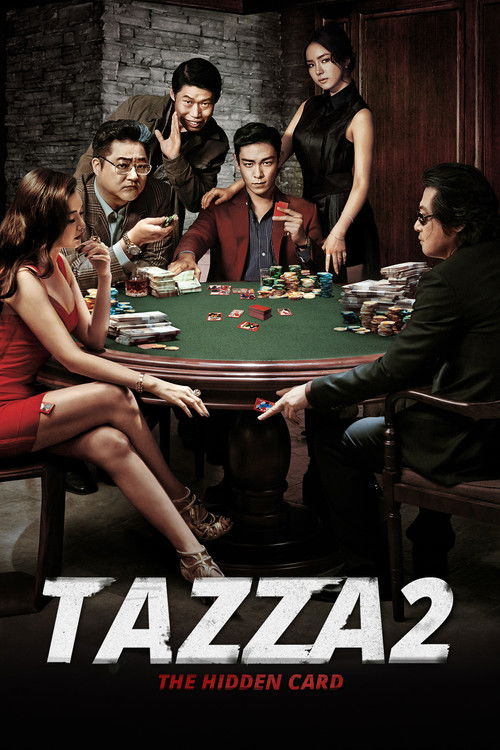
Tazza: The Hidden Card
A neon-lit Korean crime saga where a country card shark's talent curdles into obsession — cigarette smoke, spilled soju and a shuffled deck hiding every betrayal one hand away.
Tazza: The Hidden Card

Tazza: The Hidden Card

타짜: 신의 손

"The game is on."

03 September 2014 South Korea 147 min 6.9 (103)

Director: Kang Hyoung-chul

Cast: Choi Seung-hyun, Shin Sae-kyeong, Kwak Do-won, Lee Hanee, Yoo Hai-jin

Drama Crime Talent, arrogance and the gift that ruins you Betrayal and revenge Love as collateral Inheritance and the shadow of a legend Style, spectacle and the seduction of the game
Box Office: $31,278,476

Overview

Tazza: The Hidden Card (타짜: 신의 손) is a 2014 South Korean crime drama directed by Kang Hyeong-cheol, adapted from the manhwa by Huh Young-man and Kim Se-yeong and conceived as a follow-up to the 2006 hit Tazza: The High Rollers. The story follows Ham Dae-gil (Choi Seung-hyun), the nephew of Goni — the gambler at the centre of the first film — a young man from the provinces whose instinct for cards is so sharp that the game finds him long before he goes looking for it.

After proving himself at his hometown tables, Dae-gil is drawn into a slick Seoul gambling crew, a move that means leaving behind his first love, Mi-na (Shin Se-kyung). The capital offers bigger stakes, sharper suits and a professional underworld of hustlers, financiers and enforcers — among them the imperious President Woo (Lee Ha-nee) and the shabby, cunning veteran Ko Gwang-ryeol (Yoo Hae-jin). It also offers a lesson the young Tazza learns the hard way: in this world, no hand is ever played straight.

Set up as the fall guy in a crooked deal, Dae-gil disappears, rebuilds, and claws his way back toward the people who used him — a road that runs through gambling boss Jang (Kwak Do-won) and, ultimately, toward a legend named Agwi (Kim Yoon-seok). Kang stages it all as a flashy, propulsive genre ride: card tables shot like duels, a much-praised car chase, brutal violence, and a final game whose rules are designed to make cheating impossible.
Core Meaning

Beneath the swagger, Tazza: The Hidden Card is a film about talent as a trap. Dae-gil is genuinely gifted — "the hand of God" of the Korean title — and the film's argument is that a gift, in a rigged world, is simply the most efficient way to be exploited. Winning and losing at these tables are determined less by skill than by who is the cleverer, more ruthless cheat, which reframes the gambling movie as a study of predation dressed as meritocracy.

Kang also uses the sequel structure to say something about inheritance. Dae-gil follows his uncle's path almost gene-deep, and the film watches a younger generation walk knowingly into the same room, sit at the same table, and discover that the house — the money, the bosses, the legends — never changed. What looks like ambition is often just a rerun with a new face.

Finally, it is a revenge story that quietly questions the price of revenge. Dae-gil's climb back is thrilling, but every step converts a person into a stake and a feeling into leverage. The film's flashy pleasure and its moral chill are the same thing: the fun of watching someone become very good at something that will cost them everything they still love.

Thematic DNA

Talent, arrogance and the gift that ruins you 25%
Betrayal and revenge 22%
Love as collateral 18%
Inheritance and the shadow of a legend 18%
Style, spectacle and the seduction of the game 17%

Talent, arrogance and the gift that ruins you

Dae-gil's preternatural feel for cards — the 'hand of God' of the Korean title — is introduced as pure charisma and steadily revealed as a liability. His hometown wins buy him a seat with a Seoul crew; his confidence at that table is exactly what makes him useful to people who plan to burn him. The film keeps cutting between the elation of a perfect read and the humiliation that follows, arguing that in a world of professional cheats, being the most gifted player only raises your value as a mark.

Betrayal and revenge

The engine of the plot is a set-up: Dae-gil is made the fall guy in a crooked deal by the very crew that recruited him. His disappearance, his slow accumulation of a stake, and his return to face boss Jang restructure the whole film as a revenge campaign conducted with chips instead of guns. Kang stages retribution as a series of games, so that each hand carries the emotional weight of a confrontation — and each victory demands that Dae-gil become a little more like the people who wronged him.

Love as collateral

Mi-na, Dae-gil's first love, is what he leaves behind when he chooses Seoul, and the film treats that choice as the original bet. Romance in The Hidden Card is never separate from the con: affection is used as leverage, tenderness is a tell, and the women around Dae-gil — Mi-na and the formidable President Woo — occupy positions where feeling and strategy are impossible to disentangle. The tragedy is not that love is absent but that it keeps getting converted into a stake.

Inheritance and the shadow of a legend

Dae-gil exists in relation to his uncle Goni, hero of the first film, and to Agwi, the surviving legend whose reappearance in the finale collapses the distance between the two generations. The film is fascinated by the idea that the underworld is a hereditary institution: the same rooms, the same rituals, the same old man waiting at the end of the table. Dae-gil's arc is the discovery that he is not writing a new story but taking his turn in an old one.

Style, spectacle and the seduction of the game

The film is unabashedly slick — flashy visuals, a standout car chase, a bruising hand-to-hand fight, and card games cut for maximum adrenaline. That surface is thematic: the gambling life is presented as genuinely intoxicating, because a film that made it look grim would never explain why anyone stays. Critics divided precisely here, some finding the movie long on flash and short on storytelling discipline, others finding the finale's pacing and tension exemplary — a split that mirrors the film's own subject.

Character Analysis

Ham Dae-gil

Choi Seung-hyun (T.O.P)

Archetype: Antihero / prodigy protagonist Key Trait: Preternatural card instinct paired with a self-destructive refusal to walk away

Motivation

Initially the thrill of being the best in the room and the money that proves it; after the betrayal, retribution — enough winnings and leverage to make the crew that used him pay. Underneath both is a hunger for recognition inherited from the uncle whose legend he lives beside.

Character Arc

Introduced as a cocky small-town natural who cleans out his hometown card tables, Dae-gil is recruited by a slick Seoul crew and then set up as the fall guy in a crooked deal. Broken and hunted, he goes to ground, rebuilds a stake in obscurity, and returns as a colder, more calculating operator willing to face gambling boss Jang and, finally, Agwi in a game where losing is fatal. The arc runs from swagger to ruin to a hardened mastery that costs him the softness he began with.

Agwi

Kim Yoon-seok

Archetype: Returning legend / dark mentor and final antagonist Key Trait: Unreadable menace; a professional for whom stakes and lives are the same currency

Motivation

The game itself — dominance at the table, and the enforcement of a hierarchy in which no newcomer is allowed to be the best without paying for it.

Character Arc

Carried over from Tazza: The High Rollers, Agwi is withheld for most of the film and then brought into play for the life-and-death grand finale, where bizarre conditions are imposed to eliminate every opportunity for cheating. The role converts a franchise memory into a present-tense threat, and gives the sequel its authority: the new generation's ultimate test is the old generation's survivor.

All 5 characters and cast

Symbols & Motifs

The hidden card

Meaning:

The concealed card is the film's governing image of the withheld truth: the piece of information that decides everything and is, by definition, never on the table. It stands for the gap between what a person shows and what they are holding — in cards, in love, and in loyalty.

Context:

It gives the film its English title and recurs in every reversal, from the crooked deal that ruins Dae-gil to the final game, where the very rules are constructed to make hiding a card impossible — a condition that turns the whole climax into a test of who can deceive without concealment.

Hands

Meaning:

Hands are both instrument and hostage. The Korean title's 'hand of God' identifies Dae-gil's gift as bodily rather than intellectual, which also makes it something that can be taken. Hands symbolise skill, identity and vulnerability at once.

Context:

The camera fetishises fingers shuffling, palming and dealing, and the underworld's habit of settling debts on the body means every close-up on a hand carries an implicit threat. In this franchise, a gambler's hand is the most valuable and most exposed thing they own.

The gambling table as arena

Meaning:

The table is a miniature society with formal rules and no justice: everyone agrees to the etiquette while breaking it, and the outcome reflects power rather than merit.

Context:

From the pool hall and provincial games where Dae-gil earns his reputation to the sealed high-stakes rooms of Seoul, the film escalates the geography of the table. The bigger the room, the more elaborate the ceremony and the more brazen the cheating — a visual argument about how institutions launder predation.

The journey from province to Seoul

Meaning:

Geography stands in for moral transformation: the provinces represent origin, family and Mi-na, while Seoul represents ambition, money and anonymity.

Context:

Dae-gil's move to the capital with the slick city crew is the film's first irreversible bet, and his later flight and hiding invert the movement. Every return to something rural or small carries the ache of the life he traded away.

The stake

Meaning:

Money in the film is never simply money; it is time, dignity and other people converted into a countable form. The stake is how the film measures what a character is willing to lose.

Context:

Dae-gil's long grind to assemble enough of a stake to challenge Jang is the hinge of the second half, and the finale's escalation from cash to lives makes the metaphor literal: when there is nothing left to bet, you bet yourself.

Agwi

Meaning:

The returning legend functions less as a character than as a myth made flesh — proof that the game outlives every player and that the top of the ladder is occupied by someone who was already there a generation ago.

Context:

Kim Yoon-seok's Agwi is held back and then deployed in the life-and-death grand finale, so the figure operates as a symbol of destiny and continuity linking The High Rollers to The Hidden Card.

Philosophical Questions

Is exceptional talent a form of freedom or a form of bondage?

Dae-gil's gift opens every door and closes every exit. The film shows talent functioning as a recruitment mechanism: the better he plays, the more valuable he becomes to people who intend to use and discard him. His skill never lets him leave the table — it only qualifies him for a bigger one, until the final game where the prize for being the best is the risk of dying.

Can a game be fair, or does every set of rules simply disguise who holds the power?

Since winning and losing here depend less on card-playing skill than on who is the cleverest cheat, the film treats rules as theatre. The climax pushes this to its limit by imposing bizarre conditions meant to prevent all possible cheating — an experiment in whether fairness can be engineered, or whether it merely relocates the deception to the design of the rules themselves.

Does revenge restore the self it was undertaken to repair?

Dae-gil's return is presented as justice, but the film measures what he must become to obtain it: colder, more instrumental, more willing to convert people into stakes. By the finale he is closer to the men who betrayed him than to the young man from the provinces, raising the question of whether he has recovered his dignity or completed his ruin.

What is the true price of ambition, and who ends up paying it?

The choice to follow the Seoul crew costs Dae-gil his first love, and the film consistently locates the invoice for his ambition on other people — Mi-na, allies like Ko Gwang-ryeol, anyone standing near his winning streak. Ambition is dramatised not as self-improvement but as an externalised debt.

Can a person escape an inherited fate?

Dae-gil is his uncle's nephew, and the man waiting at the end of his story is the same legend who shaped the previous generation's. The film keeps offering him off-ramps — a hometown, a love, a smaller life — and watches him decline each one, leaving open whether the repetition is destiny, character, or the underworld's ability to reproduce itself in whoever walks in.

Alternative Interpretations

As a straight revenge thriller. The most common reading takes the film at face value: a gifted young gambler is framed, loses everything, rebuilds and collects. On this view the pleasures are structural — the escalation of stakes, the car chase, the fight, the reversals — and the finale's brutality is simply the genre paying off its debts.

Full ending explanation

Cultural Impact

Tazza: The Hidden Card arrived eight years after Tazza: The High Rollers, at a moment when Korean commercial cinema was aggressively mining known intellectual property — manhwa adaptations, franchises and star vehicles — for domestic blockbusters. Its long gestation is part of that story: a sequel was announced almost immediately after the first film's success, with Jang Joon-hwan attached to write and direct for a 2008 release, before pre-production collapsed and the project sat dormant until Kang Hyeong-cheol revived it.

Commercially it worked. The film hit the jackpot on home turf, passing four million admissions (4,001,813) and taking roughly US$31 million, and it travelled — a Busan International Film Festival screening, international trade reviews in Variety and The Hollywood Reporter, a North American release on September 26, 2014, and later a long streaming life on Netflix that gave it a second audience abroad. That performance secured the franchise's continuation with Tazza: One Eyed Jack in 2019, establishing 'Tazza' as one of the few durable series in Korean crime cinema.

Its most discussed cultural dimension was casting. Handing a legacy franchise lead to Choi Seung-hyun — T.O.P of Big Bang — was a bet on idol crossover appeal at exactly the point when K-pop stardom was becoming a standard route into Korean film, and much of the conversation around the film concerned whether that bet paid off. Alongside The Divine Move and The Con Artists, both also released in 2014, it belongs to a distinct cluster of Korean genre films about games, cons and rigged systems, a preoccupation that would find its global apotheosis years later in stories about people gambling their lives against institutions designed to beat them.

Audience Reception

Overall verdict: a solid commercial success with divided critics. The film drew more than four million admissions in Korea and roughly US$31 million worldwide, and it sits at a middling-to-positive audience score in the high-6 range on IMDb — the profile of a crowd-pleasing genre entry rather than a consensus classic.

What audiences praised: the style and energy. Reviewers and viewers singled out the film's very stylish look, its likeable supporting characters, a fantastic car chase, a strong hand-to-hand fight shot with restrained low-key camerawork, a real adrenaline charge during the card games, and a wonderfully paced finale that delivers genuine suspense once lives are on the table. Kim Yoon-seok's Agwi and the veteran comic presence of Yoo Hae-jin were widely welcomed, and the return of a first-film character gave franchise fans the connective payoff they wanted.

Main criticisms: discipline. Variety's Busan review judged the film long on flashy visuals and short on storytelling discipline, and that complaint recurs in audience reactions — a bloated middle, tonal swings between broad comedy and brutality, and a plot that leans on reversals rather than motivation. The decision that games are decided by cheating rather than skill frustrated some viewers, who felt it drains the card scenes of stakes even as it makes them more spectacular.

Points of contention: the casting of Choi Seung-hyun in the lead was the most argued-over element, splitting viewers between those who found his cool detachment a good fit for a young hustler and those who missed the volatility of the first film's protagonist. Comparisons with Tazza: The High Rollers were unavoidable and generally unkind. The finale's brutality and the film's treatment of its female characters — glamorous, sexualised and frequently positioned as leverage — also drew debate, with some praising Lee Ha-nee's commanding President Woo and others finding the women underwritten relative to the men.

Interesting Facts

  • The film is an adaptation of the manhwa 'Tazza' by Huh Young-man and Kim Se-yeong, the same comic source as the 2006 hit 'Tazza: The High Rollers'.
  • A sequel was announced by production company Sidus FNH on the strength of the first film's box office, with Jang Joon-hwan originally attached as screenwriter and director and a release planned for late 2008; pre-production was halted and Jang left the project, delaying the sequel by roughly six years.
  • Principal photography began on January 2, 2014, at a pool hall in Cheongnyangni-dong, Seoul, and wrapped on June 1, 2014.
  • Choi Seung-hyun (T.O.P of Big Bang) was cast as Ham Dae-gil, who is written as the nephew of Goni, the protagonist of 'Tazza: The High Rollers'.
  • Kim Yoon-seok reprises the role of Agwi from the first film, making him the direct connective tissue between the two movies.
  • The film opened in South Korea on September 3, 2014, and had already drawn about 3.1 million admissions within weeks of release.
  • It finished its Korean run with 4,001,813 admissions and grossed roughly US$31 million worldwide.
  • The film screened at the Busan International Film Festival, where it was reviewed by international trade press including Variety.
  • It received a North American release, premiering in the United States and Canada on September 26, 2014.
  • The franchise continued with 'Tazza: One Eyed Jack' in 2019, making 'The Hidden Card' the middle entry in a trilogy.

Easter Eggs

Ham Dae-gil is the nephew of Goni, the protagonist of 'Tazza: The High Rollers' (2006).

The relationship is the film's central act of franchise engineering: rather than recasting Goni, the sequel invents a blood heir, so that every comparison between Choi Seung-hyun's Dae-gil and the earlier film's hero becomes textual rather than accidental. It turns the sequel into a story about inheritance.

Kim Yoon-seok returns as Agwi, the same character he played in the 2006 film.

Agwi's reappearance in the life-or-death finale is the film's biggest gift to viewers of the original — the one figure who bridges both movies, and proof that the underworld's power structure survived the first film's bloodletting intact.

The Korean title, 타짜: 신의 손, translates as 'Tazza: Hand of God', while the international title is 'The Hidden Card'.

The two titles point at different halves of the film: the Korean one at Dae-gil's gift and the mythic status he chases, the English one at the deception that decides every game. Read together they state the movie's thesis — a divine hand is worthless against a concealed one.

The film's first act was shot in a real Cheongnyangni pool hall, and the provincial-hustler milieu of pool rooms and back-alley tables is rendered with documentary specificity.

The choice grounds a very stylised movie in a recognisable Korean underworld geography, and nods to the long local tradition of gambling and hustling stories rooted in these exact spaces.

Frequently Asked Questions

Explore More About This Movie

Dive deeper into specific aspects of the movie with our detailed analysis pages

Comments (0)

Leave a comment

No comments yet. Be the first to share your thoughts!

Similar Movies