Skip to content
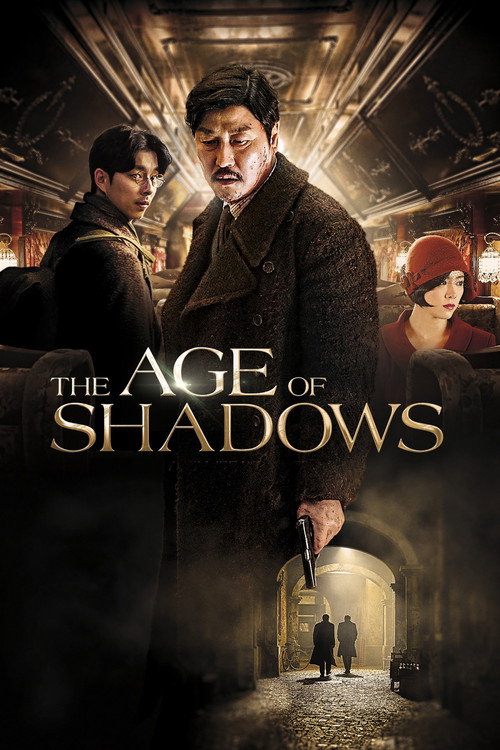
The Age of Shadows
A shadowy espionage thriller where loyalties shift like smoke in 1920s Shanghai and Seoul. Every glance is a gamble, and conscience rides a moving train toward an uncertain homeland.
The Age of Shadows

The Age of Shadows

밀정

"Infiltrate and deceive."

07 September 2016 South Korea 140 min 7.2 (386)

Director: Kim Jee-woon

Cast: Song Kang-ho, Gong Yoo, Han Ji-min, Shingo Tsurumi, Um Tae-goo

History Action Thriller Divided loyalty Collaboration and resistance under colonial rule Deception and identity Sacrifice and perseverance Trust between enemies
Budget: $9,620,000
Box Office: $53,165,427

Overview

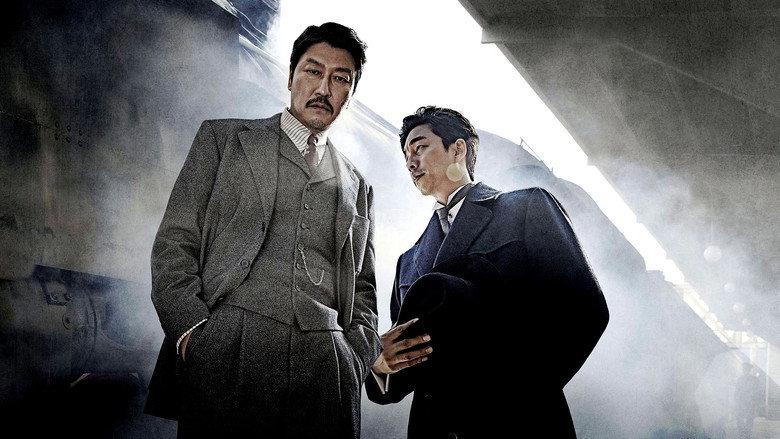
The Age of Shadows (밀정, "The Spy") is a 2016 South Korean period action thriller directed by Kim Jee-woon. It is set in Shanghai and Seoul in the 1920s, when Korea was under Japanese colonial rule. Song Kang-ho plays Lee Jung-chool, a former member of the resistance who is now one of the Japanese police's top Korean officers.

Jung-chool is ordered to take down a section of the independence movement, and his path crosses with that of Kim Woo-jin (Gong Yoo), an antique dealer. Both men are playing a game of cat and mouse. Jung-chool has his own mission to infiltrate the resistance, while the resistance tries to win him over. As the story moves toward a tense train journey filled with spies, he is caught between his duty to the colonial authorities and the pull of the cause he once served.

The film mixes period detail, big action set pieces and characters whose motives stay unclear. Critics have called it a sumptuous spy spectacle that keeps you asking whether each man is who he claims to be.
Core Meaning

At its heart, the film is about conscience under occupation. It asks what loyalty means when survival requires working with the oppressor. Kim Jee-woon doesn't split his characters into clean heroes and traitors. He looks at the gray zone where collaborators and resistance fighters watch, deceive and need each other.

The resistance leader's line that even a spy has one homeland and debts of conscience sums up the film's message. National identity and moral debt can't be fully erased, even in a man who has sold himself to the enemy. The idea that even if we fail, we must move forward presents the independence struggle as a chain of sacrifices. Individual failures still add up to historical progress.

Thematic DNA

Divided loyalty 30%
Collaboration and resistance under colonial rule 25%
Deception and identity 20%
Sacrifice and perseverance 15%
Trust between enemies 10%

Divided loyalty

Lee Jung-chool is a Korean ex-resistance member serving the Japanese police. He is torn between joining the resistance and fulfilling his obligations to his colonial masters. Critics note that the film keeps his motives uncertain almost to the very end.

Collaboration and resistance under colonial rule

The 1920s setting in Shanghai and Seoul puts the story inside the Korean independence movement. It shows the pressures that pushed Koreans either to collaborate or to resist.

Deception and identity

Nearly everyone hides behind a cover. Kim Woo-jin is an antique dealer, and Jung-chool is a policeman sent to infiltrate. The film's is-he-or-isn't-he tension turns identity into a performance that can fall apart at any moment.

Sacrifice and perseverance

The idea that the movement must keep going even if we fail runs through the resistance's story. Personal defeats are shown as steps toward a larger collective goal.

Trust between enemies

The bond between Jung-chool and Woo-jin rests on mutual suspicion. It slowly grows into respect, which makes the question of whether one man can trust another the story's emotional core.

Character Analysis

Lee Jung-chool

Song Kang-ho

Archetype: Antihero / double agent Key Trait: Cynical pragmatism hiding a guilty conscience

Motivation

At first he wants to survive and move up in a colonial system he thinks can't be beaten. He calls Korea a sinking ship. Over time, his buried sense of national duty takes over.

Character Arc

He starts as a former resistance member turned Japanese police officer who is ordered to crush the independence movement. Contact with the resistance slowly reawakens his conscience. He ends up caught between two loyalties, and the film keeps his final choice uncertain until its closing stretch.

Kim Woo-jin

Gong Yoo

Archetype: Hero / resistance fighter Key Trait: Steadfast resolve under a charming cover

Motivation

Korean independence and executing his comrades' mission.

Character Arc

He is an antique dealer who is secretly part of the resistance. He must play a dangerous game with Jung-chool, trying to win over a man who may betray him, while holding onto his commitment to independence.

All 3 characters and cast

Symbols & Motifs

The train

Meaning:

A closed space moving toward a destination nobody can escape. It is a pressure cooker where hidden loyalties are forced into the open.

Context:

An extended sequence aboard a moving train full of spies is one of the film's most praised set pieces. There, the cat-and-mouse game reaches its highest tension.

Antiques

Meaning:

They stand for a cultural heritage that the occupation threatens. They also serve as a respectable surface that hides subversive activity.

Context:

Kim Woo-jin's work as an antique dealer gives him a cover identity inside the resistance.

Shadows

Meaning:

The title image stands for a period when identities, loyalties and morality were all hidden. Nothing could be done in the open.

Context:

The English title frames the whole colonial era as an "age of shadows" in which spies and informants move unseen.

The police uniform

Meaning:

It marks Jung-chool's compromise. He wears the authority of the colonizer over a Korean conscience.

Context:

His position as one of the top police officers working for the Japanese defines his outward identity throughout the film.

Memorable Quotes

Even a spy has one homeland. He surely has debts of conscience.
— Jung Chae-san (Lee Byung-hun)

Context

The resistance leader says this while explaining why it is worth trying to win over Lee Jung-chool. (English translation of the Korean dialogue.)

Meaning

This is the film's thesis. It argues that national belonging and moral obligation can't be completely erased, even in a collaborator.

Do you think this country will gain independence? It's a sinking ship anyway.
— Lee Jung-chool (Song Kang-ho)

Context

Jung-chool uses this line to justify serving the Japanese. (English translation.)

Meaning

It captures the defeatist reasoning behind collaboration, which his arc will later test.

All 4 quotes

Philosophical Questions

Can a person who serves an oppressor still be morally redeemed?

Jung-chool's arc tests whether a collaborator's buried conscience can win out. The resistance's gamble on him says the answer may be yes.

Is survival a valid excuse for complicity?

Jung-chool's line that Korea is a sinking ship puts the collaborator's reasoning up for debate. The film sets it against the resistance's willingness to die for an uncertain cause.

What is the value of a struggle that keeps failing?

The idea that even if we fail, we must move forward presents resistance as a cumulative, generational effort rather than one decisive victory.

Can trust exist between people whose roles require deception?

The relationship between Jung-chool and Woo-jin is built on mutual lies, yet it becomes the film's most honest bond.

How It Ends

Alternative Interpretations

A conversion story: One reading sees Jung-chool's journey as a gradual moral awakening. The resistance's faith that he still carries a debt of conscience turns out to be justified.

Full ending explanation

Cultural Impact

The film was released in 2016, amid a wave of Korean films about the Japanese colonial period. As Warner Bros.' first Korean production, it showed that Hollywood studios were willing to invest directly in Korean-language filmmaking. Its opening weekend, with nearly 70% of the market, and its roughly $55 million total made it a major commercial hit.

It was chosen as South Korea's Oscar submission and premiered internationally at Venice. That helped cement Kim Jee-woon's reputation as a genre stylist able to lift familiar material through his command of mise-en-scène. The film also reached global audiences at a time when Gong Yoo's international profile was rising after Train to Busan.

Critics placed it in the tradition of classic spy cinema, such as Carol Reed's films, while noting that it is also a distinctly Korean look at the moral compromises of the colonial era.

Audience Reception

Praise: Reviewers praised the bravura opening set-piece, the tense train sequence, Kim Jee-woon's mise-en-scène, and the balance of period detail, action spectacle and complex characters. Song Kang-ho's morally ambiguous lead performance and Gong Yoo's charisma were widely noted, and critics called the film a dazzling, sumptuous spy thriller.

Criticism: The film runs over two hours, and some viewers found the plot's many turns and the heavy cast of spies and informants demanding to follow.

Verdict: The film was a big commercial success in South Korea and was well received at festivals. It is widely regarded as one of Kim Jee-woon's strongest genre works and a standout Korean period thriller.

Interesting Facts

  • The Age of Shadows was Warner Bros.' first Korean-language local production in South Korea.
  • The film had a reported budget of about US$8.62 million and was co-produced by Grimm Pictures.
  • In its opening weekend (Sept. 9–11, 2016), it earned about $16 million, almost 70 percent of the South Korean market share.
  • Its total worldwide gross was about US$55.3 million.
  • South Korea selected it as its official entry for the Academy Award for Best Foreign Language Film.
  • The film screened at the 2016 Venice Film Festival, and Kim Jee-woon also discussed it at the Busan International Film Festival.
  • It brought together Song Kang-ho, star of Snowpiercer, and Gong Yoo, who starred in Train to Busan the same year.

Easter Eggs

Lee Byung-hun appears in a small but striking role as resistance leader Jung Chae-san

Lee Byung-hun has worked with Kim Jee-woon before. His short appearance as the charismatic leader delivers the film's most quoted line.

The echoes of Carol Reed's espionage films

Critics have described the film as a riff on the films of Carol Reed. They point to its talk of loyalty and its double agents working both sides, much like classic British spy cinema.

Gong Yoo on a train again

The film came out the same year as Train to Busan, starring Gong Yoo, and it also builds to a tense set piece on a moving train.

Frequently Asked Questions

Explore More About This Movie

Dive deeper into specific aspects of the movie with our detailed analysis pages

Comments (0)

Leave a comment

No comments yet. Be the first to share your thoughts!

Similar Movies