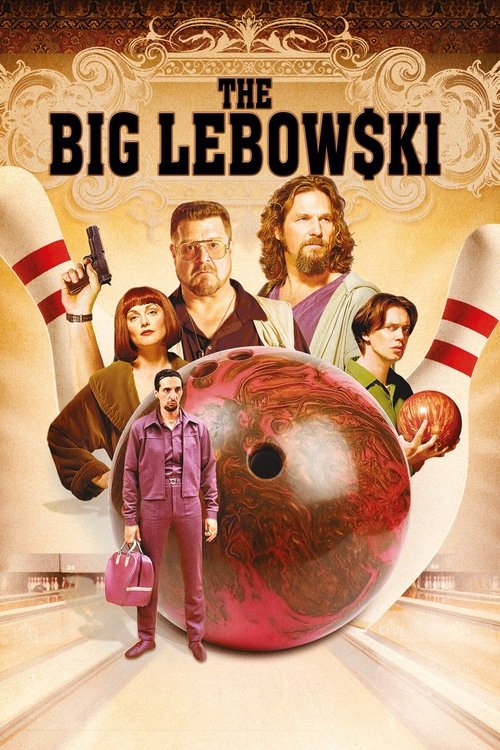
The Big Lebowski
A hazy, neo-noir comedy drifting through Los Angeles, where a case of mistaken identity sends a slacker on a cosmic journey, illuminated by bowling alleys and White Russians.
The Big Lebowski

The Big Lebowski

"Times like these call for a Big Lebowski."

06 March 1998 United Kingdom 117 min ⭐ 7.8 (11,758)
Director: Joel Coen
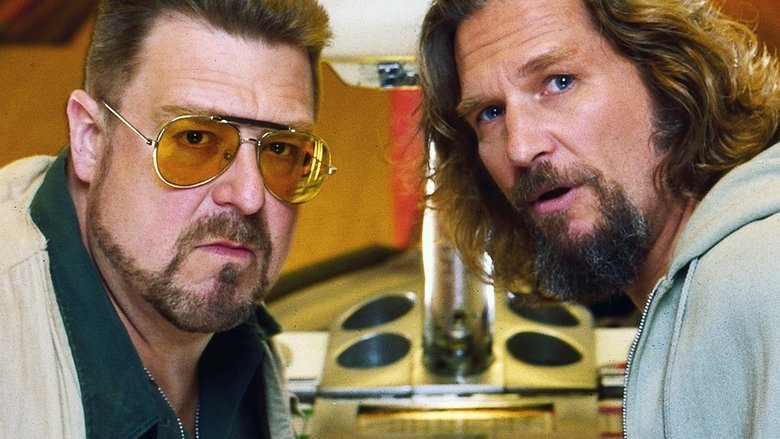
Cast: Jeff Bridges, John Goodman, Julianne Moore, Steve Buscemi, David Huddleston
Crime Comedy
Mistaken Identity and the Nature of Identity Absurdity and The Search for Meaning Masculinity and Friendship Deceit and Materialism
Budget: $15,000,000
Box Office: $47,010,480

Overview

"The Big Lebowski" (1998) follows Jeffrey "The Dude" Lebowski, a laid-back, pot-smoking bowling enthusiast living in Los Angeles. His peaceful existence is shattered when two thugs break into his apartment, rough him up, and urinate on his cherished rug, mistaking him for a millionaire of the same name. This incident of mistaken identity propels The Dude into the convoluted world of the other Jeffrey Lebowski—a wealthy, disabled philanthropist.

Urged on by his volatile Vietnam veteran friend, Walter Sobchak, The Dude seeks compensation for his ruined rug. This simple request entangles him in a bizarre kidnapping plot involving the millionaire's young wife, Bunny. Hired to deliver the ransom, The Dude and Walter's plan goes awry, leading them through a labyrinthine underworld populated by nihilists, pornographers, avant-garde artists, and rival bowlers. The plot, intentionally complex and ultimately secondary to the characters' interactions, serves as a backdrop for a series of absurd and comedic encounters.
Core Meaning

The core meaning of "The Big Lebowski" lies in its celebration of an alternative philosophy of life, embodied by The Dude's simple creed: to "abide." The film, structured like a Raymond Chandler detective story, intentionally makes its complex plot meaningless to highlight this central theme. It's not about solving the mystery, but about how one navigates the chaos and absurdity of the world. The Dude, an antihero who seeks only to maintain his relaxed existence, becomes a symbol of resistance against aggression, materialism, and ideological fanaticism.

The film explores existentialism and nihilism, questioning how individuals create meaning in a seemingly random universe. While surrounded by characters obsessed with rules (Walter), achievement (the Big Lebowski), or the belief in nothing (the nihilists), The Dude finds contentment in simple pleasures: bowling, a White Russian, and a comfortable rug. The movie suggests that perhaps the most profound way to live is to simply go with the flow, accepting life's unpredictable nature without succumbing to despair. It champions a form of passive resistance, where maintaining one's identity and inner peace is the ultimate victory.

Thematic DNA

Mistaken Identity and the Nature of Identity 30%
Absurdity and The Search for Meaning 30%
Masculinity and Friendship 25%
Deceit and Materialism 15%

Mistaken Identity and the Nature of Identity

The entire plot is set in motion by a case of mistaken identity, where "The Dude" is confused with the millionaire Jeffrey Lebowski. This initial error spirals into a complex web of misunderstandings and false assumptions. The theme goes deeper than a simple plot device, exploring how identities are constructed, performed, and misunderstood. The "Big" Lebowski presents himself as a powerful achiever but is revealed to be a fraud. Walter clings to his identity as a Vietnam vet, applying its rules to every situation. The Dude, in contrast, is secure in his simple identity, repeatedly clarifying, "I'm not 'Mr. Lebowski.' You're Mr. Lebowski. I'm The Dude." The film satirizes the masks people wear and celebrates the character who is most authentically himself.

Absurdity and The Search for Meaning

The film is a masterclass in absurdism, presenting a hopelessly complex plot that is ultimately unimportant. This narrative choice reflects an existential worldview where life's events are often random and chaotic. Characters desperately try to impose order and meaning: Walter through his rigid adherence to rules, and the nihilists through their supposed belief in nothing. The film satirizes these attempts, suggesting that the search for a grand purpose is futile. The Dude's approach is to embrace the absurdity, finding meaning not in solving the grand mystery, but in the simple, repeatable pleasures of life, like bowling with friends. The film suggests that meaning is not found, but created through one's personal philosophy and relationships.

Masculinity and Friendship

"The Big Lebowski" satirizes various archetypes of American manhood through its central trio. The Dude represents a passive, non-materialistic masculinity, a remnant of hippie culture. Walter Sobchak is the embodiment of aggressive, rule-bound hyper-masculinity, shaped by his Vietnam War experiences. Donny is the gentle, often confused follower, who serves as an anchor for his more extreme friends. Their friendship, centered around the ritual of bowling, is the film's emotional core. Despite their conflicting ideologies and Walter's constant belittling of Donny, their bond is genuine. Walter's final words to The Dude after Donny's death, "Fuck it, Dude. Let's go bowling," encapsulate the idea that friendship and shared rituals provide solace in a chaotic world.

Deceit and Materialism

Nearly every character in the film is engaged in some form of deceit. The Big Lebowski fakes the kidnapping to embezzle money from his family's foundation. Bunny's nihilist friends attempt to extort money based on her disappearance. Maude uses The Dude to conceive a child without emotional attachment. The film critiques a society driven by greed and materialism, starkly contrasting the ostentatious lifestyle of the wealthy Lebowski with The Dude's anti-materialistic existence. The Dude's primary motivation is not the million-dollar ransom but compensation for his soiled rug, a symbol of his simple, personal sense of order. Ultimately, the complex financial schemes all unravel into nothing, reinforcing the emptiness of materialism.

Character Analysis

Jeffrey "The Dude" Lebowski

Jeff Bridges

Archetype: Antihero
Key Trait: Laid-back

Motivation

The Dude's primary motivation is to return to his peaceful, uncomplicated existence. Initially, this manifests as a desire for compensation for his soiled rug. As the plot becomes more convoluted, his goal is simply to extricate himself from the mess with minimal effort. He is a reluctant hero who is consistently dragged into situations against his will. He doesn't want the money or to solve the crime; he just wants to go bowling.

Character Arc

The Dude is a rare example of a protagonist with virtually no character arc; his entire purpose is to resist change. He begins the film as a laid-back slacker and ends it the same way, having successfully navigated a maelstrom of chaos without losing his core identity. His journey is not about internal growth but about enduring external pressures. He is tested by violence, deceit, and nihilism, but he ultimately returns to his simple life of bowling and White Russians, having learned nothing and forgotten everything, which in the context of the film, is a victory. His philosophy of "abiding" is validated.

Walter Sobchak

John Goodman

Archetype: The Aggressor / Loyal Sidekick
Key Trait: Combative

Motivation

Walter is motivated by a strict, often misguided, personal code of conduct rooted in his military past and his interpretation of Judaism. He believes in rules, fairness, and responding to every situation with decisive, often violent, action. He inserts himself into The Dude's predicament out of a sense of loyalty and a desire to impose his version of order onto the chaos, almost always making things worse.

Character Arc

Like The Dude, Walter does not have a significant character arc. He remains a volatile, rule-obsessed Vietnam veteran from beginning to end. His worldview, rigidly defined by his war experience, is consistently misapplied to civilian life, causing most of the film's complications. However, the death of Donny reveals a deeper, more sentimental side to his character. His botched, heartfelt eulogy shows his profound loyalty and grief, offering a brief glimpse beneath his aggressive exterior before he quickly reverts to form and suggests, "Let's go bowling."

Theodore Donald "Donny" Kerabatsos

Steve Buscemi

Archetype: The Innocent / Comic Relief
Key Trait: Meek

Motivation

Donny is motivated by a simple desire to be part of the group and enjoy a game of bowling. He is a loyal friend who wants to participate in the conversation and understand what's happening, though he is rarely allowed to. He serves as the innocent heart of the trio, a character with no ulterior motives in a world full of them.

Character Arc

Donny's arc is tragic and brief. He exists as a sweet, simple-minded member of the trio, a foil to Walter's aggression and The Dude's detachment. He has no development and is characterized primarily by his love of bowling and his constant failure to keep up with Walter and The Dude's conversations, which results in Walter repeatedly yelling, "Shut the f**k up, Donny!" His arc concludes with his sudden death from a heart attack during a fight with the nihilists, a moment of shocking, absurd tragedy that highlights the film's theme of life's randomness.

Maude Lebowski

Julianne Moore

Archetype: The Eccentric
Key Trait: Artistic

Motivation

Maude is motivated by two things: recovering the money her father embezzled from a family foundation and conceiving a child. She approaches both goals with a detached, clinical precision. She is also driven by a strong sense of her own artistic and feminist identity, which informs her every action and interaction with The Dude.

Character Arc

Maude is a confident and self-possessed avant-garde artist who operates on her own terms. She does not change throughout the film but acts as a catalyst, providing The Dude with key information that helps unravel the (ultimately unimportant) plot. She reveals her father's lack of wealth and his embezzlement. Her arc is purely functional to her own goals: she identifies The Dude as a suitable sperm donor who will not demand a role in her child's life, accomplishes her goal of becoming pregnant, and exits the narrative.

Symbols & Motifs

The Rug

Meaning:

The rug symbolizes The Dude's personal sense of order, comfort, and domestic harmony. It is the anchor of his simple, peaceful existence. Its desecration is an attack on his lifestyle and the catalyst for the entire plot. As The Dude famously states, "That rug really tied the room together." It represents the one thing he feels is worth fighting for in his otherwise passive life.

Context:

In the opening scene, one of Jackie Treehorn's thugs urinates on The Dude's rug after mistaking him for the other Jeffrey Lebowski. This act forces The Dude out of his comfort zone to seek compensation, which leads him to the "Big" Lebowski. He later steals a rug from the mansion, which is then stolen from him, continuing the motif of his disrupted peace.

Bowling

Meaning:

Bowling represents structure, community, and a sacred ritual in the chaotic lives of The Dude, Walter, and Donny. It's a space governed by clear rules, providing a contrast to the lawless, absurd world outside the alley. For Walter, bowling has rules, unlike Vietnam. For The Dude, it is the cornerstone of his social life and a form of meditation. The act of bowling is a way to oppose nihilism by engaging in a simple, meaningful activity with friends.

Context:

The bowling alley is a recurring setting where the main characters debrief, formulate plans, and find refuge from the escalating madness of the plot. Key conversations and character moments happen here, and the film's final scene returns to the alley, showing that despite everything, the simple ritual of bowling abides.

White Russian

Meaning:

The White Russian, or "Caucasian" as The Dude calls it, is his signature drink and a symbol of his laid-back lifestyle. It's a comforting, creamy concoction that he consumes throughout the film, regardless of the situation. It represents his method of coping with stress and maintaining his equanimity. It is a constant in his life, much like bowling, providing a sense of normalcy amidst the chaos.

Context:

The Dude is seen drinking or making a White Russian in numerous scenes, from his home to the bowling alley, and even in a limousine. He drinks nine of them over the course of the film. Notably, his drink is drugged by the pornographer Jackie Treehorn, turning his source of comfort into a catalyst for a surreal, disorienting dream sequence.

Memorable Quotes

The Dude abides.

— The Dude

Context:

This line is spoken by The Dude to The Stranger at the bowling alley bar near the end of the film. After summarizing the recent chaotic events and the death of Donny, The Stranger asks how he's doing. The Dude responds with this simple, profound statement of his enduring philosophy.

Meaning:

This is the film's ultimate thesis statement and The Dude's personal mantra. It signifies his philosophy of acceptance, endurance, and tranquility in the face of life's chaos. It's a declaration that despite all the turmoil, he will remain himself and continue his easy-going existence. The line has become a cultural touchstone, representing a laid-back approach to life's challenges.

That rug really tied the room together.

— The Dude

Context:

The Dude says this line to Walter and Donny at the bowling alley immediately after the opening scene where his rug is soiled by Treehorn's thugs. It's his justification for why he must confront the other Lebowski, setting the entire story in motion.

Meaning:

This quote establishes the central, absurd motivation for The Dude's entire involvement in the plot. It highlights his focus on simple, domestic harmony over grander concerns like money or justice. The rug symbolizes order in his life, and its violation is an offense he cannot let stand. The line has become a popular idiom for describing an essential element that unifies a space, project, or idea.

Yeah, well, you know, that's just, like, your opinion, man.

— The Dude

Context:

The Dude delivers this line to Jesus Quintana in the bowling alley. After Jesus gives a typically flamboyant and intimidating speech about what he's going to do to them in the tournament, The Dude calmly deflates his entire tirade with this simple, dismissive phrase.

Meaning:

This is The Dude's ultimate, non-confrontational comeback. It's a perfect encapsulation of his passive resistance and his dismissal of others' rigid ideologies. He doesn't argue the point but simply invalidates it by relegating it to the status of a mere opinion. It reflects a postmodern worldview where absolute truths are suspect and everything is a matter of perspective.

This is not 'Nam. This is bowling. There are rules.

— Walter Sobchak

Context:

Walter screams this at his bowling opponent, Smokey, after Smokey's toe goes over the foul line during a league game. When Smokey refuses to accept the penalty, Walter pulls out a handgun to enforce the "rules," escalating the situation to a terrifying and ridiculous degree.

Meaning:

This quote perfectly illustrates Walter's character. He is unable to separate his traumatic experiences in the Vietnam War from his mundane daily life. He constantly tries to apply the life-or-death logic of war to trivial situations, like a foot-fault in bowling. It highlights his obsession with rules and order as a coping mechanism for his PTSD, while also being deeply comedic in its absurdity.

Shut the f**k up, Donny!

— Walter Sobchak

Context:

Walter yells this at Donny numerous times throughout the film, usually whenever Donny attempts to interject with a question or comment about a conversation he doesn't understand. A prime example is when Donny confuses V.I. Lenin with John Lennon.

Meaning:

This recurring line is a key part of the film's comedic dynamic and characterization. It establishes the relationship between the explosive Walter and the meek Donny, who is perpetually "out of his element." While abusive, it's played for laughs and underscores Donny's role as the innocent who can't keep up with the increasingly bizarre plot, making his eventual death all the more poignant.

Philosophical Questions

In a world of chaos and absurdity, what is the best way to live?

The film explores this question by contrasting different life philosophies. There is the aggressive, rule-based approach of Walter; the materialistic, achievement-oriented facade of the Big Lebowski; and the nihilists' belief in nothing. The film's protagonist, The Dude, offers an alternative: a philosophy of passive acceptance and "abiding." He navigates the absurd events not by trying to control them, but by enduring them and focusing on simple pleasures. The film seems to suggest that in a universe without inherent meaning, perhaps the wisest path is to create your own small pockets of meaning and peace, and simply go with the flow.

Is it possible to maintain one's principles in a corrupt and deceitful world?

The Dude is constantly confronted by deceit, from the Big Lebowski's embezzlement scheme to Maude's ulterior motives. He is a pacifist who is repeatedly subjected to violence. Despite this, he never abandons his core principles. He remains a fundamentally decent and non-violent person. His refusal to change, to become as cynical or aggressive as the world around him, is portrayed as a quiet form of victory. The film suggests that integrity is not about changing the world, but about preventing the world from changing you.

Alternative Interpretations

While on the surface "The Big Lebowski" is a stoner comedy, it invites numerous alternative interpretations:

1. A Modern Western: The film can be read as a contemporary Western. The Stranger's narration explicitly frames The Dude as "the man for his time and place," akin to a classic Western hero. The Dude is a loner caught between warring factions over missing money, a common Western trope. However, he is an inverted hero: instead of bringing order through action, he survives by remaining passive and simply abiding. His quest is not for justice, but for the return of his 'homestead' (his rug and peaceful life).

2. A Commentary on the Post-Cold War Era: The film is set in 1991, at the dawn of the New World Order. The characters can be seen as allegories for different facets of American society grappling with the end of the 20th century. The Dude represents the faded idealism of the 1960s New Left, Walter embodies the unresolved trauma and jingoism of the Vietnam/Cold War era, and the "Big" Lebowski represents the hollow, corrupt capitalism of the Reagan years. The German nihilists, who "believe in nothing," could symbolize the ideological void left after the fall of communism.

3. A Spiritual or Religious Allegory: The Dude's journey has been interpreted as a spiritual one. His laid-back, accepting philosophy mirrors tenets of Taoism or Zen Buddhism. He navigates a world of suffering and chaos by detaching from desire and accepting the flow of events. The film's narrative, with its trials and temptations, can be seen as a test of his faith in "abiding." From this perspective, the impossibly convoluted plot is simply the universe testing a man who just wants to be left alone.

Cultural Impact

Initially met with mixed reviews and modest box office results, "The Big Lebowski" has since evolved into a cultural phenomenon and a beloved cult classic. Its influence is vast and multifaceted. The film's idiosyncratic dialogue has permeated pop culture, with lines like "The Dude abides" and "That rug really tied the room together" becoming part of the common lexicon.

The character of The Dude has become an archetype for a laid-back, anti-materialistic lifestyle, inspiring a real-world philosophy and religion known as Dudeism, which promotes a modern form of Taoism. The film also spawned Lebowski Fest, an annual traveling festival where fans (known as "Achievers") gather to dress as characters, drink White Russians, and go bowling, demonstrating the strong sense of community the film has fostered.

Set in 1991 against the backdrop of the first Gulf War, the film subtly engages with the legacy of the 1960s, contrasting the former student radicalism of The Dude with the lingering trauma of Vietnam in Walter. It has been analyzed by critics and academics for its philosophical depth, exploring themes of existentialism, nihilism, and the search for meaning in a postmodern world. In 2014, its cultural significance was officially recognized when it was selected for preservation in the U.S. National Film Registry by the Library of Congress.

Audience Reception

Upon its initial release in 1998, "The Big Lebowski" received a mixed reception from critics and was a disappointment at the box office. Many were unsure what to make of its rambling, seemingly pointless plot and quirky tone. However, over time, the film has garnered a massive and devoted cult following.

Audiences have overwhelmingly praised the film for its brilliant, quotable dialogue, its cast of eccentric and memorable characters, and its unique blend of stoner comedy and neo-noir mystery. Jeff Bridges's performance as The Dude is universally celebrated as iconic. Fans are particularly drawn to the film's laid-back philosophy and its warm depiction of friendship amidst chaos. The primary criticism, especially from initial viewers, was aimed at the convoluted and meandering plot, which some found to be unsatisfying. However, most fans now recognize that the plot's pointlessness is, in fact, the point of the film.

Interesting Facts

  • Much of The Dude's wardrobe, including his jellies sandals, came directly from actor Jeff Bridges's own closet.
  • The Dude is based in part on Jeff Dowd, a film producer and political activist the Coen brothers knew. Dowd, like the character, was a member of the anti-war "Seattle Seven."
  • In an early draft of the script, it was revealed that The Dude was an heir to the inventor of the Rubik's Cube, which explained his source of income. This detail was later removed.
  • The character of Walter Sobchak was partly inspired by the famously right-wing filmmaker and screenwriter John Milius, known for his work on "Apocalypse Now" and his love of guns.
  • Despite being an avid bowler in the film, The Dude is never actually seen bowling a single time.
  • The Dude drinks a total of nine White Russians throughout the movie.
  • The film has inspired a real-life religion called "Dudeism," founded in 2005, which is devoted to the philosophy and lifestyle of The Dude.
  • The Coen Brothers have stated that the intricate plot is intentionally secondary and ultimately unimportant, a structure borrowed from Raymond Chandler's detective novels like "The Big Sleep."
  • The word "dude" is used 161 times in the film, and the F-word or its variations are used approximately 292 times.
  • Sam Elliott, who plays The Stranger, was only on set for two days to film his parts.

Easter Eggs

Steve Buscemi's character, Donny, is the opposite of his character in the Coens' previous film, "Fargo." In "Fargo," Carl Showalter is extremely chatty, while his partner is nearly silent. In "Lebowski," Donny can barely get a word in before Walter tells him to shut up.

This is a characteristic inside joke from the Coen Brothers, who often use a repertory company of actors. It creates a playful connection between their films for dedicated fans.

One of the German nihilists, Uli Kunkel (played by Peter Stormare), orders pancakes at a diner. In "Fargo," Stormare's character desperately wants to go to a pancake house but never gets to.

This is another subtle nod to "Fargo," paying off a minor running gag from the previous film and rewarding attentive viewers who are familiar with the Coens' work.

The date on The Dude's 69-cent check at the beginning of the film is September 11, 1991. The televised speech by President George H.W. Bush about Iraq's aggression was given on August 5, 1990.

This anachronism is likely intentional. It suggests The Dude is so broke that he has to post-date a check for a trivial amount by over a year, adding another layer of comedy to his financial situation.

Aimee Mann, the acclaimed singer-songwriter, has a cameo as one of the German nihilists—the one who sacrifices her toe.

This is a fun cameo for music fans, adding another quirky element to the film's eclectic cast.

In the original script, Bunny Lebowski's real name was Fawn Gunderson, a nod to Marge Gunderson, the protagonist of "Fargo."

This detail, though not in the final film, shows the interconnected creative universe of the Coen Brothers and their habit of linking their projects in subtle ways.

⚠️ Spoiler Analysis

Click to reveal detailed analysis with spoilers

Frequently Asked Questions

Explore More About This Movie

Dive deeper into specific aspects of the movie with our detailed analysis pages

Comments (0)

Leave a comment

No comments yet. Be the first to share your thoughts!