Skip to content
The Bride!
A gothic punk delirium of crackling electricity and blood-stained romance, where resurrected flesh screams against male design like a fractured mirror catching neon lightning.
The Bride!

The Bride!

"Here comes the mother f*%#ing bride!"

04 March 2026 United States of America 127 min 6.1 (622)

Director: Maggie Gyllenhaal

Cast: Jessie Buckley, Christian Bale, Peter Sarsgaard, John Magaro, Jeannie Berlin

Fantasy Science Fiction Horror Autonomy, Bodily Sovereignty, and Defiance Existential Loneliness and Amour Fou Authorship, Creation, and Reclaiming the Narrative Societal Outcasts vs. Institutional Law and Order
Budget: $80,000,000
Box Office: $23,944,025

Overview

The Bride! (2026), written and directed by Maggie Gyllenhaal, reimagines Mary Shelley’s classic mythology and James Whale’s 1935 classic Bride of Frankenstein into an audacious, genre-bending gothic romance set against the gritty underworld of 1930s Chicago. The film opens with an afterlife framing device where author Mary Shelley laments that she never got to write the definitive, terrifying continuation centered on the creature's female counterpart. Shelley's spirit reaches across the veil into 1936 Chicago, briefly possessing Ida, a mobster's companion whose subsequent confrontation with local crime bosses leads to her violent demise.

Meanwhile, Frankenstein’s reanimated monster—calling himself "Frank"—has spent over a century wandering in excruciating loneliness. Frank arrives in Chicago seeking out Dr. Cornelia Euphronius, a pioneering reanimation scientist operating under a male pseudonym. Desperate for companionship, Frank persuades Euphronius to resurrect Ida’s unclaimed corpse from a potter’s field. When the experiment succeeds, the revived woman awakens without memory of her previous life, but soon demonstrates a fierce, untamable will of her own.

Rather than quietly settling into the passive subservience envisioned by her creators, the newly christened Bride asserts her autonomy and embarks with Frank on an anarchic, explosive cross-country odyssey. As their combustible romance ignites a radical cultural movement, they become infamous fugitives pursued relentlessly by law enforcement and underworld figures.
Core Meaning

Maggie Gyllenhaal uses the gothic horror canvas to deconstruct the historical objectification and commodification of women's bodies and voices. Where the traditional Frankenstein canon treats the female creature as a passive trophy constructed solely to soothe male loneliness, The Bride! transforms her into a self-determining force of feminine rage, creative rebellion, and radical reinvention.

The film argues that true liberation requires tearing down patriarchal and social scripts: the Bride refuses to be defined by the gangsters who killed her, the scientist who reassembled her, or the lonely monster who asked for her creation. Rebirth is portrayed not as a physical anomaly, but as a continuous spiritual act of self-authorship.

Thematic DNA

Autonomy, Bodily Sovereignty, and Defiance 35%
Existential Loneliness and Amour Fou 25%
Authorship, Creation, and Reclaiming the Narrative 20%
Societal Outcasts vs. Institutional Law and Order 20%

Autonomy, Bodily Sovereignty, and Defiance

The central thematic thrust is the Bride's absolute rejection of subservience. While men repeatedly attempt to define her purpose—as a mobster’s moll, a lab experiment, or a bespoke bride—she asserts her independence through passive non-compliance and active fury.

Existential Loneliness and Amour Fou

Frank’s century-long isolation mirrors the alienated existence of societal outcasts. When Frank and the Bride unite, their bond is not a fairytale romance, but an explosive amour fou—two damaged, reassembled beings finding chaotic solace in one another.

Authorship, Creation, and Reclaiming the Narrative

By weaving Mary Shelley into the narrative, the film explores who owns a woman's story. Both Shelley and Ida reclaim their voices from male-dominated institutions, establishing a bridge between artistic creation and personal identity.

Societal Outcasts vs. Institutional Law and Order

Through the manhunt led by Detective Jake Wiles, the film contrasts the rigid morality of the 1930s establishment against the untamable countercultural fervor inspired by the runaway monster couple.

Character Analysis

The Bride / Ida / Mary Shelley

Jessie Buckley

Archetype: The Rebellious Hero / Creator Key Trait: Fierce defiance and mercurial vitality.

Motivation

To assert her own agency, survive, and forge an autonomous identity.

Character Arc

Starts as a silenced victim/ghostly author; awakens as an amnesiac creation and transforms into a ferocious, self-sovereign leader.

Frank (Frankenstein's Monster)

Christian Bale

Archetype: The Tragic Antihero / Reluctant Monster Key Trait: Melancholic tenderness wrapped in destructive strength.

Motivation

To end his crippling loneliness and find genuine connection.

Character Arc

Lumbers out of a century of isolation, attempts to control his mate through deception, and evolves into a devoted partner willing to die for her freedom.

All 5 characters and cast

Symbols & Motifs

The Inkblot and Black Lips

Meaning:

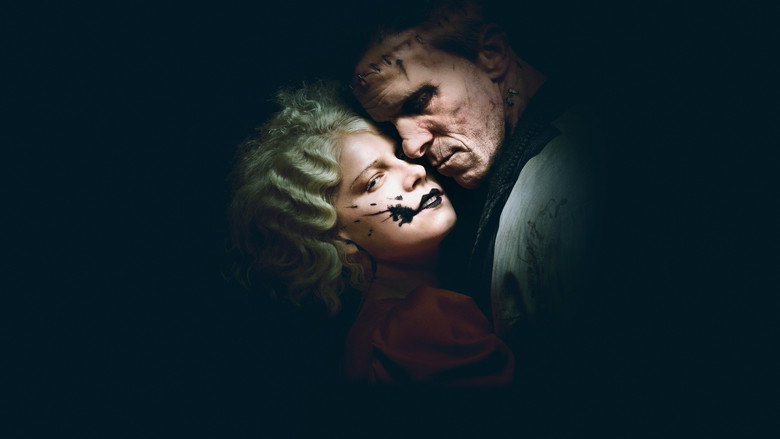
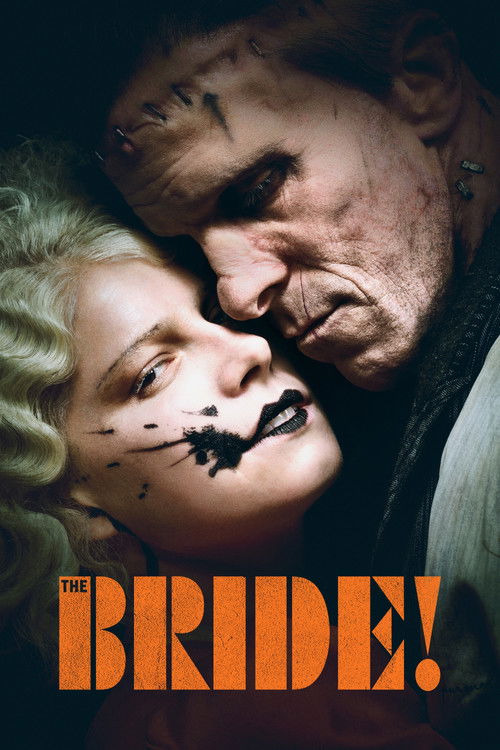
Symbolizes both the mark of Mary Shelley’s authorial ink and the stain of violence that society imprints upon marginalized women.

Context:

Featured prominently as the Bride’s signature aesthetic, showcasing black-stained lips and tongue paired with a dark inkblot on her cheek.

Electricity and Power Grid Diversion

Meaning:

Represents raw, uncaged life force and a disruption of the mechanical order to ignite divine defiance.

Context:

Utilized when rerouting municipal power to shock corpses back into vitality in Dr. Euphronius' laboratory.

The Matinee Idol (Ronnie Reed)

Meaning:

Symbolizes superficial mid-century escapism and the unattainable fantasy of polished social perfection.

Context:

Appears through Jake Gyllenhaal’s Hollywood song-and-dance persona, starkly juxtaposed against Frank’s raw physical deformity.

The Re-stitched Flesh / Scars

Meaning:

Visual testaments to trauma, memory loss, and the piecemeal reconstruction of identity after surviving social or physical annihilation.

Context:

Displayed across Frank and the Bride's bodies throughout their resurrection and journey.

The Operating Table

Meaning:

Represents cold technological commodification that transforms into an altar of rebirth and reinvention.

Context:

Serves as both the initial site of inception and the stage for the climactic laboratory finale.

Memorable Quotes

What do you want with a dead girl?
— Ida / The Bride (Jessie Buckley)

Context

Spoken as she confronts those who seek to manipulate and claim ownership over her body.

Meaning

Directly addresses and challenges the underlying necro-patriarchy of the Frankenstein mythos.

I'd prefer not to.
— The Bride (Jessie Buckley)

Context

Used repeatedly by the Bride throughout the film as an act of defiance against commands and proposals.

Meaning

A literary nod to Herman Melville's Bartleby, the Scrivener, serving as an uncompromising refusal to comply with domestic, social, and matrimonial expectations.

All 3 quotes

Philosophical Questions

Who owns the resurrected self?

Explored through the Bride's awakening with amnesia, questioning whether a reassembled life belongs to the creators who engineered the body or exclusively to the newly ignited consciousness asserting its will.

Can love exist without possession?

Examined through Frank's desire for a mate, questioning whether genuine connection can transcend the inherently non-consensual act of having someone resurrected to cure one's own loneliness.

Is rage a valid form of creative rebirth?

Demonstrated by the Bride's rejection of passive beauty and domestic compliance, framing destructive fury as an essential catalyst for self-determination and identity formation.

Alternative Interpretations

The film invites several alternative readings:

Full ending explanation

Cultural Impact

Released during a renewed cultural interest in the Frankenstein mythos, The Bride! deliberately subverts romanticized gothic horror by injecting feminist counterculture and 1930s pulp noir aesthetics.

Premiering in London on February 26, 2026, and opening globally on March 6, 2026, the film generated polarized discussions among critics and audiences, earning praise for its fearless lead performances and visual audacity while drawing debate over its narrative density. Despite commercial struggles at the box office (grossing approximately $23–24 million against an $80–90 million budget), it is positioned as an uncompromising studio swing destined to cultivate a passionate cult following.

Audience Reception

The Bride! received sharply polarized, mixed critical reviews (holding around 61% on Rotten Tomatoes and 55 on Metacritic). Critics and audiences widely celebrated the unhinged, volcanic performances of Jessie Buckley and Christian Bale, the striking maximalist cinematography, and Hildur Guðnadóttir's electrifying score. Conversely, common criticisms centered on convoluted tonal shifts, an overstuffed script, and disorienting pacing, making it one of the most divisive and daring auteur swings of 2026.

Interesting Facts

  • The project was originally in development at Netflix before moving to Warner Bros. Pictures, where it received a budget between $80 million and $90 million along with a full global theatrical and IMAX release.
  • Jessie Buckley performs a dual role as both author Mary Shelley in monochrome afterlife sequences and the resurrected 1930s mob moll Ida / The Bride.
  • The dual casting of Jessie Buckley pays homage to James Whale’s 1935 Bride of Frankenstein, where Elsa Lanchester portrayed both Mary Shelley in the prologue and the Monster’s Mate.
  • Director Maggie Gyllenhaal assembled key craft talent including cinematographer Lawrence Sher, editor Dylan Tichenor, costume designer Sandy Powell, and Oscar-winning composer Hildur Guðnadóttir.
  • The film marks a rare major creative collaboration between director Maggie Gyllenhaal and her brother Jake Gyllenhaal, who plays fictional 1930s cinema star Ronnie Reed.
  • Maggie Gyllenhaal directed her real-life husband, Peter Sarsgaard, continuing their creative partnership following The Lost Daughter.

Easter Eggs

Elsa Lanchester’s Silhouette and Hiss

The Bride’s hair, movements, and unearthly vocal screams pay homage to Elsa Lanchester's iconic 1935 performance in Bride of Frankenstein, updated with punk energy and smeared dark lipstick.

Herman Melville's Bartleby

The recurring line "I'd prefer not to" is a direct quotation of Bartleby the scrivener’s passive resistance, refashioned into a feminist slogan of absolute refusal.

Bonnie and Clyde Parallels

The middle act’s violent, headline-making crime rampage directly riffs on Arthur Penn's 1967 film Bonnie and Clyde and historical 1930s outlaw couples.

1930s Cinema Glamour (Busby Berkeley / Astaire)

Jake Gyllenhaal’s Ronnie Reed character references classic Hollywood musical star tropes, highlighting the era's escapist culture amid economic devastation.

Frequently Asked Questions

Explore More About This Movie

Dive deeper into specific aspects of the movie with our detailed analysis pages

Comments (0)

Leave a comment

No comments yet. Be the first to share your thoughts!

Similar Movies