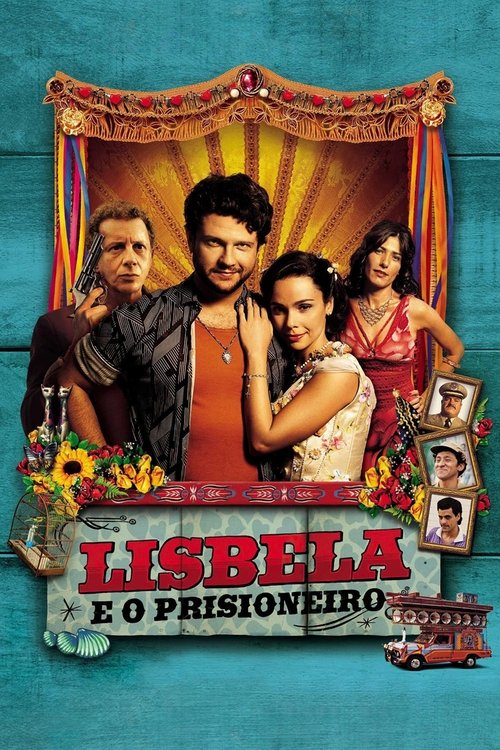
Lisbela and the Prisoner
Lisbela e o Prisioneiro
Overview
"Lisbela and the Prisoner" (Lisbela e o Prisioneiro) tells the story of Leléu (Selton Mello), a charming, fast-talking traveling performer, and Lisbela (Débora Falabella), a young woman obsessed with American movies who is engaged to be married. When Leléu's travels bring him to Lisbela's small town in Pernambuco, their immediate and intense attraction disrupts her carefully planned life. Their budding romance is complicated by several larger-than-life characters typical of the Brazilian northeastern landscape.
Among them are Frederico Evandro (Marco Nanini), a fearsome hitman hunting Leléu for having an affair with his seductive wife, Inaura (Virginia Cavendish). Adding to the pressure is Lisbela's strict father, Tenente Guedes (André Mattos), the local chief of police, and her fiancé, Douglas (Bruno Garcia), who affects a sophisticated urban accent. As their worlds collide, Lisbela and Leléu must navigate family pressure, societal expectations, and their own doubts, leading to a climactic and humorous finale where they must choose their destinies.
Core Meaning
The core meaning of "Lisbela and the Prisoner" is a celebration of the clash between fantasy and reality, and the courage to pursue a love that defies convention. Director Guel Arraes uses the story to explore the idea that life can imitate art, drawing parallels between the characters' dramatic lives and the Hollywood films Lisbela adores. The film posits that true happiness lies not in following a predetermined script but in embracing passion and adventure, even when it's dangerous. It's a deeply meta-narrative film where the characters are aware of the clichés and tropes of romantic stories, and they play with them, ultimately suggesting that love is the greatest adventure of all, worth any risk.
Thematic DNA
The Blurring of Art and Life
This is the film's central theme. Lisbela interprets her own life through the lens of the American movies she loves. She understands plot, character archetypes, and narrative conventions, often predicting what will happen in her own romance with Leléu as if it were a screenplay. The film constantly plays with this idea, culminating in a final confrontation that is deliberately staged like a movie scene, suggesting that life and cinema are intertwined expressions of human desire and storytelling.
Love vs. Convention
Lisbela is bound by an engagement that represents social stability and parental approval. Her love for Leléu is a rebellion against this convention. The film champions the idea of following one's heart, portraying their passionate, unpredictable romance as more authentic and fulfilling than the safe, arranged marriage. Lisbela's ultimate choice to abandon her wedding for a life of uncertainty with Leléu is the ultimate expression of this theme.
Celebration of Northeastern Brazilian Culture
The film is deeply rooted in the culture of Pernambuco, in the Northeast of Brazil. It features regional character archetypes like the "matador" (hired killer), the "malandro" (a charming rogue), and the stern police chief. Director Guel Arraes is known for highlighting popular elements of this culture, from its specific humor and dialect to its vibrant visual aesthetics, presenting it with both affection and a touch of caricature.
Freedom and Imprisonment
The title itself points to this theme. Leléu is literally a prisoner at times, but he is spiritually free and adventurous. Lisbela, on the other hand, is free physically but imprisoned by her engagement and societal expectations. Their love becomes a quest for mutual liberation—he frees her from a dull, prescribed future, and she offers him a reason to stop running and commit to a single great love.
Character Analysis
Leléu
Selton Mello
Motivation
Initially, his motivation is survival—escaping the vengeful Frederico Evandro—and seduction. This shifts to a genuine, all-consuming desire to win Lisbela's love and build a life with her, even if it means confronting the dangers he's been running from.
Character Arc
Leléu begins as a nomadic womanizer, always on the run and never emotionally attached. His primary goal is survival and pleasure. Upon meeting Lisbela, he is confronted with a love so profound that it challenges his transient nature. He evolves from a man who runs from all commitments to one willing to risk his life to be with one person, finding a deeper sense of freedom in devotion rather than in escape.
Lisbela
Débora Falabella
Motivation
Her motivation is to experience a love as epic and passionate as the ones she sees on screen. She is driven by the belief that her life can be more than what is planned for her, seeking a connection that is authentic and thrilling.
Character Arc
Lisbela starts as a dutiful daughter engaged to a respectable man, living vicariously through the movies she watches. Her world is one of fantasy and prescribed reality. Her encounter with Leléu awakens her own desire for a grand, cinematic love. She transforms from a passive dreamer into the active hero of her own story, bravely defying her family and society to seize the adventurous life she's always dreamed of.
Frederico Evandro
Marco Nanini
Motivation
His motivation is vengeance and honor. He is driven by the need to punish Leléu for sleeping with his wife, Inaura. He is a force of consequence, representing the past that Leléu cannot escape.
Character Arc
Frederico Evandro is a relatively static character who serves as the primary obstacle. He is a feared hitman whose reputation precedes him. While he doesn't undergo a significant personal transformation, the plot reveals a humorous and ironic complexity to his character, particularly in the climax where his code of honor and his professional duties collide in a farcical manner.
Inaura
Virginia Cavendish
Motivation
Her motivation is passion and self-interest. She seeks pleasure and excitement with Leléu and is not afraid to manipulate situations to her advantage, even with the risk of her husband's wrath.
Character Arc
Inaura is a seductive and manipulative woman who is unfaithful to her dangerous husband. She acts as a catalyst for the central conflict. Her arc involves her attempts to continue her affair with Leléu, but she ultimately loses him to Lisbela. She represents a purely physical, transactional kind of relationship, which Leléu ultimately rejects in favor of Lisbela's romantic, soulful love.
Symbols & Motifs
The Cinema
The cinema symbolizes the world of fantasy, dreams, and ideal love. It is Lisbela's escape from her mundane reality and the framework through which she understands her own epic romance. It represents the power of stories to shape our expectations and desires.
The film opens with Lisbela in a movie theater, explaining the conventions of a romantic comedy, which directly mirrors the plot of the film she is in. Her conversations with Leléu are often peppered with references to movie heroes and plot twists, showing how she superimposes cinematic narratives onto her own life.
The Traveling Circus/Show
Leléu's life as a traveling showman symbolizes freedom, improvisation, and a life outside of societal norms. It is a world of illusion and performance, mirroring Leléu's own persona as a charming trickster who is constantly playing a role.
Leléu is introduced as he arrives in town with his traveling show, selling miracle cures and putting on performances. This lifestyle is what allows him to move from place to place, escaping his past and encountering new adventures like meeting Lisbela.
Frederico Evandro's Gun
The ever-present threat of Frederico Evandro and his gun symbolizes fate, consequence, and the inescapable dangers of a passionate life. It is the real-world peril that constantly threatens to puncture the romantic fantasy that Lisbela and Leléu are building.
Frederico Evandro hunts Leléu throughout the film due to Leléu's affair with his wife. The threat of violence is always lurking, creating suspense and raising the stakes of the central romance. The final confrontation revolves around this weapon and the mortal danger it represents.
Memorable Quotes
A graça não é saber o que acontece. É saber como acontece e quando acontece.
— Lisbela
Context:
Lisbela says this in the cinema while explaining the predictable plot of a romantic film to her fiancé. She is essentially laying out the narrative contract of her own story, telling the audience to enjoy the ride rather than just wait for the ending they already know is coming.
Meaning:
Translated as "The fun isn't knowing what happens. It's knowing how and when it happens." This line encapsulates the film's core philosophy. It's a meta-commentary on storytelling itself, arguing that the journey, the style, and the emotional unfolding are more important than the predictable destination, applying equally to movies and to life.
A senhora não é noiva no coração. Só é noiva na mão e na palavra!
— Leléu
Context:
Leléu says this to Lisbela during a heartfelt, clandestine meeting as he tries to convince her that their connection is more real than her engagement. It's a pivotal moment in her decision-making process.
Meaning:
Translated as "You aren't a fiancée in your heart. Only on your hand and in your word!" This is Leléu's powerful appeal to Lisbela's true feelings, arguing that her emotional reality is more valid than her social commitments. It highlights the theme of love versus convention.
O amor me chamou pra um outro lado e eu fui atrás dele.
— Lisbela
Context:
This is part of Lisbela's explanation for her choice in the film's climax, asserting her agency and her commitment to the path of love, no matter how uncertain it may be.
Meaning:
Translated as "Love called me to another side, and I went after it." This line is Lisbela's declaration of independence and her ultimate justification for abandoning her wedding. It's a simple but profound statement about the irresistible power of true love.
Philosophical Questions
Are our lives pre-written scripts or can we improvise our own destiny?
The film explores this question through the contrast between Lisbela's engagement, which represents a pre-written, conventional life script, and her romance with Leléu, which is pure improvisation and adventure. Lisbela's fascination with predictable movie plots is ironic, as she ultimately chooses to abandon a predictable life for an unwritten one. The film suggests that while societal scripts exist, true fulfillment comes from breaking away and authoring one's own story.
What is the relationship between love and fantasy?
Lisbela's love for Leléu is born from her cinematic fantasies. She falls for him because he fits the archetype of the romantic hero she adores. The film questions whether this makes their love less authentic. It ultimately concludes that fantasy is not an escape from reality, but a vital lens through which we can shape it. The love between Lisbela and Leléu becomes real precisely because they are both willing to believe in and act out the grand, romantic story they've imagined for themselves.
Alternative Interpretations
While on the surface "Lisbela and the Prisoner" is a straightforward romantic comedy, it can also be interpreted as a deeper commentary on the nature of fiction itself. One interpretation is that the entire film is a story being willed into existence by Lisbela. Her deep understanding of narrative structure isn't just a character quirk; she is effectively the author of her own adventure. She predicts the arrival of a hero, the obstacles, and the romantic conclusion, and the film's universe complies. In this reading, Leléu isn't just a charming rogue; he is the embodiment of the cinematic hero she has been waiting for, and he must learn to play the part she has written for him.
Another perspective focuses on the film as a critique of simplistic genre definitions. By constantly having Lisbela point out the clichés of romantic comedies, the film both embraces and subverts them. It's a story that knows it's a story, and this self-awareness invites the audience to think about why these narrative formulas are so powerful and persistent in our culture. The ending, which is both a real escape and a staged performance for the town, can be seen as the ultimate statement that life doesn't just imitate art—it becomes indistinguishable from it when pursued with enough passion and flair.
Cultural Impact
Released in 2003, "Lisbela and the Prisoner" arrived during a period of revival for Brazilian cinema known as the "Retomada." The film was a huge box office success in Brazil, charming audiences with its blend of romantic comedy, regional flavor, and meta-cinematic cleverness. Critics praised it as a prime example of quality popular cinema, capable of competing with foreign blockbusters while remaining distinctly Brazilian.
The film helped solidify Guel Arraes' reputation as a director with a unique ability to translate the rich, theatrical traditions of Northeastern Brazil for a mainstream audience, following his success with "O Auto da Compadecida." It cemented Selton Mello's status as a leading man and furthered the careers of Débora Falabella and Bruno Garcia. Its witty, quotable dialogue and iconic soundtrack had a significant impact on pop culture, with songs like Caetano Veloso's version of "Você Não Me Ensinou a Te Esquecer" becoming inextricably linked to the film's romantic scenes. The movie's self-referential style, playfully acknowledging cinematic tropes, was also noted for its sophistication, making it a beloved classic that is both entertaining and intelligent.
Audience Reception
Audiences in Brazil overwhelmingly embraced "Lisbela and the Prisoner," making it one of the most popular domestic films of its year. Viewers praised its humor, charm, and the palpable chemistry between Selton Mello and Débora Falabella. The witty, fast-paced dialogue and the colorful cast of supporting characters were frequently cited as highlights. The film's celebration of Brazilian culture, particularly its affectionate portrayal of the Northeast, resonated strongly with the public. The soundtrack was also a major point of praise, with many considering it perfectly integrated with the story's emotional beats. Criticism was minimal but occasionally pointed to the film's reliance on familiar character archetypes and a plot that, by its own admission, is somewhat predictable. However, most viewers and critics agreed that this predictability was part of the film's meta-textual charm, making it a clever and heartwarming romantic comedy.
Interesting Facts
- The film is an adaptation of a 1964 play of the same name by acclaimed writer Osman Lins.
- This was director Guel Arraes' first feature film made specifically for cinema. His previous successful films, like "O Auto da Compadecida," were originally edited versions of TV miniseries.
- During production, a can containing original film negatives was lost, forcing the team to reshoot the scenes that were on it.
- The film's soundtrack was a massive commercial success in Brazil and is considered one of the best-selling Brazilian film soundtracks of all time, featuring artists like Caetano Veloso, Zé Ramalho, and Sepultura.
- Before becoming a film, Guel Arraes directed a successful stage version of the story that toured Brazil. Several actors from the play, like Virginia Cavendish and Bruno Garcia, were cast in the movie, though in different roles.
Easter Eggs
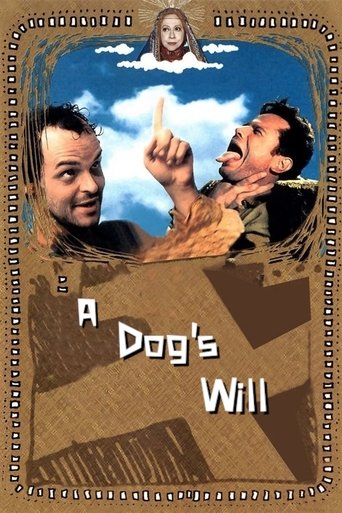
Many actors from Guel Arraes' previous hit, "O Auto da Compadecida" (A Dog's Will), appear in "Lisbela and the Prisoner."
Selton Mello, Virginia Cavendish, and Marco Nanini all had prominent roles in both films. This created a sense of a recurring troupe for audiences, connecting the two films thematically as celebrations of Northeastern Brazilian culture and humor. Nanini's hitman character, Frederico Evandro, is particularly reminiscent of his cangaceiro role in the previous film.
The film Leléu announces with his traveling show is "The Passion of Christ."
This is a direct reference to "O Auto da Compadecida," where Selton Mello's character, Chicó, makes a similar announcement for the same play. It's a clear nod to Arraes' earlier work.
The fictional band "Os Condenados" that performs in the film is fronted by Clarice Falcão.
Clarice Falcão, who later became a famous singer, comedian, and actress in her own right, is the daughter of João Falcão, the film's musical producer. This was one of her early public appearances.
⚠️ Spoiler Analysis
Click to reveal detailed analysis with spoilers
Frequently Asked Questions
Explore More About This Movie
Dive deeper into specific aspects of the movie with our detailed analysis pages
Comments (0)
No comments yet. Be the first to share your thoughts!