Full spoilers follow.
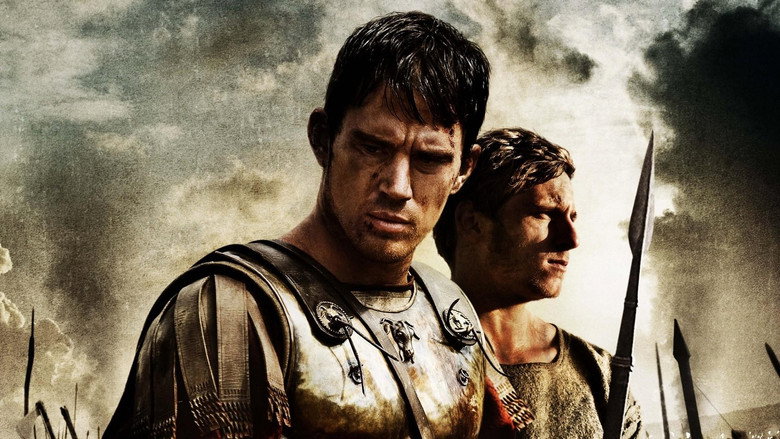
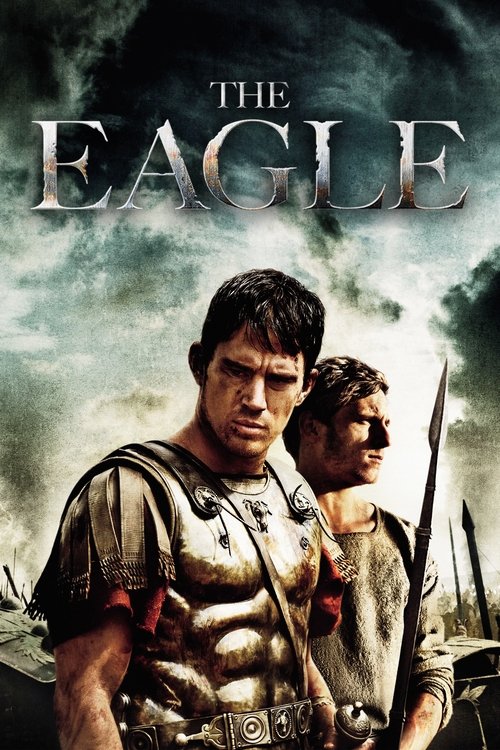
The setup: in 140 AD, twenty years after the Ninth Legion disappeared in the mountains of Caledonia under the command of Marcus's father, Marcus Flavius Aquila takes his first posting in Roman Britain, hoping to redeem the family name. He proves himself defending his garrison but is badly wounded and honorably discharged, which destroys the career through which he intended to earn that redemption. Convalescing at his uncle's villa, he spares the life of a British slave, Esca, in the arena, and Esca is given to him. When word reaches him that the Ninth's golden eagle standard has been seen in the far north, Marcus goes to get it, with Esca as his only companion.
The central inversion: beyond Hadrian's Wall, Roman authority is worthless and Marcus is entirely dependent on the man he owns. To survive among the tribes, the two must present Esca as the master and Marcus as his slave — a performance that the film deliberately keeps ambiguous. When they reach the Seal People, Esca is welcomed and Marcus is treated as property, and for a long stretch the audience is invited to believe Esca has genuinely betrayed him and gone over to his own kind. He has not: the deception is how he gets them both close to the eagle, which the Seal People hold as a trophy.
The father: before that, the pair encounter Guern, a survivor of the Ninth living in the north under an assumed identity. Through him Marcus learns what actually happened — not the noble last stand of his imagination, but a disastrous campaign, and a legion whose disintegration involved failure and desertion as much as heroism. This is the film's real destruction of the son's inherited myth: the object he is chasing turns out to commemorate something far messier than honor.
The climax: Marcus and Esca steal the eagle and flee, pursued relentlessly by the Seal People. Cornered, and with Marcus's leg failing him, they are saved when Guern and the other surviving legionaries of the Ninth reappear and stand with them — old men and deserters choosing, at last, to be soldiers again. Several die. The eagle is won at the cost of the very men whose disgrace it represents, which is the film's sharpest irony: the standard is only redeemed by people who had already given up on it.
The ending: Marcus and Esca deliver the eagle to Roman authority — Claudius Marcellus at the legion's headquarters — and the family honor is formally restored. Crucially, Esca stands beside Marcus not as a slave but as a free equal; the friendship, not the standard, is what the last scene actually certifies.
The alternate ending: filmed and included on the DVD and Blu-ray, this version has Marcus lay the recovered eagle on the funeral pyre of a fallen soldier of the Ninth, declaring that it now belongs to Britain, in homage to all who died on both sides. It is a completely different thesis — reconciliation and shared grief instead of restored Roman honor — and knowing it exists retroactively exposes the theatrical ending as a choice rather than an inevitability.