Skip to content
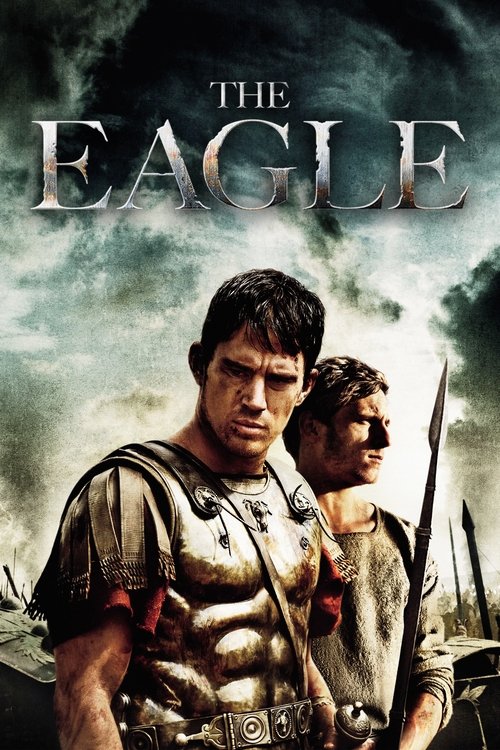
The Eagle
A muscular, mud-and-mist Roman adventure about honor carried like a wound: two men, master and slave, walking north past the last wall of the known world into a green silence that swallows empires.
The Eagle

The Eagle

"The destiny of a soldier. The honour of a slave. The fate of an empire."

08 February 2011 United States of America 114 min 6.2 (1,463)

Director: Kevin Macdonald

Cast: Channing Tatum, Mark Strong, Jamie Bell, Donald Sutherland, Denis O'Hare

Drama Adventure Honor and the inheritance of shame Slavery, ownership and the reversal of power The frontier and the limits of empire Fathers, sons and the unburied dead Loyalty across enmity
Budget: $25,000,000
Box Office: $27,122,040

Overview

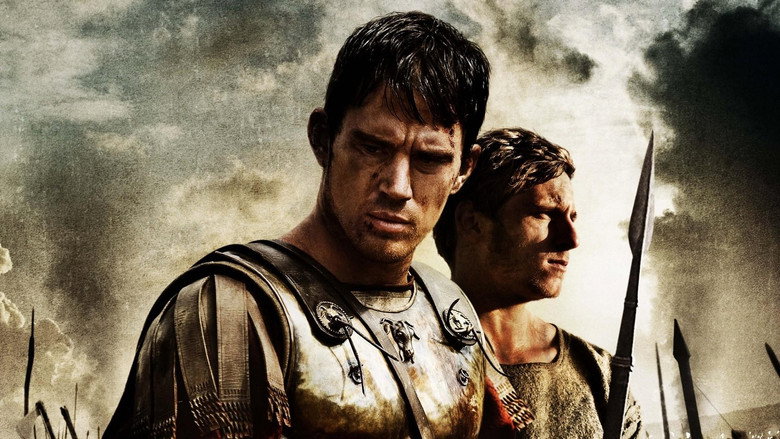
In 140 AD, twenty years after the Ninth Legion marched north of Hadrian's Wall and vanished without trace, a young centurion named Marcus Flavius Aquila arrives in Roman Britain to take his first command. He is the son of the Ninth's commander, and he carries the disgrace of that disappearance like an inherited debt — his family name shamed, his father's memory unburied, the legion's golden eagle standard lost somewhere in the mountains of Caledonia.

When injury and honorable discharge strip Marcus of the career that was supposed to redeem him, he seizes on a rumor: the eagle has been seen in the far north. Against every warning, he sets out beyond the Wall accompanied only by Esca, a British slave whose life he spared in the arena and whose people were destroyed by Rome. Two men, no army, no map worth the name, and a landscape that Rome has never managed to hold.

Directed by Kevin Macdonald from Jeremy Brock's adaptation of Rosemary Sutcliff's 1954 novel The Eagle of the Ninth, the film is less a battle epic than a hard, muddy road movie — a survival story in which the balance of power between master and slave quietly inverts the moment they cross the frontier, and in which the thing being hunted may be worth less than what the hunt costs.

Core Meaning

At its heart, The Eagle asks what a symbol is actually worth, and who gets to decide. Marcus begins believing that the eagle standard is honor — that a piece of gilded metal can restore a dead man's name and a living man's worth. The journey north systematically dismantles that faith by forcing him to see Rome from the outside: as an occupying power, through the eyes of the people it enslaved, in the wreckage of the men it abandoned.

Macdonald's film is unusually earnest about honor in a cynical era — it takes seriously the idea that a man might value his father's name above his own comfort or even his freedom. But it complicates that earnestness by giving equal weight to Esca, whose honor is owed to a different flag entirely. The film's real argument is that loyalty between two men can outlast the abstractions that put them on opposite sides. The empire is a machine; the bond forged in the mud north of the Wall is the only thing in the story that behaves like a virtue rather than a slogan.

The message, finally, is about inheritance: you do not choose the debts you are born into, but you do choose whether to keep paying them in the currency your fathers used.

Thematic DNA

Honor and the inheritance of shame 30%
Slavery, ownership and the reversal of power 25%
The frontier and the limits of empire 20%
Fathers, sons and the unburied dead 15%
Loyalty across enmity 10%

Honor and the inheritance of shame

Marcus's entire motivation is a wound he did not inflict: his father lost the Ninth, and the son inherits the dishonor. The film literalizes this — Marcus's first command, his injury, his discharge, and finally his suicidal trek north are all attempts to pay off a debt of reputation. Critics noted the film's almost old-fashioned insistence that honor may matter more than freedom or safety, a conviction that feels closer to Sutcliff's 1954 novel than to modern cinema.

Slavery, ownership and the reversal of power

Marcus is a relatively benevolent master, but benevolence is not justice — he sees nothing wrong with owning Esca until the journey strips him of that privilege. North of the Wall the roles must be performed in reverse, with Esca presenting himself as the master and Marcus as the slave, and the performance becomes uncomfortably real. Only after experiencing powerlessness himself does Marcus stop seeing Esca as a possession and start seeing him as a man.

The frontier and the limits of empire

Hadrian's Wall is the film's governing image: an empire that could conquer the world admitting, in stone, that here it stops. Everything beyond is unmapped, unowned, and hostile. Rome's disappearance of an entire legion into that emptiness is the ultimate rebuke to imperial self-confidence, and the film keeps insisting that from the other side of the Wall, Rome looks like an invader rather than a civilization.

Fathers, sons and the unburied dead

Marcus is chasing a ghost as much as an object. The mystery of the Ninth is inseparable from the mystery of his father, and the survivors he meets in the north force him to replace a heroic fantasy with a harder truth. The eagle functions as a substitute corpse — the funeral he was never allowed to hold.

Loyalty across enmity

Esca owes Marcus his life and swears loyalty; Marcus owes Esca nothing and gradually owes him everything. Esca serves as the constant foil to Marcus's unquestioning patriotism, and the film's suspense rests entirely on whether personal obligation can survive collective hatred once the two men are among Esca's own kind.

Character Analysis

Marcus Flavius Aquila

Channing Tatum

Archetype: The dutiful hero / son on a quest of restoration Key Trait: Unyielding, almost self-destructive sense of duty

Motivation

To recover the eagle of the Ninth and with it his father's name and his family's honor — a debt of shame he inherited rather than earned.

Character Arc

Begins as a rigidly correct young centurion who believes Rome's version of everything, including his own worth. Injury and discharge take away his path to redemption; the journey north takes away his power, his certainty, and eventually his illusions about his father and his empire. He ends having learned that the man beside him matters more than the emblem he came for.

Esca

Jamie Bell

Archetype: The reluctant companion / trickster-foil Key Trait: Watchful, contained, quietly subversive

Motivation

Honoring a life-debt he never asked for, while remaining loyal to his own dead people and his own idea of freedom.

Character Arc

A Brigantian whose family was destroyed by Rome, saved from death in the arena by Marcus and bound to him as a slave. He moves from sullen obligation, through the dangerous ambiguity of the reversed roles beyond the Wall, to a chosen loyalty — and the film's central tension is that we can never be sure, until late, which way he will fall.

All 5 characters and cast

Symbols & Motifs

The golden eagle standard

Meaning:

Rome's most sacred emblem of honor — and, in the film's skeptical reading, an idol. It stands simultaneously for legitimate memory of the dead and for the vanity of empire, a lump of gilt metal that men will kill and die for because of what has been agreed it means.

Context:

Lost with the Ninth, kept as a trophy by the Seal People, retrieved at enormous cost, and finally presented to Rome. The theatrical ending returns it to Roman authority; the filmed alternate ending has Marcus place it on a fallen legionary's funeral pyre and declare it belongs to Britain, which completely rewrites what the object symbolizes.

Hadrian's Wall

Meaning:

The boundary between the known and the unknown, order and chaos, master and slave. Crossing it inverts every social rule the film has established.

Context:

Marcus and Esca ride through it into an unmapped Caledonia; the film's tonal register changes the moment they pass, from Roman procedural to survival wilderness.

The Seal People and their seal-skin regalia

Meaning:

The wild, unassimilable north made flesh. Their name evokes the Scottish folkloric selkie — a shape-shifter who wears a skin to move between worlds — making them the mirror image of Marcus and Esca, who must also change skins to survive.

Context:

The fictional west-coast tribe who hold the eagle, presented as the most fearsome of the northern peoples, painted and skin-clad, keepers of the trophy.

Marcus's damaged leg

Meaning:

The body as ruined career. His wound is heroism's receipt: it wins him an honorable discharge and simultaneously destroys the only path by which he could have restored his name legitimately.

Context:

Sustained defending his garrison, it forces his medical discharge and recuperation at his uncle's villa, which is precisely what frees — and compels — him to attempt the journey north.

The master/slave role reversal

Meaning:

A performance that exposes identity as circumstance. Rank, in this film, is not essence but geography.

Context:

Beyond the Wall, Esca must speak for both of them and treat Marcus as property, and the audience is left uncertain — as Marcus is — how much of the performance is pretense.

Mud, water and the northern landscape

Meaning:

Erasure. The land does not resist Rome so much as absorb it; an entire legion simply dissolves into it.

Context:

Anthony Dod Mantle's autumnal Scottish exteriors — bog, river, rain, stone — dominate the second half, shot deliberately in October for that dying-year palette.

Philosophical Questions

Can honor be inherited — and can shame?

Marcus has done nothing wrong, yet lives as though convicted. The film never questions that the debt is real; it only questions the price. By making his father's failure into his own life's project, it asks whether a name is a possession we hold in trust for the dead or a prison built by them.

Is a symbol worth a life?

The eagle is gilded metal. Men die for it in both directions — Romans to keep it, the Seal People to hold it. The film puts the object at the center of every act and then, in its alternate ending, has its hero burn it, which is the sharpest possible statement of the question.

What is freedom worth compared to loyalty?

Esca is offered, repeatedly and in different forms, the chance to walk away free. The story's suspense is built entirely on whether obligation freely accepted can outweigh liberation, and the film's answer — that it can — is its most unfashionable claim.

Can a relationship built on ownership become a genuine friendship?

Marcus is a decent master, which the film treats as insufficient rather than exculpatory. Only when the power relation is inverted beyond the Wall does anything like equality become possible, suggesting friendship requires not kindness from the powerful but the removal of power itself.

How does an empire look from the outside?

Everything Marcus believes about Rome — order, civilization, legitimacy — is true within the Wall and meaningless beyond it. The journey north is essentially an exercise in forced perspective-taking, in which the protagonist is made to occupy the position his own society has assigned to others.

Alternative Interpretations

The patriotic reading. Taken straight, the film is exactly what its theatrical ending says it is: a young man restores his father's honor, the eagle returns to Rome, and duty is vindicated. This is closest to Sutcliff's spirit and to the film's own sincere, unironic treatment of honor as a value that outranks freedom.

Full ending explanation

Cultural Impact

The Eagle arrived in 2011 at the tail end of the post-Gladiator sword-and-sandal revival, and in the same short window as several other films riffing on the legend of the lost Ninth Legion — a legend that owes far more to Rosemary Sutcliff's beloved 1954 novel than to the documentary record. Sutcliff's book is a cornerstone of British children's literature, and much of the film's cultural weight comes from that source: a story generations of British readers grew up with, translated into a Hollywood-financed, American-fronted vehicle.

Its most interesting cultural gesture is its casting logic. By making Rome American and the northern tribes British, the film invites an obvious post-Iraq reading: a technologically superior empire that cannot hold territory beyond a line on a map, whose soldiers cannot tell friend from enemy, and whose most sacred symbols are worth nothing to the people they occupy. Critics at the time repeatedly picked up on that resonance, even where they found the execution flat.

Commercially and critically it was a modest disappointment — around $39 million against a $25 million budget, 39% on Rotten Tomatoes and 55 on Metacritic — and it has often been cited since as a marker of the moment the ancient-world epic ran out of momentum. Its afterlife has been kinder: a strong resurgence on Netflix years later prompted renewed argument that the genre deserves revival, and its comparatively careful attention to Roman military detail has earned it praise from historians who are usually hostile to the form.

Audience Reception

Overall verdict: mixed and mildly disappointed at release, warmer in retrospect. The film holds roughly 39% on Rotten Tomatoes, 55 on Metacritic and about 6.2/10 on IMDb, with the critical consensus summarizing the split neatly: a pleasantly traditional action-adventure appeal undercut by stolid direction and an uninspired lead performance.

What was praised: the production design and unusually convincing period detail — one historian has since given it near-perfect marks for accuracy, which is rare for the genre; Anthony Dod Mantle's photography of the Scottish landscape; Jamie Bell's performance as Esca, widely regarded as the film's strongest element; the grubby, unglamorous, non-CGI feel of the combat; and the earnest, old-fashioned sincerity of its treatment of honor.

Main criticisms: Channing Tatum's central performance drew the heaviest fire, with one reviewer memorably complaining of a leading man who emotes less than a marble bust. Viewers also flagged the predictability of the master-and-slave friendship arc, a slack middle stretch, and visible mismatches between the Hungarian and Scottish locations standing in for one country.

Contested points: the American-accented Romans divided audiences sharply — read as a clever anti-imperial choice by some and as distracting miscasting by others. The theatrical ending's return of the eagle to Rome remains the film's most argued-over decision, especially among viewers who have seen the alternate ending on the disc. Its later success on Netflix has driven a real reappraisal, with commentators arguing it deserved better and that the genre it belongs to is due for revival.

Interesting Facts

  • The film adapts Rosemary Sutcliff's classic 1954 children's historical novel The Eagle of the Ninth, with a screenplay by Jeremy Brock, who had previously written The Last King of Scotland for director Kevin Macdonald.
  • Principal photography began on 24 August 2009 in Hungary, where the countryside around Budapest doubled for Roman Britain south of Hadrian's Wall.
  • Everything set north of Hadrian's Wall was shot on location in Scotland; the production deliberately filmed the Hungarian material first in late summer and moved to Scotland in October to capture the autumnal look wanted for the highland sequences.
  • Cinematography is by Anthony Dod Mantle, who shot Macdonald's The Last King of Scotland and won an Academy Award for Slumdog Millionaire.
  • In a deliberate reversal of Hollywood convention, the Romans are played largely by American actors and Rome's adversaries by British actors — meaning British performers including Mark Strong, Paul Ritter and Pip Carter adopted American accents to play Romans.
  • The Seal People are a fictional west-coast Caledonian tribe invented for the story rather than a documented historical people.
  • An alternate ending was filmed and released as a special feature on the DVD and Blu-ray, in which Marcus places the recovered eagle on a fallen legionary's funeral pyre and declares that it belongs to Britain.
  • The film was made for a budget of roughly $25 million and grossed about $39 million worldwide.
  • Reception was mixed-to-negative on release: roughly 39% on Rotten Tomatoes, a Metacritic score of 55, and about 6.2/10 on IMDb, with the site consensus praising its traditional adventure appeal while faulting Macdonald's stolid direction and Tatum's central performance.
  • Despite the lukewarm reviews, the film found a large second life on Netflix years later, prompting commentary that it made a case for reviving the Roman/ancient-world adventure genre — and at least one historian has praised it for unusually high accuracy in its depiction of the period.

Easter Eggs

The name "Seal People"

The tribe's name evokes the selkie of Scottish and Northern Isles folklore — a shape-shifting being that wears a skin in human form and lives beside the water. It quietly folds native mythology into a fictional tribe and rhymes with the film's own theme of men changing skins to survive.

Americans as Romans, Britons as the tribes

An in-joke and a thesis at once: instead of the traditional cut-glass British accent for Rome, the empire sounds American and the resistance sounds British. It flips a decades-old peplum convention and invites a reading of Rome as a contemporary superpower on an unwinnable frontier.

The alternate ending on the home-video release

The disc's alternate finale — the eagle burned on a British funeral pyre "for Britain" — is effectively a second, more reconciliatory version of the film's meaning, and fans treat it as the truer ending to the story Macdonald was telling.

Kevin Macdonald and Jeremy Brock's Scottish reunion

Director and screenwriter had collaborated on The Last King of Scotland, and Macdonald returns here with cinematographer Anthony Dod Mantle to shoot the Scottish landscape again — this time as prehistory rather than history.

Frequently Asked Questions

Explore More About This Movie

Dive deeper into specific aspects of the movie with our detailed analysis pages

Comments (0)

Leave a comment

No comments yet. Be the first to share your thoughts!

Similar Movies