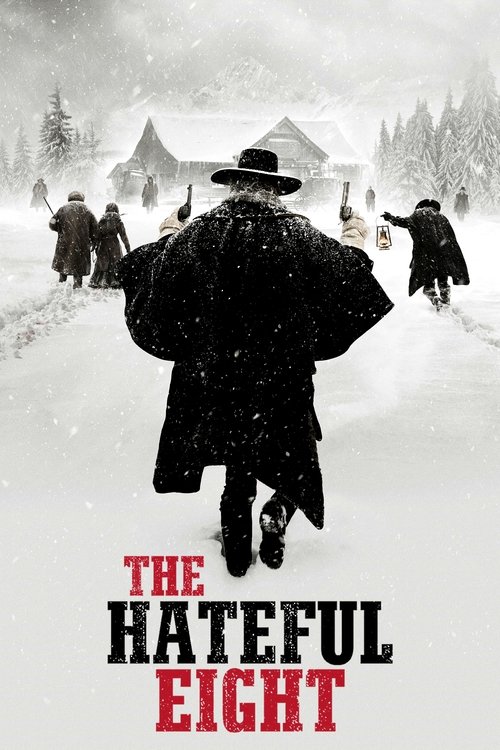
The Hateful Eight
"No one comes up here without a damn good reason."
Overview
In post-Civil War Wyoming, a stagecoach hurtles through a wintry landscape, carrying bounty hunter John Ruth and his fugitive prisoner, Daisy Domergue, towards the town of Red Rock. Along the way, they encounter two strangers: Major Marquis Warren, a former Union soldier turned bounty hunter, and Chris Mannix, a Southern renegade claiming to be the town's new sheriff. With a blizzard nipping at their heels, the group seeks refuge at Minnie's Haberdashery, a stagecoach stopover.
Upon arrival, they find the owners missing and the lodge occupied by four unfamiliar faces: a Mexican caretaker, a British hangman, a quiet cowboy, and an aging Confederate general. As the storm rages outside, trapping them together, the volatile mix of personalities and hidden agendas ignites. Suspicion mounts as Ruth realizes that one of these strangers is likely working with Daisy to free her, turning the shelter into a pressure cooker of lies, betrayal, and impending violence.

Core Meaning
The Hateful Eight serves as a cynical allegory for the unresolved racial and political tensions of post-Civil War America, mirroring modern societal fractures. Tarantino uses the confined setting to explore the impossibility of true reconciliation when history is built on lies and bloodshed.
Ultimately, the film deconstructs the myth of American justice, suggesting that 'civilized' law is merely a performance, and that beneath the surface, the nation remains trapped in a cycle of hateful tribalism where the only common ground between enemies is mutual violence.
Thematic DNA
Racism and the Civil War Legacy
The film posits that the Civil War never truly ended for its characters. The tension between Major Warren and General Smithers, as well as Chris Mannix, drives the conflict, illustrating how deep-seated racial hatred and historical grievances poison the present. The divide is not just North vs. South, but a permanent scar on the American psyche.
Truth vs. Deception
Almost every character is playing a role or hiding a secret. From the fake Lincoln Letter to the true identities of the passengers, the film examines the power of lies to command respect or manipulate outcomes. The central mystery forces the audience to question the authenticity of every narrative presented.
Justice vs. Frontier Justice
John Ruth represents 'civilized' justice, insisting on hanging Daisy legally rather than killing her instantly. The film contrasts this with 'frontier justice'—immediate, emotional, and often brutal. Tarantino questions whether the legal ritual of hanging is any more moral than shooting someone in cold blood.
Paranoia and Isolation
Heavily influenced by The Thing, the theme of paranoia is central. The blizzard isolates the characters, stripping away societal norms and forcing them into a survivalist pressure cooker where trust is fatal and everyone is a potential enemy.
Character Analysis
Major Marquis Warren
Samuel L. Jackson
Motivation
Survival and revenge against Confederates; proving his dominance in a white world.
Character Arc
A Union veteran and bounty hunter who survives by exploiting white guilt and fear. He transitions from a solitary operator to an uneasy ally with his arch-enemy Mannix. He is the sharpest mind in the room, unraveling the mystery before succumbing to his wounds.
John Ruth
Kurt Russell
Motivation
To see Daisy Domergue hang legally; to uphold his code of justice.
Character Arc
Known as 'The Hangman', he is obsessed with the procedural correctness of the law. His arc is one of tragic naivety; his belief in 'civilized' justice and the Lincoln Letter blinds him to the treachery around him, leading to his betrayal and death.
Daisy Domergue
Jennifer Jason Leigh
Motivation
To escape execution and signal her gang to kill her captors.
Character Arc
Initially a battered captive, she is revealed to be the mastermind's sister and a feral force of nature. She endures brutal physical abuse while silently calculating her escape, ultimately becoming the final focal point of the men's shared hatred.
Chris Mannix
Walton Goggins
Motivation
To survive and establish his authority as the new Sheriff of Red Rock.
Character Arc
A racist Lost-Causer who starts as Warren's antagonist but becomes his only ally. His arc validates his claim of being Sheriff as he chooses to uphold the law (hanging Daisy) over tribal loyalty (making a deal with her).
Symbols & Motifs
The Lincoln Letter
It symbolizes the false promise of black acceptance in white America. It is a shield Warren uses to gain status and safety ('armor'), but it is ultimately a forgery—a lie necessary for survival in a racist society.
Warren carries a letter he claims was written to him by Abraham Lincoln. It earns him John Ruth's respect, but is later revealed to be fake, shattering Ruth's trust and highlighting the tragic necessity of the deception.
The Broken Door
Represents the fragile barrier between civilization (the interior) and the savage chaos of nature (the blizzard). The need to constantly 'nail it shut' symbolizes the effort required to maintain social order against external and internal entropy.
Every character entering the Haberdashery must kick the door open and nail it shut, a ritual that emphasizes the hostility of the environment and the trapped nature of the characters.
The Poisoned Coffee
A subversion of the Western trope of hospitality. It turns a communal act of sharing warmth into a silent, cowardly weapon of death, signaling that the rules of honor have been completely abandoned.
While Warren is distracted confronting the General, a member of the gang poisons the coffee pot, leading to the gruesome deaths of John Ruth and O.B.
The Blizzard
Symbolizes the indifferent, hellish force of nature that traps the characters in their own purgatory. It washes away the outside world, leaving only the 'hate' inside to consume them.
The storm rages throughout the film, preventing escape and visually enforcing the white/cold aesthetic that contrasts with the blood/warmth inside.
Memorable Quotes
The only time black folks are safe, is when white folks is disarmed.
— Major Marquis Warren
Context:
Warren explains to Mannix why he forged the letter, stripping away the illusion of friendship he had with John Ruth.
Meaning:
Explains the necessity of the fake Lincoln Letter. It encapsulates the film's commentary on the precarious existence of black Americans in a hostile society.
You only need to hang mean bastards, but mean bastards you need to hang.
— John Ruth
Context:
Ruth explaining his philosophy on why he brings bounties in alive, unlike Warren.
Meaning:
Defines Ruth's moral code. He distinguishes between killing for money and the ritual of justice, a distinction the film constantly tests.
When the handbill says 'dead or alive', the rest of us just shoot you in the back from up on top a perch somewhere... and bring you in dead over a saddle. But when John Ruth the Hangman catches you... you hang!
— Major Marquis Warren
Context:
Warren describing Ruth's unique method to the other passengers in the stagecoach.
Meaning:
Establishes John Ruth's reputation and the central theme of the performative nature of 'civilized' justice versus efficient killing.
Whatever you do, don't sell that diamond ring to some injun, cause he's just gonna get drunk and lose it.
— Sheriff Chris Mannix
Context:
Mannix making a racist remark that inadvertently signals he might be telling the truth about being Sheriff (or just a good liar).
Meaning:
A darkly comedic line that seemingly reveals a plot hole (how did he know about the ring?) but actually hints at his perceptive nature or racist assumptions, typical of the film's dialogue style.
Philosophical Questions
Is there a moral difference between 'legal' hanging and murder?
The film juxtaposes John Ruth's insistence on a legal hanging with Warren's preference for summary execution. By the end, the 'legal' hanging of Daisy is an act of gruesome vengeance, blurring the line and asking if the law is just a civilized mask for bloodlust.
Can a nation built on lies and hate ever be unified?
The tenuous alliance between Warren (North/Black) and Mannix (South/White) is formed only through mutual violence and a shared lie (the Lincoln Letter). This suggests that unity in America is fragile, cynical, and perhaps only possible in the face of death.
Alternative Interpretations
The Purgatory Theory: Some critics interpret Minnie's Haberdashery as a literal Purgatory or Hell. The characters are dead souls trapped in a loop of violence, judged for their sins. The 'coachman' O.B. could be seen as Charon, ferrying them to the underworld.
The Lincoln Letter Reality: While Warren admits the letter is fake, an alternative reading suggests the sentiment is the only real thing in the film. It represents the shared American ideal that never existed but is necessary to pretend to believe in to prevent total chaos. The final scene, where Mannix reads it with reverence, suggests that the lie has become a shared truth that allows them to die with dignity.
Cultural Impact
The Hateful Eight is culturally significant for its revival of the 70mm Roadshow format, an event that reintroduced audiences to the ritual of an overture, intermission, and souvenir programs, influencing a renewed interest in large-format projection. Released during a period of heightened racial tension in the U.S. (post-Ferguson), the film's brutal, dialogue-heavy exploration of racism and police/judicial power struck a nerve, earning both praise for its boldness and criticism for its perceived cruelty.
It stands as a grim post-script to Django Unchained; where Django was a heroic fantasy of black vengeance, The Hateful Eight is a nihilistic reflection on the lingering scars of history. It cemented Samuel L. Jackson's Major Warren as one of the genre's most complex black protagonists.
Audience Reception
Audience reaction was polarized. Fans praised the razor-sharp dialogue, the masterful performances (especially Jennifer Jason Leigh and Samuel L. Jackson), and the stunning 70mm cinematography. The film holds a strong cult following for its atmosphere and mystery elements.
However, many viewers criticized the film's excessive length and the extreme, almost sadistic violence, particularly the physical abuse directed at the sole female character, Daisy Domergue, which sparked debates about misogyny. Some found the single-location setting too theatrical or claustrophobic compared to Django Unchained.
Interesting Facts
- Kurt Russell accidentally smashed a priceless antique Martin guitar from the 1870s, thinking it was a prop. Jennifer Jason Leigh's shocked reaction in the scene is genuine.
- Ennio Morricone composed the score, his first for a Western in 34 years, and it won him his first competitive Academy Award.
- The film was shot in Ultra Panavision 70, a rare format not used since 1966's 'Khartoum', requiring special lenses to be refurbished.
- Quentin Tarantino almost cancelled the film after the script leaked online, but a successful live reading convinced him to proceed with a rewritten ending.
- The snow in the film is a mix of real snow and movie magic; the cast and crew worked in sub-zero temperatures on location in Telluride, Colorado.
- Channing Tatum spent weeks hiding in the cast hotel to keep his cameo appearance a secret from the press and public.
- The film has no opening credits for the actors, only the title, mirroring the style of classic roadshow releases.
Easter Eggs
Kurt Russell and The Thing
The film deliberately mirrors John Carpenter's The Thing (which also starred Kurt Russell). Both feature a group of men trapped in a snowy location with a hidden enemy, paranoia, and an Ennio Morricone score (some unused tracks from The Thing were actually used here).
Red Apple Cigarettes
Tarantino's fictional brand of cigarettes, 'Red Apple', appears in the film (smoked by Bob), connecting it to the shared Tarantino universe (Pulp Fiction, Django Unchained, etc.).
Django's Saddle
The green corduroy jacket and saddle belonging to Django from Django Unchained can be seen in the background of Minnie's Haberdashery, suggesting a shared timeline.
Christ on the Cross
The lingering opening shot of a snowy crucifix parallels the themes of suffering and the absence of divine intervention in this 'hell' on earth.
⚠️ Spoiler Analysis
Click to reveal detailed analysis with spoilers
Frequently Asked Questions
Explore More About This Movie
Dive deeper into specific aspects of the movie with our detailed analysis pages
Comments (0)
No comments yet. Be the first to share your thoughts!