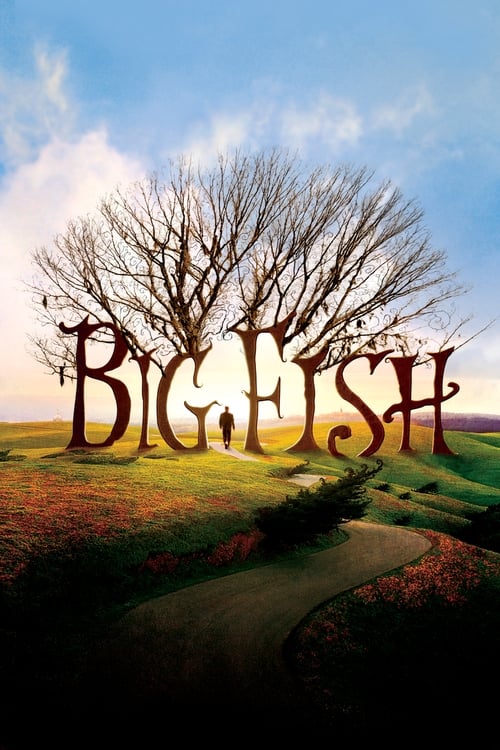
Big Fish
Southern Gothic/Fantasy + Melancholy & Wonder + A giant fish swimming away into a golden sunset. A poignant exploration of a dying father's tall tales and a son's desperate search for the truth beneath the myths.
Big Fish

Big Fish

"An adventure as big as life itself."

04 December 2003 United States of America 125 min ⭐ 7.8 (7,576)
Director: Tim Burton
Cast: Ewan McGregor, Albert Finney, Billy Crudup, Jessica Lange, Helena Bonham Carter
Drama Fantasy Adventure
Storytelling vs. Reality Father-Son Reconciliation Mortality and Legacy Growth and Ambition
Budget: $70,000,000
Box Office: $123,200,000

Overview

Big Fish tells the story of Edward Bloom, a man who has spent his life spinning larger-than-life narratives about his past, involving giants, witches, and werewolves. Now terminally ill, Edward is visited by his estranged son, Will, a pragmatic journalist who feels he never truly knew his father beneath the layers of fabrication.

As Edward recounts his fantastical life story—from leaving the small town of Ashton to joining a circus and wooing his wife Sandra—Will attempts to investigate the reality behind the myths. The narrative oscillates between the vibrant, hyper-real flashbacks of Edward's youth and the sterile, somber reality of his deathbed.

Ultimately, the film is a journey of reconciliation. As Edward's condition worsens, Will discovers that the truth he sought was less important than the emotional truth his father conveyed through storytelling. The climax blurs the line between reality and fantasy, offering a cathartic resolution that celebrates the power of legacy and imagination.
Core Meaning

At its heart, Big Fish is a meditation on the nature of truth and the immortality of storytelling. Director Tim Burton suggests that objective facts are often less meaningful than the stories we tell to make sense of our lives. The film posits that we become the stories we tell, and through them, we achieve a form of eternal life. It also explores the complicated dynamic of father-son relationships, moving from misunderstanding and resentment to acceptance and love.

Thematic DNA

Storytelling vs. Reality 35%
Father-Son Reconciliation 30%
Mortality and Legacy 20%
Growth and Ambition 15%

Storytelling vs. Reality

The central conflict creates a dichotomy between Will's desire for dry facts and Edward's commitment to myth. The film argues that myth can capture the spirit of a person better than a biography of dates and statistics.

Father-Son Reconciliation

The emotional core is Will's journey from resentment to understanding. He learns to accept his father not by stripping away the lies, but by understanding why he told them—to protect himself and to inspire others.

Mortality and Legacy

Edward's obsession with the Witch's prophecy of his death shows his acceptance of mortality. The film suggests that one conquers death by becoming a story that outlives the physical body.

Growth and Ambition

The motif of being a 'big fish in a small pond' drives Edward's character. It represents the human need to outgrow one's origins and seek a life that fits one's potential.

Character Analysis

Edward Bloom

Ewan McGregor (Young) / Albert Finney (Old)

Archetype: The Charismatic Storyteller / The Hero
Key Trait: Unrelenting Optimism

Motivation

To live a life big enough to match his imagination and to leave a legacy that transcends his small-town origins.

Character Arc

Moves from an ambitious young man seeking adventure to a dying father trying to connect with his son through his only language: story. He remains consistent in his identity, forcing others to adjust to him.

Will Bloom

Billy Crudup

Archetype: The Skeptic / The Seeker
Key Trait: Pragmatism

Motivation

To find the 'real' father hidden behind the mask of tall tales.

Character Arc

Starts as a resentful realist demanding facts; ends by embracing the role of the storyteller, understanding that the 'lie' was a form of love.

Sandra Bloom

Alison Lohman (Young) / Jessica Lange (Old)

Archetype: The Soulmate / The Anchor
Key Trait: Unconditional Love

Motivation

To love Edward for who he is and to bridge the gap between father and son.

Character Arc

Remains the constant center of Edward's universe. She understands him better than Will does, accepting the magic he brings to her life without needing to dissect it.

Karl the Giant

Matthew McGrory

Archetype: The Gentle Giant / The Outcast
Key Trait: Misunderstood Nature

Motivation

To find acceptance in a world too small for him.

Character Arc

Begins as a feared monster eating livestock; becomes a refined, successful companion through Edward's friendship.

Symbols & Motifs

The Big Fish

Meaning:

Symbolizes immortality, Edward Bloom himself, and the elusive nature of the truth. A fish that cannot be caught grows larger than life, just as Edward's legend does.

Context:

Appears in the opening narration, the story of the wedding ring, and the final transformative scene at the river.

The Glass Eye

Meaning:

Represents fear of the unknown and the ability to see one's fate. It suggests that knowing how the story ends allows one to live without fear.

Context:

Used by the Witch to show Edward his death; later associated with the old woman in the fraternity house.

The Town of Spectre

Meaning:

Symbolizes complacency, stagnation, or a false heaven/purgatory. It is a place of comfort where people stop moving forward.

Context:

Edward discovers this hidden town twice: once when he is too early to settle down, and later when he helps rebuild it.

Shoes on the Line

Meaning:

Represent abandoning one's journey and settling down. To leave Spectre, Edward must walk barefoot, symbolizing the pain required to grow.

Context:

Residents of Spectre throw their shoes over a power line, signifying they never intend to leave.

Water

Meaning:

Symbolizes the subconscious, transformation, and the boundary between life and death.

Context:

Edward is constantly associated with water: he requires it to not 'dry out,' and he returns to it in the finale.

Memorable Quotes

A man tells his stories so many times that he becomes the stories. They live on after him, and in that way he becomes immortal.

— Will Bloom

Context:

Spoken in the final voiceover narration as the camera pans over the funeral.

Meaning:

The film's thesis statement: we are defined not by biological existence but by the narrative legacy we leave behind.

There are some fish that cannot be caught. It's not that they are faster or stronger than other fish, they're just touched by something extra.

— Edward Bloom

Context:

Opening monologue describing the legend of the Beast.

Meaning:

Refers to the magical quality of certain beings (and people) who refuse to be bound by the ordinary rules of life.

I've been nothing but myself since the day I was born, and if you can't see that, it's your failing, not mine.

— Edward Bloom (Old)

Context:

During a heated argument with Will in the spare bedroom.

Meaning:

Edward's defense of his identity. He asserts that his stories are his true self, not a mask.

They say when you meet the love of your life, time stops, and that's true. What they don't tell you is that when it starts again, it moves extra fast to catch up.

— Edward Bloom (Young)

Context:

Voiceover describing the moment he first sees Sandra at the circus.

Meaning:

A poetic description of love at first sight and the fleeting nature of time spent with loved ones.

The truth is... I've always been a fool.

— Edward Bloom (Old)

Context:

Spoken to Sandra near the end of his life.

Meaning:

A rare moment of vulnerability where Edward admits his flaws, though couched in his usual charm.

Philosophical Questions

Is subjective myth more valuable than objective fact?

The film questions the utility of 'dry facts.' Edward's stories bring joy, inspire ambition, and build community. The film suggests that emotional truth—how an event felt—is a valid, perhaps superior, form of history compared to literal accuracy.

What constitutes immortality?

Big Fish proposes a secular form of immortality. We do not survive through a literal afterlife, but through the narratives we leave behind in the minds of others. To be remembered is to remain alive.

Alternative Interpretations

Spectre as Purgatory/Limbo: Some critics interpret the town of Spectre not just as a hidden village, but as a metaphysical waiting room for the afterlife. The shoes on the line represent souls giving up their earthly journey. Edward's arrival early in life suggests a near-death experience, and his return later signifies his acceptance of death.

Edward as a Serial Liar: A cynical reading suggests Edward was a narcissist who used stories to cover up his absences and infidelities (hinted at with Jenny). From this view, Will's acceptance isn't a discovery of truth, but a capitulation to his father's manipulation. However, the film strongly leans against this by showing the 'characters' at the funeral.

Will as the New Storyteller: The ending isn't just about Will understanding Edward; it's about the transfer of the mantle. By telling the final story at the river, Will ceases to be the 'dry realist' and becomes the new 'Big Fish,' ensuring the survival of the Bloom oral tradition.

Cultural Impact

Big Fish marked a significant turning point in Tim Burton's career, signaling a maturity and emotional depth that critics felt was lacking in his previous work like Planet of the Apes. Released in 2003, it resonated deeply with audiences for its poignant handling of grief and family dynamics, becoming a touchstone for viewers dealing with the loss of a parent.

While it was a moderate box office success, its lasting legacy is its reputation as arguably Burton's most 'human' and emotionally accessible film. It bridges the gap between the fantastical blockbusters of the 90s and modern magical realism. The film's success led to a Broadway musical adaptation in 2013, further cementing its story in American pop culture.

Critically, it is often cited alongside Ed Wood as Burton's masterpiece of character study. It validated the genre of 'Southern Gothic fantasy' in modern cinema and influenced subsequent films that blend whimsy with serious emotional stakes.

Audience Reception

Big Fish is widely regarded as one of Tim Burton's most beloved films. Audiences frequently praise the emotional payout of the ending, often citing it as a 'tearjerker' that effectively earns its sentiment. The performances of Albert Finney and Ewan McGregor are universally acclaimed for their seamless continuity.

Some criticism at the time of release focused on the film's episodic nature and perceived sentimentality, with a few critics feeling it was too 'saccharine' compared to Burton's edgier work. However, over time, the consensus has shifted to view it as a heartwarming modern classic. It holds a high audience score on platforms like Rotten Tomatoes and IMDB, frequently recommended for its visual beauty and life-affirming message.

Interesting Facts

  • Director Tim Burton signed on to the film shortly after the death of his own father (and mother), making the theme of father-son reconciliation deeply personal for him.
  • Steven Spielberg was originally attached to direct, with Jack Nicholson in mind for the role of Edward Bloom.
  • Ewan McGregor was cast as Young Edward partly because of his striking physical resemblance to a young Albert Finney.
  • Helena Bonham Carter was pregnant during filming, which required her costume for The Witch to be specially designed; she also played Jenny (both young and old).
  • The banjo player in the town of Spectre is Billy Redden, the same actor who played the 'Banjo Boy' in the film Deliverance (1972).
  • The town of Spectre was built as a real set on an island in Alabama and was left abandoned there; it has since become a popular tourist attraction.
  • The film was the first time Tim Burton focused significantly on a realistic emotional drama rather than purely stylized gothic fantasy.
  • Pearl Jam's song 'Man of the Hour' was written specifically for the film after Eddie Vedder saw an early screening.
  • Matthew McGrory (Karl the Giant) was naturally over 7 feet tall, but camera tricks and forced perspective were used to make him appear over 10 feet tall.

Easter Eggs

Jack Skellington Reflection

In the opening scene, as the camera pans over fishing lures, a reflection of Jack Skellington's skull from The Nightmare Before Christmas can be seen in one of the spoons.

The Swirly Tie

When young Edward proposes to Sandra in the field of daffodils, he wears a tie with a swirl pattern identical to the iconic hill in The Nightmare Before Christmas.

Pee-Wee's Breakfast Machine

The Rube Goldberg machine Edward presents at the science fair is a direct reference (and similar design) to the breakfast machine in Tim Burton's directorial debut, Pee-wee's Big Adventure.

Daniel Wallace Cameo

The author of the original novel, Daniel Wallace, makes a cameo appearance as the Economics professor in the classroom scene.

⚠️ Spoiler Analysis

Click to reveal detailed analysis with spoilers

Frequently Asked Questions

Explore More About This Movie

Dive deeper into specific aspects of the movie with our detailed analysis pages

Comments (0)

Leave a comment

No comments yet. Be the first to share your thoughts!