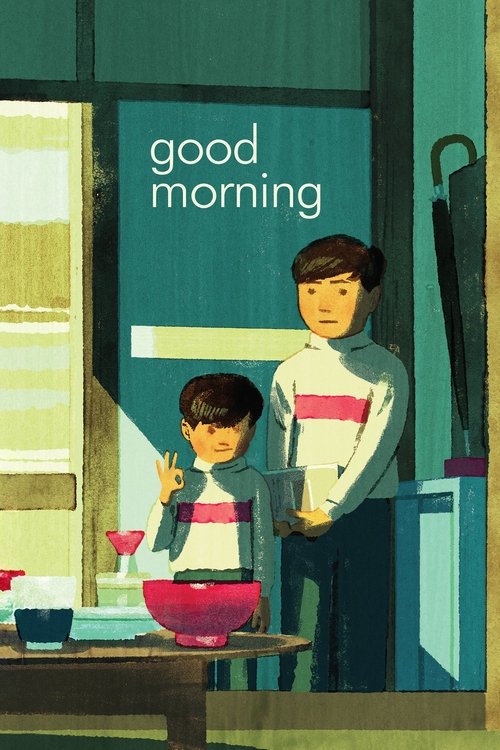
Good Morning
お早よう
"Important things are hard to say."
Overview
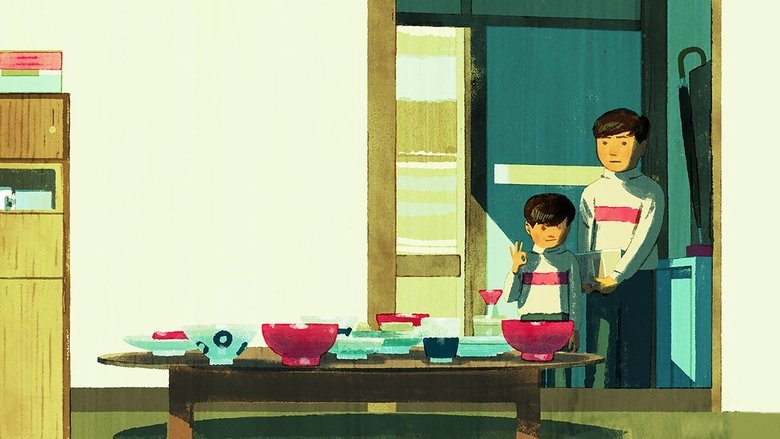
In a cramped suburban housing development in Tokyo, the daily lives of several families intersect through gossip and shared spaces. The central conflict arises in the Hayashi household, where two young brothers, Minoru and Isamu, become obsessed with television. When their parents refuse to buy a set, citing that it will produce "100 million idiots," the boys rebel. They point out the hypocrisy of adults who scold them for talking too much yet spend their own days exchanging meaningless pleasantries.
In protest, the brothers take a vow of silence, refusing to speak to anyone, including their parents, teachers, and neighbors. This silence unintentionally wreaks havoc on the community, causing misunderstandings and fueling rumors among the local housewives, who misinterpret the boys' silence as a snub orchestrated by their mother. Meanwhile, a parallel subplot involves the budding, unspoken romance between the boys' aunt and their English tutor, who struggle to move beyond the very polite small talk the boys despise.
The film balances these tensions with low-brow humor, specifically a recurring game where the neighborhood boys try to fart on command. As the community navigates the "useless" rituals of social interaction, the boys' strike forces a re-evaluation of communication. Eventually, the parents relent and purchase the television, restoring peace to the household, while the adults continue their "meaningless" but necessary social dances.
Core Meaning
At its heart, Good Morning is a philosophical defense of the "useless" pleasantries that bind society together. Ozu contrasts the brutal honesty of children with the necessary artificiality of the adult world.
While the boys see greetings like "Good Morning" as a waste of breath, the film argues that these "meaningless" words act as a social lubricant, preventing friction in a crowded community. Through the lens of light comedy, Ozu suggests that while truth is important, the small, empty rituals of politeness are essential for maintaining harmony and human connection in a changing world.
Thematic DNA
Communication and Social Lubricant
The central theme explores the function of language. The boys reject "useless" talk, but the film shows that without these phatic expressions (like "Good Morning" or comments on the weather), social bonds fray and misunderstandings arise. The tutor explicitly states that these "useless things" are like a lubricant for society.
Modernity vs. Tradition
Set in a Western-style housing complex, the film captures the tension of postwar Westernization. Symbols like the television and washing machine represent the encroaching consumer culture that the older generation resists but eventually accepts. The boys' desire for a TV highlights the generational shift towards new media.
Community and Gossip
The layout of the neighborhood, with houses close together, creates a fishbowl environment where privacy is impossible. Gossip becomes a weapon and a form of social currency among the housewives, illustrating how fragile reputation is in a tight-knit community.
Childhood Rebellion
Minoru and Isamu represent the unadulterated, logical view of the world that conflicts with adult complexities. Their "farting game" serves as a subversive parallel to adult greetings—a ritual with its own rules, but one that adults find vulgar, highlighting the arbitrary nature of "proper" behavior.
Character Analysis
Minoru Hayashi
Koji Shitara
Motivation
To get a television set and to expose the perceived illogical nature of adult behavior.
Character Arc
Starts as a frustration-fueled boy wanting a TV, escalates to a philosophical protester against adult hypocrisy, and ends as a content child who has won his battle but perhaps learned the value of compromise.
Isamu Hayashi
Masahiko Shimazu
Motivation
To be like his big brother and to watch sumo wrestling.
Character Arc
Blindly follows his older brother's lead in the silence strike, often struggling to maintain it because he doesn't fully understand the principle, only the goal (TV).
Heiichiro Fukui
Keiji Sada
Motivation
To tutor the boys and connect with their aunt, Setsuko.
Character Arc
Serves as the bridge between the boys' logic and the adult world. He struggles to express his own feelings for the aunt, ironically falling victim to the very "difficulty of saying important things" he analyzes.
Keitaro Hayashi
Chishū Ryū
Motivation
To maintain order and traditional values in his home.
Character Arc
Initially resists the intrusion of modernity (TV) and demands obedience, but eventually softens, recognizing the changing times and his love for his children.
Symbols & Motifs
Television
Symbolizes the irresistible tide of Western modernity and consumerism. It represents the future and the new "electric hearth" that replaces the traditional family dynamic.
The boys worship the TV at their neighbor's house and eventually force their parents to capitulate and buy one, marking the family's entry into the modern era.
Farts
A subversive counter-ritual to adult small talk. Just as adults exchange empty words to signal belonging, the boys exchange gas to signal membership in their peer group.
Used throughout the film as a comic motif, specifically the boys' game of pressing foreheads to induce flatulence, mocking the seriousness of adult social rules.
Greetings ("Good Morning")
Represents the "social lubricant"—the seemingly empty phrases that actually maintain peace and acknowledge the existence of others.
The title itself; spoken repeatedly by characters to smooth over conflicts and start the day, and conspicuously absent during the boys' silence strike.
The Red Kettle
A signature Ozu visual element, representing domestic stability and the meticulously composed beauty of everyday life.
Placed prominently in the corner of the room in the Hayashi household, acting as a visual anchor in Ozu's vivid color palette.
Memorable Quotes
Daiji na koto wa, nakanaka ienai mon da yo. Mudaguchi tte no wa, yononaka no jun katsuyu mitai na mon da ne.
— Heiichiro Fukui (The Tutor)
Context:
Spoken to the aunt (Setsuko) at the train station as they discuss the boys' strike and the nature of communication.
Meaning:
"Important things are difficult to say. Meaningless things are like a lubricant for the world."
This is the film's thesis statement. It explains why we need small talk: to make the difficult machinery of human interaction run smoothly.
Ohayô.
— Various Characters
Context:
Used throughout the film, but most poignantly at the end when the characters resume their daily routines, affirming their connections.
Meaning:
"Good morning."
The title of the film and the most frequent line. It signifies the restoration of order and the acceptance of social roles.
I love you.
— Isamu Hayashi
Context:
Isamu says this repeatedly to the tutor and his brother, treating the English phrase as a game.
Meaning:
A phrase the young boy repeats without understanding its weight, treating it as a toy or a simple sound, contrasting with the adults who are terrified to say it for real.
Otona wa zuibun muda na koto o iu n da ne.
— Minoru Hayashi
Context:
During the argument with his father when he is told to shut up.
Meaning:
"Adults say so many meaningless things."
The inciting incident for the silence strike. Minoru points out the hypocrisy of adults who talk without saying anything real.
Philosophical Questions
Is 'small talk' actually meaningless?
The film posits that while phrases like "Good Morning" convey no factual information, they are essential ethical acts that acknowledge the other person's humanity. Without them, we are just efficient machines, not a community.
Does technology connect or divide us?
The TV is initially a source of division (causing the strike), but ultimately becomes a communal hearth where the boys bond. Ozu explores whether modern devices destroy traditional conversation or simply create new modes of being together.
Alternative Interpretations
The Fart as Language: Some critics interpret the boys' farting game not just as a joke, but as a genuine alternative language. Since adults use "empty" words to signal belonging, the boys use "empty" gas. Both are phatic acts—meaningless in content but functional in signaling group membership.
Silence as Violence: Another reading suggests the silence strike is a passive-aggressive act of violence that exposes the fragility of the community. By simply removing the "lubricant" of greetings, the boys inadvertently cause chaos, proving that the community's harmony is superficial and held together only by polite lies.
Cultural Impact
Good Morning holds a unique place in cinema history as a bridge between the Golden Age of Japanese cinema and the emerging Japanese New Wave. Created during the "Japanese economic miracle," it captures a pivotal moment when American consumerism (TVs, washing machines) began to redefine Japanese domestic life.
While initially dismissed by some contemporary critics as "light" or "minor" Ozu compared to the gravity of Tokyo Story, it has since been re-evaluated as a masterful satire. It influenced the genre of shomin-geki (dramas about common people) by introducing a level of absurdity and scatological humor that was rare for the time. Philosophically, it remains a touchstone for discussions on linguistics and social etiquette, frequently cited in sociology and film studies for its profound defense of "small talk."
Audience Reception
Modern audiences and critics universally adore the film, holding a 100% rating on Rotten Tomatoes. It is frequently praised for its visual beauty, specifically the "candy-colored" cinematography, and its universal portrayal of childhood obstinacy.
Praised aspects: The humor (especially the fart jokes), the charm of the child actors, and the subtle social commentary.
Criticisms: Some viewers expecting the tragic weight of Ozu's dramas find it too slight or the pacing too leisurely.
Verdict: It is widely considered the most accessible entry point into Ozu's filmography.
Interesting Facts
- This was Yasujirō Ozu's second film shot in color (AgfaColor), and he famously used red objects (like the kettle) to structure the visual space.
- The film is a loose self-remake of Ozu's 1932 silent classic I Was Born, But..., updating the themes for the television age.
- The fart sounds were not stock effects; Ozu insisted on creating a 'suite' of different pitched fart sounds to match each character, which critics have jokingly called 'tuned farts.'
- Chishū Ryū, who plays the father, was Ozu's most frequent collaborator, appearing in 32 of his 54 films.
- The distinctive low camera angle used throughout the film is known as the 'tatami shot,' designed to replicate the eye level of someone kneeling on a tatami mat.
- Isamu's actor, Masahiko Shimazu, was cast partly because of his ability to look genuinely confused and his chemistry with the older boy.
Easter Eggs
The 'I Was Born, But...' connection
The entire plot is a direct reference to Ozu's earlier silent masterpiece. While the silent film focused on social class, this version shifts the focus to consumerism and communication, showing how Ozu's worldview evolved over 27 years.
The Red Kettle
A recurring visual prop that appears in almost every Ozu color film. It serves as a visual signature, anchoring the domestic space in a bright, warm color that contrasts with the muted suburban tones.
⚠️ Spoiler Analysis
Click to reveal detailed analysis with spoilers
Frequently Asked Questions
Explore More About This Movie
Dive deeper into specific aspects of the movie with our detailed analysis pages
Comments (0)
No comments yet. Be the first to share your thoughts!