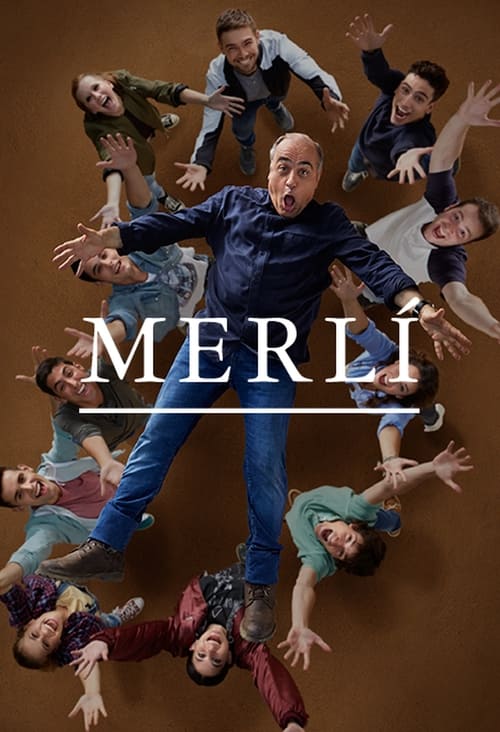
Merlí
Overview
"Merlí" follows the story of Merlí Bergeron, an unemployed philosophy teacher with unorthodox and provocative methods, who is forced to move in with his mother and care for his estranged teenage son, Bruno. He gets a job at his son's high school, Àngel Guimerà Institute, where his classes quickly become a space for rebellion, critical thinking, and personal growth for a group of students he dubs "The Peripatetics."
Across three seasons, the series explores the turbulent lives of these teenagers as they grapple with issues of identity, sexuality, family problems, social pressures, and the future. Each episode is structured around the teachings of a specific philosopher or philosophical school, which Merlí uses to connect with his students and help them navigate their personal dilemmas. The narrative skillfully balances the comedic and often chaotic classroom environment with the dramatic, and sometimes heartbreaking, personal stories of both Merlí and his students, creating a rich tapestry of adolescent and adult life in contemporary Barcelona.

Core Meaning
The core meaning of "Merlí" is a passionate defense of philosophy, not as an abstract academic discipline, but as a vital and practical tool for navigating the complexities of everyday life. The creator, Héctor Lozano, aimed to demystify philosophy and show its relevance, particularly for young people seeking to understand themselves and the world around them. The series posits that critical thinking, questioning authority, and challenging preconceived notions are essential for personal freedom and authentic living. It carries a message of empowerment, urging viewers to "Sapere Aude" (Dare to Know), to think for themselves, and to live life with intellectual curiosity and emotional honesty, even when it leads to conflict or discomfort.
Thematic DNA
The Role of Education
The series is a direct critique of traditional, rigid educational systems. Merlí's unorthodox methods, inspired by films like Dead Poets Society, clash with the school's more conservative teachers, particularly Eugeni Bosc. Merlí champions an education that stimulates critical thought over rote memorization, encouraging students to question everything. This theme evolves from a simple teacher-student dynamic to a broader commentary on how mentorship can profoundly shape a young person's life, for better or worse, culminating in his students' enduring passion for knowledge.
Adolescent Self-Discovery
This is the central pillar of the series. Each student in "The Peripatetics" undergoes a significant journey. The show tackles themes of sexuality (Bruno's coming out and his relationship with Pol), body image (Tània's insecurities), family trauma (Pol's difficult home life, Ivan's agoraphobia), social anxiety, and first loves with a raw honesty. The philosophical lessons serve as a framework for them to process these intense experiences, evolving from confused teenagers into more self-aware young adults by the series' end.
Philosophy in Daily Life
Each episode is named after a philosopher (e.g., Socrates, Nietzsche, Machiavelli), whose ideas are woven directly into the characters' personal problems. The series brilliantly illustrates how concepts of ethics, existentialism, politics, and love are not just abstract theories but are constantly at play in relationships, decisions, and personal crises. This theme remains constant, demonstrating that philosophy is a continuous, living practice of questioning and understanding.
Morality and Ethics
Merlí himself is a morally ambiguous character. He is inspiring and beloved by his students, but he is also manipulative, egotistical, and often makes questionable decisions in his personal life, blurring ethical lines. The series constantly questions the nature of "good" and "bad," both through philosophical debates in the classroom and through Merlí's own flawed actions. It explores whether the ends justify the means, especially in the context of teaching and mentorship.
Character Analysis
Merlí Bergeron
Francesc Orella
Motivation
Merlí's primary motivation is to provoke critical thinking and challenge the status quo, both in the education system and in his students' minds. He is driven by a narcissistic need to be the center of attention and the smartest person in the room, but this is coupled with a genuine desire to see young people liberate themselves from conformity. His motivation evolves to include a more paternalistic, albeit unconventional, care for his students' well-being.
Character Arc
Merlí begins as a brilliant but arrogant and ethically questionable teacher, forced into his role by circumstance. Throughout the series, his primary arc is not one of radical personal change, but of deepening impact. While he remains flawed—often manipulative and self-serving—his genuine passion for philosophy and his profound effect on his students are undeniable. He learns to connect with his son, Bruno, on a deeper level and is forced to confront the consequences of his methods. His ultimate legacy is cemented not in his own perfection, but in the intellectual fire he ignites in his students, particularly Pol.
Pol Rubio
Carlos Cuevas
Motivation
Initially, Pol is motivated by a desire to appear strong and mask his vulnerability and difficult family situation. Merlí provides him with an intellectual escape and a sense of purpose. His motivation shifts from mere survival and posturing to a genuine thirst for knowledge and self-understanding. He is driven to become someone better than his circumstances would suggest, inspired entirely by his mentor.
Character Arc
Pol starts as a tough, popular, and seemingly indifferent student from a troubled home who repeats courses. Initially resistant, he is captivated by Merlí's teaching and becomes his most brilliant and devoted student. His arc is one of the most significant in the series. He transforms from a hot-headed teen into a passionate, intellectually curious young man. He grapples intensely with his sexuality, particularly his feelings for Bruno, and his identity. By the end of the series, he has decided to follow in Merlí's footsteps, a journey that continues in the spin-off, Merlí: Sapere Aude.
Bruno Bergeron
David Solans
Motivation
Bruno is primarily motivated by a need for connection and love. He seeks the approval of his often-absent father and yearns for the romantic affection of Pol. His journey is about learning that his self-worth cannot be dependent on others. His motivation evolves from seeking external validation to finding internal acceptance and the courage to pursue his own happiness.
Character Arc
Bruno's arc is defined by his struggle for identity and acceptance, both as Merlí's son and as a gay teenager. Initially embarrassed by his father, he slowly comes to appreciate his influence. His central conflict is his unrequited, and later complicated, love for his best friend, Pol. Throughout the series, Bruno grows from an insecure and sometimes petulant teen into a more confident and self-aware young man. He learns to stand up for himself, confronts his feelings openly, and ultimately makes the decision to forge his own path, separate from both his father and Pol, by choosing to live in Rome.
Tània Illa
Elisabet Casanovas
Motivation
Tània is motivated by a deep desire for love and to be seen as desirable. She is incredibly loyal to her friends, and much of her action is driven by supporting them. As the series progresses, her motivation shifts towards finding her own voice and happiness, culminating in her budding relationship with Pol at the end of the series, where she demands to be treated as more than just a friend.
Character Arc
Tània begins as the kind, reliable, and often overlooked best friend, particularly to Bruno. She is insecure about her body and often feels invisible to boys. Her arc is a quiet but powerful journey of self-esteem. Over the three seasons, she learns to value herself beyond her friendships and romantic prospects. She becomes a more assertive and confident young woman, navigating the complexities of her close but sometimes fraught relationships with Pol and Bruno. She represents the struggle for self-worth in a world that often judges based on superficial standards.
Symbols & Motifs
The Peripatetics
Named after Aristotle's school of philosophy where teachers and students would walk while discussing ideas, "The Peripatetics" symbolizes an active, engaged, and non-traditional approach to learning and life. It represents the community and intellectual bond Merlí forges with his students.
This is the name Merlí gives to his core group of students. The name is established in the first season and becomes their collective identity throughout the series. Many of their most important lessons and conversations happen outside the confines of the classroom, embodying the peripatetic spirit.
The Classroom
The classroom symbolizes a sanctuary and a battleground. For the students, it is a safe space where they can freely express their doubts and ideas under Merlí's guidance. For the teachers, it represents the ideological clash between traditional and progressive educational philosophies.
Throughout all three seasons, Merlí's classroom is the central hub of the series. It's where philosophical concepts are introduced, debates erupt, and personal revelations often occur. Its physical appearance doesn't change much, but its symbolic weight as a space of liberation grows with each season.
Philosophers' Names (Episode Titles)
Each episode title, named after a specific philosopher, symbolizes the central theme or moral dilemma that will be explored in that chapter of the characters' lives. It frames the narrative and provides a lens through which the audience can interpret the events.
This is a structural motif for the entire series. For example, the episode "Machiavelli" explores themes of power and manipulation in the school's social dynamics, while "Epicurus" deals with questions of pleasure and happiness.
Memorable Quotes
Que la vida sigui absurda no implica que hàgim de caure en una profunda apatia.
— Merlí Bergeron
Context:
This is a recurring philosophical idea that Merlí imparts to his students in various classroom contexts throughout the series, encouraging them to engage with life actively rather than passively accepting its absurdity.
Meaning:
"That life is absurd doesn't mean we should fall into a deep apathy." This quote encapsulates the series' existentialist spirit. It's a call to action against nihilism, urging the students to find meaning and create their own purpose even in a seemingly meaningless world.
Vales molt, per molt que et trepitgin o et facin mal. Vales, i molt.
— Merlí Bergeron
Context:
Merlí often says variations of this to his students during one-on-one conversations when they are facing personal crises, reinforcing his role as a supportive, albeit unconventional, father figure.
Meaning:
"You are worth a lot, no matter how much they step on you or hurt you. You are worthy, very worthy." This quote is a direct message of empowerment and self-worth from Merlí to his students, particularly those struggling with insecurity like Tània or Joan. It's a core tenet of his mentorship.
Deixeu de mirar la vida a través d'una càmera i gaudiu-la amb els ulls.
— Merlí Bergeron
Context:
This line is said during a class discussion about modern alienation and the nature of existence in the digital age, challenging the students' habits and perspectives.
Meaning:
"Stop looking at life through a camera and enjoy it with your eyes." This is a critique of modern society's obsession with social media and digital representation over lived experience. It's a plea for authenticity and being present in the moment.
Mentre existim, la mort no està present. I quan la mort es presenta, és que nosaltres ja no hi som.
— Merlí Bergeron
Context:
This is from the episode "Epicurus" (Season 1, Episode 9), where Merlí discusses the philosopher's views on death and pleasure to help the students, particularly Joan, cope with anxieties about mortality.
Meaning:
"While we exist, death is not present. And when death is present, we no longer exist." Paraphrasing Epicurus, this quote is meant to alleviate the fear of death. It promotes a focus on living life to the fullest without being paralyzed by an existential dread of the inevitable.
Episode Highlights
Els Peripatètics (The Peripatetics)
The first episode introduces Merlí Bergeron as he starts his new job and immediately disrupts the school's status quo. It establishes his character, his strained relationship with his son Bruno, and his unique teaching style. We meet the key students who will form "The Peripatetics."
This episode sets the entire tone and premise of the series. It establishes the central conflicts: Merlí vs. the school system, Merlí vs. Bruno, and the students vs. their own personal struggles. It's the birth of the unique bond between teacher and students.
Epicur (Epicurus)
This episode focuses on Joan Capdevila's severe anxiety and agoraphobic tendencies. Merlí uses the teachings of Epicurus to help Joan confront his fears about life and death. The episode is a powerful exploration of mental health and friendship.
It highlights Merlí's ability to apply philosophy in a deeply personal and therapeutic way, going beyond the classroom to genuinely help a student in crisis. It solidifies the loyalty of the Peripatetics.
Nietzsche
The season one finale is packed with emotional turning points. The students face the consequences of their actions, Bruno makes a significant step in accepting his sexuality, and the school mourns the sudden death of a beloved teacher, Santi.
This episode is a pivotal moment of maturation for the students, forcing them to confront grief and guilt. Santi's death deeply affects the group, especially Bruno, and marks the end of the series' initial, more lighthearted phase.
Judith Butler
Focusing on the theories of gender and performance by philosopher Judith Butler, this episode tackles issues of identity, transphobia, and sexism within the school. It forces the students, especially Pol, to confront their own prejudices and assumptions about gender roles.
It's one of the most socially relevant episodes, demonstrating the show's willingness to engage with contemporary and complex philosophical ideas. It marks a key point in Pol's development and his understanding of sexuality and identity.
Merlí Bergeron
The series finale. The episode jumps forward seven years after the students' graduation, showing where their lives have led. The main focus, however, is revealing the shocking and tragic death of Merlí himself, and how his former students come together to mourn and honor his memory.
A powerful and heartbreaking conclusion that cements Merlí's lasting impact on his students. The time jump provides closure for the characters' arcs while emphasizing that Merlí's true legacy is the way they continue to live their lives. It directly sets the stage for the spin-off, Merlí: Sapere Aude.
Philosophical Questions
What is the purpose of education?
The series constantly explores this question through the clash between Merlí's Socratic, questioning-based approach and the school's focus on curriculum and discipline. Merlí argues that the goal of education is not to provide answers but to teach students how to think for themselves, to question authority, and to apply critical thought to their own lives. The entire show is a dramatized debate between education as indoctrination versus education as liberation.
How should one live an authentic life?
This existential question is at the heart of every character's journey. From Bruno's struggle with his sexuality to Pol's search for an identity beyond his tough exterior, the series uses various philosophical frameworks (Nietzschean self-overcoming, Butler's performativity, etc.) to explore what it means to live truthfully. Merlí pushes his students to reject societal pressures and define their own values, even if it leads to pain and conflict, arguing that an unexamined life is not worth living.
What is the nature of love and desire?
"Merlí" delves into the complexities of love in its many forms: romantic, platonic, familial, and unrequited. The central relationship between Pol and Bruno explores the fluidity of sexuality and the pain of loving someone who may not be able to reciprocate fully. Philosophical ideas from Plato to Schopenhauer are used to dissect the nature of desire, attachment, and the inherent suffering that can come with human connection.
Alternative Interpretations
The Ambiguity of a Flawed Mentor
While the dominant interpretation of Merlí is that of an inspirational, life-changing teacher, a significant critical perspective views him as a problematic and even toxic figure. This interpretation argues that his methods are often manipulative and self-serving. Critics point to his narcissism, his tendency to cross ethical boundaries with students and colleagues, and his use of philosophical rhetoric to justify his own questionable behavior.
From this viewpoint, the series isn't just a celebration of unconventional teaching but also a cautionary tale about the dangers of charismatic mentors who blur the lines between education and personal influence. Some analyses argue that Merlí's actions, particularly his relationships with women and his manipulation of students for his own battles against the school administration, are deeply patriarchal and undermine his progressive message. The ending, where he is lionized after his death, can be interpreted not as a testament to his greatness, but as a romanticized glossing over of his significant flaws.
Cultural Impact
Cultural Context and Influence
"Merlí" premiered on Catalonia's TV3 in 2015, quickly becoming a phenomenon not just in its home region but across Spain and, later, the world, thanks to its distribution on Netflix. Its success was particularly notable in Spanish-speaking Latin America, where it resonated deeply with audiences. The series arrived at a time of growing demand for authentic, character-driven teen dramas that didn't shy away from complex issues.
Its primary cultural impact was its ability to make philosophy accessible, engaging, and relevant to a mainstream audience, particularly young people. By weaving the teachings of major philosophers into the everyday struggles of teenagers, the show succeeded in demystifying a subject often perceived as dense and disconnected from reality. This led to a renewed public interest in philosophy and was even credited with boosting enrollment in university philosophy courses.
The show was also praised for its frank and non-judgmental portrayal of LGBTQ+ themes, especially the complex relationship between Bruno and Pol, which was central to the series' emotional core. It presented a nuanced exploration of sexual identity and coming-of-age that was considered groundbreaking for Spanish television. The series' legacy is cemented by its successful spin-off, Merlí: Sapere Aude, which continues the story of Pol Rubio and further explores the themes of the original, proving the enduring appeal of its formula.
Audience Reception
"Merlí" received an overwhelmingly positive reception from audiences, both in its native Catalonia and internationally. Viewers praised the series for its originality, its compelling and relatable characters, and its unique premise of blending philosophy with a coming-of-age drama. The character of Merlí Bergeron was widely celebrated for his charisma and wit, while the journeys of the students, particularly Pol and Bruno, resonated deeply with younger audiences.
The main points of praise focused on the show's intelligent writing, its humor, and its honest and sensitive handling of difficult topics like sexuality, mental health, and family dysfunction. However, some criticism was directed at the character of Merlí himself, with some viewers finding him overly narcissistic and his actions ethically questionable, feeling that the show sometimes glorified his manipulative behavior. The series finale, with its shocking twist and time jump, was divisive but largely seen as a poignant and fitting end that highlighted the teacher's lasting legacy. Overall, the audience verdict was that "Merlí" was a refreshing, thought-provoking, and emotionally resonant series that stood out in the television landscape.
Interesting Facts
- The series was created and written by Héctor Lozano.
- The original language of the series is Catalan, and it was produced by the Catalan channel TV3.
- The show was heavily influenced by films like "Dead Poets Society".
- The success of the series in Catalonia led to it being dubbed in Spanish and later acquired by Netflix for international distribution, gaining massive popularity in Latin America.
- The main storyline of Merlí helping a student with agoraphobia (Ivan) was inspired by a real-life story from a friend of the creator, Héctor Lozano, who was a literature teacher.
- A spin-off and sequel series, "Merlí: Sapere Aude," was created, focusing on Pol Rubio's life at university.
- The series' success reportedly led to an increase in philosophy course enrollments in Spain.
⚠️ Spoiler Analysis
Click to reveal detailed analysis with spoilers
Frequently Asked Questions
Explore More About This Movie
Dive deeper into specific aspects of the movie with our detailed analysis pages
Comments (0)
No comments yet. Be the first to share your thoughts!