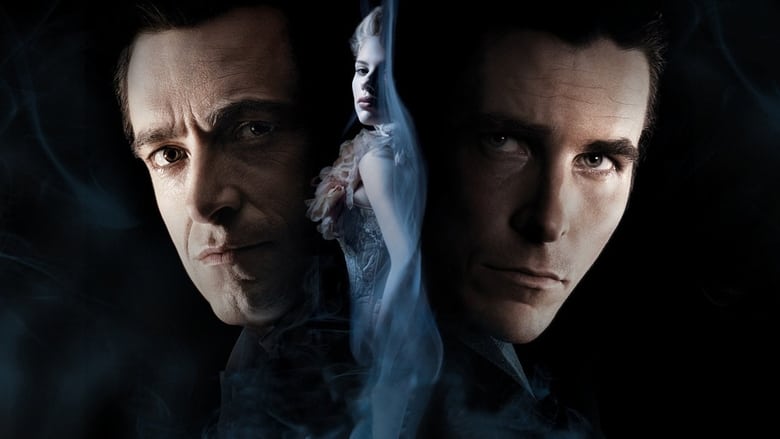
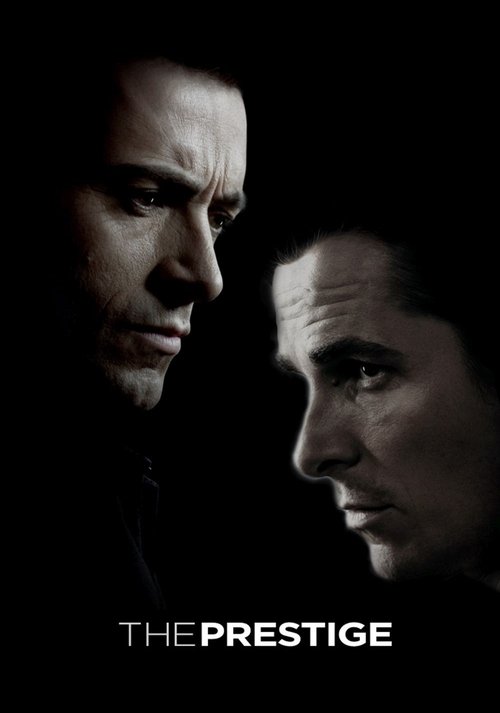
The Prestige
A Victorian mystery veiled in suspense, this film captures the chilling heart of obsession through the dark art of illusion.
The Prestige

The Prestige

"Are You Watching Closely?"

17 October 2006 United Kingdom 130 min ⭐ 8.2 (16,835)
Director: Christopher Nolan
Cast: Hugh Jackman, Christian Bale, Michael Caine, Piper Perabo, Rebecca Hall
Drama Mystery Science Fiction
Obsession and Rivalry Sacrifice Deception and Identity Science vs. Illusion
Budget: $40,000,000
Box Office: $109,676,311

Overview

Set in late 19th-century London, "The Prestige" chronicles the fierce rivalry between two aspiring magicians, Robert Angier (Hugh Jackman) and Alfred Borden (Christian Bale). Initially partners, a tragic accident during a performance shatters their friendship and ignites a bitter feud. As they embark on separate careers, their competition escalates into a dangerous game of one-upmanship, sabotage, and theft.

The narrative unfolds through their personal diaries, revealing their deepest secrets and the extreme lengths they will go to create the ultimate illusion. Angier, the consummate showman, becomes obsessed with uncovering the secret to Borden's seemingly impossible trick, "The Transported Man." This obsession leads him on a perilous journey, involving his assistant Olivia (Scarlett Johansson) and the brilliant, enigmatic inventor Nikola Tesla (David Bowie), pushing the boundaries of science and ethics. Their relentless pursuit of supremacy ensnares those around them, including their mentor and stage engineer, John Cutter (Michael Caine), with devastating consequences.
Core Meaning

The core meaning of "The Prestige" is a dark exploration of obsession, sacrifice, and the deceptive nature of truth. Director Christopher Nolan uses the world of stage magic as a metaphor for the extreme lengths people will go for their art and ambition. The film posits that true dedication requires immense, often unseen, sacrifice, questioning the price of greatness. It delves into the duality of human nature, showing how the pursuit of perfection can lead to self-destruction and the blurring of identity. Ultimately, the film suggests that audiences, and people in general, prefer a beautiful lie to a harsh reality; they want to be fooled, and the secret behind the illusion is often a grim and painful truth.

Thematic DNA

Obsession and Rivalry 35%
Sacrifice 30%
Deception and Identity 25%
Science vs. Illusion 10%

Obsession and Rivalry

The film is dominated by the escalating rivalry between Angier and Borden. What begins as professional competition spirals into a destructive obsession that consumes their lives. Angier's obsession with beating Borden costs him his fortune, his friendships, and ultimately his very self, as he is willing to kill clones of himself nightly. Borden's obsession with maintaining the secrecy of his and his twin's shared life leads to the suicide of his wife, Sarah, and the alienation of his lover, Olivia. The theme is reinforced by the secondary rivalry between historical inventors Nikola Tesla and Thomas Edison, highlighting how such conflicts can drive both innovation and ruin.

Sacrifice

The central question of the film is "What are you willing to sacrifice for your art?" Both protagonists make horrific sacrifices. Angier sacrifices his identity and life over and over, drowning a clone of himself after every performance of his ultimate trick. The Borden twins sacrifice a complete life; each man lives only half a life, sharing an identity, a wife, a lover, and a child, which leads to immense personal suffering and tragedy. Their sacrifices are presented as the terrible 'prestige' of their greatest tricks—the grim reality hidden from the audience.

Deception and Identity

Deception is the bedrock of the film, not just in the magic tricks, but in the characters' lives. The film explores the duality of identity through its two main twists: Borden is actually two identical twins sharing one life, and Angier uses a machine to create a clone of himself, whom he then murders. This theme suggests that artists often lead double lives, a concept made literal by the Borden twins. Angier also adopts a false, working-class American persona to hide his aristocratic British roots as Lord Caldlow. The film constantly challenges the audience's perception of reality, mirroring the structure of a magic trick itself.

Science vs. Illusion

The film contrasts Borden's traditional sleight-of-hand and brilliant, low-tech illusion with Angier's resort to science and technology. Borden achieves his "Transported Man" through pure cunning and sacrifice—using his identical twin. Angier, unable to deduce this simple but profound secret, turns to Nikola Tesla to build a machine that performs what seems to be actual magic: duplication. This creates a conflict between true, gritty craftsmanship (Borden) and the showman who uses advanced, almost supernatural means to achieve a similar effect without the same level of personal ingenuity (Angier).

Character Analysis

Robert Angier / The Great Danton

Hugh Jackman

Archetype: The Antihero / The Obsessive
Key Trait: Obsessive Showman

Motivation

Primarily, Angier is motivated by a burning need to defeat Borden, whom he blames for his wife's death. He is also driven by a desire for the audience's adoration, unsatisfied by letting a double take the final bow. This culminates in his quest for the ultimate trick, one that is truly 'real' and not just an illusion, leading him to Nikola Tesla's machine.

Character Arc

Angier begins as a talented magician but is more of a showman than a true innovator. His wife's death transforms him, fueling a desperate obsession with revenge and outdoing Borden. He is willing to sacrifice everything—his morality, his fortune, and ultimately his own life, repeatedly—for the sake of a perfect illusion. His arc is a descent into moral darkness, starting as a sympathetic grieving husband and ending as a man who murders a copy of himself nightly to win a rivalry.

Alfred Borden / The Professor

Christian Bale

Archetype: The Genius / The Martyr
Key Trait: Dedicated Purist

Motivation

Borden's primary motivation is the perfection of his craft. He is driven to invent the greatest illusions and is willing to live a fractured, painful life to protect the secret that makes them possible. His rivalry with Angier is secondary to his dedication to magic, though he engages in it fiercely.

Character Arc

Borden is a rougher, working-class magician who is a true innovator and purist of the craft. From the start, he is living a shared life with his identical twin, a secret that allows him to create the perfect illusion but at an immense personal cost. His arc is one of sustained sacrifice. He endures the loss of his wife and lover, imprisonment, and eventually the death of one twin, all to protect their secret and their art. He is colder and more ruthless than Angier initially appears, but his dedication is to the magic itself.

John Cutter

Michael Caine

Archetype: The Mentor / The Moral Compass
Key Trait: Pragmatic Moralist

Motivation

Cutter is motivated by a respect for the craft of magic and a sense of decency. He wants to create brilliant illusions but is horrified by the inhuman lengths Angier goes to. His final motivation is to correct a wrong and protect an innocent child from the wreckage of the magicians' feud.

Character Arc

Cutter is an "ingénieur," a designer of magic tricks who initially works with both Angier and Borden. He serves as a mentor figure to Angier after the split. He represents the traditional ethics and boundaries of magic. His arc involves him becoming increasingly disillusioned with Angier's deepening obsession and cruelty. He ultimately realizes the true horror of what Angier has done and facilitates the final confrontation, choosing to help the surviving Borden twin escape with his daughter.

Sarah Borden

Rebecca Hall

Archetype: The Tragic Victim
Key Trait: Intuitive Despair

Motivation

Sarah is motivated by a desire for a stable, honest love from her husband. She desperately wants to understand the man she married, but his unwavering commitment to his secret makes that impossible, driving her to destruction.

Character Arc

Sarah is Alfred Borden's wife, who is caught in the impossible situation of being married to two men who are sharing one identity. Her arc is a tragic descent into confusion, despair, and madness. She senses the duality in her husband—his wildly shifting moods and affections—but cannot comprehend the truth. This emotional turmoil ultimately leads to her suicide, a direct casualty of the Borden twins' obsessive secret.

Symbols & Motifs

The Birdcage

Meaning:

The vanishing birdcage trick symbolizes the immense and often cruel sacrifice required for a great illusion. To perform the trick, one bird is crushed, and a hidden duplicate is revealed. It represents the brutal, unseen cost of the 'prestige'.

Context:

Early in the film, a magician performs the trick for an audience, and Sarah's nephew astutely asks, "Where's his brother?" This line foreshadows the entire film's central twists: the crushing of one thing (or person) for the sake of the trick, and the existence of a hidden twin or duplicate. The symbol directly mirrors both Borden's twin secret and Angier's nightly sacrifice of his clones.

Top Hats

Meaning:

The piles of identical top hats symbolize Angier's method for his final trick: duplication. Each hat is a perfect copy, just like the clones produced by Tesla's machine. They represent the soulless, mass-produced nature of his 'magic' compared to Borden's more organic, if deceptive, method.

Context:

The film opens with a cryptic shot of dozens of top hats scattered in a forest. Later, we see Tesla's machine duplicate Angier's hat hundreds of times during a test run. The hats end up in the same forest clearing, revealing that each performance of Angier's "Real Transported Man" creates a new clone, a new 'hat' to be discarded.

Water

Meaning:

Water subverts its typical association with life and instead symbolizes death and sacrifice. It is the instrument of death that both starts and fuels the magicians' rivalry and their ultimate, horrific sacrifices.

Context:

The conflict begins when Angier's wife, Julia, drowns in a water tank during a performance. This event haunts Angier and drives his obsession. His final, gruesome trick involves drowning a cloned version of himself in an identical water tank every single night, mirroring his wife's death.

Knots

Meaning:

Knots represent risk, commitment, and the inescapable bonds of the characters' choices. A simple change in a knot can mean the difference between life and death, love and hate, a simple trick and a fatal one.

Context:

The feud ignites when Angier blames Borden for tying a different, more dangerous knot that leads to his wife's drowning. Later, Borden's wife Sarah questions his love, noting that some days he means it and some days he doesn't, unaware she is speaking to two different men—the two sides of an unbreakable knot.

Memorable Quotes

Are you watching closely?

— Alfred Borden

Context:

The line is first heard in voiceover at the very beginning of the film and is later spoken by Borden to Sarah's nephew as he performs a simple coin trick.

Meaning:

This is the film's opening line and a recurring motif. It functions as a direct challenge to the audience, inviting them to pay attention to the details and solve the film's puzzle. It underscores the central theme of perception and deception, suggesting that the truth is hidden in plain sight if one is truly looking.

Now you're looking for the secret... but you won't find it, because of course you're not really looking. You don't really want to know. You want to be fooled.

— John Cutter

Context:

This is part of Cutter's opening narration explaining the three parts of a magic trick, which frames the structure of the film itself.

Meaning:

This quote explains the psychology of a magic audience and serves as a thesis for the entire film. It suggests that people prefer the wonder of the illusion to the often mundane or gruesome reality behind it. It implies that the audience is complicit in their own deception, a theme that resonates with the film's final, shocking revelations.

Sacrifice... that's the price of a good trick.

— Alfred Borden (in his diary)

Context:

Angier reads this line from Borden's diary while trying to uncover the secret to "The Transported Man." At the time, he doesn't grasp the true, literal meaning of the sacrifice Borden is making.

Meaning:

This line encapsulates the core theme of the film. It explicitly states that true mastery of their craft requires immense, painful sacrifice. For both Borden and Angier, this goes beyond mere dedication, involving the sacrifice of lives, loves, and their very identities.

No one cares about the man in the box, the man who disappears.

— Robert Angier

Context:

Angier says this to Cutter after performing a version of "The Transported Man" with a lookalike, expressing his dissatisfaction with being the one hidden under the stage—the man in the box.

Meaning:

This quote reveals Angier's vanity and his motivation for seeking a trick where he gets to be the one on stage for the applause. It highlights the difference between him and Borden: Angier is a showman obsessed with glory, while Borden is a purist obsessed with the method. Angier cannot stand having a double receive the adulation, which drives him to seek a more extreme solution.

Man's reach exceeds his grasp? It's a lie. Man's grasp exceeds his nerve.

— Nikola Tesla

Context:

Tesla says this to Angier in his Colorado Springs laboratory while discussing Angier's request for an "impossible" machine.

Meaning:

This quote reflects Tesla's worldview as a scientist and visionary. He believes that humanity is not limited by what is possible, but by the courage to pursue it. It foreshadows the terrifying nature of the machine he will create for Angier, a device so powerful and morally fraught that using it requires immense—or perhaps foolish—nerve.

Philosophical Questions

What is the true cost of greatness and ambition?

The film relentlessly explores the destructive nature of unchecked ambition. Both magicians achieve the pinnacle of their craft, but the price is absolute. Angier gives up his soul, becoming a murderer of himself nightly. The Borden twins sacrifice their individuality, love, and happiness for their art. The film asks whether such profound success is worth the moral and personal devastation required to achieve it, leaving the audience to ponder if the 'prestige' was worth the horrific 'turn'.

What is the nature of identity?

"The Prestige" uses its central twists to question the concept of a singular, stable identity. Are the Borden twins one person ('Alfred Borden') or two? If they share every aspect of a life, where does one begin and the other end? More profoundly, Angier's clones raise questions from the ship of Theseus paradox. Is the cloned Angier who appears in the balcony the 'real' Angier? Does he have the same soul? By creating a perfect copy and killing the original, Angier annihilates the very idea of a unique self, suggesting identity can be a fluid, discardable, and ultimately meaningless concept in the face of obsession.

Are we complicit in our own deception?

Cutter's opening and closing monologue posits that audiences actively want to be deceived. We seek out illusion and are often disappointed by the mundane reality behind it. The film extends this idea beyond magic to life itself, suggesting a universal human desire to believe in something extraordinary, even if it's a beautiful lie. The shocking violence and sacrifice behind the magicians' tricks serve as a dark commentary on what we choose not to see in order to be entertained or to maintain our worldview.

Alternative Interpretations

While the film's ending provides a direct explanation for the central mysteries, some viewers and critics have proposed alternative readings, particularly regarding Tesla's machine.

One interpretation questions whether the machine truly worked as shown. Some theories suggest that Angier's use of the machine is a form of misdirection for the audience, and that the final scenes of him with his clones are an elaborate illusion or metaphor for his loss of self, rather than a literal, scientific reality. Roger Ebert, for instance, criticized the ending as a "cheat" because it moved from the realm of illusion into science fiction, breaking the established rules of the 'trick'. This perspective argues that the film's integrity would be greater if Angier had also used a clever, non-supernatural method.

Another theory focuses on the identity of the 'original' Angier. When the machine is first tested, it creates a clone several feet away. The Angier on the machine then shoots this clone. However, in his stage show, the clone appears in the balcony while the Angier on stage drops into the tank to drown. This has led to debates about which Angier is the 'original' and whether the man who experiences the 'prestige' is a new soul or the same consciousness. Some argue the original Angier died in the very first use of the machine, and every subsequent version is just a copy of a copy, adding another layer to the theme of lost identity.

Cultural Impact

Released in 2006, "The Prestige" arrived at a time when Christopher Nolan was cementing his reputation as a director of intelligent, complex blockbusters, following the success of "Batman Begins." The film was critically acclaimed, praised for its intricate, non-linear narrative, atmospheric Victorian setting, and compelling performances. It holds a 77% approval rating on Rotten Tomatoes and is often cited by critics and audiences as one of Nolan's best and most underrated films.

"The Prestige" has had a lasting influence on the psychological thriller genre, encouraging more complex and puzzle-like storytelling that challenges viewers to pay close attention. Its themes of obsession, the cost of ambition, and the ambiguity between hero and villain have resonated in many subsequent films. While not a massive box-office smash on the level of Nolan's Batman films, it has cultivated a strong following over the years, with its shocking ending and layered secrets making it highly rewatchable and a frequent subject of online analysis and discussion. The film's assertion that audiences "want to be fooled" has become a widely quoted reflection on the nature of cinematic storytelling itself.

Audience Reception

Audience reception for "The Prestige" has been very positive, with many considering it a masterpiece of intricate storytelling. On IMDb, it holds a high rating based on over a million votes. Audiences polled by CinemaScore gave the film a "B" grade, suggesting some initial division, but its reputation has grown significantly over time. Viewers frequently praise the film's clever, non-linear structure, the shocking plot twists, and the compelling performances by Hugh Jackman and Christian Bale. The ending is a major point of discussion, with many viewers finding it brilliant and thought-provoking, prompting immediate re-watches to catch the clues and foreshadowing they missed. Common points of criticism from some viewers center on the introduction of science fiction elements (Tesla's machine), which some felt was an unexpected genre shift that undermined the grounded rivalry. Others found the narrative overly complex or the tone relentlessly grim. Overall, however, it is regarded by audiences as a deeply satisfying and intellectually stimulating thriller that rewards close attention.

Interesting Facts

  • The screenplay, written by Christopher and Jonathan Nolan, took about five years to complete.
  • Author Christopher Priest, who wrote the novel the film is based on, initially wanted Sam Mendes to direct. He was convinced to go with Christopher Nolan after Nolan sent him a copy of his first film, "Following".
  • David Bowie, who was a huge fan of Nikola Tesla, initially turned down the role. Nolan flew to New York to personally convince him, explaining that Bowie was the only person he could imagine playing the part.
  • The character Milton the Magician, played by Ricky Jay, is a terrible magician in the film. In real life, Ricky Jay was a world-renowned magician and acted as a consultant on the film, coaching Hugh Jackman and Christian Bale on sleight-of-hand.
  • The film contains an average of one time jump per minute, with a total of 146 shifts in the timeline.
  • Production designer Nathan Crowley designed the sets in Christopher Nolan's garage while the script was still being written.
  • The line "I know what you are," spoken by Sarah (Rebecca Hall) to Borden, was ad-libbed by the actress. She reportedly felt terrible afterward, thinking she had given away the ending.
  • The infant child of Alfred and Sarah Borden was played by Christopher Nolan's son, Oliver.
  • Five of the main actors have appeared in superhero films: Christian Bale (Batman), Hugh Jackman (Wolverine), Scarlett Johansson (Black Widow), Michael Caine (Alfred Pennyworth), and Rebecca Hall (Iron Man 3).

Easter Eggs

The main characters' initials, Alfred Borden (A.B.) and Robert Angier (R.A.), spell out 'ABRA' when combined, as in 'Abracadabra'.

This is a subtle nod to the world of magic the film inhabits, embedding a classic magical incantation within the names of the rival magicians.

The opening shots of the film spoil the methods of both magicians' tricks.

The film opens with a shot of dozens of identical top hats in a forest, followed by a shot of two identical canaries in a cage. This visually represents the central conflict and the secrets of their respective illusions: Angier uses clones (mass-produced duplicates like the hats), while Borden uses a twin (a pair, like the birds).

In the scene where Sarah's nephew figures out the bird trick, he cries out, "Where's his brother?"

This seemingly innocent line of dialogue is a direct piece of foreshadowing that reveals the entire secret of the Borden twins. The boy intuits the cruel truth of the trick—that a duplicate is used—and in doing so, spells out the central twist of the plot long before the final reveal.

Both Angier and one of the Borden twins die in a manner that mirrors the death of their respective wives.

Angier's wife, Julia, drowns in a water tank. Angier's clones suffer the same fate in every performance. Borden's wife, Sarah, hangs herself. The Borden twin who loved Sarah is ultimately executed by hanging. This creates a dark, fatalistic symmetry, suggesting their obsessions led them to the same tragic ends as the loved ones they lost along the way.

⚠️ Spoiler Analysis

Click to reveal detailed analysis with spoilers

Frequently Asked Questions

Explore More About This Movie

Dive deeper into specific aspects of the movie with our detailed analysis pages

Comments (0)

Leave a comment

No comments yet. Be the first to share your thoughts!