Evangelion: 3.0+1.0 Thrice Upon a Time
A visually stunning animated sci-fi opera delivering a cathartic, emotionally resonant finale that blossoms into a hopeful farewell to cyclical trauma.
Evangelion: 3.0+1.0 Thrice Upon a Time

Evangelion: 3.0+1.0 Thrice Upon a Time

シン・エヴァンゲリオン劇場版:||

"Bye-bye, all of EVANGELION."

08 March 2021 Japan 155 min ⭐ 8.2 (877)
Director: Katsuichi Nakayama Kazuya Tsurumaki Mahiro Maeda Hideaki Anno
Cast: Megumi Ogata, Yuko Miyamura, Maaya Sakamoto, Megumi Hayashibara, Kotono Mitsuishi
Drama Animation Action Science Fiction
Growing Up and Accepting Adulthood Breaking Cycles of Trauma and Repetition Finding Hope and Meaning in Reality Meta-Commentary on Evangelion and Fandom
Budget: $29,700,000
Box Office: $93,882,453

Overview

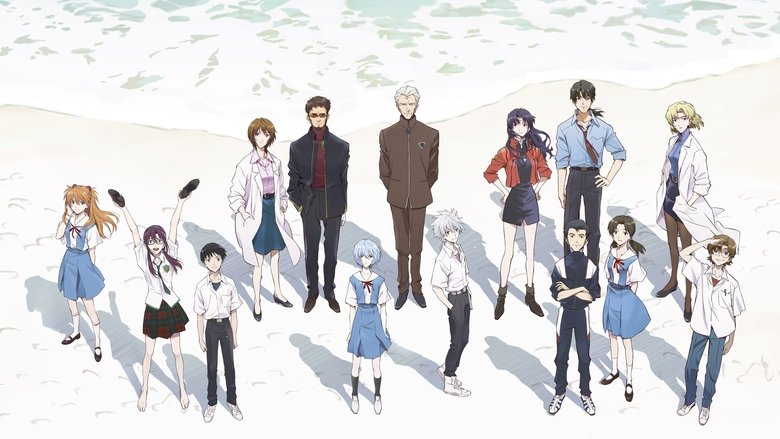
Following the harrowing events of Evangelion: 3.0, a catatonic Shinji Ikari, along with Asuka Shikinami Langley and a Rei Ayanami clone, wander the crimson wastelands of a post-Impact world. They find refuge in Village-3, a settlement of survivors, where Shinji slowly begins to heal by witnessing the resilience of humanity. Here, he learns to live outside of an Evangelion cockpit, finding a sliver of peace and purpose.

However, this peace is short-lived as his father, Gendo Ikari, sets in motion his final plan for the Human Instrumentality Project. Shinji must confront his past, his trauma, and his father one last time, making a monumental decision that will not only determine the fate of humanity but also rewrite the very nature of their reality, aiming to create a new world free from the curse of the Evangelions.

Core Meaning

The core meaning of Evangelion: 3.0+1.0 is a powerful and definitive statement about moving on and embracing reality. After decades of exploring themes of depression, escapism, and trauma, director Hideaki Anno uses this finale to guide his characters—and by extension, the audience—towards a future free from the cyclical pain of the past. The film argues that true growth comes not from retreating into fantasy or idealized worlds (Instrumentality), but from accepting the pain and joy of real life and finding the will to keep living. Shinji's final choice to create a "Neon Genesis," a new world without Evas, symbolizes breaking free from the fiction that has defined him and stepping into adulthood. The film serves as Anno's farewell to his creation, encouraging viewers to find happiness in the real world, much like he has.

Thematic DNA

Growing Up and Accepting Adulthood 40%
Breaking Cycles of Trauma and Repetition 30%
Finding Hope and Meaning in Reality 20%
Meta-Commentary on Evangelion and Fandom 10%

Growing Up and Accepting Adulthood

This is the central theme of the film. Shinji's journey from a catatonic state to a mature young adult who takes responsibility for his actions and the future is the story's backbone. Unlike previous iterations where he remained trapped in self-pity, this Shinji learns to connect with others, understand his father, and ultimately makes a selfless choice for the sake of the world. The final scene, depicting the characters as adults in the real world, is the ultimate expression of this theme—they have literally grown up and left the world of Evangelion behind.

Breaking Cycles of Trauma and Repetition

The entire Rebuild series plays with the idea of a repeating or cyclical timeline, a concept made explicit in this final film. Characters like Kaworu are aware of being trapped in a loop. Shinji's ultimate act is not just to save the world, but to break this cycle for everyone. He provides closure for Asuka, Rei, and Kaworu, and even for his father Gendo, by confronting their shared trauma. The film suggests that acknowledging and understanding the source of pain is the only way to stop repeating the same mistakes.

Finding Hope and Meaning in Reality

The first act in Village-3 is crucial. Here, Shinji, for the first time, witnesses a community actively rebuilding their lives and finding happiness despite the apocalyptic landscape. This instills in him a newfound sense of hope. The film contrasts Gendo's desire to escape reality for an idealized reunion with his wife against Shinji's decision to embrace a world that contains both pain and joy. It champions the beauty of a mundane, ordinary life over a fantastical, conflict-ridden existence.

Meta-Commentary on Evangelion and Fandom

Hideaki Anno uses the film to deconstruct his own creation. The climactic battle between Shinji and Gendo takes place on a soundstage and breaks the fourth wall, showing the artifice of the world they inhabit. This meta-narrative serves as a message to both Anno and the audience that it's time to let go of Evangelion. The ending, where the animation transitions to live-action shots of Anno's hometown, reinforces the idea of leaving fiction behind for the real world.

Character Analysis

Shinji Ikari

Megumi Ogata

Archetype: The Transformed Hero
Key Trait: Mature

Motivation

Initially, his motivation is simply to exist without causing more pain. This evolves into a desire to take responsibility and save everyone, not out of a need for praise, but from a place of genuine empathy and love for his friends and the world. His final motivation is to end the cycle of suffering by erasing the Evangelions from existence.

Character Arc

Shinji begins the film in a catatonic state, broken by the events of 3.0. Through his time in Village-3, he slowly rediscovers his will to live. His arc is a culmination of his entire journey, moving from passive victimhood and self-loathing to active agency and self-acceptance. He confronts his father not with violence, but with understanding, and ultimately makes the mature decision to create a new world for everyone's happiness, even at the cost of his own existence within it. This Shinji truly grows up.

Gendo Ikari

Fumihiko Tachiki

Archetype: The Tragic Antagonist
Key Trait: Obsessed

Motivation

His sole motivation is to initiate the Additional Impact to rewrite reality and be with his wife Yui again, whom he lost during the Unit-01 contact experiment. He sees Instrumentality as the only way to overcome the pain of her absence.

Character Arc

Gendo's character is finally given depth and explanation. The film reveals his past, showing him as a lonely, isolated man who, like Shinji, feared connecting with others until he met Yui. Her loss drove him to orchestrate the entire plot, not out of pure malice, but from a desperate, selfish desire to reunite with her. His arc concludes when Shinji confronts him with empathy, forcing Gendo to acknowledge his own weakness and fear. He finally finds peace and accepts his fate, sacrificing himself alongside Yui.

Asuka Shikinami Langley

Yuko Miyamura

Archetype: The Resigned Warrior
Key Trait: Lonely

Motivation

Her primary motivation is to destroy NERV and Gendo, driven by a sense of duty and a lifetime of conditioning as a pilot. Beneath that is a deep-seated need for validation and a place to belong, which she struggles to articulate.

Character Arc

Asuka's arc finds a quiet, bittersweet resolution. It's revealed she is a clone from the "Shikinami series," which explains her desperation to prove her individuality. She struggles with her inability to connect with the people of Village-3 and maintains her harsh exterior. In her final moments within the Anti-Universe, Shinji finally acknowledges her past feelings for him, giving her the closure she needed. She finds her own place of peace, implied to be with Kensuke, who saw her as a person, not a pilot.

Rei Ayanami (Clone)

Megumi Hayashibara

Archetype: The Blank Slate
Key Trait: Inquisitive

Motivation

Initially, she has no motivation. Her journey becomes one of finding a purpose and an identity for herself, separate from the original Rei Ayanami and her role as an Eva pilot. She wants to understand the world and her place in it.

Character Arc

The Rei clone who accompanies Shinji at the start has no identity beyond following orders. Her time in Village-3 is a journey of discovering what it means to be human. She learns to work, to feel, and to form bonds, particularly with the village children and Toji's family. She chooses her own name and develops a distinct personality. Her inevitable death—as her clone body cannot survive outside NERV's support systems—is tragic, but her life serves as a catalyst for Shinji, showing him the value of an ordinary existence.

Mari Illustrious Makinami

Maaya Sakamoto

Archetype: The Mysterious Guardian
Key Trait: Proactive

Motivation

Mari's motivations are clearer here: she works to undo the damage caused by Gendo and NERV and to ensure Shinji's survival and well-being. She has a promise to keep, and she fulfills it by guiding Shinji to his new beginning.

Character Arc

Mari remains enigmatic but is revealed to have a much deeper connection to the past than previously shown, having known Gendo and Yui when they were younger. Her role is that of a catalyst and a savior. She consistently supports and pushes the other characters, particularly Asuka and Shinji. Her arc is fulfilled in the end when she is the one to "find" Shinji and lead him out of the world of Evangelion and into the real world, symbolizing a new, healthier relationship and a future free from the past's burdens.

Symbols & Motifs

Village-3

Meaning:

Village-3 symbolizes hope, resilience, and the possibility of a normal life outside the conflict with the Angels. It represents a tangible, grounded reality that contrasts sharply with the abstract, destructive world of NERV and the Evas. It is where Shinji learns to heal and rediscover his will to live.

Context:

The first hour of the film is set in Village-3, where Shinji, Asuka, and Rei are taken in by adult versions of Toji and Kensuke. Shinji witnesses people farming, working, and raising families, which helps him recover from his catatonic state.

The Anti-Universe / Minus Space

Meaning:

The Anti-Universe is a metaphysical space where thoughts and imagination can be made manifest. It symbolizes the inner worlds of the characters, the realm of psychoanalysis, and the very fabric of fiction itself. It's a place outside of conventional reality where the rules can be rewritten.

Context:

The final confrontation between Shinji and Gendo, as well as Shinji's farewells to the other pilots, takes place within the Anti-Universe. Gendo wants to use this space to trigger the Additional Impact and rewrite reality to reunite with Yui.

The Train Station

Meaning:

The final scene at the train station symbolizes a point of departure and a transition into a new phase of life. The characters are seen on opposite platforms, signifying their separate but peaceful paths into adulthood. For Shinji and Mari, it's the beginning of their journey together into the real, post-Evangelion world.

Context:

In the film's epilogue, an adult Shinji is waiting at a train station. Across the platform, he sees adult versions of Rei, Asuka, and Kaworu. Mari arrives and they leave the station together as the animated world transitions into live-action footage of Ube, Hideaki Anno's hometown.

DSS Choker

Meaning:

The DSS Choker symbolizes Shinji's burden, his perceived sins, and the lack of trust others have in him after the Near Third Impact. It's a literal explosive collar designed to kill him if he pilots an Eva again. Its removal represents freedom, trust, and Shinji's liberation from his past trauma.

Context:

Shinji wears the choker for a significant portion of the film. In the final scene, Mari playfully removes a conceptual version of the choker from an adult Shinji, signifying that he is finally free from the "curse" of Evangelion.

Memorable Quotes

さようなら、全てのエヴァンゲリオン。

— Shinji Ikari

Context:

This line is spoken by Shinji during the climax in the Anti-Universe, as he uses the Lances of Cassius and Gaius to enact his "Neon Genesis"—the creation of a new world without Evas.

Meaning:

Translated as "Goodbye, all of Evangelion." This is the film's thesis statement. It's Shinji's final decision, spoken as he rewrites the world. It signifies not just the end of the giant robots within the narrative, but a meta-textual farewell from Hideaki Anno to the franchise that has defined his career, allowing both the characters and the creator to finally move on.

泣くのは自分だけの救済。泣いても誰も助けてはくれない。だから、もう泣かない。

— Shinji Ikari

Context:

Shinji says this to Kaworu during their conversation in the Anti-Universe, reflecting on his past behavior and his new resolve.

Meaning:

"Crying is just a relief for oneself. Me crying won't save anyone. That's why I won't cry anymore." This quote showcases Shinji's profound maturation. He moves beyond the self-pity that defined him for so long, understanding that passive emotional release is not a solution. It marks his transition to proactive responsibility.

弱さを受け入れたくなかっただけだと思う。

— Shinji Ikari

Context:

This is said during the climactic father-son confrontation in the Anti-Universe, a moment that shifts their dynamic from one of conflict to one of mutual understanding.

Meaning:

"I think it's because you don't want to accept your weakness." Shinji says this to his father, Gendo, but it's a realization about them both. It's the moment of catharsis where Shinji finally understands the core of his father's pain and, in turn, his own. It highlights their shared fear of vulnerability, which drove them to isolate themselves.

Birth of a new world. Neon Genesis.

— Shinji Ikari

Context:

Shinji utters this line as he makes his final wish to rewrite the universe, giving a new, positive meaning to the series' foundational phrase.

Meaning:

This is a direct and powerful reference to the original series' title, Neon Genesis Evangelion. Here, Shinji reclaims the term. Instead of being about a new era of conflict, his "Neon Genesis" is the creation of a peaceful reality. It signifies a complete thematic reset, transforming the franchise's title into a promise of hope.

Philosophical Questions

Can one truly escape a cycle of trauma, or is it doomed to repeat?

The film explores this through its explicit confirmation of a time loop or repeating narrative. Characters are trapped, reliving similar events with slight variations. Gendo represents the desire to force an end to the cycle through a destructive act of escapism (Instrumentality). Shinji, however, offers a different path: he breaks the cycle not by erasing the past, but by understanding it, learning from it, and choosing to create a future where the instruments of that trauma (the Evas) no longer exist. The film's optimistic answer is that escape is possible through maturity, empathy, and the will to create a new beginning.

Is there more value in a perfect, imaginary world or an imperfect, real one?

This is the core conflict between Gendo and Shinji. Gendo seeks Instrumentality, a merging of all souls into a single consciousness, to create a perfect world where he can be with Yui, free from the pain of loss. This represents the ultimate escapist fantasy. Shinji, having experienced life in Village-3, chooses the imperfect real world. He recognizes that reality includes suffering and pain, but also joy, connection, and the potential for happiness. The film unequivocally champions reality, with all its flaws, over any idealized fiction.

What is the relationship between a creator, their creation, and their audience?

Through its meta-narrative, the film delves into this question. The deconstruction of the 'Evangelion' world into a film set is Hideaki Anno directly addressing the audience. It suggests that both the creator and the fans can become trapped by a beloved fiction. Shinji's decision to create a world without Evas is mirrored by Anno's decision to finally end the series. The film's message is that stories should be a source of inspiration, but not a substitute for living one's own life in the real world.

Alternative Interpretations

While the primary interpretation is a literal and meta-textual farewell, viewers have proposed several alternative readings:

  • The "Delusion" Theory: One interpretation suggests that the entire Evangelion saga, including the original series and the Rebuilds, has been a complex delusion or fantasy created by an adult Shinji. The final scene isn't a new world, but Shinji finally breaking free from his delusions and embracing his real life, with Mari being the only other "real" person who has entered his fantasy. The other pilots he says goodbye to are figments of his imagination that he is finally letting go of.
  • The "Parallel Worlds" Theory: Instead of rewriting the existing world, Shinji creates an entirely new, parallel universe without Evas and moves there with Mari. The original world, with Rei, Asuka, and Kaworu, continues to exist but is now healed and peaceful. The train station is a metaphorical bridge between these realities where they can see each other one last time before parting ways.
  • The "Character-Oriented" Reading: This interpretation focuses less on the literal events and more on the symbolic. The ending isn't about creating a new world but about the characters finally achieving narrative closure and spilling out of the confines of their story. They have grown beyond their archetypes and are now free from the roles the fiction imposed on them, allowing them to simply be happy adults.

Cultural Impact

Evangelion: 3.0+1.0 Thrice Upon a Time served as a monumental cultural event in Japan and for anime fans worldwide. Released after years of anticipation and delays, its debut was met with critical acclaim and massive box office success, grossing over ¥10 billion in Japan. The film is more than just a conclusion to a movie series; it's seen as the definitive end to Hideaki Anno's 26-year journey with the franchise that began in 1995.

Critically, the film was praised for providing a satisfying and emotionally mature conclusion to one of anime's most complex and influential series. It departs from the bleak, ambiguous endings of the past, offering a message of hope and the importance of moving forward—a message that resonated deeply with a generation of fans who grew up with the characters' struggles. The film's self-referential, meta-textual climax, where the very medium of animation is deconstructed, has been lauded as a bold and fitting farewell from its creator. By concluding the saga on a positive note, Anno not only provided closure for his characters but also for himself, reframing the legacy of Evangelion from one of perpetual adolescent angst to a completed journey into adulthood.

Audience Reception

Audience reception for Evangelion: 3.0+1.0 was overwhelmingly positive, with many longtime fans hailing it as a deeply satisfying and emotionally resonant conclusion to the saga. Viewers widely praised the film's stunning animation, complex action sequences, and powerful musical score. The most lauded aspect was the sense of closure it provided. Many felt the film successfully tackled the series' dense psychological themes and finally allowed its characters, especially Shinji, to achieve genuine growth and find peace.

Points of criticism were less common but did exist. Some viewers felt the first hour in Village-3, while thematically important, slowed the pacing considerably. Others found the plot, with its introduction of new concepts like the "Additional Impact" and "Evangelion Imaginary," to be overly convoluted even by Evangelion standards. A segment of the audience expressed disappointment with certain character pairings in the epilogue, particularly the resolution of Asuka's arc and the prominent role of Mari in the ending. Despite these minor criticisms, the general consensus among the audience was that it was a beautiful, cathartic, and fitting farewell to a landmark franchise.

Interesting Facts

  • The film's production was significantly delayed, releasing over eight years after the previous film, 'Evangelion: 3.0 You Can (Not) Redo'. Part of this delay was due to director Hideaki Anno's struggle with depression following the troubled production of 3.0, and his work on the film 'Shin Godzilla' (2016).
  • At 155 minutes, it is the longest film in the entire 'Evangelion' franchise and one of the longest animated films ever made.
  • The final scene transitions from animation to live-action footage of Hideaki Anno's real hometown, Ube, in Yamaguchi Prefecture. This was a deliberate choice to reinforce the film's core message of returning to reality.
  • The Japanese title, シン・エヴァンゲリオン劇場版:||, includes a musical repeat sign at the end (𝄇). Fans have speculated this hints at the story's cyclical nature.
  • An updated version of the film titled 'Evangelion: 3.0+1.01' was released in Japanese theaters a few months after the original debut, featuring minor animation tweaks and corrections.
  • The climactic fight scene between Eva Unit-01 and Eva-13 intentionally breaks traditional animation rules, transitioning from 2D animation to rough CGI and even what looks like motion-capture data on a soundstage, reflecting the deconstruction of the fictional world.
  • Hideaki Anno has stated that this film is his final work on the 'Evangelion' franchise, intending to open it up for new creators in the future, similar to the 'Gundam' series.

Easter Eggs

The final battle between Shinji and Gendo takes place on a series of elaborate sets, including a perfect recreation of Misato's apartment and the Tokyo-3 cityscape from the original TV series, which are then physically deconstructed to reveal they are on a film soundstage.

This is a major meta-reference to the entire franchise. By showing the environments as literal film sets, Anno breaks the fourth wall, acknowledging the fictional nature of the story and signaling his and the audience's departure from it. The inclusion of cameras operated by PlayStation controllers is a nod to the actual production techniques used by Studio Khara.

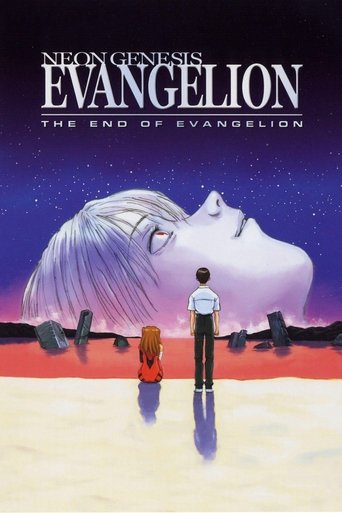
Asuka's final scene with Shinji takes place on the same desolate beach from the infamous ending of 'The End of Evangelion' (1997).

This directly references and provides a new, healthier resolution to one of the most debated endings in anime history. In 'The End', Shinji and Asuka are left in a state of ambiguous hostility. Here, Shinji offers her closure and a gentle goodbye, signifying growth and rewriting a painful moment from the past.

During the final montage of the new world, there is a subtle cameo of a poster for 'Nadia: The Secret of Blue Water', one of Hideaki Anno's earliest directorial works.

This is a fun nod to Anno's long and influential career, placing 'Evangelion' within the broader context of his creative history as he bids farewell to the franchise.

The name of the ship Misato commands, the AAA Wunder, is a reference to the German term for "wonder" or "miracle," fitting for a vessel designed to combat god-like beings.

This continues the series' tradition of using German terminology for its military hardware and organizations, adding to the world's unique aesthetic and lore.

⚠️ Spoiler Analysis

Click to reveal detailed analysis with spoilers

Frequently Asked Questions

Explore More About This Movie

Dive deeper into specific aspects of the movie with our detailed analysis pages

Comments (0)

Leave a comment

No comments yet. Be the first to share your thoughts!